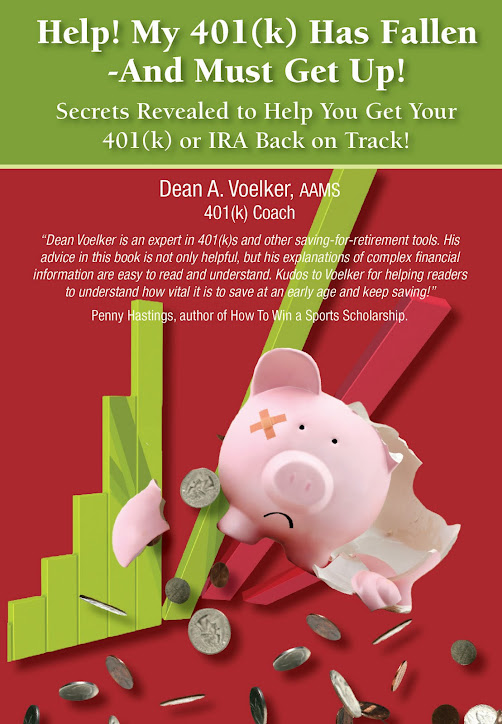
New Book - Coming November 2010

New Book - Coming November 2010
Help! My 401(k) Has Fallen - And Must Get Up!
Showing posts with label WHME. Show all posts

Wednesday, August 25, 2010

Could You Use An Extra $1000/Month - Legally?


OK, that's a silly question. OF COURSE you could use an extra $1000/month. Who couldn't?

For someone in retirement, an extra $1000 would certainly help to make ends meet. According to a recent survey done by the Employee Benefit Retirement Institute (EBRI), only 3 in 5 retirees (60%) feel "very" or "somewhat" confident that they would have a comfortable retirement. This is sharply down from just 3 years ago, when in 2007, 79% felt confident in their retirement.

Did you also know that according to the Social Security Administration that the Maximum Social Security retirement benefit the could be earned by an individual reaching full retirement age in 2010 (age 66) is only $2346/month? Think of how many people receive less than this, and depend on Social Security for the majority of their income in retirement.

What would you do with an extra $1000/month?

Would you do more travelling? Eat out a few more times? Spoil the grandkids? Play more golf? Would an extra $1000/month in income give you a little more peace of mind?

What if I told you that YOU CAN have an extra $1000/month TAX-FREE?

No, you don't have to rob a bank or do anything illegal. This is perfectly legitimate.
No silly multilevel marketing schemes either, where you try to sell junk to your friends and family.
You don't need to be able to dunk a basketball, or pound 300 yard drives that split the fairway.

All you need to do is......

Start putting money into a Roth IRA and make regular contributions. That's it! See - simple, legal, and you get to keep your friends.

Here is how it works. Let's use a 45 year old, starting from scratch. Currently, as of 2010, the most which you can put into a Roth IRA is $5000 per year. At age 50 and older, the maximum contribution is $6000.
Let's say that our 45 year old puts in $5000 per year, and at age 50 starts putting in $6000. Let's also say that we get a return of 6% per year on our money. (Contact me for information on how to get 6%.) For someone who is 45 years old now in 2010, their full retirement age to begin collecting Social Security benefits would be 67.

Age    Roth IRA Contribution   Ending Balance (6% Return)
45       $5,000                              $    5,161
46       $5,000                              $  10,632
47       $5,000                              $  16,431
48       $5,000                              $  22,578
49       $5,000                              $  29,094
50       $6,000                              $  37,033
51       $6,000                              $  45,448
52       $6,000                              $  54,368
53       $6,000                              $  63,824
54       $6,000                              $  73,846
55       $6,000                              $  84,470
56       $6,000                              $  95,732
57       $6,000                              $107,669
58       $6,000                              $120,322
59       $6,000                              $133,735
60       $6,000                              $147,952
61       $6,000                              $163,023
62       $6,000                              $178,997
63       $6,000                              $195,931
64       $6,000                              $213,880
65       $6,000                              $232,906
66       $6,000                              $253,073 
          $147,000                          $253,073

Benjamin Franklin once remarked that Compound Interest was the 8th wonder of the world. Saving a nest egg of over $250,000 in 22 years is a great accomplishment.

If you are younger than 45, the message is start NOW. You can do even better.
If you are older than 45, the message is still start NOW!

So how do we get our $1000/month from this?
To get an income of $1000/month, just take 5% per year from this figure $253,073.

$253,073 x .05 = $12,653.65 This is our annual TAX-FREE income from our Roth IRA.
$12,653.65 Divided by 12 months = $1,054.47/Month.   

Please Contact Me for more information on how to make this work for you, and create lifetime income from an IRA or Roth IRA. If you live in the South Bend, IN area, I am also happy to help with 401(k) rollovers or IRA reviews. You can follow me on Twitter, Linked In, or Facebook.


My weekly radio show is Improving Your Financial Health on WHME-FM in South Bend, and archives are available for listening on my website.





Thursday, July 8, 2010

Match Game

Employers want you in the 401(k) plan at work. The more money which is in their plan, the lower the fees should be. Also, because they most likely do not offer a pension, they want to be sure they are doing their part in helping you to save for retirement.

Many 401(k) plan sponsors are focusing on two features: automatic enrollment and automatic increases in savings as an employee's pay goes up. However, one of the biggest factors which drives plan participation is the matching contribution. Money Magazine writer Penelope Wang wrote in her March 2010 article Make the Best of a Bad 401(k) that in 2009, matches had dropped off due to the sluggish economy.

Matching contributions are great for employers though. They provide a tax deduction and studies have shown that it is a great way to get employees involved with the plan. 401(k) Plans with a match have higher particpation rates than those with no match.  

Matching formulas vary widely. According to Schwab, one of the most common formulas for matching is for the employer to offer a 50% match of an employees deferred salary up to a 6% contribution. In English, that means that the most they put in for you is 3% of your pay - and you have to put in 6% to get that.

Here is an example. Let's say that Bob earns $60,000/year at ABC Company. He puts 6% of his pay into
his 401(k) - $3,600.

                    Bob's Salary (before taxes)                        $60,000
                    Bob's 401(k)                                               $3,600
                    Bob's Taxable Pay                                     $56,400
                    ABC Match                                                 $1,800
                    Total contribution into Bob's 401(k)              $5,400

Now if Bob bumped up his contribution to 10%, he would still only get $1800 from ABC. Many advisors (myself included) believe that we should be saving 10% or more into a 401(k) plan. Over a long period of time, this should allow someone to replace approximately 75% of their income at retirement.

Let's see what happens if Bob decides to put in 10%.

                    Bob's Salary                                               $60,000
                    Bob's 401(k)                                                $6,000
                    Bob's Taxable Pay                                      $54,000
                    ABC Match                                                  $1,800
                    Total contribution into Bob's 401(k)              $7,800 

Changing his contribtuion from 6% to 10% gives him an extra $2,400/year into the plan. My book, Help! My 401(k) Has Fallen - And Must Get Up! shows that this could be huge over time. The other plus is that even though Bob raises his contribution by $2,400/year, his take home pay after taxes should only be about $1,800 less because the taxes are deferred on this. $1,800/year works out to less than $35/week.

$35/week - that's all!!

Over a 25 year period, if Bob was able to get a 7% average return on his 401(k) plan, here is the difference between 6% and 10% This also includes the employer match of 3% (50 cents per dollar, up to 6%).
The difference after 25 years is $157,493!! 

6%   ($3,600) = $359,789
10% ($6,000) = $517,282
Difference      = $157,493

You can contact me in the South Bend, IN area for 401(k) rollovers. My website is http://www.helpmy401k.us/
Get a FREE REPORT titled "The 5 Biggest Problems With 401(k) Plans - And How To Fix Them!"

My book, Help! My 401(k) Has Fallen - And Must Get Up! is written to help everyday people to get more from their retirement savings. My radio program, Improving Your Financial Health is also heard weekly on WHME-FM in South Bend, IN and archives are available on my website.