New Book - Coming November 2010

New Book - Coming November 2010
Help! My 401(k) Has Fallen - And Must Get Up!
Showing posts with label South Bend. Show all posts

Wednesday, October 13, 2010

This Time It's Different?

The late Sir John Templeton, founder of Franklin Templeton Investments liked to say, "The Four most expensive words in the English Language are ‘This time it’s Different.’"


Is it really?

The National Bureau of Economic Research states that the United States has weathered a recession in EVERY decade since the 1920′s.


It is easy to say “This time its different.” Many people are still feeling that way.
However, it is important to keep in mind a few points.


* Financial decisions (any financial decisions) should not be based on emotion.

* Historically, after every past recession, the market has gone on to hit new highs.

* Declines in the market & economy, even our most severe ones, have been temporary.

* Since 1926, the Dow Jones has had TWICE AS MANY positive returns as negative ones.

Despite more than 12 recessions dating back to 1926, $1.00 invested in the Dow in 1926 would have been worth $2045.00 at the end of 2008.

It was two years ago this week (Oct. 16, 2008), that Warren Buffett wrote his “Buy America, I Am” article in the New York Times. Buffett encouraged investors to “be fearful when others are greedy, and be greedy when others are fearful.” Since Mr. Buffett wrote this letter, the S&P 500 Index has gained 29.1% on a total return basis through the close of business on Friday October 8, 2010, according to the New York Times.

“This time it’s different?” Warren Buffett didn’t think so. Neither did Sir John Templeton. Neither should we. Investing is a long term process. Recessions are opportunities. My job as an advisor is to provide you with a beacon of hope, and see the light at the end of the dark tunnel.

Let me know how I may be of service. Contact me about the IRA Security Blanket!

Help! My 401(k) Has Fallen – And Must Get Up! is my new book. It has several ideas and strategies which will help you in your retirement savings journey. Get your ‘Fallen’ 401(k) back on its feet. Contact me to reserve your copy today. You can also get a FREE report at my website The 5 Biggest Problems With 401(k) Plans – And How To Fix Them.

You may also listen to my weekly radio program – Improving Your Financial Health on WHME-FM in South Bend. Archives can be heard on my website as well. If you live in the South Bend, IN area, I specialize in 401(k) rollovers or IRA reviews. You can also follow me on Twitter, Linked In, or Facebook.

Friday, October 8, 2010

The Grand (Money) Illusion - Why Grow?

Recently, I wrote an article here titled, It's Not Much, But It's All I Have . This has been a very common reaction among people when talking (or not talking) about their money. We continue to deal with economic uncertainty, and its human nature to be afraid of losing it. However when we let fear control our thoughts, we also prevent growth. Money closed inside of a fist serves no purpose and can't grow. To grow your funds, you have to open your hand - and your mind.

"Hold on loosely....but don't let go. If you cling too tightly....you're gonna lose control." (.38 Special)

Why do we need to grow our money? One word - INFLATION!

According to the US Bureau of Labor Studies, $400,000 of taxable income in 1953 is equivalent to $2.8 Million in today's dollars.

When you decide to retire, you could easily be retired for 20 years or more. Do you believe that the costs of living for you will go up - or stay the same? Consider this - in 1990, a loaf of bread costs about $1.00. Today, we pay an average of $2.69 for the same loaf. A postage stamp was only .08 in 1990, while today it's .44....and climbing.

If you have been on a fixed income for the last 20 years, you have suffered a 40% loss of purchasing power. Plain and simple - your money must continue to grow over the long term to keep up with rising costs. You just can't keep stuffing it under a mattress, which is paying about the same interest as a CD today.


So what can you do?

Start by putting more money into your 401(k) plan or IRA. Look at your cash flow, and give yourself a pay raise! Pay yourself first - 10% of your income should go into your 401(k) plan. Meet with an advisor to set up an ongoing program for you. Talk with them about which investments are most appropriate for you in your 401(k) or IRA, based on your time horizon, risk tolerance and future income.

“Some people say they want to wait for a clearer view of the future. But when the future is again clear, the present bargains will have vanished. In fact, does anyone think that today’s prices will prevail once full confidence has been restored?” (Dean Witter, May 1932)


Please Contact Me for more information on how to protect your long term savings and USE your money wisely. I can help you create lifetime income from an IRA or Roth IRA. If you live in the South Bend, IN area, I am also happy to help with 401(k) rollovers or IRA reviews. You can follow me on Twitter, Linked In, or Facebook.

You can also listen to my weekly radio show, Improving Your Financial Health on WHME-FM in South Bend, and archives are available for listening on my website. My book, Help My 401(k) Has Fallen – And Must Get Up is helping everyday people to get their 401(k) plan back on its feet and working harder. Contact me about how to get a copy.

Monday, October 4, 2010

Its the Great Security Blanket Charlie Brown!

Get A Blanket!

Did you have a "blankie" as a child? Was the "blankie" your contstant companion, protecting you from the forces of evil? No matter what happened, your blanket was there for you.

The late cartoonist, Charles Schulz popularized the image of Linus and his blanket in his Peanuts comic strips and cartoons. You may even remember that Linus was quite skilled at using it. He could catch fly balls, use it as a parachute, and even revive a sickly Christmas tree.

If you are like most people, your 401(k) or IRA has taken quite a beating the last few years.

What if I told you that you could have your very own IRA Security Blanket?

* Protect yourself against future market disasters.

* Protect yourself from inflation and rising costs.

* Protect yourself from the uncertain future of Social (In)Security.

To learn more about how to get your IRA Security Blanket, you can contact me at http://www.helpmy401k.us/.

Help! My 401(k) Has Fallen – And Must Get Up! is my new book. It has several ideas and strategies which will help you in your retirement savings journey. Get your ‘Fallen’ 401(k) back on its feet. Contact me to reserve your copy today. You can also get a FREE report at my website - The 5 Biggest Problems With 401(k) Plans – And How To Fix Them.

You may also listen to my weekly radio program – Improving Your Financial Health on WHME-FM in South Bend. Archives can be heard on my website as well.


If you live in the South Bend, IN area, I specialize in 401(k) rollovers or IRA reviews. You can also follow me on Twitter, Linked In, or Facebook.

Tuesday, September 28, 2010

Can Facebook Help You Save Money?

As I have been out talking about my new book, Help! My 401(k) Has Fallen - And Must Get Up!, one of the most common questions I am asked is this -

What is the one thing I can do to fix my 401(k)?

Of course, the person asking wants a simple answer, not a lot of broker speak. So here it is. Regardless of age, gender, or income, the simplest best answer I can give is:

Save More Money!  

How's that for simple? Money Magazine released some new information in a study from their Retirement Guide 2011 (Oct. 2010 issue).  If you are 35 years old and earn  $70,000/year and you save 10% of your pay, you'll have saved $936,100 by age 65.*

By waiting just 5 years to start and doing the same - saving 10% at age 40, your nest egg at age 65 will be $697,700.* (*Assumes 3% annual pay increases and 7% average annual returns on investment into a tax-sheltered account - IRA, 401k or 403b.)

While both figures sound like a lot of money, the difference of $238,400 means a difference of what you can potentially use for income. Assuming you take out 5% per year from your nest egg ($238,400 x .05 = $11,920/year) means that by starting at age 40, you could be cutting your future income by nearly $1,000/month!

Ben Franklin often preached on the virtues of compound interest. He called it the 8th wonder of the world.

So how do we save more money? As Nike might say, "Just Do It!"

It is much easier though if you can have someone to hold you accountable. This is where Facebook might come in. What if you posted a notice on your Facebook page to your friends and tell them to hold you to it. You could "tweet" it also.

"I promise, starting TODAY to pay myself first and put 10% of my pay into my 401(k)." 

Honestly, when you see some of the others posts on Facebook (i.e. "I hate rainy days.", "Halloween is coming.", "Out walking the dog."), you'd have to feel a bit proud posting something inteligent that will make a positive difference in your life, wouldn't you? You could start a trend. Have your friends (or at least one or two) hold you accountable.  

You could also set e-mail reminders which are specific. use a personal website such as http://www.mint.com/.
Send a message to your e-mail Inbox such as "Put $1000 into my Roth IRA this month." or "Every 3rd of the month I put $400 into my Roth IRA." You could arrange these to hit your Inbox when you get a bonus or unexpected money.

Don't despair if you've turned 45 and still haven't done much. Remember we had talked about how you could still achieve an added $1000/month of income at retirement by starting now and following a disciplined goal. I'll be reviewing some other ideas from the Money Magazine retirement guide in upcoming posts.

My book, Help! My 401(k) Has Fallen – And Must Get Up! has several ideas and strategies which will help you in your retirement savings journey. Get your ‘Fallen’ 401(k) back on its feet. Contact me to reserve your copy today. You can also get a FREE report at my website. The 5 Biggest Problems With 401(k) Plans – And How To Fix Them. I also host a 30 minute weekly radio program - Improving Your Financial Health on WHME-FM in South Bend. Archives can be heard on my website as well.

If you live in the South Bend, IN area, I am also happy to help with 401(k) rollovers or IRA reviews. You can follow me on Twitter, Linked In, or Facebook.

Thursday, July 8, 2010

Match Game

Employers want you in the 401(k) plan at work. The more money which is in their plan, the lower the fees should be. Also, because they most likely do not offer a pension, they want to be sure they are doing their part in helping you to save for retirement.

Many 401(k) plan sponsors are focusing on two features: automatic enrollment and automatic increases in savings as an employee's pay goes up. However, one of the biggest factors which drives plan participation is the matching contribution. Money Magazine writer Penelope Wang wrote in her March 2010 article Make the Best of a Bad 401(k) that in 2009, matches had dropped off due to the sluggish economy.

Matching contributions are great for employers though. They provide a tax deduction and studies have shown that it is a great way to get employees involved with the plan. 401(k) Plans with a match have higher particpation rates than those with no match.  

Matching formulas vary widely. According to Schwab, one of the most common formulas for matching is for the employer to offer a 50% match of an employees deferred salary up to a 6% contribution. In English, that means that the most they put in for you is 3% of your pay - and you have to put in 6% to get that.

Here is an example. Let's say that Bob earns $60,000/year at ABC Company. He puts 6% of his pay into
his 401(k) - $3,600.

                    Bob's Salary (before taxes)                        $60,000
                    Bob's 401(k)                                               $3,600
                    Bob's Taxable Pay                                     $56,400
                    ABC Match                                                 $1,800
                    Total contribution into Bob's 401(k)              $5,400

Now if Bob bumped up his contribution to 10%, he would still only get $1800 from ABC. Many advisors (myself included) believe that we should be saving 10% or more into a 401(k) plan. Over a long period of time, this should allow someone to replace approximately 75% of their income at retirement.

Let's see what happens if Bob decides to put in 10%.

                    Bob's Salary                                               $60,000
                    Bob's 401(k)                                                $6,000
                    Bob's Taxable Pay                                      $54,000
                    ABC Match                                                  $1,800
                    Total contribution into Bob's 401(k)              $7,800 

Changing his contribtuion from 6% to 10% gives him an extra $2,400/year into the plan. My book, Help! My 401(k) Has Fallen - And Must Get Up! shows that this could be huge over time. The other plus is that even though Bob raises his contribution by $2,400/year, his take home pay after taxes should only be about $1,800 less because the taxes are deferred on this. $1,800/year works out to less than $35/week.

$35/week - that's all!!

Over a 25 year period, if Bob was able to get a 7% average return on his 401(k) plan, here is the difference between 6% and 10% This also includes the employer match of 3% (50 cents per dollar, up to 6%).
The difference after 25 years is $157,493!! 

6%   ($3,600) = $359,789
10% ($6,000) = $517,282
Difference      = $157,493

You can contact me in the South Bend, IN area for 401(k) rollovers. My website is http://www.helpmy401k.us/
Get a FREE REPORT titled "The 5 Biggest Problems With 401(k) Plans - And How To Fix Them!"

My book, Help! My 401(k) Has Fallen - And Must Get Up! is written to help everyday people to get more from their retirement savings. My radio program, Improving Your Financial Health is also heard weekly on WHME-FM in South Bend, IN and archives are available on my website.

Monday, June 28, 2010

Five Situations for Variable Annuities

According to the Insured Retirement Institute, sales of Variable Annuities grew by 3% from this time last year. VAs aren't for everyone, however in the right circumstances, variable annuities offer solid benefits. There are at least 5 scenarios in which an advisor may consider recommending a variable annuity to clients.

Feel free to add your own to the list! You can contact me for more information on annuties at http://www.helpmy401k.us/

1. Lowering Income Taxes
If you are in the maximum federal and state tax bracket, a VA may help to lower your taxes. Please review your situation with a tax specialist, but a VA can work similarly to an IRA in deferring taxes until money is withdrawn from the acccount.

2. Calming Jittery Investors
This is likely the biggest reason why VA sales are up. If you are nervous about the market but still need your money to grow over time, a VA can act as a "life preserver" for your long term savings.

3. Saving Above Contribution Maximums
If you have maxed out your IRA and 401(k) and still want to save more for retirement, you can put money into a VA. If you are a small business owner, you may also consider a SEP IRA (Simplified Employee Pension). The SEP allows you to save up to 25% of your income and deduct it from your taxes.

4. Guaranteed Income
Annuities have a primary purpose of providing guaranteed income. With people living longer and needing income in retirement, having an annuity can be like setting up a personal pension plan from your savings. Look for plans which offer Lifetime Income.

5. Death Benefit
If you haven't taken income, many annuities will guarantee a death benefit of the amount you invested as a minimum. This is important, and this is where an annuity differs from ordinary mutual funds.

Here's an example. Let's take 2 investors, George and Jerry. Let's say that both of them retire at 65 years old and have 401(k) balances of $100,000. They roll their 401(k) plans over to IRAs. George invests in mutual funds, while Jerry invests in a variable annuity with a guaranteed minimum death benefit. After 4 years, we have another huge loss in the stock market, and their accounts drop to $80,000. Neither of them have taken any income out of their IRAs yet, and are still under the age of 70 1/2 when they would need to take a Required Minimum Distribution.

If George dies, he leaves the balance of his account - $80,000 to his beneficiaries. If Jerry dies, he would leave $100,000, which is what he started with, even if the value of the account is less. Of course, if the account balance in either case is more than $100,000, the death benefit would be the same as the account balance.

Annuities can be beneficial in the right situations. Please contact me and let me know how I may help further.

Thursday, June 24, 2010

Ageism

Ever heard of ageism? Ageism is a term coined by Dr. Robert Butler which refers to discrimination against the elderly. How does this affect you?

As a nation, we are getting older. People are living longer than they did in previous generations. According to http://www.socialsecurity.gov/ a male who lives to age 65 can reasonably expect to live until age 82. A female at age 65 can reasonably expect to live until age 85. Earlier this year, Federal Reserve Chairman Ben Bernanke discussed the effects of aging on the U.S. economy. Mr. Bernanke stated that "the U.S. must begin now to prepare for this coming demographic transition."  
Dr. Robert Butler, 83 is in charge of the National Institute on Aging. Dr. Butler, a Pulitzer Prize winner, has also written six books about aging issues and is the the founder of the International Longevity Center. In a recent article in Investment Advisor magazine, Dr. Butler discusses his thoughts on aging. Did you know that in 2025, only 15 years from now, more than 1 in 5 persons will be 65 or older?

Dr. Butler says that older people "should probably plan to work longer than they envisioned." He adds that regarding Social Security and our workforce, "It's very obvious and striking that if people stay in the workforce longer, they put more money into the system and take less money out."

What does this mean for you?

For those in my generation (I am 46 at this time.) we need to think seriously about working longer. Also, we need to prepare for changer in Social Security. We must do a better job of saving and investing in our 401(k) or 403(b) plans. Since we don't have pensions and can't count on Social Security for our future income, the 401(k) has to be our main method for retirement savings.

Saving in a 401(k) means you have to do the work. No one else will care about your future the way you do. My book, Help! My 401(k) Has Fallen - And Must Get Up! has several ideas and strategies which will help you in your journey. Get your 'Fallen' 401(k) back on its feet. Contact me to reserve your copy today, or visit http://www.my401khasfallen.com/.

You can also get a FREE report at my website, http://www.helpmy401k.us/ The 5 Biggest Problems With 401(k) Plans - And How To Fix Them. If you live in the South Bend, IN area, I am also happy to help with 401(k) rollovers or IRA reviews. You can follow me on Twitter, Linked In, or Facebook.

My weekly radio show is Improving Your Financial Health on WHME-FM in South Bend, and archives are available for listening on my website.   

Thursday, June 17, 2010

3 Big 401(k) Mistakes


I had a chance to read a great article this week by Joe Mont. Big 401(k) Mistakes That Hurt Savings - June 1, 2010. This article was interesting to me for a few reasons. The facts he outlines tell me that there is definitely a need for my book,
Help! My 401(k) Has Fallen - And Must Get Up!

Mr. Mont agrees with me that "neither the market losses of 2008 nor the robust rally of 2009 have motivated workers to make their 401(k) plans their top priority." This is based on Hewitt Associates annual retirement study.

"While it's encouraging that most workers stayed the course, most did so simply because they were disengaged with the retirement saving process or too paralyzed with fear and confusion to touch their 401(k) plans", says Pamela Hess, Hewitt's director of retirement research. "If employees continue to ignore their 401(k) plans, they're hurting themselves by letting the market dictate their retirement strategy."

Mistake #1 - We Don't Save Enough

We don't save enough in these plans! There STILL needs to be a sense of urgency. Your 401(k) = Your Retirement - PERIOD!

Pensions began to disappear at about the same time leisure suits and Betamax video did - and NONE of these are coming back! When it comes to Social Security, Americans everywhere of all ages are concerned about the Federal Government's ability to continue the program as it currently exists. Also, it was never intended to be anyone's main source of retirement income. However for 1/3 of elderly Americans, it is the source of nearly all their income. This is according to the Center on Budget and Policy Priorities.

Your 401(k) - or 403(b) if you work for a non-profit organization may be ALL YOU HAVE!

Hewitt's study also shows about 28% of participants don't contribute enough to even get the full matching benefit from their employers. That's frightening especially considering that many companies have reduced or eliminated matching contributions over the past year. Penelope Wang reports in her March 2010 article, Make the Best of a Bad 401(k) that "before the financial crisis, only 6% of plans didn't offer workers a matching contribution as an incentive to boost participation. But that number spiked last year, as another 12% of employers reduced or suspended their matches." 

Ms. Wang goes on to add - "If you have a missing or reduced match, there's no getting around the fact that you'll have to make up the difference by saving more."


Pamela Hess of Hewitt says, "It was interesting to watch employee reactions to the match suspension. We had expected some really serious impacts to the savings rates, but it didn't change things as much as we thought."

Mistake # 2 - We Don't Rebalance

Here's a question for you. How often do you visit your dentist? What would happen to your teeth if you didn't brush or visit the dentist regularly?

Just like the dentist, you need to review your 401(k) plan with a professional to make sure you are on track with your retirement goals and that you have the right mix. Balance helps you to lower your overal risk. You get your tires re-balanced to keep your car straight, and rebalancing your account serves the same purpose.

With that in mind, target-date funds have become much more popular. A 'target-date fund' is one made up of a blend of several mutual funds. You can easily spot them in your menu of investment choices because they have a year in the name of the fund. "Fidelity Freedom 2040" would be an example of a target-date fund. The year represents the approximate time in which you would wish to retire. With this type of fund, it gradually become more and more conservative as the year approaches.

Hewitt's study from Mr. Mott's article shows that in 2009, 25% of workers use target-date funds in their  401(k) plans. Mr. Mott explains that some of this is due to employers who automatically enroll their new workers into the company 401(k) plan. 69% of these employers use a target-date fund as the default option.
Greg Johnson, president and CEO of Franklin Resources says that "target-date funds will become a bigger and bigger part of the new money that's flowing into 401(k)s."  

Even if you do use a target-date fund, please review your account with an advisor. Ask them about the mix. Is it too conservative? too aggressive? or just about right? Are you saving enough to reach your goals? What will your income needs be at retirement? How will your 401(k) be able to meet your income needs? All great questions for an advisor. Don't do your own dental work! Get a pro to prevent 'decay' in your 401(k).

Mistake # 3 - We Kill Our 401(k)s From Withdrawals

Hewitt's study shows that in 2009, 7.1% of participants withdrew from reitrement plans. That is more than in any year since 2002. Loans kill 401(k)s also, and loans automatically become withdrawals once employment ends at the company. Hewitt reports that more than 25% of employees had an existing loan on their 401(k) plan at the end of 2009.

This isn't all that surprising to me. I have spoken with several people who have cashed out 401(k)s. The reasons are varied, but they all boil down to "I need the money right now." It is especially common among younger workers who don't see the future and feel the need to use the money for something else. They don't seem to realize or be concerned that this money may be cut almost IN HALF after taxes and penalties are taken out. A $20,000 account could be reduced to about $11,000 or $12,000 easily when it is withdrawn.

Joe Mont's article is right on time. Please AVOID these big mistakes in your 401(k). I have attempted to contact Mr. Mott after reading this piece and offer him a guest spot on Improving Your Financial Health. As of today, I am waiting to hear back from him.

Please contact me at my website, http://www.helpmy401k.us/ for more information and a FREE REPORT, The Five Biggest Problems With 401(k) Plans - And How To Fix Them! I'm also well equipped to help with 401(k) rollovers or plan reviews.


You can follow me on Twitter, Linked In, or Facebook. I also host a radio program, Improving Your Financial Health, on WHME-FM (103.1) in South Bend, IN.
Friday, April 16, 2010

You DO Judge A Book By Its Cover


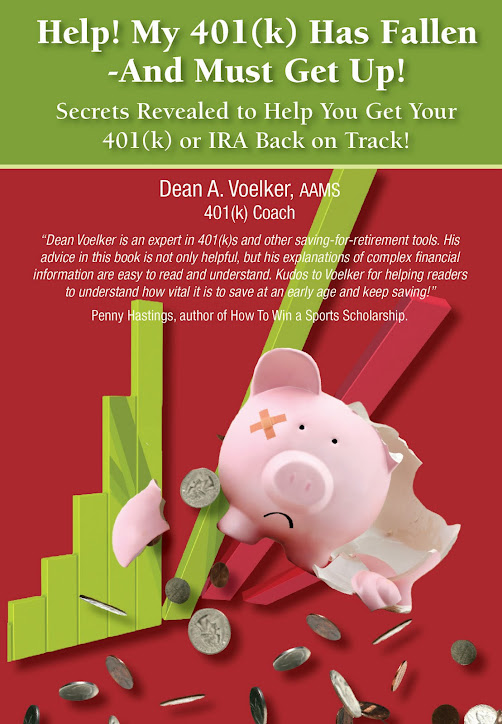
Well, its all coming together now. Here is the final cover design by Aimee Sims for my upcoming book "Help! My 401(k) Has Fallen - And Must Get Up!"
Currently the book is in typesetting and from there will be sent to Create Space. I am very excited about this and look forward to helping people get more from their 401(k) or IRA. Because it focuses on the
401(k), which is the biggest source of savings for many of us, and it is easy to understand - this book is unique.

It should be available to order by the end of May!

If you feel like you need your 401(k) working harder for you, please contact me. You can contact me through my website , Linked In, or on Twitter. I also host an advice program "Improving Your Financial Health" on Blog Talk Radio and on Harvest 103.1 WHME-FM in South Bend.

The book website will be http://www.my401khasfallen.com/.

Wednesday, April 7, 2010

Diary of a Wimpy 401(k) - Typesetting

One of the things I wasn't looking forward to with my book was typesetting. I am actually not the greatest typist in the world, and Microsoft Word isn't equipped for a clean copy. Typesetting means 'formatting' the words so that all paragraphs and spacing is even, and all graphs look clean and sharp.

When you self-publish, typesetting is one of those things that will make the book look more professional as opposed to just having it printed yourself. "Help! My 401(k) Has Fallen - And Must Get Up!" may sound like a catchy title, but I really want a professional look for it, not a 'wimpy' one. This is an opportunity to establish myself as THE authority on 401(k) plans.

I had about 2 options for this. First, I could have used Create Space, which will also assemble and print the book. Since Create Space is part of Amazon, they will also handle the customer ordering and shipping. They offered to do the typesetting also, and thought they could do it for about $1000 for my 100 page book.

They also told me that because I am using some graphs and tables in the book, I should make the size about 7"x10". Fine with me. I just need to let my graphic artist, Aimee Sims know that.

From reading "The Well-Fed Self Publisher" by Peter Bowerman, he also makes suggestions for firms which he uses to get his books done. Peter seems like a straight shooter, who knows what he is talking about, so I e-mailed a copy to a firm he endorses, Hoehne-Werner Book & Graphic Design.

I have spoken with Angela Werner there, and looked at their work on the website. Angela gave me an estimate of $800. If they are good enough for Peter, they are good enough for me. He suggests cutting costs where possible. Its also important to remember that you get what you pay for. With Hoehne-Werner, I believe it will be the right call. Typesetting is their specialty.

One thing I learned right away - I had wasted a LOT of time putting page numbers with my index. Angela suggested taking the page numbers out. Once the book is typeset, the page numbers could easily change!
"D'OH!" Oh well, I will know that next time.

The whole process should take about a month, so I am hoping to have the book out now by the end of May.

You can contact me for more information on "Help! My 401(k) Has Fallen - And Must Get Up!" at my website, http://www.helpmy401k.us/. Follow me on Linked In or Twitter also. I am currently hosting an advice show, "Improving Your Financial Health" on Blog Talk Radio, which also airs on Harvest 103.1 WHME-FM in South Bend.

Friday, April 2, 2010

James Gandolfini Won't Call Me Back

I got to spend some time this week working on the promotional video for the book, "Help! My 401(k) Has Fallen - And Must Get Up!"

I must clear up the crazy rumor that's been going around. James Gandolfini is NOT playing the lead role.....mostly because I can't get him to call me back. Bruce Willis either. (What's with these Hollywood guys anyway?)

James may be pretty useful though for those 401(k) reviews such as the one I mentioned in my last couple of posts - "Is Your Employer Wimpy?"

You know, he could tag along. We would just "have a little talk." Get these companies and their HR people to see my point of view. Bada Bing! Yes, I need to keep that idea on file.

Also, there is NO truth to the other rumor about the video. After seeing all the fuss this past week about singer Erykah Badu and her new video, I won't be shedding any clothing. The book could certainly use publicity, but you DON'T want to see me naked - TRUST ME on that!

What you WILL see when the video is done will be some cool animation with a piggy bank. My new friend Michael Rupchock (who does return calls) does some free lance video work through Pentavision here in South Bend. Michael & I worked through a small script this week and will continue smoothing it out. We are hoping it will be done in a few weeks, about the time the book should be available. This book is one of a kind, one of the few which focuses on helping average people to get more from their 401(k) plan.

Once the video is complete, I will post it here, and on sites such as You Tube. The video will also be on the book website, http://www.my401khasfallen.com/ . The website will be up once we have all the material in place to launch it. You can still contact me through my website, http://www.helpmy401k.us/.

Happy Easter!!

Legal Disclaimer: No animals or trees were harmed in writing this article. James Gandolfini was not actually contacted about making a video. He also was not harmed in any way.

Friday, March 26, 2010

Is Your Employer 'Wimpy'?


When was the last time you had something happen that really pissed you off - but you were also extremely thankful for it?

First, if you are offended by the word "pissed", I apologize. I use that word to get your attention and it does a much better job of describing my feelings in this case than "angry" or "mad". I was "pissed" because I witnessed some real wimpiness from an employer.

I did a 401(k) plan review for a local small business recently. These reviews are to help employers to look at their retirement savings plans and find places where they can improve. The goal for everyone is to lower their fees, reduce their liability, and provide better education for employees as well. Everyone wins!

So what pissed me off? My contact person at the company ABSOLUTELY DID NOT CARE!! It doesn't bother me if someone doesn't know their 401(k), and wants to learn. It bothers me greatly when you don't give a ****.  She wasn't even the owner, but a rather small-minded, pencil-pushing "Gate Keeper".

Why am I extremely thankful? Simple. This is one of the main reasons I wrote my book "Help! My 401(k) Has Fallen - And Must Get Up!"

There are some wimpy employers out there, and this "Gate Keeper" (I'll refer to her as G.K.) was a vivid example of what's wrong with many 401(k) plans today. She is part of a 3 person 401(k) committee, which also included the company president and V.P. The first part of my review is a questionaire and gathering information about the funds in the plan.

Money Magazine Senior Writer Penelope Wang wrote a recent article "Make the Best of a Bad 401(k)" . She points out that "even the nation's biggest 401(k) plans fall short in some key areas". 

Employers must understand that they have a fiduciary responsibility to their employees. If a retirement plan is offered by the company, it needs to include the best possible mutual funds at the lowest possible cost. Also, employees must be kept well-informed about how the plan works and what the benefits are.

Fiduciary responsibility is not just a "good idea". Its the law, part of the Pension Protection Act of 2006, and recent updates to ERISA (Employee Retirement Income Security Act).  Companies may be exposed to potential lawsuits by not doing their best for their employees.

Let's get back to "G.K." Here are some of the highlights (or lowlights) of her responses to my questions about their plan.

Q: How often does the trustee committee meet to review the plan.
A: We let the advisor take care of that. 

Q: Are all 3 members of your committee aware of the meaning & responsibility of being a 'fiduciary'?
A: Yes. 

Q: Are you also aware of potential personal liability which comes with fiduciary repsonsibility?
A: Well, that's what we have insurance for.

Q: How does your company help the participants in the plan to make informed investment decisions?
A: Information is available on-line and they can call the advisor. 

Q: How often does he meet with your employees?
A: I think once a year. People can call him if they have other questions.

Q: What process do you use for monitoring the mutual funds in the plan for performance and expenses?
A: We rely on the advisor for that.

Q: Do you have a current enrollment kit?
A: (She handed me a packet from 2008 - NO KIDDING, I couldn't make this stuff up!)

Q: Do you have a more current kit?
A: Our advisor needs to get us some new ones. We haven't had any new employees so it hasn't been
     needed.

Q: How are employees kept informed of mutual fund expenses?
A: We rely on the advisor for that.

There is more, but you get the idea. People like G.K. just don't get it. Her small-minded attitude costs her company money. She is also depriving the employees there of their rights to learn more about their benefits and their rights to better investments. (I will talk about this in the next segment. Stay tuned - it gets MUCH WORSE when we review the investments.)

The bad news is that there are plenty of G.K. s out there. If I were an employee at this company, I'd either want a different person in charge of the 401(k) plan or learn what my legal options are. G.K. is a time-bomb.

You can contact me at http://www.helpmy401k.us/ . Pick up your free report on my website – "The 5 Biggest Problems With 401(k) Plans – And How to Fix Them". My new book, "Help! My 401(k) Has Fallen - And Must Get Up!" is due out in April.

My weekly financial advice program, Improving Your Financial Health is on Blog Talk Radio and Saturday mornings at WHME-FM.      


Wednesday, March 24, 2010

Diary of a Wimpy 401(k) - Editing

Today I spent some time on editing. I had sent out my book to several people and have gotten some good feedback on it.

If you ever write a book, I would absolutely recommend having others take a look and do editing for you. It's almost impossible to do it yourself. I know I probably still missed and have a typo somewhere. Some of the editing also involved changing wording to make it clearer.

One thing that did make me feel a bit better - I was reading "The Christmas Sweater" by Glenn Beck ("Wimpy", I know.) recently and noticed a typo in it. I'm not going to say what or where - you can find it on your own. But its nice to know that others slip up too.

The hardest part was putting together an index. I had done one a few weeks ago and put page numbers on everything. Now with my edits, it changed the page numbers. (As Homer Simpson would say - "D'OH!")
A book like "Help! My 401(k) Has Fallen - And Must Get Up!" definitely needs a good index and also a guide for resources and websites. This book uses several resources for 401(k)s as well as financial authors.

I also had a chance to speak with Pentavision once more. I'm very excited about doing the video for it - even if I can't get Bruce Willis to star. It should be about 30-40 sec and will go up on You Tube when its done. To save on costs, I am trying to locate images myself and send them to be added in.

Also, the domain name is http://www.my401khasfallen.com/ .You can try to go there, but the site isn't ready yet. Once the cover and video are done and also some other details, I'll get it up & running.

In the mean time you can still contact me at http://www.helpmy401k.us/ . Pick up your free report on my website – “The 5 Biggest Problems With 401(k) Plans – And How to Fix Them”.


You may also contact me on Linked In or Twitter . I also host a weekly financial advice program, Improving Your Financial Health on Blog Talk Radio and WHME-FM.

Wednesday, February 3, 2010

Taking Stock

I'm not a big individual stock fan. For most people, mutual funds are a much better way to invest. Its easier to be diverisfied and its also easier to add money systematically.

However, I did see something recently which I thought my readers may enjoy. If you were going to invest in stocks, which companies would be good ones to own long-term? At least one sign of a great company is one which is able to consistently increase their dividend payment.

If you aren't sure what a dividend is, think of it this way. When you own stock, you own a tiny piece of that company. Your investment rises and falls with the performance of the company. Over time, you would like to think the company will grow, and your money will grow with it. Companies which have established themselves and become profitable will share part of their profits with you as a part owner. Those profit sharing payments are known as dividends and are usually paid once every 3 months.

Again, the sign of a great company is one which has raised its dividend payment consistently, even in tough times. Raising the dividend for shareholders is like giving them a pay raise. (CDs don't do THAT!!) Those companies would be great to own long term.

What if a company were able to raise its dividend 25 years in a row or more?

Here are the ones which have:
Abbott Labs                     (ABT)
Bemis                               (BMS)
Century Tel                     (CTL)
Chubb                               (CB)
Coca-Cola                        (KO)
Exxon-Mobil                    (XOM)
Johnson & Johnson         (JNJ)
Mc Donalds                     (MCD)
3M                                   (MMM)

Pitney Bowes                  (PBI)
PPG                                 (PPG)
Proctor & Gamble          (PG)
Walmart                          (WMT)    

S&P reports that since 1926, dividends have contributed to about 1/3 of the total return on your investment.

Another thing I like about dividends is that when the stock price goes down, the dividend yield goes up. Its a great time to buy more of great companies. That is what Warren Buffett does!

For example, lets look at Proctor & Gamble. Shares of PG are currently (2/3/10) at $62.90. Dividends are paid at $1.76/share, which is divided into 4 quarterly payments. You will get a dividend return of 2.8% on any shares purchased at that price.

What if you had been fortunate enough to buy in March of 2009, when it was selling for around $44/share? Well, you still would have gotten $1.76 per share, but that works out to about a 4% dividend return. (Better than a CD, and with potential to grow!)

Warren Buffett has become extremely wealthy because he buys great companies and holds them, collecting dividends which increase year after year after year.

Again, I am not encouraging people to buy individual stocks. There are plenty of financial stocks such as Citigroup and Bank of America which also had wonderful histories of increased dividends, until 2008.
Dividends are certainly something to consider though for any investment - including mutual funds and annuities.

You can contact me through my website, http://www.helpmy401k.us/. You can also contact me on LinkedIn at http://www.linkedin.com/in/dvoelker, or Twitter at http://www.twitter.com/deanvoelker. I am currently hosting a weekly financial advice program, "Improving Your Financial Health" on Blog Talk Radio at http://www.blogtalkradio.com/401kcoach.  Let me know how I may help you!


Friday, January 8, 2010

Tired of Taxes?


Are you tired of taxes? Tired of hearing about them? Tired of giving your hard-earned dollars to Uncle Sam? Tired of politicians who say they will lower your taxes - then do the opposite?
How would you like a stream of income later in life that you WON'T pay taxes on at all?
That's what the Roth IRA is all about!
The Roth IRA was created as a future Tax Reduction Account in 1997. It's a great way to save for your future retirement. The name "Roth" is in honor of the bill's main creator - late Sen. William Roth of Delaware.
The beauty of the Roth is that there are NO TAXES on either the growth, or withdrawals you take after age 59 1/2. So your income will be TAX FREE!
You can contribute to a Roth IRA for either 2009 or 2010 right now - up to $5000/year. If you are 50 or older, you can put in an extra $1000.
Here are 2 new things in 2010 about the Roth IRA you should know.
* There are no income restrictions for making Roth IRA contributions this year. This allows
more people than ever before to use a Roth.
* You can convert your traditional pre-tax IRA to a Roth by simply paying taxes on the amount
you convert. That isn't new, but what IS new is that you can SPLIT the tax burden over
2 Years - 2011 & 2012.
If you really want less taxes later, set up your Roth IRA (Tax Reduction Account) today. You have until April 15 to contribute for 2009.
You can contact me in South Bend, IN through my website at www.helpmy401k.us. You can also follow my on Twitter at www.twitter.com/deanvoelker. I also host a weekly internet radio program, "Improving Your Financial Health" on Blog Talk Radio www.blogtalkradio.com/401kcoach.


Monday, January 4, 2010

New Years Resolutions

"Now is the accepted time to make your regular annual good resolutions. Next week you can begin paving hell with them as usual." Mark Twain

Here we are - a New Year. Some also say a New Decade.

What 'Financial' Resolutions have you made? Can't think of any? Here are a few tips.

1. Review and Rebalance your Investments and 401(k)
If you have been putting it off for a while to "wait & see", your account is probably seriously out of balance. Sit down with an advisor to review your goals and make your your fund mix matches what your needs are.

2. Increase Contributions to Your 401(k)
Are you putting between 10% and 15% into your 401(k) at work? If not, then at least raise the amount you are putting in. Gradually work yourself up to that level. You will need the nest egg for income later.

3. Pay Off Credit Cards and Other Debt
If you are having trouble with #2, get these paid off and free up some money for yourself.

4. Set Up a Budget and Stick To It
There are a number of places you can find good basic worksheets for setting up a budget. It should be simple. Just make sure all of your money has a place to go - either savings or expenses. Here is a site with some downloadable sheets. http://www.betterbudgeting.com/

5. Contribute to a Roth IRA and Convert Pre-Tax Retirement Savings
You can put up to $5000 into a Roth ($6000 if you are 50 and older). You can still make 2009 contributions up until April 15. The Roth IRA of course grows tax free and allows you to make withdrawals at retirement which are also tax free.

There are no income restrictions for the Roth this year and if you choose to convert any money from your Traditional Pre-Tax IRA to the Roth, you may spread the taxes out over the next 2 years.

You can contact me through my website, http://www.helpmy401k.us/. You may also follow me on Twitter at http://www.twitter.com/deanvoelker. I also host a weekly internet radio program at http://www.blogtalkradio.com/401kcoach.

Friday, October 23, 2009

Wipe Out The Fear in South Bend


Feel like you are drowning in today's economy?
Inflation?
Shaky stock market?
Sinking dollar?
Unemployment?
Staggering debt?

Watching the news may seem like an ongoing care wreck - especially if you watch Glenn Beck, who always looks like he will suffer a breakdown right on camera - but as horrifying and overwhelming as the news is, you can't seem to pull yourself away.

We don't suffer from a lack of information - rather TOO MUCH information. Its all so confusing and you can feel like the rag doll being pulled apart from all directions.

How does all of this affect your ability to save for retirement? Is it possible to still have goals and dreams? Can you still retire with dignity?

Dan Rather was once quoted as saying "If all of the difficulties were known at the outset of a long journey, most of us would not start out at all."

Nothing great was ever achieved without hardships along the way. As an advisor, my job is to help you resolve your fears. Let's wipe them out and provide some peace of mind.

This year, when I became an iindependent advisor and opened my own office, I've been learning that most people would rather "not lose anymore" than to win with their long term savings. To quote another great American, Will Rogers - "I'm more concerned with the return OF my money than the return ON my money."

With that in mind, my purpose has been to focus on helping people to find a vehicle that would "not lose" and still let you win. What if I could toss you a "Life Preserver" for your savings? Remember when you first learned to swim? Those kickboards or noodles came in handy, didn't they? You learned eventually that the water is your friend. Once you stopped fighting it, and let it help you, swimming became more fun, right?

Russell Pearlman recently wrote an article titled, "Problems? What Problems?" from the November 2009 issue of "Smart Money" magazine. His article focused on annuities, which have become much more popular with investors as a life preserver for long term savings.
"Don't tell that (regarding annuity cost) to baby boomers looking for retirement security at a time when their 401(k) plans are still hurting; they just keep buying annuities. Through the first six months of the year, total annuity sales were almost $127 billion, only a 3 percent drop from 2008." he writes.

Again, the message I get from my clients and others I meet is "We want SAFETY and Peace of Mind."

Can we get "Guaranteed" growth for our long term savings?
Will it be better than current CD rates?
Can we get "Guaranteed" income when I retire - also better than current CD rates?
Can we make sure the income never goes down?
And lasts for a lifetime - even if we live to 100 or beyond?
And when that lifetime does end, can we leave something for our family and loved ones?

In short - YES! Mr. Pearlman goes on to write "Are annuities for you? Experts say the peace of mind may be worth it."

Another of my favorite articles this year was written by Leslie Scism of the Wall Street Journal. "Long Derided, This Investment Now Looks Wise". "Because of such guarantees, many holders of variable annuities actually saw their accounts increase 6% or more in value last year, when the Standard & Poors 500 stock index dropped nearly 39%." Ms. Scism writes.

Contact me today to learn more about how to get a life preserver (or noodle if you prefer) for your savings. Treat yourself to some Peace of Mind!

You can contact me through my website, http://www.helpmy401k.us and follow me on Twitter at http://www.twitter.com/deanvoelker. I also host a weekly internet radio braodcast, "Improving Your Financial Health" at http://www.blogtalkradio.com/401kcoach.


Wednesday, October 14, 2009

Cut The Fat in your 401(k)

Last week, we asked “Where’s the Beef?” Today, we ask “Where’s the Fat?”
Its very important to trim the ‘fat’ in your 401(k) plan – or fund expenses. Today on my Blog Talk Radio program, I had a listener ask about fund expenses. These can really affect your long term return on your retirement savings.

Expenses come from managing the mutual fund. The fund family charges a percentage of the assets invested to manage the fund – deciding what to buy, what to sell, and how much to buy or sell and when to do it. Less trading = lower expenses. Also the advisor on the plan may be paid from these expenses.

Knowing this, it would make sense to look for funds in your plan which have a lower expense rate. If its about 1%, that isn’t too bad, much more than that can negatively affect your returns over time.

To give you an example, I did some figuring on my financial calculator . Let’s look at a 22 year old college graduate, starting their 401(k) plan. Of course you would expect them to bump up their contributions over time, but lets say they put in $300/month with an 8% average return until age 66. They would have saved $1,340,048 in 44 years.

What if they were using a fund with expenses that were 1% more? In other words, the fund may have averaged 8%, but the real return was 7% due to higher expenses. With all the other factors being the same, we now have a total savings of $993,985, which is a difference of $346,063. OUCH! If you figure on taking 4%/year of the nest egg at retirement for income, that means we would need to live on less income -$13842 per year less. See where 1% can make a big difference?

So look carefully at your statement. Don’t just look at ‘performance’ but also fund expenses, which do affect long term performance. Have an advisor help you with this and also help you determine how much to save, so you can have the type of retirement you want.

You may contact me through my website at http://www.helpmy401k.us. You can also follow me on Twitter at http://www.twitter.com/deanvoelker. I also host a Weekly Internet Radio Broadcast “Improving Your Financial Health on Blog Talk Radio http://www.blogtalkradio.com/401kcoach

Friday, October 9, 2009

Where's The Beef?


During the 1980’s there was a very popular commercial by Wendy’s. An elderly lady ordered a burger at a generic fast food counter. Upon seeing how puny and pathetic her tiny burger was, she grilled the sales clerk repeatedly - “Where’s the beef?” The commercial was a huge hit and “Where’s the beef?” was a well known catch phrase.

These days “Where’s the beef?” could easily be applied to the 401(k)s & IRAs of many people. In Daniel R. Solin’s book, “The Smartest 401(k) Book You’ll Ever Read”, he points out that “the typical twenty-something only invests 50.4% of his or her account in stock mutual funds.” You can’t keep up with inflation that way! Mr. Solin goes on to say that as we get older, that figure is also pretty timid. “The typical worker in their forties invests only 54.3% in stock funds.”

It doesn’t matter how old you are. Even people on the verge of retirement should be invested in stock mutual funds with a good part of their long term savings. After all, you could be retired for 20-30 years.

Stocks have been the only investment which has beaten inflation over the long term. And we NEED to prepare for inflation! Did you know that in 1989 (20 years ago), a loaf of bread costs an average of 0.67? And a postage stamp was just 0.25?

Mr. Solin also points out that “If you invested $1.00 in blue chip stocks in 1926, it would be worth $3077.33 today. That pencils out to a 10.42 average yearly return.”

Don’t be too fancy trying to pick the “right” fund. Look for mutual funds with long histories (10 years or longer) and low expenses. High management fees can really affect the return on your investment.

We will be looking at a few other ways to put some “Beef” back into your 401(k) in a future article.

You may contact me through my website at http://www.helpmy401k.us. You can also follow me on Twitter at http://www.twitter.com/deanvoelker. I also host a Weekly Internet Radio Broadcast "Improving Your Financial Health on Blog Talk Radio http://www.blogtalkradio.com/401kcoach
 

Friday, October 2, 2009

Digging A Hole


Do People still invest in CDs anymore? (Don’t answer that.) I know that they are the “investment” of choice for a number of folks and for banks. Let’s be honest though – Rates are TERRIBLE!!
As of today, Oct. 2, 2009, according to bankrate.com, the best rate on a 12 month CD in the USA is 2.05 at India Bank. For a 3 Year CD, the best available rate is 2.97 at Flagstar Bank.
When I called banks in the area, I actually had to keep a straight face when Diana told me about their “Special Rate” of 1.5% on a 13 month CD – only for current customers, though. Woo-Hoo!!

CDs do appeal to those who want “safety”, which means the FDIC Guarantee. That means your money is guaranteed by the Federal Deposit Insurance Corporation (i.e. the U.S. Government) OK, I feel MUCH BETTER about THAT!!

About a year ago, as part of the new financial legislation, the FDIC raised its limit on the maximum amount guaranteed from $100,000 to $250,000. I’m not sure exactly how that helps Joe Lunchbucket, but there was quite a bit of fuss made about it last October.

Dave Ramsey has often referred to CDs as “Certificates of Depression” and with good reason. Did you know that for 11 of the past 20 years, CDs actually have a “Real Return” that is Less Than 1%? Once you consider inflation and taxes on the interest, it is really about the same as burying your savings in the backyard.

As a retiree, wouldn’t you like to get a better return on your savings? What if you could have your nestegg generate income for you of at least 5% of the principal – and have that income paid to you for the rest of your life?
Often when I meet with clients, I learn about their situation and their goals and suggest an appropriate solution which will help them with their long term savings. Clients normally can see the value, but may get hung up on time frames with CD money. A common response may be “That sounds great. I’ve got a CD due in a couple of months. Call me back then, and we will get back together. I can’t touch it until then.” (The Early Withdrawal Penalty looms overhead like the ‘Grim Reaper’.)

So, being a good guy (I don’t want to see anyone lose money.) I mark the date on my calendar and follow up with them as they asked me to. Except now the situation has changed. The CD was renewed. OR the due date was different from what they thought. OR the dog needs braces. OR….. Bottom Line - EVERYONE (most of all the client) LOSES.

Soooo, this being October, I called 3 leading banks in South Bend to see just how “scary” the Early Withdrawal Penalty is. At Wells Fargo , I was told that the penalty would be forfeiting 6 months of interest on a 16 month CD and 3 months of interest on a 12 month. First Source Bank had the best rate locally on a CD – 1.5% on a 13 month CD, which also came with a penalty of 6 months of interest for early withdrawal. National City Bank (soon to be PNC) told me that you could lose 1/2 of your interest for the remainder of your term or 3 months of interest, whichever is greater.

OK, lets do the math. Let’s say you have a CD of $10,000. You have about 3 months left on the term. Let’s give you the BEST rate (a whopping 1.5%) and the stiffest penalty for taking it out early (6 months interest). $10,000 x .015 x .5 (6 months is 1/2 of a year) = a loss of $75.

But what do you gain? There are only 2 types of money – liquid cash (you need it NOW) and investment savings (you need it LATER). What if you invested it into something that gave you an average return of 5% or more? $10,000 x .05 = $500 after 1 year. Last time I checked, $500 – $75 = a GAIN of $425. And I want the best for my clients. So let’s leave the “scariness” to the little ghouls and goblins on Halloween.

Remember to invest for the long term!

You can always contact me through my website, http://www.helpmy401k.us/. You can also follow me on Twitter at www.twitter.com/deanvoelker My weekly Internet Radio Program is “Improving Your Financial Health” on Blog Talk Radio at http://www.blogtalkradio.com/401kcoach