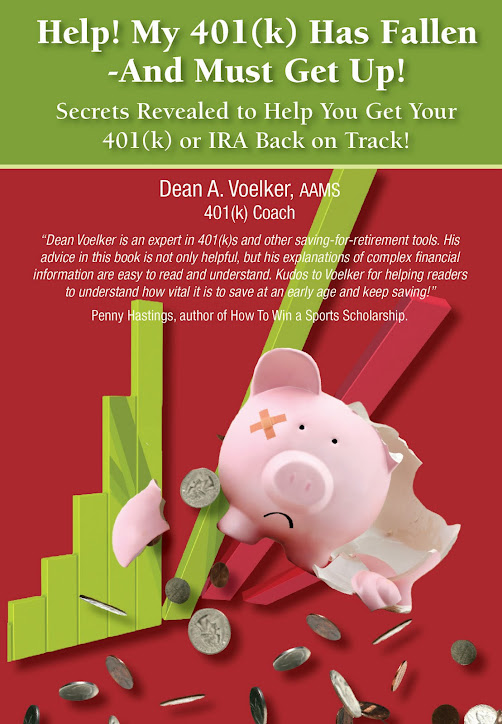
New Book - Coming November 2010

New Book - Coming November 2010
Help! My 401(k) Has Fallen - And Must Get Up!
Showing posts with label Penelope Wang. Show all posts

Thursday, October 7, 2010

The Grand (Money) Illusion

OK, admit it. You've done it too. With the recent rise in the stock market, you've seen your 401(k) balance rise also. You've started to think "Its going up, so everything is fine. It was down for a while, but now its coming back."

Does that sound like you? When you open your 401(k) or IRA statement, do you just look at the total balance and try to figure out if it's up or down? 

Money Magazine has their 2011 Retirement Guide out now. Senior Editor, and Retirement Expert Penelope Wang urges you to think of your retirement differently. Don't just look at the total lump sum. Look at what the future income will be, which the lump sum will generate. This is the Grand Illusion (not the Styx song) when it comes to your 401(k), she says. Remember that your future purchasing power also will be eroded by inflation.

Recently, I had a client ask me if $1,000,000 was enough to retire on. My answer was that we don't know until we look at your income needs, and cash flow. What are your monthly and yearly expenses? 

Let's assume that you have $1,000,000 (I know, I know.....just play along, OK). Let's assume also that you will be drawing 4% per year from the $1,000,000 nest egg. In order to do that, your money needs to be invested so that you are getting at least a 4% real return (after taxes and inflation). That way you can take money out without shrinking your nest egg.

So, using the $1,000,000 figure we can multiply that by .04 and get $40,000. We will take $40,000 per year for income. Will $40,000 meet your expenses? Do you have other debt? How about other sources of income?  

You MUST look at your 401(k) or IRA this way! It is a source of future income for you. The bigger the nest egg, the more income it will generate. But now you know WHY you need a bigger nest egg! "People understand how much money they need each month, so it makes the saving process more relevant," says UCLA behaviorial finance professor Shlomo Benartzi.

By the way, Ms. Wang also shows an illustration in her article on how long we think our money will last. Although most experts asvise retirees to limit their withdrawals to a maximum of 4%/year, there is a myth that you can take out more. According to the Met Life Retirement Income IQ Test (2008), about 26% of those surveyed thought that withdrawing 7%/year from a nest egg was safe. A whopping 43% (nearly HALF) of the respondants believed that it would be OK to withdraw 10% or more per year!!

Picture a small boat with a leak.


At first, you may not notice the leak. As water rushes into the boat, you start to panic. The water pours in
faster and faster, until the boat begins to sink. That's what happens to IRAs when you take out too much money. Eventually you reach a point where you can't keep up.

Let's keep your boat floating!

Help! My 401(k) Has Fallen – And Must Get Up! is my new book. It has several ideas and strategies which will help you in your retirement savings journey. Get your ‘Fallen’ 401(k) back on its feet. Contact me to reserve your copy today. You can also get a FREE report at my website

The 5 Biggest Problems With 401(k) Plans & How To Fix Them.


You may also listen to my weekly radio program – Improving Your Financial Health on WHME-FM in South Bend. Archives can be heard on my website as well. If you live in the South Bend, IN area, I specialize in 401(k) rollovers or IRA reviews. You can also follow me on Twitter, Linked In, or Facebook .

Thursday, June 17, 2010

3 Big 401(k) Mistakes


I had a chance to read a great article this week by Joe Mont. Big 401(k) Mistakes That Hurt Savings - June 1, 2010. This article was interesting to me for a few reasons. The facts he outlines tell me that there is definitely a need for my book,
Help! My 401(k) Has Fallen - And Must Get Up!

Mr. Mont agrees with me that "neither the market losses of 2008 nor the robust rally of 2009 have motivated workers to make their 401(k) plans their top priority." This is based on Hewitt Associates annual retirement study.

"While it's encouraging that most workers stayed the course, most did so simply because they were disengaged with the retirement saving process or too paralyzed with fear and confusion to touch their 401(k) plans", says Pamela Hess, Hewitt's director of retirement research. "If employees continue to ignore their 401(k) plans, they're hurting themselves by letting the market dictate their retirement strategy."

Mistake #1 - We Don't Save Enough

We don't save enough in these plans! There STILL needs to be a sense of urgency. Your 401(k) = Your Retirement - PERIOD!

Pensions began to disappear at about the same time leisure suits and Betamax video did - and NONE of these are coming back! When it comes to Social Security, Americans everywhere of all ages are concerned about the Federal Government's ability to continue the program as it currently exists. Also, it was never intended to be anyone's main source of retirement income. However for 1/3 of elderly Americans, it is the source of nearly all their income. This is according to the Center on Budget and Policy Priorities.

Your 401(k) - or 403(b) if you work for a non-profit organization may be ALL YOU HAVE!

Hewitt's study also shows about 28% of participants don't contribute enough to even get the full matching benefit from their employers. That's frightening especially considering that many companies have reduced or eliminated matching contributions over the past year. Penelope Wang reports in her March 2010 article, Make the Best of a Bad 401(k) that "before the financial crisis, only 6% of plans didn't offer workers a matching contribution as an incentive to boost participation. But that number spiked last year, as another 12% of employers reduced or suspended their matches." 

Ms. Wang goes on to add - "If you have a missing or reduced match, there's no getting around the fact that you'll have to make up the difference by saving more."


Pamela Hess of Hewitt says, "It was interesting to watch employee reactions to the match suspension. We had expected some really serious impacts to the savings rates, but it didn't change things as much as we thought."

Mistake # 2 - We Don't Rebalance

Here's a question for you. How often do you visit your dentist? What would happen to your teeth if you didn't brush or visit the dentist regularly?

Just like the dentist, you need to review your 401(k) plan with a professional to make sure you are on track with your retirement goals and that you have the right mix. Balance helps you to lower your overal risk. You get your tires re-balanced to keep your car straight, and rebalancing your account serves the same purpose.

With that in mind, target-date funds have become much more popular. A 'target-date fund' is one made up of a blend of several mutual funds. You can easily spot them in your menu of investment choices because they have a year in the name of the fund. "Fidelity Freedom 2040" would be an example of a target-date fund. The year represents the approximate time in which you would wish to retire. With this type of fund, it gradually become more and more conservative as the year approaches.

Hewitt's study from Mr. Mott's article shows that in 2009, 25% of workers use target-date funds in their  401(k) plans. Mr. Mott explains that some of this is due to employers who automatically enroll their new workers into the company 401(k) plan. 69% of these employers use a target-date fund as the default option.
Greg Johnson, president and CEO of Franklin Resources says that "target-date funds will become a bigger and bigger part of the new money that's flowing into 401(k)s."  

Even if you do use a target-date fund, please review your account with an advisor. Ask them about the mix. Is it too conservative? too aggressive? or just about right? Are you saving enough to reach your goals? What will your income needs be at retirement? How will your 401(k) be able to meet your income needs? All great questions for an advisor. Don't do your own dental work! Get a pro to prevent 'decay' in your 401(k).

Mistake # 3 - We Kill Our 401(k)s From Withdrawals

Hewitt's study shows that in 2009, 7.1% of participants withdrew from reitrement plans. That is more than in any year since 2002. Loans kill 401(k)s also, and loans automatically become withdrawals once employment ends at the company. Hewitt reports that more than 25% of employees had an existing loan on their 401(k) plan at the end of 2009.

This isn't all that surprising to me. I have spoken with several people who have cashed out 401(k)s. The reasons are varied, but they all boil down to "I need the money right now." It is especially common among younger workers who don't see the future and feel the need to use the money for something else. They don't seem to realize or be concerned that this money may be cut almost IN HALF after taxes and penalties are taken out. A $20,000 account could be reduced to about $11,000 or $12,000 easily when it is withdrawn.

Joe Mont's article is right on time. Please AVOID these big mistakes in your 401(k). I have attempted to contact Mr. Mott after reading this piece and offer him a guest spot on Improving Your Financial Health. As of today, I am waiting to hear back from him.

Please contact me at my website, http://www.helpmy401k.us/ for more information and a FREE REPORT, The Five Biggest Problems With 401(k) Plans - And How To Fix Them! I'm also well equipped to help with 401(k) rollovers or plan reviews.


You can follow me on Twitter, Linked In, or Facebook. I also host a radio program, Improving Your Financial Health, on WHME-FM (103.1) in South Bend, IN.