Most people have never heard of a SIMPLE IRA before, and are curious to know how it differs from a 401(k). A SIMPLE IRA stands for Savings Investment Match PLan for Employees.
One of the key differences of why your employer may have a SIMPLE IRA versus a 401(k), is that SIMPLE IRAs are geared for employers with less than a 100 employees. In addition to that, the administrative cost of a SIMPLE IRA for your employer is considerably much less than what a 401(k) would be. (It’s shortened to SIMPLE because it’s…..SIMPLE for small businesses.)
1. Your Employer’s Contributions Are 100% Vested
With some 401(k)s you need to have worked for the employer for a certain number of years to be vested. That means that if you were to leave that employer you could take that employer’s matching contribution. With 401(k)s, you have anywhere from three to five years to where you’re 100% vested. Anything you put in is yours, but anything which they put in may be subject to a vesting schedule. With a SIMPLE IRA, you are 100% vested whenever the employer deposits that into your account. There is no vesting schedule at all.
2. Employers Have To Match In A SIMPLE IRA
Each year, the employer is required to make a contribution to your SIMPLE IRA account whether it be in the form of a match or what’s called a non-elected contribution. Matching contribution states that the employer has to match at least what you match. So, if you’re matching 3%, the employer has to match 3% as well. Note that 3% is the most that the employer has to match, which could be considerably different than compared to a 401(k).
If the employer chooses to not do a match, then they may do what is called a non-elect contribution and what that means is that they will contribute 2% of your salary no matter what. Even if you are contributing 3% of your salary, they will only contribute the 2%.
To sum this up, the employer can choose:
* Match contributions up to 3% of salaries for any employees who choose to participate in the
SIMPLE IRA.
* Contribute 2% of salaries for ALL employees, whether or not they participate.
The decision should be based on which option provides the most benefits and tax savings to the employer.
3. Employees Control The Investments
With most 401(k)s, you are limited to the investment options that you have. This is considerably different when compared to the SIMPLE IRA. Being a self-directed retirement plan, the SIMPLE IRA gives you the discretion of what exactly you want your money invested into. That means that if you want to buy individual stocks, mutual funds, ETFs, or CDs, you are allowed.
To keep things “simple”, it is most common to work with an established family of mutual funds which offers a wide variety of investments.
4. Employees Can Contribute 100% Of Income Into A
SIMPLE IRA
As of 2010, you are allowed to contribute up to $11,500 per year in a SIMPLE IRA. For those who are age 50 and older, you are allowed a catch-up contribution, which is currently $2,500, for a maximum total of $14,000 in 2010. To do this, you must have at least $14,000 in earned income. Currently, the maximum contribution for a 401(k) is $16,500 with a catch-up of $5,500 for ages 50 and up. The SIMPLE IRA is tax-deferred similar to a 401(k).
5. SIMPLE IRAs Do Not Allow Loans
A lot of 401(k)s have loan provisions that allow the employee to borrow against their money if need be. With SIMPLE IRAs, this is not the case. For employers who are weighing their options on retirement savings plans, that may be a consideration. No matter which type of plan you have - Loans are NOT advised. Money which is contributed to retirement savings is to be used for exactly that - retirement! The drawback to using a loan in a 401(k) is that when you leave the company, the loan is immediately due, and then treated as a withdrawal. The withdrawal is then counted as income, and taxed and penalized accordingly.
6. The SIMPLE IRA Two-Year Rule
This is something that should be definitely different from a traditional IRA within the SIMPLE IRA. Most retirement plans — 401(k)s, IRAs, or Roth IRAs — have the 10% early withdrawal penalty if you take money out and you are under the age of 59.5. The SIMPLE IRA goes one step further. If the SIMPLE IRA that you’ve started is less than two years old, and you cash that out, you will be subject to a 25% penalty in addition to ordinary income tax. That is a huge item to not be overlooked. Again, we do not recommend withdrawing money from a retirement savings account before retirement.
If you were attempting to roll over your SIMPLE IRA into a rollover IRA, the 25% penalty would apply as well if the SIMPLE is less than two years old. Once the two year period has passed, a SIMPLE IRA can be easily rolled over into a traditional IRA with no tax consequence. Cashing it out would then incur the same 10 % penalty and taxation as any other account.
7. Which Businesses Use SIMPLE IRAs
Any business which has less than 100 employees may consider using a SIMPLE IRA. The main benefits are:
* SIMPLE to set up and maintain.
* Variety of investment choices available.
* Employer contributions are tax-deductible.
A SIMPLE IRA may be established prior to October 1 to be recognized for that year.
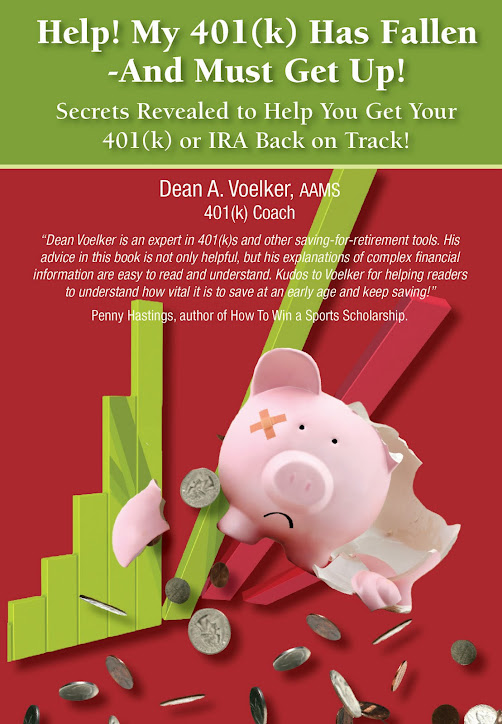
My book, Help! My 401(k) Has Fallen - And Must Get Up! has several ideas and strategies which will help you in your retirement savings journey. Get your 'Fallen' 401(k) back on its feet. Contact me to reserve your copy today. You can also get a FREE report at my website. The 5 Biggest Problems With 401(k) Plans - And How To Fix Them. If you live in the South Bend, IN area, I am also happy to help with
401(k) rollovers or IRA reviews. You can follow me on Twitter, Linked In, or Facebook.
My weekly radio show is Improving Your Financial Health on WHME-FM in South Bend, and archives are available for listening on my website.
Showing posts with label diversification. Show all posts
Showing posts with label diversification. Show all posts
Tuesday, September 21, 2010


Thursday, June 17, 2010
3 Big 401(k) Mistakes

I had a chance to read a great article this week by Joe Mont. Big 401(k) Mistakes That Hurt Savings - June 1, 2010. This article was interesting to me for a few reasons. The facts he outlines tell me that there is definitely a need for my book,
Help! My 401(k) Has Fallen - And Must Get Up!
Mr. Mont agrees with me that "neither the market losses of 2008 nor the robust rally of 2009 have motivated workers to make their 401(k) plans their top priority." This is based on Hewitt Associates annual retirement study.
"While it's encouraging that most workers stayed the course, most did so simply because they were disengaged with the retirement saving process or too paralyzed with fear and confusion to touch their 401(k) plans", says Pamela Hess, Hewitt's director of retirement research. "If employees continue to ignore their 401(k) plans, they're hurting themselves by letting the market dictate their retirement strategy."
Mistake #1 - We Don't Save Enough
We don't save enough in these plans! There STILL needs to be a sense of urgency. Your 401(k) = Your Retirement - PERIOD!
Pensions began to disappear at about the same time leisure suits and Betamax video did - and NONE of these are coming back! When it comes to Social Security, Americans everywhere of all ages are concerned about the Federal Government's ability to continue the program as it currently exists. Also, it was never intended to be anyone's main source of retirement income. However for 1/3 of elderly Americans, it is the source of nearly all their income. This is according to the Center on Budget and Policy Priorities.
Your 401(k) - or 403(b) if you work for a non-profit organization may be ALL YOU HAVE!
Hewitt's study also shows about 28% of participants don't contribute enough to even get the full matching benefit from their employers. That's frightening especially considering that many companies have reduced or eliminated matching contributions over the past year. Penelope Wang reports in her March 2010 article, Make the Best of a Bad 401(k) that "before the financial crisis, only 6% of plans didn't offer workers a matching contribution as an incentive to boost participation. But that number spiked last year, as another 12% of employers reduced or suspended their matches."
Ms. Wang goes on to add - "If you have a missing or reduced match, there's no getting around the fact that you'll have to make up the difference by saving more."
Pamela Hess of Hewitt says, "It was interesting to watch employee reactions to the match suspension. We had expected some really serious impacts to the savings rates, but it didn't change things as much as we thought."
Mistake # 2 - We Don't Rebalance
Here's a question for you. How often do you visit your dentist? What would happen to your teeth if you didn't brush or visit the dentist regularly?
Just like the dentist, you need to review your 401(k) plan with a professional to make sure you are on track with your retirement goals and that you have the right mix. Balance helps you to lower your overal risk. You get your tires re-balanced to keep your car straight, and rebalancing your account serves the same purpose.
With that in mind, target-date funds have become much more popular. A 'target-date fund' is one made up of a blend of several mutual funds. You can easily spot them in your menu of investment choices because they have a year in the name of the fund. "Fidelity Freedom 2040" would be an example of a target-date fund. The year represents the approximate time in which you would wish to retire. With this type of fund, it gradually become more and more conservative as the year approaches.
Hewitt's study from Mr. Mott's article shows that in 2009, 25% of workers use target-date funds in their 401(k) plans. Mr. Mott explains that some of this is due to employers who automatically enroll their new workers into the company 401(k) plan. 69% of these employers use a target-date fund as the default option.
Greg Johnson, president and CEO of Franklin Resources says that "target-date funds will become a bigger and bigger part of the new money that's flowing into 401(k)s."
Even if you do use a target-date fund, please review your account with an advisor. Ask them about the mix. Is it too conservative? too aggressive? or just about right? Are you saving enough to reach your goals? What will your income needs be at retirement? How will your 401(k) be able to meet your income needs? All great questions for an advisor. Don't do your own dental work! Get a pro to prevent 'decay' in your 401(k).
Mistake # 3 - We Kill Our 401(k)s From Withdrawals
Hewitt's study shows that in 2009, 7.1% of participants withdrew from reitrement plans. That is more than in any year since 2002. Loans kill 401(k)s also, and loans automatically become withdrawals once employment ends at the company. Hewitt reports that more than 25% of employees had an existing loan on their 401(k) plan at the end of 2009.
This isn't all that surprising to me. I have spoken with several people who have cashed out 401(k)s. The reasons are varied, but they all boil down to "I need the money right now." It is especially common among younger workers who don't see the future and feel the need to use the money for something else. They don't seem to realize or be concerned that this money may be cut almost IN HALF after taxes and penalties are taken out. A $20,000 account could be reduced to about $11,000 or $12,000 easily when it is withdrawn.
Joe Mont's article is right on time. Please AVOID these big mistakes in your 401(k). I have attempted to contact Mr. Mott after reading this piece and offer him a guest spot on Improving Your Financial Health. As of today, I am waiting to hear back from him.
Please contact me at my website, http://www.helpmy401k.us/ for more information and a FREE REPORT, The Five Biggest Problems With 401(k) Plans - And How To Fix Them! I'm also well equipped to help with 401(k) rollovers or plan reviews.
You can follow me on Twitter, Linked In, or Facebook. I also host a radio program, Improving Your Financial Health, on WHME-FM (103.1) in South Bend, IN.
Wednesday, May 19, 2010
What Do Mary Kay and Your 401(k) Have In Common?

I finally got some feedback from my compliance supervisor, regarding my upcoming book, "Help! My 401(k) Has Fallen - And Must Get Up!"
As a licensed Financial Advisor, I certainly want to be sure my book stays "in bounds". I need to "C M A" - so to say.
How do I C M A? (Cover My ***) Two main rules -
1. No wild promises.
2. No product endorsements.
Years ago, I remember reading the story of Mary Kay Ash, founder of Mary Kay Cosmetics. Mary Kay said that she lived by a principle which I found fitting. "I never promised a woman that my products would make her beautiful, but I always tried to give her hope."
I like that. You could certainly apply the same concept to financial services and even more specifically to my book. We have been bombarded by the media with "hopelessness" at every turn. My job is to be a beacon of light. Straight talk and common sense to show the way. With no pensions, a weak Social Security system, and people living much longer, you really need your 401(k) to grow strong.
In the book, there are examples which DO show specific mutual funds. However, I was asked to simply enter a disclaimer footnote. This avoids endorsement of a certain product or fund.
"Investors should carefully consider the investment objectives, risks, charges, and expenses of mutual funds. This and other important information is contained in each fund's summary prospectus and/or prospectus, which can be obtained from a financial professional and should be read carefully before investing. Investments outside the United States involve additional risks - as does investing in smaller companies - such as currency fluctuations, political instability, differing securities regulations, and periods of illiquidity. Equity investments are subject to market fluctuations."
There. I feel much better now, don't you? I have also taken a lot of time to make sure that "Help! My 401(k) Has Fallen - And Must Get Up!" is properly referenced and indexed. If someone else said it, it must be OK for me to say it - as long as I credit the source.
In the end, I'm happy with the way the book is turning out. My next piece will be on the final editing.
I'm proud to say - I covered my "A".
You can contact me through my website. I am currently accepting new clients and specialize in 401(k) rollovers. You can get a FREE REPORT there also, "The 5 Biggest Problems With 401(k) Plans - And How to Fix Them". Follow me on Twitter or Linked In.
My radio program, "Improving Your Financial Health" is weekly on Saturday mornings at 9:00am EST on Harvest 103.1 WHME-FM in South Bend. Archived programs are also on my website under WHME.
Best wishes to you!
Wednesday, March 17, 2010
Diary of a Wimpy 401(k) - Wimpy Friends
The interesting thing about writing a book - I am learning who my friends are.
One of the things I had wanted was to get testimonials from people from all walks of life. The book was written in simple language with plenty of stories to make it easy for anyone to understand.
We all have a 401(k) or 403(b) - almost all of us anyway. Unless you are self-employed or one of the rare few who still have a pension.
So about a month ago, I sent requests for testimonials to about 65 people. Some I knew better than others. Some were financial experts who I had interviewed on "Improving Your Financial Health". Some were friends in the financial industry. Some were friends and clients I knew locally, or small business owners. Still others were people who were involved in the project in some way.
A few were celebs who I didn't know, but I wanted to get a testimonial from them.
In asking for testimonials, I believe that we are all very busy. I am willing to be patient and follow up a few times to get testimonials. These 'blurbs' from others can help to promote the book.
If you have a 401(k) and you aren't happy with it, and you are nervous about the future, you should read this book!
One guy (a writer whom I won't name) turned me down, but was very nice about it. He explained that he gets many similar requests and he simply does not have time to answer them all. He also didn't believe that his testimonial would carry much weight, with him not having a financial background.
Although I was slightly disappointed, I appreciated his sincerity and his prompt response.
I've also had a few of my financial heroes tell me that although they like the book and see its value, they aren't allowed to respond due to compliance constraints. Again, I respect this.
That's one way to do it. Here's the WRONG WAY!
Another previous guest on my program (I won't name her - but I promise she WON'T BE BACK!) had her assistant send this "snooty form letter" remark. "As a policy, our team focuses on content that is being published by a major imprint. We don’t read or consider unsolicited material. Should your book get picked up by a major imprint, please do feel free to reach out to me at that time, and I’ll do my best to get it to (her) for a possible endorsement."
Again, this type of chilly response really alienated me. I've lost a lot of respect for this person and needless to say, she won't be back as a guest on my program.
I am still looking for testimonials. I've gotten several very ones so far. Let me kinow if you'd like a copy of the book for review. If you want to learn more about 401(k)s and think you can write a couple of kind words - contact me and I will gladly send you a copy of the draft.
Here are some of my favorite testimonials so far.
"Unless you plan to work till you drop, the 401(k) is your eventual ticket to freedom. Your plan may have fallen in 2008 and Dean Voelker is just the person to help get it back up." -
Jonathan Chevreau, Financial Post columnist, and author of Findependence Day.
“Dean Voelker does a great job of laying out the case for aggressively pursuing your 401(k). This book presents compelling reasons for getting involved in your future TODAY, rather than tomorrow. Dean’s story telling approach takes the 401(k) from its birth through today in an easy to read and storytelling manner.” - Len Fox, author of Recipe Investing.
“Dean Voelker is a real pro. He reveals some things about the Social Security system and how
401(k)s work that I never knew. This book is short, sweet and to the point. Everyone needs to read it quickly to see if they are doing what they should to get their retirement plans back on track. Thanks, Dean for putting this together for us.” - John S. Cohoat, President of Cohoat Business Growth Advisors, and author of No Thank You, Mr. President.
Go ahead, don't be "wimpy". Contact me today. You can also get a copy of a free report on my website -
"The 5 Biggest Problems With 401(k) Plans - And How to Fix Them"
You may also contact me on Linked In at http://www.linkedin.com/in/dvoelker or Twitter at http://www.twitter.com/deanvoelker. I also host a weekly financial advice program, Improving Your Financial Health at http://www.blogtalkradio.com/401kcoach.
One of the things I had wanted was to get testimonials from people from all walks of life. The book was written in simple language with plenty of stories to make it easy for anyone to understand.
We all have a 401(k) or 403(b) - almost all of us anyway. Unless you are self-employed or one of the rare few who still have a pension.
So about a month ago, I sent requests for testimonials to about 65 people. Some I knew better than others. Some were financial experts who I had interviewed on "Improving Your Financial Health". Some were friends in the financial industry. Some were friends and clients I knew locally, or small business owners. Still others were people who were involved in the project in some way.
A few were celebs who I didn't know, but I wanted to get a testimonial from them.
In asking for testimonials, I believe that we are all very busy. I am willing to be patient and follow up a few times to get testimonials. These 'blurbs' from others can help to promote the book.
If you have a 401(k) and you aren't happy with it, and you are nervous about the future, you should read this book!
One guy (a writer whom I won't name) turned me down, but was very nice about it. He explained that he gets many similar requests and he simply does not have time to answer them all. He also didn't believe that his testimonial would carry much weight, with him not having a financial background.
Although I was slightly disappointed, I appreciated his sincerity and his prompt response.
I've also had a few of my financial heroes tell me that although they like the book and see its value, they aren't allowed to respond due to compliance constraints. Again, I respect this.
That's one way to do it. Here's the WRONG WAY!
Another previous guest on my program (I won't name her - but I promise she WON'T BE BACK!) had her assistant send this "snooty form letter" remark. "As a policy, our team focuses on content that is being published by a major imprint. We don’t read or consider unsolicited material. Should your book get picked up by a major imprint, please do feel free to reach out to me at that time, and I’ll do my best to get it to (her) for a possible endorsement."
Again, this type of chilly response really alienated me. I've lost a lot of respect for this person and needless to say, she won't be back as a guest on my program.
I am still looking for testimonials. I've gotten several very ones so far. Let me kinow if you'd like a copy of the book for review. If you want to learn more about 401(k)s and think you can write a couple of kind words - contact me and I will gladly send you a copy of the draft.
Here are some of my favorite testimonials so far.
"Unless you plan to work till you drop, the 401(k) is your eventual ticket to freedom. Your plan may have fallen in 2008 and Dean Voelker is just the person to help get it back up." -
Jonathan Chevreau, Financial Post columnist, and author of Findependence Day.
“Dean Voelker does a great job of laying out the case for aggressively pursuing your 401(k). This book presents compelling reasons for getting involved in your future TODAY, rather than tomorrow. Dean’s story telling approach takes the 401(k) from its birth through today in an easy to read and storytelling manner.” - Len Fox, author of Recipe Investing.
“Dean Voelker is a real pro. He reveals some things about the Social Security system and how
401(k)s work that I never knew. This book is short, sweet and to the point. Everyone needs to read it quickly to see if they are doing what they should to get their retirement plans back on track. Thanks, Dean for putting this together for us.” - John S. Cohoat, President of Cohoat Business Growth Advisors, and author of No Thank You, Mr. President.
Go ahead, don't be "wimpy". Contact me today. You can also get a copy of a free report on my website -
"The 5 Biggest Problems With 401(k) Plans - And How to Fix Them"
You may also contact me on Linked In at http://www.linkedin.com/in/dvoelker or Twitter at http://www.twitter.com/deanvoelker. I also host a weekly financial advice program, Improving Your Financial Health at http://www.blogtalkradio.com/401kcoach.
Wednesday, February 3, 2010
Taking Stock

However, I did see something recently which I thought my readers may enjoy. If you were going to invest in stocks, which companies would be good ones to own long-term? At least one sign of a great company is one which is able to consistently increase their dividend payment.
If you aren't sure what a dividend is, think of it this way. When you own stock, you own a tiny piece of that company. Your investment rises and falls with the performance of the company. Over time, you would like to think the company will grow, and your money will grow with it. Companies which have established themselves and become profitable will share part of their profits with you as a part owner. Those profit sharing payments are known as dividends and are usually paid once every 3 months.
Again, the sign of a great company is one which has raised its dividend payment consistently, even in tough times. Raising the dividend for shareholders is like giving them a pay raise. (CDs don't do THAT!!) Those companies would be great to own long term.
What if a company were able to raise its dividend 25 years in a row or more?
Here are the ones which have:
Abbott Labs (ABT)
Bemis (BMS)
Century Tel (CTL)
Chubb (CB)
Coca-Cola (KO)
Exxon-Mobil (XOM)
Johnson & Johnson (JNJ)
Mc Donalds (MCD)
3M (MMM)
Pitney Bowes (PBI)
PPG (PPG)
Proctor & Gamble (PG)
Walmart (WMT)
S&P reports that since 1926, dividends have contributed to about 1/3 of the total return on your investment.
Another thing I like about dividends is that when the stock price goes down, the dividend yield goes up. Its a great time to buy more of great companies. That is what Warren Buffett does!
For example, lets look at Proctor & Gamble. Shares of PG are currently (2/3/10) at $62.90. Dividends are paid at $1.76/share, which is divided into 4 quarterly payments. You will get a dividend return of 2.8% on any shares purchased at that price.
What if you had been fortunate enough to buy in March of 2009, when it was selling for around $44/share? Well, you still would have gotten $1.76 per share, but that works out to about a 4% dividend return. (Better than a CD, and with potential to grow!)
Warren Buffett has become extremely wealthy because he buys great companies and holds them, collecting dividends which increase year after year after year.
Again, I am not encouraging people to buy individual stocks. There are plenty of financial stocks such as Citigroup and Bank of America which also had wonderful histories of increased dividends, until 2008.
Dividends are certainly something to consider though for any investment - including mutual funds and annuities.
You can contact me through my website, http://www.helpmy401k.us/. You can also contact me on LinkedIn at http://www.linkedin.com/in/dvoelker, or Twitter at http://www.twitter.com/deanvoelker. I am currently hosting a weekly financial advice program, "Improving Your Financial Health" on Blog Talk Radio at http://www.blogtalkradio.com/401kcoach. Let me know how I may help you!
Monday, January 4, 2010
New Years Resolutions
"Now is the accepted time to make your regular annual good resolutions. Next week you can begin paving hell with them as usual." Mark Twain
Here we are - a New Year. Some also say a New Decade.
What 'Financial' Resolutions have you made? Can't think of any? Here are a few tips.
1. Review and Rebalance your Investments and 401(k)
If you have been putting it off for a while to "wait & see", your account is probably seriously out of balance. Sit down with an advisor to review your goals and make your your fund mix matches what your needs are.
2. Increase Contributions to Your 401(k)
Are you putting between 10% and 15% into your 401(k) at work? If not, then at least raise the amount you are putting in. Gradually work yourself up to that level. You will need the nest egg for income later.
3. Pay Off Credit Cards and Other Debt
If you are having trouble with #2, get these paid off and free up some money for yourself.
4. Set Up a Budget and Stick To It
There are a number of places you can find good basic worksheets for setting up a budget. It should be simple. Just make sure all of your money has a place to go - either savings or expenses. Here is a site with some downloadable sheets. http://www.betterbudgeting.com/
5. Contribute to a Roth IRA and Convert Pre-Tax Retirement Savings
You can put up to $5000 into a Roth ($6000 if you are 50 and older). You can still make 2009 contributions up until April 15. The Roth IRA of course grows tax free and allows you to make withdrawals at retirement which are also tax free.
There are no income restrictions for the Roth this year and if you choose to convert any money from your Traditional Pre-Tax IRA to the Roth, you may spread the taxes out over the next 2 years.
You can contact me through my website, http://www.helpmy401k.us/. You may also follow me on Twitter at http://www.twitter.com/deanvoelker. I also host a weekly internet radio program at http://www.blogtalkradio.com/401kcoach.
Here we are - a New Year. Some also say a New Decade.
What 'Financial' Resolutions have you made? Can't think of any? Here are a few tips.
1. Review and Rebalance your Investments and 401(k)
If you have been putting it off for a while to "wait & see", your account is probably seriously out of balance. Sit down with an advisor to review your goals and make your your fund mix matches what your needs are.
2. Increase Contributions to Your 401(k)
Are you putting between 10% and 15% into your 401(k) at work? If not, then at least raise the amount you are putting in. Gradually work yourself up to that level. You will need the nest egg for income later.
3. Pay Off Credit Cards and Other Debt
If you are having trouble with #2, get these paid off and free up some money for yourself.
4. Set Up a Budget and Stick To It
There are a number of places you can find good basic worksheets for setting up a budget. It should be simple. Just make sure all of your money has a place to go - either savings or expenses. Here is a site with some downloadable sheets. http://www.betterbudgeting.com/
5. Contribute to a Roth IRA and Convert Pre-Tax Retirement Savings
You can put up to $5000 into a Roth ($6000 if you are 50 and older). You can still make 2009 contributions up until April 15. The Roth IRA of course grows tax free and allows you to make withdrawals at retirement which are also tax free.
There are no income restrictions for the Roth this year and if you choose to convert any money from your Traditional Pre-Tax IRA to the Roth, you may spread the taxes out over the next 2 years.
You can contact me through my website, http://www.helpmy401k.us/. You may also follow me on Twitter at http://www.twitter.com/deanvoelker. I also host a weekly internet radio program at http://www.blogtalkradio.com/401kcoach.
Wednesday, October 14, 2009
Cut The Fat in your 401(k)
Last week, we asked “Where’s the Beef?” Today, we ask “Where’s the Fat?”
Its very important to trim the ‘fat’ in your 401(k) plan – or fund expenses. Today on my Blog Talk Radio program, I had a listener ask about fund expenses. These can really affect your long term return on your retirement savings.
Expenses come from managing the mutual fund. The fund family charges a percentage of the assets invested to manage the fund – deciding what to buy, what to sell, and how much to buy or sell and when to do it. Less trading = lower expenses. Also the advisor on the plan may be paid from these expenses.
Knowing this, it would make sense to look for funds in your plan which have a lower expense rate. If its about 1%, that isn’t too bad, much more than that can negatively affect your returns over time.
To give you an example, I did some figuring on my financial calculator . Let’s look at a 22 year old college graduate, starting their 401(k) plan. Of course you would expect them to bump up their contributions over time, but lets say they put in $300/month with an 8% average return until age 66. They would have saved $1,340,048 in 44 years.
What if they were using a fund with expenses that were 1% more? In other words, the fund may have averaged 8%, but the real return was 7% due to higher expenses. With all the other factors being the same, we now have a total savings of $993,985, which is a difference of $346,063. OUCH! If you figure on taking 4%/year of the nest egg at retirement for income, that means we would need to live on less income -$13842 per year less. See where 1% can make a big difference?
So look carefully at your statement. Don’t just look at ‘performance’ but also fund expenses, which do affect long term performance. Have an advisor help you with this and also help you determine how much to save, so you can have the type of retirement you want.
You may contact me through my website at http://www.helpmy401k.us. You can also follow me on Twitter at http://www.twitter.com/deanvoelker. I also host a Weekly Internet Radio Broadcast “Improving Your Financial Health on Blog Talk Radio http://www.blogtalkradio.com/401kcoach
Its very important to trim the ‘fat’ in your 401(k) plan – or fund expenses. Today on my Blog Talk Radio program, I had a listener ask about fund expenses. These can really affect your long term return on your retirement savings.
Expenses come from managing the mutual fund. The fund family charges a percentage of the assets invested to manage the fund – deciding what to buy, what to sell, and how much to buy or sell and when to do it. Less trading = lower expenses. Also the advisor on the plan may be paid from these expenses.
Knowing this, it would make sense to look for funds in your plan which have a lower expense rate. If its about 1%, that isn’t too bad, much more than that can negatively affect your returns over time.
To give you an example, I did some figuring on my financial calculator . Let’s look at a 22 year old college graduate, starting their 401(k) plan. Of course you would expect them to bump up their contributions over time, but lets say they put in $300/month with an 8% average return until age 66. They would have saved $1,340,048 in 44 years.
What if they were using a fund with expenses that were 1% more? In other words, the fund may have averaged 8%, but the real return was 7% due to higher expenses. With all the other factors being the same, we now have a total savings of $993,985, which is a difference of $346,063. OUCH! If you figure on taking 4%/year of the nest egg at retirement for income, that means we would need to live on less income -$13842 per year less. See where 1% can make a big difference?
So look carefully at your statement. Don’t just look at ‘performance’ but also fund expenses, which do affect long term performance. Have an advisor help you with this and also help you determine how much to save, so you can have the type of retirement you want.
You may contact me through my website at http://www.helpmy401k.us. You can also follow me on Twitter at http://www.twitter.com/deanvoelker. I also host a Weekly Internet Radio Broadcast “Improving Your Financial Health on Blog Talk Radio http://www.blogtalkradio.com/401kcoach
Friday, October 9, 2009
Where's The Beef?

During the 1980’s there was a very popular commercial by Wendy’s. An elderly lady ordered a burger at a generic fast food counter. Upon seeing how puny and pathetic her tiny burger was, she grilled the sales clerk repeatedly - “Where’s the beef?” The commercial was a huge hit and “Where’s the beef?” was a well known catch phrase.
These days “Where’s the beef?” could easily be applied to the 401(k)s & IRAs of many people. In Daniel R. Solin’s book, “The Smartest 401(k) Book You’ll Ever Read”, he points out that “the typical twenty-something only invests 50.4% of his or her account in stock mutual funds.” You can’t keep up with inflation that way! Mr. Solin goes on to say that as we get older, that figure is also pretty timid. “The typical worker in their forties invests only 54.3% in stock funds.”
It doesn’t matter how old you are. Even people on the verge of retirement should be invested in stock mutual funds with a good part of their long term savings. After all, you could be retired for 20-30 years.
Stocks have been the only investment which has beaten inflation over the long term. And we NEED to prepare for inflation! Did you know that in 1989 (20 years ago), a loaf of bread costs an average of 0.67? And a postage stamp was just 0.25?
Mr. Solin also points out that “If you invested $1.00 in blue chip stocks in 1926, it would be worth $3077.33 today. That pencils out to a 10.42 average yearly return.”
Don’t be too fancy trying to pick the “right” fund. Look for mutual funds with long histories (10 years or longer) and low expenses. High management fees can really affect the return on your investment.
We will be looking at a few other ways to put some “Beef” back into your 401(k) in a future article.
You may contact me through my website at http://www.helpmy401k.us. You can also follow me on Twitter at http://www.twitter.com/deanvoelker. I also host a Weekly Internet Radio Broadcast "Improving Your Financial Health on Blog Talk Radio http://www.blogtalkradio.com/401kcoach
Thursday, July 2, 2009
This Time Its Different
Last year (2008), the Dow Jones Industrial Average fell about 34% (www.djindexes.com), then dropped ANOTHER 20% in the first 2 months of 2009.
It is estimated that investors accounts have declined in value by about $10 TRILLION DOLLARS TOTAL. http://www.businessweek.com/mediacenter/podcasts/cover_stories/covercast_03_05_09.htm
Severe recessions such as this one can test the resolve of even the most experienced investors.
It is easy to say "This time its different." Many people are still feeling that way.
However, it is important to keep in mind a few points.
* Financial decisions (any financial decisions) should not be based on emotion.
* Historically, after every past recession, the market has gone on to hit new highs.
* Declines in the market & economy, even our most severe ones, have been temporary.
* Since 1926, the Dow Jones has had TWICE AS MANY positive returns as negative ones.
Despite more than 12 recessions dating back to 1926, $1.00 invested in the Dow in 1926
would have been worth $2045.00 at the end of 2008.
The late Sir John Templeton, founder of Franklin Templeton Investments liked to say, "The Four most expensive words in the English Language are 'This time it's Different.' "
The National Bureau of Economic Research www.nber.com http://www.nber.org/cycles/
states that the United States has weathered a recession EVERY decade since the 1920's. https://financialprofessional.hartfordinvestor.com/planco/om/P7135.pdf - Page 4.
As painful as the recessions are, when we are experiencing one, they have always been short lived, about 11 months on average. It can be difficult to predict when one will end, and announcing the "end" may take a while. According to NBER, they have waited an average of 15 months before declaring an "end". This way they avoid confusion. If there is further economic turmoil, it can be linked to a new recession, rather than the old one.
While we are "waiting to see what will happen" rebounds are often quick and robust. Stocks tend to recover about 6 months before the economy does. According to Morningstar www.morningstar.com, stocks are referred to as a leading indicator. On average, stocks have returned about 25% from market lows to the "end of the recession".
Did you know that the Dow Jones has increased by nearly 30% since its low point on
March 9, 2009? Have you been "in" the whole time, or did you go to something "safe"?
3/9/2009 - 6547
7/1/2009 - 8504
"The most expensive words in the English Language are 'This time it's different'."
Sir John Templeton
If you went to cash, thinking you were being "smart", think again. Cash can actually slow your recovery, and make it much harder to get your savings back.
In a recent study, Hartford shows data from the recession of 1973-1974, which had been our most severe until the present one. The study (please contact me at www.helpmy401k.us for more information) shows 4 seperate scenarios, each starting with $100,000 invested in equities on Dec. 31, 1972.
(Equities are represented by the S & P 500 Index. Cash is represented by the 30 Day Treasury Bill Index.)
In the study, they wanted to see how long it would take to recover the original $100,000 for the Low Point in the Market (Sept. 30, 1974)
Investor A (stayed in Equities) - back to $100,000 in July 1976 (1.75 years)
Investor B (moved to cash for 6 months, starting 9/30/1974) (5.3 years, or Jan. 1980)
Investor C (moved to cash for 12 months, starting 9/30/1974) (also 5.3 years)
Investor D (moved to cash for 18 months, starting 9/30/1974) (6.2 years, or Nov. 1980)
Yogi Berra sometimes said, "Its deja vu all over again."
In a challenging economy such as this one, isn't this precisely when you need a financial professional working side by side with you?
For more information, please contact me at http://www.helpmy401k.us. You may also follow me on Twitter at www.twitter.com/deanvoelker.
It is estimated that investors accounts have declined in value by about $10 TRILLION DOLLARS TOTAL. http://www.businessweek.com/mediacenter/podcasts/cover_stories/covercast_03_05_09.htm
Severe recessions such as this one can test the resolve of even the most experienced investors.
It is easy to say "This time its different." Many people are still feeling that way.
However, it is important to keep in mind a few points.
* Financial decisions (any financial decisions) should not be based on emotion.
* Historically, after every past recession, the market has gone on to hit new highs.
* Declines in the market & economy, even our most severe ones, have been temporary.
* Since 1926, the Dow Jones has had TWICE AS MANY positive returns as negative ones.
Despite more than 12 recessions dating back to 1926, $1.00 invested in the Dow in 1926
would have been worth $2045.00 at the end of 2008.
The late Sir John Templeton, founder of Franklin Templeton Investments liked to say, "The Four most expensive words in the English Language are 'This time it's Different.' "
The National Bureau of Economic Research www.nber.com http://www.nber.org/cycles/
states that the United States has weathered a recession EVERY decade since the 1920's. https://financialprofessional.hartfordinvestor.com/planco/om/P7135.pdf - Page 4.
As painful as the recessions are, when we are experiencing one, they have always been short lived, about 11 months on average. It can be difficult to predict when one will end, and announcing the "end" may take a while. According to NBER, they have waited an average of 15 months before declaring an "end". This way they avoid confusion. If there is further economic turmoil, it can be linked to a new recession, rather than the old one.
While we are "waiting to see what will happen" rebounds are often quick and robust. Stocks tend to recover about 6 months before the economy does. According to Morningstar www.morningstar.com, stocks are referred to as a leading indicator. On average, stocks have returned about 25% from market lows to the "end of the recession".
Did you know that the Dow Jones has increased by nearly 30% since its low point on
March 9, 2009? Have you been "in" the whole time, or did you go to something "safe"?
3/9/2009 - 6547
7/1/2009 - 8504
"The most expensive words in the English Language are 'This time it's different'."
Sir John Templeton
If you went to cash, thinking you were being "smart", think again. Cash can actually slow your recovery, and make it much harder to get your savings back.
In a recent study, Hartford shows data from the recession of 1973-1974, which had been our most severe until the present one. The study (please contact me at www.helpmy401k.us for more information) shows 4 seperate scenarios, each starting with $100,000 invested in equities on Dec. 31, 1972.
(Equities are represented by the S & P 500 Index. Cash is represented by the 30 Day Treasury Bill Index.)
In the study, they wanted to see how long it would take to recover the original $100,000 for the Low Point in the Market (Sept. 30, 1974)
Investor A (stayed in Equities) - back to $100,000 in July 1976 (1.75 years)
Investor B (moved to cash for 6 months, starting 9/30/1974) (5.3 years, or Jan. 1980)
Investor C (moved to cash for 12 months, starting 9/30/1974) (also 5.3 years)
Investor D (moved to cash for 18 months, starting 9/30/1974) (6.2 years, or Nov. 1980)
Yogi Berra sometimes said, "Its deja vu all over again."
In a challenging economy such as this one, isn't this precisely when you need a financial professional working side by side with you?
For more information, please contact me at http://www.helpmy401k.us. You may also follow me on Twitter at www.twitter.com/deanvoelker.
Tuesday, June 30, 2009
Lets Say I Live To 100
People are living much longer these days. With modern medicine, technology, and taking better care of ourselves, reaching 100 is much more common than it used to be. According to a Wall Street Journal article from April 14, 2008, Hallmark sold over 85,000 “Happy 100th Birthday”
cards in 2007. And that is just Hallmark. Currently the average life expectancy for a Female is 87 years, and 85 years for a Male.
Living that long is great, but it can also raise concerns about your savings. What are you doing to make sure your money lasts that long also? Can your savings generate income for the rest of your life, even if you live to 100 or beyond?
Also, how prepared are you to keep up with rising costs? Did you know that 20 years ago (1989), the cost of a postage stamp was 0.25 and a gallon of gas was about 0.97? Compare those prices with today. A stamp is 0.44 and a gallon of gas…..well it fluctuates more than the stock market. As of today, it is about 2.45, and last summer had peaked well over 4.00.
If you are retired for 20 years or more, costs will go up. How can your savings handle that? Can you give yourself “Pay Raises” and still make it last?
One last question for consideration - this past year was one of the most challenging ever for investors. How can you grow your income, make your money last, and do it “Safely”?
Here are some tips that may help answer these burning questions.
* Talk with your advisor. And if you don’t have a strong relationship with your advisor, or
you don’t feel they have your best interests in mind, find a new one. Your advisor needs to be a
great listener, and your partner - NOT just a stockbroker. Tell them what your needs are.
What is most important to you about your money?
* Be Open Minded. If your money is going to last for your lifetime, CDs aren’t going to get it
done. Especially at the current bank rates today. There are other ways you can invest, and
let your money grow over time safely. A good advisor should learn as much about you as
they are able - just like a doctor who will learn your history before prescribing anything.
“Whatever you fear most has no power - it is your fear that has the power.”
Oprah Winfrey
* Be Diversified. I’ve always thought of “diversification” like clothes in your closet.
You need to have clothing for summer, winter, fall, casual wear, dressing up,
working in the yard…..ALL occasions and ALL types of weather. Investing needs to be
the same. Would you like less risk? The best way to do that is by diversifying.
“Money, you should pardon the expression, is a little bit like manure. It doesn’t
do any good unless it’s spread around, encouraging young things to grow.”
Barbra Streisand
For more information on how to make your money last to 100 or beyond, please contact me at
www.helpmy401k.us. You may also follow me on Twitter at www.twitter.com/deanvoelker.
cards in 2007. And that is just Hallmark. Currently the average life expectancy for a Female is 87 years, and 85 years for a Male.
Living that long is great, but it can also raise concerns about your savings. What are you doing to make sure your money lasts that long also? Can your savings generate income for the rest of your life, even if you live to 100 or beyond?
Also, how prepared are you to keep up with rising costs? Did you know that 20 years ago (1989), the cost of a postage stamp was 0.25 and a gallon of gas was about 0.97? Compare those prices with today. A stamp is 0.44 and a gallon of gas…..well it fluctuates more than the stock market. As of today, it is about 2.45, and last summer had peaked well over 4.00.
If you are retired for 20 years or more, costs will go up. How can your savings handle that? Can you give yourself “Pay Raises” and still make it last?
One last question for consideration - this past year was one of the most challenging ever for investors. How can you grow your income, make your money last, and do it “Safely”?
Here are some tips that may help answer these burning questions.
* Talk with your advisor. And if you don’t have a strong relationship with your advisor, or
you don’t feel they have your best interests in mind, find a new one. Your advisor needs to be a
great listener, and your partner - NOT just a stockbroker. Tell them what your needs are.
What is most important to you about your money?
* Be Open Minded. If your money is going to last for your lifetime, CDs aren’t going to get it
done. Especially at the current bank rates today. There are other ways you can invest, and
let your money grow over time safely. A good advisor should learn as much about you as
they are able - just like a doctor who will learn your history before prescribing anything.
“Whatever you fear most has no power - it is your fear that has the power.”
Oprah Winfrey
* Be Diversified. I’ve always thought of “diversification” like clothes in your closet.
You need to have clothing for summer, winter, fall, casual wear, dressing up,
working in the yard…..ALL occasions and ALL types of weather. Investing needs to be
the same. Would you like less risk? The best way to do that is by diversifying.
“Money, you should pardon the expression, is a little bit like manure. It doesn’t
do any good unless it’s spread around, encouraging young things to grow.”
Barbra Streisand
For more information on how to make your money last to 100 or beyond, please contact me at
www.helpmy401k.us. You may also follow me on Twitter at www.twitter.com/deanvoelker.
Thursday, June 25, 2009
Income For Life
One of my clients once told me that the biggest lesson he learned in retirement was this. You don't retire on a Lump Sum of Money. Rather, you retire on the INCOME which the Lump Sum of Money can create. Think about that statement for a bit. Let it sink in. In fact, let me repeat it, because this is what retirement means. You don't retire on a Lump Sum of Money. Rather, you retire on the INCOME which the Lump Sum of Money can create. You spend your working career saving, accumulating, investing, and building a "lump sum". At some point, you will want to use it for income.
Soooo.....what exactly is a "Lump Sum of Money"? Is it $100,000? $300,000? How about $1,000,000? More than that?
The best way to answer that is that the amouth may be different for everyone. However, we can help you to narrow down what you amount should be at retirement. Here are 4 steps.
1. Determine your monthly budget. You don't want any debt at retirement. Leave plenty of
room for "Miscellaneous" expenses - travel, kids, hobbies. If you aren't working, you are
spending.
2. Determine your Social Security Income amount. There are 3 categories for Social
Security income - Reduced Benefit (usually age 62), Full Benefit (usually age 66), and
Enhanced Benefit (age 70). As the terms suggest, if you take Social Security at an earlier age,
you are "stuck" with a smaller amount of income - and "Grounded For Life." There has also
been a growing movement for proposed changes in Social Security in order to make the
money last longer. At least one of those changes includes pushing back the age for Full
Retirement Benefits, which would force most of us to work longer. Whatever benefit amount
you select, you need to know the amount so it can be applied to your budget.
3. Do you have other sources of income? These may include rental property, part time
work, or anything else which generates income.
4. Look at your budget again, and deduct your budgeted expenses from your total
income.
This sounds simple - and it is- however you would be surprised at how many people don't do
it. Do you have enough income to cover your expenses? Is there money to do "special" things
you want to do in retirement? Travel? Golf when you want?
If there is a "gap", how much is the gap? Let's assume there is a gap of $800/month. $800 x
12 months = $9600/year. Now let's take $9600 and divide it by .04. (4% is a reasonably
"safe" amount to withdraw from a lump sum.) $9600/.04 = $240,000. Now we have a "lump
sum" goal of saving for retirement. This can be saved in your 401(k), IRA, Roth IRA, or
ordinary savings. Do not retire until you have this amount saved to cover your additional
budgeted expenses.
In a future article we will look further at annuities and how they can provide income for life. We also need to consider the impact of inflation on your savings.
For more income on annuities or on budgeting, please contact me at http://www.helpmy401k.us. You may also follow me on Twitter at www.twitter.com/deanvoelker
Soooo.....what exactly is a "Lump Sum of Money"? Is it $100,000? $300,000? How about $1,000,000? More than that?
The best way to answer that is that the amouth may be different for everyone. However, we can help you to narrow down what you amount should be at retirement. Here are 4 steps.
1. Determine your monthly budget. You don't want any debt at retirement. Leave plenty of
room for "Miscellaneous" expenses - travel, kids, hobbies. If you aren't working, you are
spending.
2. Determine your Social Security Income amount. There are 3 categories for Social
Security income - Reduced Benefit (usually age 62), Full Benefit (usually age 66), and
Enhanced Benefit (age 70). As the terms suggest, if you take Social Security at an earlier age,
you are "stuck" with a smaller amount of income - and "Grounded For Life." There has also
been a growing movement for proposed changes in Social Security in order to make the
money last longer. At least one of those changes includes pushing back the age for Full
Retirement Benefits, which would force most of us to work longer. Whatever benefit amount
you select, you need to know the amount so it can be applied to your budget.
3. Do you have other sources of income? These may include rental property, part time
work, or anything else which generates income.
4. Look at your budget again, and deduct your budgeted expenses from your total
income.
This sounds simple - and it is- however you would be surprised at how many people don't do
it. Do you have enough income to cover your expenses? Is there money to do "special" things
you want to do in retirement? Travel? Golf when you want?
If there is a "gap", how much is the gap? Let's assume there is a gap of $800/month. $800 x
12 months = $9600/year. Now let's take $9600 and divide it by .04. (4% is a reasonably
"safe" amount to withdraw from a lump sum.) $9600/.04 = $240,000. Now we have a "lump
sum" goal of saving for retirement. This can be saved in your 401(k), IRA, Roth IRA, or
ordinary savings. Do not retire until you have this amount saved to cover your additional
budgeted expenses.
In a future article we will look further at annuities and how they can provide income for life. We also need to consider the impact of inflation on your savings.
For more income on annuities or on budgeting, please contact me at http://www.helpmy401k.us. You may also follow me on Twitter at www.twitter.com/deanvoelker
Tuesday, June 16, 2009
Using Protection?
That should have gotten your attention!
In my last post, I discussed some basics of annuities. Annuities can offer some protection for your savings which other investments, such as stocks or mutual funds do not. Keep in mind that the value of your account may still go down.
Lets talk about a few protections which you may get from an annuity.
GUARANTEED DEATH BENEFIT - The first one, common to most annuities, is the Guranteed Death Benefit. What is means is that if you invested a sum of money into an annuity, your beneficiaries will receive at least that amount (minus any income or withdrawals taken).
For example, lets say that John puts $100,000 into a variable annuity. The market goes south, and the value of the annuity dips to $80,000, when John dies. If he has not taken income, his heirs will get the full $100,000. Now lets say that the market goes up, and the account grows to $120,000. When John dies, his heirs get $120,000. In this case, it would not matter if he has taken income - if the account value has grown from his original investment, his heirs get the account value.
GUARANTEED GROWTH - There are a lot of different insurance brokers who provide annuities, and not all of them offer this. Whichever provider you use, I would certainly recommend using a large, stable, reputable (Name Brand) company. The protection is only as good as the insurance company backing it.
I have become familiar with Jackson National Life, one of the largest annuity providers in the US. They have an AA rating in Financial Strength from Fitch & Standard & Poors, which is Very Strong. What that means to a client is that they should feel secure with the protections they are getting on their money. (Source: Jackson Life http://www.jackson.com/)
Jackson offers a Fixed Account Option on its annuities. The Fixed Option offers a 1 Year Interest Rate, which is reset each year, but is never less than 3% (Special Benefit Value). 3% actually looks pretty good right now, doesn't it?
Lets say that John starts out at age 55 by investing his $100,000 in a Fixed Index Annuity. Assuming that the annuity value has grown by 3% per year, by age 65 (10 years) it will be worth $134,392 minimum. (Source: Jackson Ascender Plus Select Brochure, http://www.jackson.com/).
A Variable Annuity should provide more growth over time, however its performance is related to the stock market. The Standard & Poors Index, also referred to as the S & P 500 represents the largest 500 companies in the USA. It has been the measuring stick for comparing investment performance.
If John had been investing his $100,000 in a Variable Annuity using the S & P Index, Jackson lets you have a "win-win". If the market goes up, the account will also go up. If the market goes down, the account value stays the same. This would have been particularly valuable in 2008 when the S & P declined by 42.9%. The value in John's account would have been the same. Had John kept his money invested over the last 10 years, he would have $145,825 today. (Source: Jackson Ascender Plus Select Brochure, http://www.jackson.com/)
I will look at Guaranteed Income Options in another segment. I will also look at additional charges for these features (where they apply). Please keep in mind that an annuity is not for everyone. You should consult with your advisor to determine if an annuity is right for you.
For more information, you may contact me at http://www.helpmy401k.us/. You may also follow me on Twitter at http://twitter.com/DeanVoelker .
In my last post, I discussed some basics of annuities. Annuities can offer some protection for your savings which other investments, such as stocks or mutual funds do not. Keep in mind that the value of your account may still go down.
Lets talk about a few protections which you may get from an annuity.
GUARANTEED DEATH BENEFIT - The first one, common to most annuities, is the Guranteed Death Benefit. What is means is that if you invested a sum of money into an annuity, your beneficiaries will receive at least that amount (minus any income or withdrawals taken).
For example, lets say that John puts $100,000 into a variable annuity. The market goes south, and the value of the annuity dips to $80,000, when John dies. If he has not taken income, his heirs will get the full $100,000. Now lets say that the market goes up, and the account grows to $120,000. When John dies, his heirs get $120,000. In this case, it would not matter if he has taken income - if the account value has grown from his original investment, his heirs get the account value.
GUARANTEED GROWTH - There are a lot of different insurance brokers who provide annuities, and not all of them offer this. Whichever provider you use, I would certainly recommend using a large, stable, reputable (Name Brand) company. The protection is only as good as the insurance company backing it.
I have become familiar with Jackson National Life, one of the largest annuity providers in the US. They have an AA rating in Financial Strength from Fitch & Standard & Poors, which is Very Strong. What that means to a client is that they should feel secure with the protections they are getting on their money. (Source: Jackson Life http://www.jackson.com/)
Jackson offers a Fixed Account Option on its annuities. The Fixed Option offers a 1 Year Interest Rate, which is reset each year, but is never less than 3% (Special Benefit Value). 3% actually looks pretty good right now, doesn't it?
Lets say that John starts out at age 55 by investing his $100,000 in a Fixed Index Annuity. Assuming that the annuity value has grown by 3% per year, by age 65 (10 years) it will be worth $134,392 minimum. (Source: Jackson Ascender Plus Select Brochure, http://www.jackson.com/).
A Variable Annuity should provide more growth over time, however its performance is related to the stock market. The Standard & Poors Index, also referred to as the S & P 500 represents the largest 500 companies in the USA. It has been the measuring stick for comparing investment performance.
If John had been investing his $100,000 in a Variable Annuity using the S & P Index, Jackson lets you have a "win-win". If the market goes up, the account will also go up. If the market goes down, the account value stays the same. This would have been particularly valuable in 2008 when the S & P declined by 42.9%. The value in John's account would have been the same. Had John kept his money invested over the last 10 years, he would have $145,825 today. (Source: Jackson Ascender Plus Select Brochure, http://www.jackson.com/)
I will look at Guaranteed Income Options in another segment. I will also look at additional charges for these features (where they apply). Please keep in mind that an annuity is not for everyone. You should consult with your advisor to determine if an annuity is right for you.
For more information, you may contact me at http://www.helpmy401k.us/. You may also follow me on Twitter at http://twitter.com/DeanVoelker .
Thursday, June 11, 2009
"OK, Now What?"
The market has performed much better over the past 3 months. From a low on 3/09/09 to now, the S & P has risen over 34%. This is an encouraging sign for investors.....BUT.....(as a friend of mine might say, "That's a mighty big but you have!")
All kidding aside, the question we all face is - "OK, Now WHAT?" As I talk with clients, attitudes range from "Gloom & Doom" expecting yet another downturn in our roller-coaster ride, to "Cautiously Optimistic". A common quote is "I don't want to lose anymore." (Sound familiar?)
We still have the same issues - we are living longer than we used to. Hallmark sold over 85,000 birthday cards last year for individuals who had reached at least their 100th birthday. The 100+ group is our fastest growing demographic and current life expectancies are 85 for males, 87 for females.
Over that time, being retired for 25 or more years, you WILL see inflation. As certain as death & taxes.
* Do you have enough money to live 25 years or more in retirement?
* Are you prepared to keep up with rapidly rising costs?
* Is your money protected well enough to weather another economic storm?
How can you get growth, income, and protection at the same time? One idea is with a variable annuity. Please meet with your advisor to determine if a variable annuity is right for you. There are several benefits (protections) which annuities offer which are appealing. I'll address these in a future article, but for now lets look at the basics.
According to wikipedia http://en.wikipedia.org/wiki/Annuity_(US_financial_products), an annuity contract is created when an individual gives a life insurance company money which may grow on a tax-deferred basis and then can be distributed back to the owner in several ways.
A variable annuity works much like a mutual fund (or funds). The funds, known as subaccounts, are held and backed by an insurance company. The insurance company can provide protections on your investment for income, death benefit, and in some cases they can even provide a minimum rate of growth. The 'catch' is that you pay for the protection thru annual fees and charges.
Annuities (and insurance) has changed much over the past 10 years. New government regulations has made insurers to become more client friendly, easier to understand, with more benefits to clients.
One way to look at the positive changes in annuities is to think of improvements made in other products. Think of cell phones for example. When they first arrived on the scene in the 1980's, phones were heavy (remember the backpacks!), expensive, with poor reception, and few features. Now think of them today - you can do all kinds of activities on a cell phone, even take pictures, videos, and use the internet - and the phone easily fits into your pocket.
I will be covering more on annuities to come. You may contact me at www.helpmy401k.us. You may also follow me on Twitter at www.twitter.com/DeanVoelker.
All kidding aside, the question we all face is - "OK, Now WHAT?" As I talk with clients, attitudes range from "Gloom & Doom" expecting yet another downturn in our roller-coaster ride, to "Cautiously Optimistic". A common quote is "I don't want to lose anymore." (Sound familiar?)
We still have the same issues - we are living longer than we used to. Hallmark sold over 85,000 birthday cards last year for individuals who had reached at least their 100th birthday. The 100+ group is our fastest growing demographic and current life expectancies are 85 for males, 87 for females.
Over that time, being retired for 25 or more years, you WILL see inflation. As certain as death & taxes.
* Do you have enough money to live 25 years or more in retirement?
* Are you prepared to keep up with rapidly rising costs?
* Is your money protected well enough to weather another economic storm?
How can you get growth, income, and protection at the same time? One idea is with a variable annuity. Please meet with your advisor to determine if a variable annuity is right for you. There are several benefits (protections) which annuities offer which are appealing. I'll address these in a future article, but for now lets look at the basics.
According to wikipedia http://en.wikipedia.org/wiki/Annuity_(US_financial_products), an annuity contract is created when an individual gives a life insurance company money which may grow on a tax-deferred basis and then can be distributed back to the owner in several ways.
A variable annuity works much like a mutual fund (or funds). The funds, known as subaccounts, are held and backed by an insurance company. The insurance company can provide protections on your investment for income, death benefit, and in some cases they can even provide a minimum rate of growth. The 'catch' is that you pay for the protection thru annual fees and charges.
Annuities (and insurance) has changed much over the past 10 years. New government regulations has made insurers to become more client friendly, easier to understand, with more benefits to clients.
One way to look at the positive changes in annuities is to think of improvements made in other products. Think of cell phones for example. When they first arrived on the scene in the 1980's, phones were heavy (remember the backpacks!), expensive, with poor reception, and few features. Now think of them today - you can do all kinds of activities on a cell phone, even take pictures, videos, and use the internet - and the phone easily fits into your pocket.
I will be covering more on annuities to come. You may contact me at www.helpmy401k.us. You may also follow me on Twitter at www.twitter.com/DeanVoelker.
Saturday, June 6, 2009
Fixing Your 401(k) - Part 7
Problem #6 - Education
Of all the issues we have been discussing that are plaguing 401(k) plans right now, the biggest is EDUCATION on how it works. Why? Very simple. If proper education was taking place, it would help to solve the other issues, and reduce the liability each employer and plan sponsor currently faces.
Jackson Life did a survey of several passers-by and asked them questions about 401(k)s. (Source Rollover Rx, Jackson National Life Insurance) If you have ever watched Jay Leno do his "Jaywalking" bit on the Tonight Show, you have a pretty good idea of how it went.
Here are a few actual responses when people were asked about education offered by their employers for their 401(k) plans.
"I wasn't aware of any education."
"Don't participate in this. Its on a webinar."
"Information meetings are inconvenient to attend. I'm too busy."
"I think there is on line stuff, but I don't think anyone uses it."
"What can you tell me about it?"
I have personally talked to several clients who tell me that when there are "meetings", the advisor simply hands out his card and runs thru a quick power point presentation, then asks if there are any questions. This is usually met with blank "deer in the headlights" looks.
Education must be done on an INDIVIDUAL BASIS. Everyone's situation is different.
John, the 49 year old manager is in a different spot from Brandon, the 24 year old sales rep, who is new to 401(k) investing - although Brandon needs to know he is in a great place to get started now. Kim, the 35 year old customer service rep, may be thinking about borrowing against her plan, and Sue, the 42 year old customer service manager, is new to the company and wants to know how much she should invest, and what funds to pick.
How can you address individual situations in a "webinar" or "power point"?
A survey done by The Spectrum Group (www.spectrem.com - Source Jackson Life, Rollover Rx) tells us that 85% of employees want professional advice, however only 37% of employers offer any real contact with an advisor. That is not good for the employees, or the employer/sponsors, who are exposing their companies to liability and potential lawsuits. http://accounting.smartpros.com/x40690.xml
So what should you be doing?
Let's review the Problems I've covered so far.
Problem Current Situation Solution
Participation We don't participate & Start participating in your plan don't contribute enough. and max it out.
Portability Too many cash out when Roll the old 401(k) to the plan with
changing jobs. your new job, or to an IRA.
Loans Heavy tax consequences Set up an savings fund of 3-6 mos
and penalties. expenses. Don't borrow on 401(k)
Investments We try to 'advise' ourselves. Diversify. Get professional advice.
Its your money, your future.
Education Not enough advice by Find an advisor you can work with.
employers.
Here are 3 key questions you & your advisor should be asking.
1. Do I have enough money to live through at least 25 years or more in retirement?
How can I make my money last for the rest of my life?
2. Will my savings & income keep up with rapidly rising costs?
3. How can my savings be protected against declines in the stock market?
Let me end with this quote from one of my favorite songs.
"Working so hard to make it easy......got to turn....turn this thing around - Right Now!
Its your tomorrow. Right Now! Its everything." (Van Halen - Right Now)
Bet you never thought you'd see a Van Halen reference in an article on retirement!
Get started on your plan - Right Now! Meet with your advisor today and get started on Improving Your Financial Health. For more information, please contact me at http://www.helpmy401k.us. You can also follow me on Twitter - http://www.twitter.com/DeanVoelker
Of all the issues we have been discussing that are plaguing 401(k) plans right now, the biggest is EDUCATION on how it works. Why? Very simple. If proper education was taking place, it would help to solve the other issues, and reduce the liability each employer and plan sponsor currently faces.
Jackson Life did a survey of several passers-by and asked them questions about 401(k)s. (Source Rollover Rx, Jackson National Life Insurance) If you have ever watched Jay Leno do his "Jaywalking" bit on the Tonight Show, you have a pretty good idea of how it went.
Here are a few actual responses when people were asked about education offered by their employers for their 401(k) plans.
"I wasn't aware of any education."
"Don't participate in this. Its on a webinar."
"Information meetings are inconvenient to attend. I'm too busy."
"I think there is on line stuff, but I don't think anyone uses it."
"What can you tell me about it?"
I have personally talked to several clients who tell me that when there are "meetings", the advisor simply hands out his card and runs thru a quick power point presentation, then asks if there are any questions. This is usually met with blank "deer in the headlights" looks.
Education must be done on an INDIVIDUAL BASIS. Everyone's situation is different.
John, the 49 year old manager is in a different spot from Brandon, the 24 year old sales rep, who is new to 401(k) investing - although Brandon needs to know he is in a great place to get started now. Kim, the 35 year old customer service rep, may be thinking about borrowing against her plan, and Sue, the 42 year old customer service manager, is new to the company and wants to know how much she should invest, and what funds to pick.
How can you address individual situations in a "webinar" or "power point"?
A survey done by The Spectrum Group (www.spectrem.com - Source Jackson Life, Rollover Rx) tells us that 85% of employees want professional advice, however only 37% of employers offer any real contact with an advisor. That is not good for the employees, or the employer/sponsors, who are exposing their companies to liability and potential lawsuits. http://accounting.smartpros.com/x40690.xml
So what should you be doing?
Let's review the Problems I've covered so far.
Problem Current Situation Solution
Participation We don't participate & Start participating in your plan don't contribute enough. and max it out.
Portability Too many cash out when Roll the old 401(k) to the plan with
changing jobs. your new job, or to an IRA.
Loans Heavy tax consequences Set up an savings fund of 3-6 mos
and penalties. expenses. Don't borrow on 401(k)
Investments We try to 'advise' ourselves. Diversify. Get professional advice.
Its your money, your future.
Education Not enough advice by Find an advisor you can work with.
employers.
Here are 3 key questions you & your advisor should be asking.
1. Do I have enough money to live through at least 25 years or more in retirement?
How can I make my money last for the rest of my life?
2. Will my savings & income keep up with rapidly rising costs?
3. How can my savings be protected against declines in the stock market?
Let me end with this quote from one of my favorite songs.
"Working so hard to make it easy......got to turn....turn this thing around - Right Now!
Its your tomorrow. Right Now! Its everything." (Van Halen - Right Now)
Bet you never thought you'd see a Van Halen reference in an article on retirement!
Get started on your plan - Right Now! Meet with your advisor today and get started on Improving Your Financial Health. For more information, please contact me at http://www.helpmy401k.us. You can also follow me on Twitter - http://www.twitter.com/DeanVoelker
Wednesday, June 3, 2009
Fixing Your 401(k) - Part 6
Problem #5 - Investments (Company Stock)
Do you own stock in your own company? Companies have always encouraged employees to think like an owner. By owning stock, you are a part owner of your own company. There is nothing wrong with that idea, and if you work for a large company which issues stock, that may be an option available to you in your 401(k) plan.
But how much should you own? Not more than 5-10% of the company in your 401(k). There are just too many "Murphys" out there. http://www.murphys-laws.com/murphy/murphy-true.html
Mutual funds are much more recommended as a way to spread your money out so it can grow.
“Money, you should pardon the expression, is a little bit like manure. It doesn’t do any
good unless it’s spread around, encouraging young things to grow.” Barbra Streisand
One of the worst examples of company stock going sour in a 401(k) is Enron. Enron has been a running joke since 2002 for their collapse due to fraudulent business & accounting practices.
Many of their workers lost their life savings when Enron filed bankruptcy and their stock was rendered worthless. http://www.albionmonitor.com/0202a/enrontimeline.html
Enron's 401(k) plan was enormous - over $1 Billion in total assets, of which $600 Million was in Enron stock - That is 60%! Enron offered a matching plan of up to 6% of an employee's base pay - but paid the match in STOCK, not cash. When the stock plummeted from over $90 per share to less than a $1.00 in 16 months, their employees lost their life savings and any chance at retiring the way they had planned.
http://encarta.msn.com/media_701610605___1___6/the_fall_of_enron_stock.html
Please meet with your advisor if you have more than 10% of your 401(k) or portfolio in company stock. For more information, or to contact me, please visit http://www.helpmy401k.us. You can also follow me on Twitter at http://www.twitter.com/DeanVoelker
Do you own stock in your own company? Companies have always encouraged employees to think like an owner. By owning stock, you are a part owner of your own company. There is nothing wrong with that idea, and if you work for a large company which issues stock, that may be an option available to you in your 401(k) plan.
But how much should you own? Not more than 5-10% of the company in your 401(k). There are just too many "Murphys" out there. http://www.murphys-laws.com/murphy/murphy-true.html
Mutual funds are much more recommended as a way to spread your money out so it can grow.
“Money, you should pardon the expression, is a little bit like manure. It doesn’t do any
good unless it’s spread around, encouraging young things to grow.” Barbra Streisand
One of the worst examples of company stock going sour in a 401(k) is Enron. Enron has been a running joke since 2002 for their collapse due to fraudulent business & accounting practices.
Many of their workers lost their life savings when Enron filed bankruptcy and their stock was rendered worthless. http://www.albionmonitor.com/0202a/enrontimeline.html
Enron's 401(k) plan was enormous - over $1 Billion in total assets, of which $600 Million was in Enron stock - That is 60%! Enron offered a matching plan of up to 6% of an employee's base pay - but paid the match in STOCK, not cash. When the stock plummeted from over $90 per share to less than a $1.00 in 16 months, their employees lost their life savings and any chance at retiring the way they had planned.
http://encarta.msn.com/media_701610605___1___6/the_fall_of_enron_stock.html
Please meet with your advisor if you have more than 10% of your 401(k) or portfolio in company stock. For more information, or to contact me, please visit http://www.helpmy401k.us. You can also follow me on Twitter at http://www.twitter.com/DeanVoelker
Monday, June 1, 2009
Fixing Your 401(k) - Part 5
Problem #5 - Investments
If you have been following me on this blog lately, you might think that I'm against the idea of 401(k) plans. Not so! Let me state this clearly. I LOVE 401(k) plans as a source of saving for retirement. EVERYONE should be participating in a 401(k).
However, there are many potential hazards that you must be aware of in your 401(k) plans.
So my purpose here has been acting as a 'caddy' and letting you know where the bunkers & water hazards are at so we can avoid them. And I certainly want you all to finish the 'course'.
Today, we will look at the problem which most investors find it easiest to point fingers at -
Investments.
How many investment choices are offered in your plan? And how do you choose which ones are right for you? How long do you stay with invesments in your plan before you look for
"greener grass"?
A survey done by Watson Wyatt in January 2008, (Watson Wyatt is the trusted business partner to the world’s leading organizations on people and financial issues)
http://www.watsonwyatt.com/us/pubs/insider/showarticle.asp?ArticleID=18489
gives us this information.
* 30% of all participants have NO equity (stock mutual funds) in their plans.
* 20% of investors at least 45 and older have stopped contributing.
* Too many people are invested heavily in their company stock, some who have at least
50% or more of their plans in company stock.
(Company stock is an issue I will look at in further detail in my next article.)
Dave Ramsey likes to ask this question - If you were CFO of your own finances, would you fire you? Well, the reality is that YES YOU ARE the CFO of your finances & retirement savings!
"Investors Behaving Badly: An Analysis of Investor Trading Patterns in Mutual Funds" is a 2001 article that shows people are holding their funds for shorter and shorter time periods, as short as 2.9 years, and probably even less time these days after all of the challenges recently.
http://spwfe.fpanet.org:10005/public/Unclassified%20Records/FPA%20Journal%20November%202001%20-%20Investors%20Behaving%20Badly_%20An%20Analysis%20of%20Investor%20Trading%20Patt.pdf
This is like moving your boat all around the pond in search of the 'perfect' fishing spot. It usually just scares the fish! This also explains why people finally give up and put everything into "safe" money market funds, because as one gentleman puts it. "At least I'm not losing nothing."
Wayne Gretzky said (during his playing days), "I skate to where the puck is going, not where it has been." How do we know where the 'puck' is going? We don't. That would mean market timing, and as Warren Buffett would say, "I'm not smart enough for that."
How many funds should an employer's plan offer? Anywhere from about 12 - 20 is a good range. Your personal plan should meet these objectives.
* Look for funds which have 10 year (or longer) histories. Established funds give a much
clearer long term picture of what to expect.
* Pay attention to fund expenses. The higher the expenses, the more it can hurt your return.
* Treat the plan as if you are at a "buffet". The plan offers a menu of choices, and it is best to
have somthing from all of the food groups. Just as you wouldn't eat only the fried chicken,
you also need fixed income, dividend paying funds (large companies), medium sized
companies, small companies, and international.
* Meet with an advisor to help you find the mix you should have and how much to put in.
Many good advisors (including myself) offer to do this at no charge to you. Let him or her
help you put a roadmap together which will help you get to (and through) retirement
safely.
Next we will examine the issue of company stock in 401(k) plans. For more information or to contact me, please visit http://www.helpmy401k.us/. You can also follow me on Twitter at
http://twitter.com/DeanVoelker
If you have been following me on this blog lately, you might think that I'm against the idea of 401(k) plans. Not so! Let me state this clearly. I LOVE 401(k) plans as a source of saving for retirement. EVERYONE should be participating in a 401(k).
However, there are many potential hazards that you must be aware of in your 401(k) plans.
So my purpose here has been acting as a 'caddy' and letting you know where the bunkers & water hazards are at so we can avoid them. And I certainly want you all to finish the 'course'.
Today, we will look at the problem which most investors find it easiest to point fingers at -
Investments.
How many investment choices are offered in your plan? And how do you choose which ones are right for you? How long do you stay with invesments in your plan before you look for
"greener grass"?
A survey done by Watson Wyatt in January 2008, (Watson Wyatt is the trusted business partner to the world’s leading organizations on people and financial issues)
http://www.watsonwyatt.com/us/pubs/insider/showarticle.asp?ArticleID=18489
gives us this information.
* 30% of all participants have NO equity (stock mutual funds) in their plans.
* 20% of investors at least 45 and older have stopped contributing.
* Too many people are invested heavily in their company stock, some who have at least
50% or more of their plans in company stock.
(Company stock is an issue I will look at in further detail in my next article.)
Dave Ramsey likes to ask this question - If you were CFO of your own finances, would you fire you? Well, the reality is that YES YOU ARE the CFO of your finances & retirement savings!
"Investors Behaving Badly: An Analysis of Investor Trading Patterns in Mutual Funds" is a 2001 article that shows people are holding their funds for shorter and shorter time periods, as short as 2.9 years, and probably even less time these days after all of the challenges recently.
http://spwfe.fpanet.org:10005/public/Unclassified%20Records/FPA%20Journal%20November%202001%20-%20Investors%20Behaving%20Badly_%20An%20Analysis%20of%20Investor%20Trading%20Patt.pdf
This is like moving your boat all around the pond in search of the 'perfect' fishing spot. It usually just scares the fish! This also explains why people finally give up and put everything into "safe" money market funds, because as one gentleman puts it. "At least I'm not losing nothing."
Wayne Gretzky said (during his playing days), "I skate to where the puck is going, not where it has been." How do we know where the 'puck' is going? We don't. That would mean market timing, and as Warren Buffett would say, "I'm not smart enough for that."
How many funds should an employer's plan offer? Anywhere from about 12 - 20 is a good range. Your personal plan should meet these objectives.
* Look for funds which have 10 year (or longer) histories. Established funds give a much
clearer long term picture of what to expect.
* Pay attention to fund expenses. The higher the expenses, the more it can hurt your return.
* Treat the plan as if you are at a "buffet". The plan offers a menu of choices, and it is best to
have somthing from all of the food groups. Just as you wouldn't eat only the fried chicken,
you also need fixed income, dividend paying funds (large companies), medium sized
companies, small companies, and international.
* Meet with an advisor to help you find the mix you should have and how much to put in.
Many good advisors (including myself) offer to do this at no charge to you. Let him or her
help you put a roadmap together which will help you get to (and through) retirement
safely.
Next we will examine the issue of company stock in 401(k) plans. For more information or to contact me, please visit http://www.helpmy401k.us/. You can also follow me on Twitter at
http://twitter.com/DeanVoelker
Tuesday, April 28, 2009
401(k) Bargains
I've been talking with several clients lately (even in their 30's & 40's) who aren't sure what they should be doing with their 401(k)s. A few of them have even taken money out of the 401(k) or IRA, because they "don't want to lose anymore".
We need to remember that while the market goes up and also goes down, over time IT GOES UP. Putting money into your 401(k) now (while prices are low) can only help, especially if your employer matches your contribution. We MUST get back to thinking big picture, not just what is happening today. As one advisor likes to say, "Short Term thinking is very murky, but Long Term is crystal clear."
Walter Updegrave mentions this in his article "Don't Miss Out on 401(k) Bargains" in Money Magazine. http://finance.yahoo.com/focus-retirement/article/106833/Don't-Miss-Out-on-401k-Bargains;_ylt=Ajq2DWlNpxka9nV4LwU8Qf.VBa1_?mod=fidelity-readytoretire
The best time to invest is when prices are low, and you don't want to take money out if you don't have to. It has the same effect as uprooting a plant - You are killing your money tree, in addition to paying taxes and a 10% penalty.
When would you prefer to buy groceries - at regular price or on sale?
Treat your investing the same way.
Want to lower your risk? How diversified are you?
The one thing missing in most 401(k) plans is professional advice & education for the employees. It's not enough for the guy (or lady) to come out a couple of times a year and ask if anyone has questions. My job as a professional must be to sit down with you and help you with a road map. We need to see where you are now, and where you need to be. The 401(k) is a vehicle which can (and should) be used to help you get there.
Don't miss out on 401(k) bargains!
For more information, please contact me at www.deanvoelker.com .
We need to remember that while the market goes up and also goes down, over time IT GOES UP. Putting money into your 401(k) now (while prices are low) can only help, especially if your employer matches your contribution. We MUST get back to thinking big picture, not just what is happening today. As one advisor likes to say, "Short Term thinking is very murky, but Long Term is crystal clear."
Walter Updegrave mentions this in his article "Don't Miss Out on 401(k) Bargains" in Money Magazine. http://finance.yahoo.com/focus-retirement/article/106833/Don't-Miss-Out-on-401k-Bargains;_ylt=Ajq2DWlNpxka9nV4LwU8Qf.VBa1_?mod=fidelity-readytoretire
The best time to invest is when prices are low, and you don't want to take money out if you don't have to. It has the same effect as uprooting a plant - You are killing your money tree, in addition to paying taxes and a 10% penalty.
When would you prefer to buy groceries - at regular price or on sale?
Treat your investing the same way.
Want to lower your risk? How diversified are you?
The one thing missing in most 401(k) plans is professional advice & education for the employees. It's not enough for the guy (or lady) to come out a couple of times a year and ask if anyone has questions. My job as a professional must be to sit down with you and help you with a road map. We need to see where you are now, and where you need to be. The 401(k) is a vehicle which can (and should) be used to help you get there.
Don't miss out on 401(k) bargains!
For more information, please contact me at www.deanvoelker.com .
Saturday, April 25, 2009
A "Golden" Opportunity?
My job is to help others to grow their savings and improve their financial health. These days, we all need to get healthy. A common question I get is whether or not to invest in gold.
Gold is an investment that can be part of your portfolio. Talk with your advisor to decide how much, part should be.
Warren Buffett likes to say, " We simply attempt to be fearful when others are greedy and to be greedy only when others are fearful."
http://www.brainyquote.com/quotes/authors/w/warren_buffett_2.html
I don't know about you, but when I hear every other commercial on Financial TV & Radio
promoting gold, it sounds pretty "greedy" to me, wouldn't you agree?
Dave Ramsey put on a Town Hall for Hope on Thurs. April 23. Over 6000 watched and decided it was time to put fear aside and start making smart choices with their money. From the site
http://www.townhallforhope.com/ , Dave shares some interesting facts about gold & other investments.
Did you know that gold has only risen an average of 2.14% per year? And that includes a surge since 2001 to present. http://www.townhallforhope.com/index.cfm?event=displayPostStats
Did you also know that the S & P has grown by 1250% since 1974, from 63 to 850? That includes recessions in the 1970's, 1980s, 2001-2002, and the present.
http://www.townhallforhope.com/index.cfm?event=displayPostStats
Check out these other interesting stats at http://www.townhallforhope.com/
Before investing, talk with your advisor to determine your goals, time horizon & risk tolerance.
For more information, or to contact me directly, visit my site at http://www.deanvoelker.com/ .
Gold is an investment that can be part of your portfolio. Talk with your advisor to decide how much, part should be.
Warren Buffett likes to say, " We simply attempt to be fearful when others are greedy and to be greedy only when others are fearful."
http://www.brainyquote.com/quotes/authors/w/warren_buffett_2.html
I don't know about you, but when I hear every other commercial on Financial TV & Radio
promoting gold, it sounds pretty "greedy" to me, wouldn't you agree?
Dave Ramsey put on a Town Hall for Hope on Thurs. April 23. Over 6000 watched and decided it was time to put fear aside and start making smart choices with their money. From the site
http://www.townhallforhope.com/ , Dave shares some interesting facts about gold & other investments.
Did you know that gold has only risen an average of 2.14% per year? And that includes a surge since 2001 to present. http://www.townhallforhope.com/index.cfm?event=displayPostStats
Did you also know that the S & P has grown by 1250% since 1974, from 63 to 850? That includes recessions in the 1970's, 1980s, 2001-2002, and the present.
http://www.townhallforhope.com/index.cfm?event=displayPostStats
Check out these other interesting stats at http://www.townhallforhope.com/
Before investing, talk with your advisor to determine your goals, time horizon & risk tolerance.
For more information, or to contact me directly, visit my site at http://www.deanvoelker.com/ .
Friday, April 17, 2009
How Diversified Are You?
Diversification - Now there's a word you hear a LOT in the investing world. For those of you who may not have a Series 7 license - WHAT DOES IT MEAN in layman's terms? WHY is "diversification" important to me & my money?
Good question - Here's what diversification is NOT -
* Having Money at different banks.
* Dealing with different financial advisors.
* Owning CDs due at different times.
The simplest way I know of to define "Diversification" that most of us can relate to is this.
Think of your closet at home, where you keep your clothes. We all may prefer a different style or taste in clothing, but clothing generally falls into these main groups.
* Winter or cold weather wear
* Summer wear
* Spring wear
* Dress up or formal wear
* Casual wear
* Sleepwear
* Working clothes (Painting or yard work)
* Shoes
* Rain gear
In other words, different clothing for different occasions. No matter what's happening in your life or with the weather, you have clothes to wear that fit the situation. And we need to have the right amounts.
If you don't like the weather in Indiana, don't worry. It will change soon. It would be silly to own all t-shirts & shorts. Wouldn't it also be silly to live in Arizona, and own too much winter wear?
The same is true for investing. You need a full "closet" of clothing so that you are ready for whatever the economy is doing. That's how you minimize all the types of risk.
Talk with your advisor today to make sure your "closet" is full of the right financial "clothes".
(Is it time to get rid of the Nehru Jacket & Leisure Suit yet?)
For more information, you can contact me at http://www.deanvoelker.com/
Good question - Here's what diversification is NOT -
* Having Money at different banks.
* Dealing with different financial advisors.
* Owning CDs due at different times.
The simplest way I know of to define "Diversification" that most of us can relate to is this.
Think of your closet at home, where you keep your clothes. We all may prefer a different style or taste in clothing, but clothing generally falls into these main groups.
* Winter or cold weather wear
* Summer wear
* Spring wear
* Dress up or formal wear
* Casual wear
* Sleepwear
* Working clothes (Painting or yard work)
* Shoes
* Rain gear
In other words, different clothing for different occasions. No matter what's happening in your life or with the weather, you have clothes to wear that fit the situation. And we need to have the right amounts.
If you don't like the weather in Indiana, don't worry. It will change soon. It would be silly to own all t-shirts & shorts. Wouldn't it also be silly to live in Arizona, and own too much winter wear?
The same is true for investing. You need a full "closet" of clothing so that you are ready for whatever the economy is doing. That's how you minimize all the types of risk.
Talk with your advisor today to make sure your "closet" is full of the right financial "clothes".
(Is it time to get rid of the Nehru Jacket & Leisure Suit yet?)
For more information, you can contact me at http://www.deanvoelker.com/
Subscribe to:
Posts (Atom)