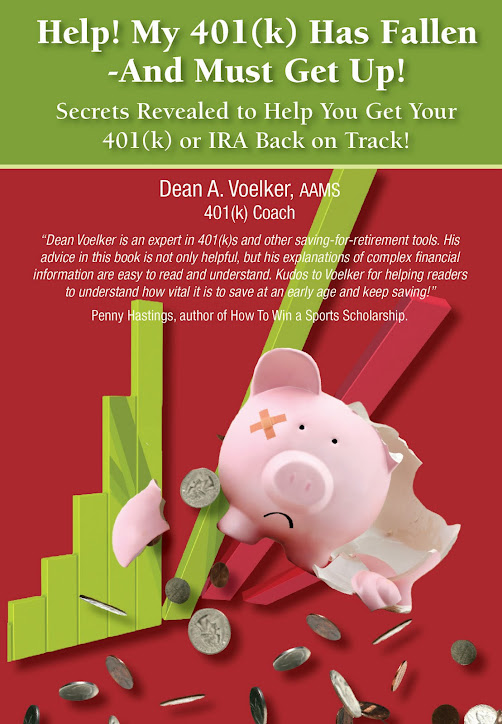
New Book - Coming November 2010

New Book - Coming November 2010
Help! My 401(k) Has Fallen - And Must Get Up!
Showing posts with label CD. Show all posts

Friday, October 8, 2010

The Grand (Money) Illusion - Why Grow?

Recently, I wrote an article here titled, It's Not Much, But It's All I Have . This has been a very common reaction among people when talking (or not talking) about their money. We continue to deal with economic uncertainty, and its human nature to be afraid of losing it. However when we let fear control our thoughts, we also prevent growth. Money closed inside of a fist serves no purpose and can't grow. To grow your funds, you have to open your hand - and your mind.

"Hold on loosely....but don't let go. If you cling too tightly....you're gonna lose control." (.38 Special)

Why do we need to grow our money? One word - INFLATION!

According to the US Bureau of Labor Studies, $400,000 of taxable income in 1953 is equivalent to $2.8 Million in today's dollars.

When you decide to retire, you could easily be retired for 20 years or more. Do you believe that the costs of living for you will go up - or stay the same? Consider this - in 1990, a loaf of bread costs about $1.00. Today, we pay an average of $2.69 for the same loaf. A postage stamp was only .08 in 1990, while today it's .44....and climbing.

If you have been on a fixed income for the last 20 years, you have suffered a 40% loss of purchasing power. Plain and simple - your money must continue to grow over the long term to keep up with rising costs. You just can't keep stuffing it under a mattress, which is paying about the same interest as a CD today.


So what can you do?

Start by putting more money into your 401(k) plan or IRA. Look at your cash flow, and give yourself a pay raise! Pay yourself first - 10% of your income should go into your 401(k) plan. Meet with an advisor to set up an ongoing program for you. Talk with them about which investments are most appropriate for you in your 401(k) or IRA, based on your time horizon, risk tolerance and future income.

“Some people say they want to wait for a clearer view of the future. But when the future is again clear, the present bargains will have vanished. In fact, does anyone think that today’s prices will prevail once full confidence has been restored?” (Dean Witter, May 1932)


Please Contact Me for more information on how to protect your long term savings and USE your money wisely. I can help you create lifetime income from an IRA or Roth IRA. If you live in the South Bend, IN area, I am also happy to help with 401(k) rollovers or IRA reviews. You can follow me on Twitter, Linked In, or Facebook.

You can also listen to my weekly radio show, Improving Your Financial Health on WHME-FM in South Bend, and archives are available for listening on my website. My book, Help My 401(k) Has Fallen – And Must Get Up is helping everyday people to get their 401(k) plan back on its feet and working harder. Contact me about how to get a copy.

Friday, September 3, 2010

It's Not Much But It's All I Have

Probably the most common response I get when people talk about their long term savings or retirement money is this. "It's not much, but it's all I have. I can't afford to lose it."

Well, I certainly understand how you feel. I am investing and saving for my retirement as well. Author Robert Gignac writes that people are "afraid of money" in his book, Rich Is A State Of Mind. Mr. Gignac will be an upcoming guest on Improving Your Financial Health to discuss his book. He goes on to make a very interesting observation. If money was meant to make us happy, we should have better looking people - or at least smiling faces.

With all due respect to George Washington, would something like this encourage you to save a little more?


"It's not much, but it's all I have. I can't afford to lose it."

If that is true, then wouldn't it make sense to PROTECT it? To truly PROTECT your money, you also need to protect your purchasing power. Your money must be able to keep up with rising costs. Just how much interest is that Folger's coffee can or cookie jar paying these days? Perhaps you keep it under a mattress so you can 'sleep on it'. (Last time I checked, the First National Bank of "Sealy" was paying CD rates 0.25 % higher than the national average.) However, we all know that your money won't grow under the Sealy, or in the Folger's can.

"It's not much, but it's all I have. I can't afford to lose it."

This type of thinking practically guarantees that you WILL LOSE IT! Author Rhonda Byrne says that we transmit thoughts as if our brain was a powerful radio signal. In her book The Secret, she writes that we always get what we visualize. If you say you don't want to be late for a meeting, guess what almost always happens?

"It's not much, but it's all I have. I can't afford to lose it."

Perhaps you have heard this story before.

The kingdom of heaven is like a man traveling to a far country, who called his own servants and delivered his goods to them. And to one he gave five gold coins, to another two, and to another one, to each according to his own ability; and immediately he went on a journey. 

Then he who had received the five gold coins went and traded with them, and made another five coins. And likewise he who had received two gold coins gained two more also.


But he who had received one went and dug in the ground, and hid the money there.


After a long time the man came home and settled accounts with his servants. He who had received five coins came and brought five other coins, saying, 'Lord, you gave to me five gold coins. Look, I have gained five more.' The man said to him, 'Well done, good and faithful servant; you were faithful over a few things, I will make you ruler over many things.'


He also who had received two talents came and said, 'Lord, you gave to me two gold coins. Look, I have gained two more.' The man said to him, 'Well done, good and faithful servant; you have been faithful over a few things, I will make you ruler over many things.'


Then he who had received the one coin came and said, 'Lord, I was afraid, and went and hid your coin in the ground. Look, there you have what is yours.'


His lord answered and said to him, 'You wicked and lazy servant, you ought to have deposited my money with the bankers, and at my coming I would have received back my own with interest. Take the coin from him, and give it to him who has ten gold coins.


For to everyone who has, more will be given, and he will have abundance; but from him who does not have, even what he has will be taken away.

This is the story from Matthew 25: 14-29. The moral is of course to use what we are given. We strengthen and grow our financial muscles from using them. Not using them makes us weak.

"It's not much, but it's all I have. I can't afford to lose it."


One other thought I am having today on this theme, from 1 Kings.

Elijah the prophet told the woman. “Please bring me some bread to eat.”


The widow stopped, turned around, and looked at him in surprise. The widow answered Elijah, “As the Lord your God lives, I do not have bread, only a handful of flour in a bin, and a little oil in a jar; and see, I am gathering a couple of sticks that I may go in and prepare it for myself and my son, that we may eat it, and then we will die.”


Elijah then said to her, “Do not fear; go and do as you have said, but make me a small loaf from it first, and bring it to me; and afterward make some for yourself and your son. For thus says the Lord God of Israel: ‘The bin of flour shall not be used up, nor shall the jar of oil run dry, until the day the Lord sends rain on the earth.’”

She took the last of her flour and oil and made some bread for Elijah to eat.


Here is what happened; “She and her household ate for many days. The bin of flour was not used up, nor did the jar of oil run dry, according to the word of the Lord which He spoke by Elijah.”

USE it - or LOSE it!

Keep your money HAPPY!

Please Contact Me for more information on how to protect your long term savings and USE your money wisely. I can help you create lifetime income from an IRA or Roth IRA. If you live in the South Bend, IN area, I am also happy to help with 401(k) rollovers or IRA reviews. You can follow me on Twitter, Linked In, or Facebook.

My weekly radio show is Improving Your Financial Health on WHME-FM in South Bend, and archives are available for listening on my website. My book, Help My 401(k) Has Fallen - And Must Get Up is helping everyday people to get their 401(k) plan back on its feet and working harder. Contact me about how to get a copy.





Friday, February 5, 2010

Tax Free Interest In Indiana - Shhh, Your Bank Doesn't Want You To Know

Do you live in "The Middle"? Besides unpredictable weather and being referred to as "Hoosiers", there are actually a few perks to living in Indiana.

Indiana offers some tax benefits to investors that are unique to our state. Municipal Bonds are very popular here. These bonds are a great (and Safe) way to earn more interest on your savings. The interest you earn on a bond from ANY STATE is FREE from Federal Tax, State Tax, and Local Taxes!

Municipal Bonds, or Munis have been used for over 200 years as a way to raise money to build or improve schools, hospitals, libraries, and roads. These days, stadiums have also been funded by having bonds issued. Once the bond is issued, you can loan money to the project and be repaid with interest which is free from Federal taxes. When the bond matures, you get the amount back which you loaned to the project.

If the bond is issued by your home state, your interest may also be free from State and Local taxes.

Again, the benefit for us "Hoosiers" living in Indiana is this. It doesn't matter which state the bond came from. We enjoy interest income on any muni bond which is free from Federal, State, and Local Taxes!  
That may be worth an additional 1.5% - 2% or more on your savings, depending on your tax bracket. 
(Check with your advisor when buying bonds to see if you may be subject to Alternative Minimum Tax, depending on your total income.)

Currently, http://www.bankrate.com/ (as of Feb. 4, 2010), shows us what the highest rates are for a 1 Year CD
(1.7%) and a 5 Year CD (3.55%).  Dave Ramsey refers to these as "Certificates of Depression". You can see why!

Did you also know that CDs are RISKY? Why is that, you ask?
Easy - You LOSE Future Buying Power!

Let's do the math, and see which option may be better for long term savings.

5 Year Municipal (Investment Quality) Bond at 5%

$10,000 x .05 = $500/year. 
$500 x 5 years = $2500 (TAX FREE) 
Most Bonds pay interest twice per year, directly to you the investor, so you will get 2 checks each year for
$250 for 5 years. When the bond is due, you get the $10,000 back. That may also happen if the bond is called early, but that's another lesson.

5 Year CD at 3.55%
Remember that was the BEST rate in the US today on http://www.bankrate.com/.

$10,000 x .0355 = $355/year.
$355 x 5 years = $1775, and you WILL PAY TAXES on this.

Hmmmm......let's see.....I can get $2500 in interest that is tax free OR $1775 in interest that is taxable. I wonder which one I should pick......

Did you ever wonder how banks make money? They use your money and either loan it or invest it.
Now you can see why your bank may not share the muni bond idea with you.

If you would like to learn more about Municipal Bonds, please contact me. 
You may also contact me for more information on 401(k) plans or IRAs at http://www.helpmy401k.us/.
You may also contact me on Linked In at http://www.linkedin.com/in/dvoelker or Twitter at http://www.twitter.com/deanvoelker. I also host a weekly financial advice program, Improving Your Financial Health at http://www.blogtalkradio.com/401kcoach.

Wednesday, February 3, 2010

Taking Stock

I'm not a big individual stock fan. For most people, mutual funds are a much better way to invest. Its easier to be diverisfied and its also easier to add money systematically.

However, I did see something recently which I thought my readers may enjoy. If you were going to invest in stocks, which companies would be good ones to own long-term? At least one sign of a great company is one which is able to consistently increase their dividend payment.

If you aren't sure what a dividend is, think of it this way. When you own stock, you own a tiny piece of that company. Your investment rises and falls with the performance of the company. Over time, you would like to think the company will grow, and your money will grow with it. Companies which have established themselves and become profitable will share part of their profits with you as a part owner. Those profit sharing payments are known as dividends and are usually paid once every 3 months.

Again, the sign of a great company is one which has raised its dividend payment consistently, even in tough times. Raising the dividend for shareholders is like giving them a pay raise. (CDs don't do THAT!!) Those companies would be great to own long term.

What if a company were able to raise its dividend 25 years in a row or more?

Here are the ones which have:
Abbott Labs                     (ABT)
Bemis                               (BMS)
Century Tel                     (CTL)
Chubb                               (CB)
Coca-Cola                        (KO)
Exxon-Mobil                    (XOM)
Johnson & Johnson         (JNJ)
Mc Donalds                     (MCD)
3M                                   (MMM)

Pitney Bowes                  (PBI)
PPG                                 (PPG)
Proctor & Gamble          (PG)
Walmart                          (WMT)    

S&P reports that since 1926, dividends have contributed to about 1/3 of the total return on your investment.

Another thing I like about dividends is that when the stock price goes down, the dividend yield goes up. Its a great time to buy more of great companies. That is what Warren Buffett does!

For example, lets look at Proctor & Gamble. Shares of PG are currently (2/3/10) at $62.90. Dividends are paid at $1.76/share, which is divided into 4 quarterly payments. You will get a dividend return of 2.8% on any shares purchased at that price.

What if you had been fortunate enough to buy in March of 2009, when it was selling for around $44/share? Well, you still would have gotten $1.76 per share, but that works out to about a 4% dividend return. (Better than a CD, and with potential to grow!)

Warren Buffett has become extremely wealthy because he buys great companies and holds them, collecting dividends which increase year after year after year.

Again, I am not encouraging people to buy individual stocks. There are plenty of financial stocks such as Citigroup and Bank of America which also had wonderful histories of increased dividends, until 2008.
Dividends are certainly something to consider though for any investment - including mutual funds and annuities.

You can contact me through my website, http://www.helpmy401k.us/. You can also contact me on LinkedIn at http://www.linkedin.com/in/dvoelker, or Twitter at http://www.twitter.com/deanvoelker. I am currently hosting a weekly financial advice program, "Improving Your Financial Health" on Blog Talk Radio at http://www.blogtalkradio.com/401kcoach.  Let me know how I may help you!


Friday, October 23, 2009

Wipe Out The Fear in South Bend


Feel like you are drowning in today's economy?
Inflation?
Shaky stock market?
Sinking dollar?
Unemployment?
Staggering debt?

Watching the news may seem like an ongoing care wreck - especially if you watch Glenn Beck, who always looks like he will suffer a breakdown right on camera - but as horrifying and overwhelming as the news is, you can't seem to pull yourself away.

We don't suffer from a lack of information - rather TOO MUCH information. Its all so confusing and you can feel like the rag doll being pulled apart from all directions.

How does all of this affect your ability to save for retirement? Is it possible to still have goals and dreams? Can you still retire with dignity?

Dan Rather was once quoted as saying "If all of the difficulties were known at the outset of a long journey, most of us would not start out at all."

Nothing great was ever achieved without hardships along the way. As an advisor, my job is to help you resolve your fears. Let's wipe them out and provide some peace of mind.

This year, when I became an iindependent advisor and opened my own office, I've been learning that most people would rather "not lose anymore" than to win with their long term savings. To quote another great American, Will Rogers - "I'm more concerned with the return OF my money than the return ON my money."

With that in mind, my purpose has been to focus on helping people to find a vehicle that would "not lose" and still let you win. What if I could toss you a "Life Preserver" for your savings? Remember when you first learned to swim? Those kickboards or noodles came in handy, didn't they? You learned eventually that the water is your friend. Once you stopped fighting it, and let it help you, swimming became more fun, right?

Russell Pearlman recently wrote an article titled, "Problems? What Problems?" from the November 2009 issue of "Smart Money" magazine. His article focused on annuities, which have become much more popular with investors as a life preserver for long term savings.
"Don't tell that (regarding annuity cost) to baby boomers looking for retirement security at a time when their 401(k) plans are still hurting; they just keep buying annuities. Through the first six months of the year, total annuity sales were almost $127 billion, only a 3 percent drop from 2008." he writes.

Again, the message I get from my clients and others I meet is "We want SAFETY and Peace of Mind."

Can we get "Guaranteed" growth for our long term savings?
Will it be better than current CD rates?
Can we get "Guaranteed" income when I retire - also better than current CD rates?
Can we make sure the income never goes down?
And lasts for a lifetime - even if we live to 100 or beyond?
And when that lifetime does end, can we leave something for our family and loved ones?

In short - YES! Mr. Pearlman goes on to write "Are annuities for you? Experts say the peace of mind may be worth it."

Another of my favorite articles this year was written by Leslie Scism of the Wall Street Journal. "Long Derided, This Investment Now Looks Wise". "Because of such guarantees, many holders of variable annuities actually saw their accounts increase 6% or more in value last year, when the Standard & Poors 500 stock index dropped nearly 39%." Ms. Scism writes.

Contact me today to learn more about how to get a life preserver (or noodle if you prefer) for your savings. Treat yourself to some Peace of Mind!

You can contact me through my website, http://www.helpmy401k.us and follow me on Twitter at http://www.twitter.com/deanvoelker. I also host a weekly internet radio braodcast, "Improving Your Financial Health" at http://www.blogtalkradio.com/401kcoach.


Friday, October 2, 2009

Digging A Hole


Do People still invest in CDs anymore? (Don’t answer that.) I know that they are the “investment” of choice for a number of folks and for banks. Let’s be honest though – Rates are TERRIBLE!!
As of today, Oct. 2, 2009, according to bankrate.com, the best rate on a 12 month CD in the USA is 2.05 at India Bank. For a 3 Year CD, the best available rate is 2.97 at Flagstar Bank.
When I called banks in the area, I actually had to keep a straight face when Diana told me about their “Special Rate” of 1.5% on a 13 month CD – only for current customers, though. Woo-Hoo!!

CDs do appeal to those who want “safety”, which means the FDIC Guarantee. That means your money is guaranteed by the Federal Deposit Insurance Corporation (i.e. the U.S. Government) OK, I feel MUCH BETTER about THAT!!

About a year ago, as part of the new financial legislation, the FDIC raised its limit on the maximum amount guaranteed from $100,000 to $250,000. I’m not sure exactly how that helps Joe Lunchbucket, but there was quite a bit of fuss made about it last October.

Dave Ramsey has often referred to CDs as “Certificates of Depression” and with good reason. Did you know that for 11 of the past 20 years, CDs actually have a “Real Return” that is Less Than 1%? Once you consider inflation and taxes on the interest, it is really about the same as burying your savings in the backyard.

As a retiree, wouldn’t you like to get a better return on your savings? What if you could have your nestegg generate income for you of at least 5% of the principal – and have that income paid to you for the rest of your life?
Often when I meet with clients, I learn about their situation and their goals and suggest an appropriate solution which will help them with their long term savings. Clients normally can see the value, but may get hung up on time frames with CD money. A common response may be “That sounds great. I’ve got a CD due in a couple of months. Call me back then, and we will get back together. I can’t touch it until then.” (The Early Withdrawal Penalty looms overhead like the ‘Grim Reaper’.)

So, being a good guy (I don’t want to see anyone lose money.) I mark the date on my calendar and follow up with them as they asked me to. Except now the situation has changed. The CD was renewed. OR the due date was different from what they thought. OR the dog needs braces. OR….. Bottom Line - EVERYONE (most of all the client) LOSES.

Soooo, this being October, I called 3 leading banks in South Bend to see just how “scary” the Early Withdrawal Penalty is. At Wells Fargo , I was told that the penalty would be forfeiting 6 months of interest on a 16 month CD and 3 months of interest on a 12 month. First Source Bank had the best rate locally on a CD – 1.5% on a 13 month CD, which also came with a penalty of 6 months of interest for early withdrawal. National City Bank (soon to be PNC) told me that you could lose 1/2 of your interest for the remainder of your term or 3 months of interest, whichever is greater.

OK, lets do the math. Let’s say you have a CD of $10,000. You have about 3 months left on the term. Let’s give you the BEST rate (a whopping 1.5%) and the stiffest penalty for taking it out early (6 months interest). $10,000 x .015 x .5 (6 months is 1/2 of a year) = a loss of $75.

But what do you gain? There are only 2 types of money – liquid cash (you need it NOW) and investment savings (you need it LATER). What if you invested it into something that gave you an average return of 5% or more? $10,000 x .05 = $500 after 1 year. Last time I checked, $500 – $75 = a GAIN of $425. And I want the best for my clients. So let’s leave the “scariness” to the little ghouls and goblins on Halloween.

Remember to invest for the long term!

You can always contact me through my website, http://www.helpmy401k.us/. You can also follow me on Twitter at www.twitter.com/deanvoelker My weekly Internet Radio Program is “Improving Your Financial Health” on Blog Talk Radio at http://www.blogtalkradio.com/401kcoach

Monday, August 3, 2009

Caught In The Web


One of the truly wonderful things about being an Independent Financial Advisor is that it has really allowed me to open myself up and explore new and different ways of connecting with prospective clients.
I'm sure you'd agree that the past couple of years have been difficult for investors, haven't they? Difficult because of disappointing returns on your savings. Even if you don't consider yourself a stock market investor, you are discouraged with interest rates on your CDs and savings accounts.
However a dangerous side effect to all of this has been that many people have scrapped solid investing principles. They have become like ships without a rudder, not knowing where to turn, and fearful of trusting anyone or anything. Times like these are when we really NEED professional advice more than ever, wouldn't you agree? So where do you find good sound professional advice? Whom do you trust?
For someone like myself, I'm learning that traditional marketing methods - cold calling, mailers, and print ads have been less effective than usual in reaching out to others and making connections. Have you noticed that over the years, TV and Radio Programs include MORE ads and LESS programs? http://www.nydailynews.com/archives/entertainment/2005/07/28/2005-07-28_kelley__too_many_ads_on_netw.html
Its like that old Wendy's ad (oops there is another one!) "Where's the Beef?"
We've become jaded and resistant to traditional marketing. Again, my belief is that people need professional advice NOW more than ever. For me, its also very important to connect with clients whom I can truly serve. A great client is one that we have established a bond of trust. They have shared their goals and dreams with me, and they are open-minded to my advice. When they hear my advice, they can easily see that I want to help them reach their goals, and my advice is truly in their best interests.
So how does one find "great clients" without traditional marketing methods that aren't effective?Using social media websites has been one solution. Writing this blog has been fun, and its allowed me to provide professional advice which anyone can use and benefit from.
Linked In (www.linkedin.com/in/dvoelker) is a great site to reinforce my professional side. It is my online resume and helps me to establish my credentials. I'm also very active in my local Chamber of Commerce (www.sjchamber.org). This provides some great networking opportunities.
Twitter (www.twitter.com/DeanVoelker) allows us to say anything to the whole world (in 140 characters or less). This is a good way to post notices for my blog or other articles of interest.
Facebook (www.facebook.com/dean.voelker) is an absolute blast, which has allowed me to show a more personal side, as well as professsional. And of course, all of these sites allow you to access my own website (www.helpmy401k.us), which serves as another excellent resource for retirement savings.
Most recently, at the suggestion of my friend, Brian, whom I've know since high school, I've also begun a weekly internet radio broadcast (www.blogtalkradio.com/401kcoach). Brian has extensive radio experience and has been very helpful in helping me get started. This show has been a lot of work, but also fun to do, and certainly helps to set me apart from other advisors.
I've always been a believer in giving. What goes around comes around. My faith in God tells me that we will get throught this challenging time, and be stronger for it. Someone recently told me that God is never in a recession. Have Faith!
Please contact me at www.helpmy401k.us if I may be of service to you in any way.

Tuesday, June 30, 2009

Lets Say I Live To 100

People are living much longer these days. With modern medicine, technology, and taking better care of ourselves, reaching 100 is much more common than it used to be. According to a Wall Street Journal article from April 14, 2008, Hallmark sold over 85,000 “Happy 100th Birthday”
cards in 2007. And that is just Hallmark. Currently the average life expectancy for a Female is 87 years, and 85 years for a Male.

Living that long is great, but it can also raise concerns about your savings. What are you doing to make sure your money lasts that long also? Can your savings generate income for the rest of your life, even if you live to 100 or beyond?

Also, how prepared are you to keep up with rising costs? Did you know that 20 years ago (1989), the cost of a postage stamp was 0.25 and a gallon of gas was about 0.97? Compare those prices with today. A stamp is 0.44 and a gallon of gas…..well it fluctuates more than the stock market. As of today, it is about 2.45, and last summer had peaked well over 4.00.

If you are retired for 20 years or more, costs will go up. How can your savings handle that? Can you give yourself “Pay Raises” and still make it last?

One last question for consideration - this past year was one of the most challenging ever for investors. How can you grow your income, make your money last, and do it “Safely”?

Here are some tips that may help answer these burning questions.

* Talk with your advisor. And if you don’t have a strong relationship with your advisor, or
you don’t feel they have your best interests in mind, find a new one. Your advisor needs to be a
great listener, and your partner - NOT just a stockbroker. Tell them what your needs are.
What is most important to you about your money?

* Be Open Minded. If your money is going to last for your lifetime, CDs aren’t going to get it
done. Especially at the current bank rates today. There are other ways you can invest, and
let your money grow over time safely. A good advisor should learn as much about you as
they are able - just like a doctor who will learn your history before prescribing anything.

“Whatever you fear most has no power - it is your fear that has the power.”
Oprah Winfrey

* Be Diversified. I’ve always thought of “diversification” like clothes in your closet.
You need to have clothing for summer, winter, fall, casual wear, dressing up,
working in the yard…..ALL occasions and ALL types of weather. Investing needs to be
the same. Would you like less risk? The best way to do that is by diversifying.

“Money, you should pardon the expression, is a little bit like manure. It doesn’t
do any good unless it’s spread around, encouraging young things to grow.”
Barbra Streisand

For more information on how to make your money last to 100 or beyond, please contact me at
www.helpmy401k.us. You may also follow me on Twitter at www.twitter.com/deanvoelker.

Tuesday, June 16, 2009

Using Protection?

That should have gotten your attention!

In my last post, I discussed some basics of annuities. Annuities can offer some protection for your savings which other investments, such as stocks or mutual funds do not. Keep in mind that the value of your account may still go down.

Lets talk about a few protections which you may get from an annuity.

GUARANTEED DEATH BENEFIT - The first one, common to most annuities, is the Guranteed Death Benefit. What is means is that if you invested a sum of money into an annuity, your beneficiaries will receive at least that amount (minus any income or withdrawals taken).

For example, lets say that John puts $100,000 into a variable annuity. The market goes south, and the value of the annuity dips to $80,000, when John dies. If he has not taken income, his heirs will get the full $100,000. Now lets say that the market goes up, and the account grows to $120,000. When John dies, his heirs get $120,000. In this case, it would not matter if he has taken income - if the account value has grown from his original investment, his heirs get the account value.

GUARANTEED GROWTH - There are a lot of different insurance brokers who provide annuities, and not all of them offer this. Whichever provider you use, I would certainly recommend using a large, stable, reputable (Name Brand) company. The protection is only as good as the insurance company backing it.

I have become familiar with Jackson National Life, one of the largest annuity providers in the US. They have an AA rating in Financial Strength from Fitch & Standard & Poors, which is Very Strong. What that means to a client is that they should feel secure with the protections they are getting on their money. (Source: Jackson Life http://www.jackson.com/)

Jackson offers a Fixed Account Option on its annuities. The Fixed Option offers a 1 Year Interest Rate, which is reset each year, but is never less than 3% (Special Benefit Value). 3% actually looks pretty good right now, doesn't it?

Lets say that John starts out at age 55 by investing his $100,000 in a Fixed Index Annuity. Assuming that the annuity value has grown by 3% per year, by age 65 (10 years) it will be worth $134,392 minimum. (Source: Jackson Ascender Plus Select Brochure, http://www.jackson.com/).

A Variable Annuity should provide more growth over time, however its performance is related to the stock market. The Standard & Poors Index, also referred to as the S & P 500 represents the largest 500 companies in the USA. It has been the measuring stick for comparing investment performance.

If John had been investing his $100,000 in a Variable Annuity using the S & P Index, Jackson lets you have a "win-win". If the market goes up, the account will also go up. If the market goes down, the account value stays the same. This would have been particularly valuable in 2008 when the S & P declined by 42.9%. The value in John's account would have been the same. Had John kept his money invested over the last 10 years, he would have $145,825 today. (Source: Jackson Ascender Plus Select Brochure, http://www.jackson.com/)

I will look at Guaranteed Income Options in another segment. I will also look at additional charges for these features (where they apply). Please keep in mind that an annuity is not for everyone. You should consult with your advisor to determine if an annuity is right for you.

For more information, you may contact me at http://www.helpmy401k.us/. You may also follow me on Twitter at http://twitter.com/DeanVoelker .

Wednesday, April 22, 2009

How Should I Invest?

Everyone has beeen asking lately - "How should I be investing my money?" or "What's Good Right Now"?

The answers to those questions should provoke several other questions from your advisor.
I could say "Depends", which doesn't mean to invest in adult diapers, but you should give your advisor more information.

How you should invest your money really does depend on you.

* What are your goals?

Is it to be 'debt free'? Is it to own a 60 foot yacht? Golf everyday? Spend time with grandkids?
What does having money mean to YOU? Once you figure that out and communicate that with an advisor, he or she can help to give you the right place to put your money.

* What are your financial circumstances?

Someone with $100,000 in savings and no debt is in a different place in their life than someone who has $500 to "play with", but no other savings. As an advisor, I do not want to "gamble" with anyone's money. I look to provide appropriate long term solutions to help you reach your goals.
My job is to give you the "Map" you need to get from where you are now, to where you want to be - and make sure you are happily involved every step of the way.

* What is your tolerance for Risk?

OK I said it - the "R" word. To which you may say "I don't want any risk."
It's important to understand that ALL investments have risk. Even your savings account which
is FDIC insured has risk.

"How is that?" you ask.
Savings & CDs have "inflation risk", which means they are not good long term vehicles to keep up with the rising cost of living - inflation.

The best way to minimize risk is to use a mix of different investments that have different purposes - like different clothes in your closet - or "Diversification". There are also questions which your advisor may ask you to help you understand what risk means.

It all boils down to one question - Money means different things to different people.
What is important about money to you?

For more information, or to contact me directly, please visit www.deanvoelker.com


Friday, April 17, 2009

How Diversified Are You?

Diversification - Now there's a word you hear a LOT in the investing world. For those of you who may not have a Series 7 license - WHAT DOES IT MEAN in layman's terms? WHY is "diversification" important to me & my money?

Good question - Here's what diversification is NOT -
* Having Money at different banks.
* Dealing with different financial advisors.
* Owning CDs due at different times.

The simplest way I know of to define "Diversification" that most of us can relate to is this.

Think of your closet at home, where you keep your clothes. We all may prefer a different style or taste in clothing, but clothing generally falls into these main groups.

* Winter or cold weather wear
* Summer wear
* Spring wear
* Dress up or formal wear
* Casual wear
* Sleepwear
* Working clothes (Painting or yard work)
* Shoes
* Rain gear

In other words, different clothing for different occasions. No matter what's happening in your life or with the weather, you have clothes to wear that fit the situation. And we need to have the right amounts.

If you don't like the weather in Indiana, don't worry. It will change soon. It would be silly to own all t-shirts & shorts. Wouldn't it also be silly to live in Arizona, and own too much winter wear?

The same is true for investing. You need a full "closet" of clothing so that you are ready for whatever the economy is doing. That's how you minimize all the types of risk.

Talk with your advisor today to make sure your "closet" is full of the right financial "clothes".
(Is it time to get rid of the Nehru Jacket & Leisure Suit yet?)

For more information, you can contact me at http://www.deanvoelker.com/

Wednesday, April 15, 2009

What Else Do You Know About Munis?

Over the past few days, I have been promoting the value of municipal bonds. Right now, they offer a better bargain for your long term savings than CDs.

One of the things I dislike about CDs is that they are really just a holding place for your money.
Money falls into 2 main categories -
*Liquid Money - Money that can be used now or held in an emergency fund (about $10,000
or 3 -6 months of expenses).
*Invested Money - Money that is invested that you don't have an immediate need for.

Looking at those two groups, CDs are kind of a "tweener" - your money seems tied up, so you
can't get to it. Also, the rates are so low currently that it really isn't invested either. Talk about being caught between a "rock" and a "hard place"!

CD yields are so poor, that you may even consider the idea of early withdrawal to take advantage of better (and tax FREE) yields with munis. The penalty usually is forfeiting some interest (WHAT interest??), as much as 6 months.

If you had $10000 in a CD, paying 2% ($200/year, taxable), you would lose $100 to the bank. If you re-invested it in a 5% muni bond, you would earn $500 on the same amount, and not pay federal taxes (perhaps even no state or local taxes) on the interest.

You do the math.

Here are a couple of other articles which support the idea of using muni bonds.

MARKET WATCH - "Muni Yields Aren't Puny"
http://www.marketwatch.com/news/story/bargains-abound-tax-free-muni-bonds/story.aspx?guid=%7B2A55A5F2-2F94-4181-A51A-7FFA12E1A9D2%7D

KIPLINGERS - "Steals In Tax-Free Bonds"
http://www.kiplinger.com/magazine/archives/2008/05/kinnel.html

Warren Buffett likes munis too, and you could do a lot worse than listening to Mr. Buffett!

For more information on municipal bonds, or any other savings ideas, please contact me at
www.deanvoelker.com .

Tuesday, April 14, 2009

Single Bonds or Mutual Funds?

What's the best way to buy municipal bonds? Should I buy single bonds or mutual funds?

Like most decisions, there are pros & cons with both methods. You should talk with you advisor about which method is right for you - possibly a mix of both.

One of the advantages of owning a single bond is that you have a fixed rate of return - you know exactly what you are getting. For example, on a $100,000 muni bond paying a 5% coupon, you will get $5000 per year in interest income. Because you don't have to pay federal taxes and you may not need to pay state taxes, that may be similar to getting 7% or more, depending on your tax bracket.

Interest from a single bond is usually paid ever; 6 months, so you would get $2500 with each installment. You may also ask your advisor to structure your bonds in such a way that you are able to receive income every month.

Another advantage it that while your advisor does get paid, his or her commission is built into the price of the bond when you buy it. This is a common question I am asked.

Think of buying soup at your local grocery store. The grocer buys soup in large bulk quantities, with all brand names & flavors. Because they buy so much soup at once, they can buy at a wholesale price. When a customer buys soup, they pay a retail price and may only buy 1 can, or a few cans at a time.

Bonds work the same way. If you buy a bond worth $10000, you will get $10000 when it comes due. Along the way, you have gotten a great tax free rate of return every 6 months. If you are fortunate enough to be working with a great advisor, you may have even been able to buy the bond at a discount, so that when it does come due, you even had a small gain. (Woo-Hoo!)
Its great when everyone wins!

One more thing about a single bond - You know exactly which project you are supporting.
(Example - St. Joseph Regional Medical Center Bond)

A big disadvantage is that a single bond is not diversified. This is where mutual funds are better. Going back to the "soup" example, a mutual fund allows you to carry all the "flavors" in one investment, which is managed by professionals at a mutual fund family.

Most bond mutual funds also pay interest monthly, because they own hundreds of bonds. This can be helpful if you are counting on monthly income from your investments, and a huge advantage over CDs.

Also, it is much easier to invest a smaller amount. For those who don't have the 5000 or 10000 minimums required by many single bonds, you can establish a mutual fund for as little as 1000.
Once you have a fund, you can add to it or even withdraw money easily.

Sales charges on bond funds purchased through your advisor may be as high as 4.25%, although you may qualify for volume discounts, also known as "breakpoints" if you are able to invest large amounts of money.

For more information on municipal bonds or other investing, please contact me at www.deanvoelker.com

Monday, April 13, 2009

Tax-Free Bonds - - Are They Safe?

On Friday, we talked about how a municipal bond can pay higher interest then a CD, and its even better when you consider you don't pay Federal taxes on the interest you earn. You may also be free from State & Local taxes depending on where you live, and where the bond(s) was issued.

A common question which I am asked is - "How safe are they?"

Muni bonds are very safe investments. They are backed by the taxing power of the state which issued the bond. Bonds are given ratings based on the credit quality of the issuer.

AAA - Very High Credit Quality
AA - High Quality
A - Good Quality
BBB - Investment Grade (still a safe investment)

For obvious reasons, I would not advise buying bonds with less than a BBB rating. For my clients, I generally prefer at least an A rating or above.

When we say 'safe', it means that you should have a reasonable expectation of receiving your interest payments on time and also receiving your principal investment repaid on time. Think of your car. When you go to start your car, you would have a reasonable expectation that it would start when you turn the key.

On the very slim chance it didn't, of course you would take steps (i.e. jump start, battery change) if needed to get it started, and return to having a 'reasonable expectation' for it to start when you need it. Bonds work much the same way, even if you are worried about the ability of a certain state to repay its loan, the state may simply levy a tax to pay back the bond.

You can also buy muni bonds which are insured for that extra layer of safety. Common insurers are MBIA (Municipal Bond Insurance Association) www.mbia.com, AMBAC (American Municipal Bond Assurance Corporation) www.ambac.com, and FSA (Financial Security Assurance) www.fsa.com .

Tomorrow, we can talk about the 2 main ways to buy muni bonds - individual bonds or mutual funds.

For more information on muni bonds, you may contact me at www.deanvoelker.com .

Friday, April 10, 2009

How To Get Higher Interest and Lower Taxes

Want to get more return on your savings?
What if you didn’t have to pay taxes on the interest you earned?
And you could still sleep at night, knowing that your savings are…..safe?

Sound too good to be true? Well, municipal bonds do all of that. Munis have long provided funding for projects such as libraries, hospitals, schools, airports, and roads. They are a fantastic bargain right now, paying you a much better return on your savings than CDs.

According to www.bankrate.com as of April 9, 2009, the highest CD rate I found was 3.6% for 5 years, and 2.6 for 1 year. Dave Ramsey, Financial Talk-Radio host, likes to refer to CDs as “Certificates of Depression”, and its easy to see why.

You can easily find investment grade (safe, not junk) Municipal Bonds through a good advisor, paying 5% or better, for a period of 5 years or less. When you consider that you don’t have to pay Federal income taxes on the interest, 5% is an excellent return!

If you live in Indiana, where I’m located, you are also exempt from state and local taxes. That can be similar to earning at least 7% on your savings if you paid taxes on the interest.

So why do people still buy CDs? I guess its like the story about the railroad track width measurement. The width is 4 ft 8 1/2 inches. Why? That’s what it was in England. Why? That was the measurement the tramways used before railroads. Why? Tramways were built using the same width as wagons and that was the spacing between wagon wheels. Why? The wagons had to fit the ruts in the road made by Roman Chariots. Chariots were built to accommodate the width of 2 horses. In other words, "We've always done it that way."

If you still believe CDs are better for your savings, ask yourself this -
When you buy a CD, what does your bank do with the money?