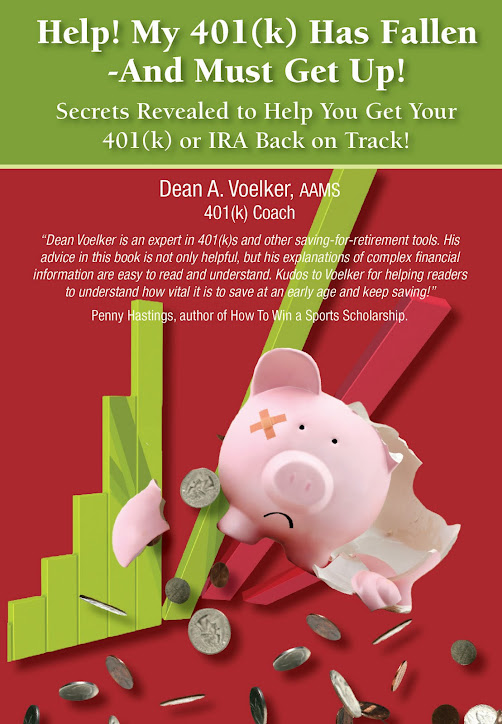
New Book - Coming November 2010

New Book - Coming November 2010
Help! My 401(k) Has Fallen - And Must Get Up!
Showing posts with label tax free. Show all posts

Wednesday, August 25, 2010

Could You Use An Extra $1000/Month - Legally?


OK, that's a silly question. OF COURSE you could use an extra $1000/month. Who couldn't?

For someone in retirement, an extra $1000 would certainly help to make ends meet. According to a recent survey done by the Employee Benefit Retirement Institute (EBRI), only 3 in 5 retirees (60%) feel "very" or "somewhat" confident that they would have a comfortable retirement. This is sharply down from just 3 years ago, when in 2007, 79% felt confident in their retirement.

Did you also know that according to the Social Security Administration that the Maximum Social Security retirement benefit the could be earned by an individual reaching full retirement age in 2010 (age 66) is only $2346/month? Think of how many people receive less than this, and depend on Social Security for the majority of their income in retirement.

What would you do with an extra $1000/month?

Would you do more travelling? Eat out a few more times? Spoil the grandkids? Play more golf? Would an extra $1000/month in income give you a little more peace of mind?

What if I told you that YOU CAN have an extra $1000/month TAX-FREE?

No, you don't have to rob a bank or do anything illegal. This is perfectly legitimate.
No silly multilevel marketing schemes either, where you try to sell junk to your friends and family.
You don't need to be able to dunk a basketball, or pound 300 yard drives that split the fairway.

All you need to do is......

Start putting money into a Roth IRA and make regular contributions. That's it! See - simple, legal, and you get to keep your friends.

Here is how it works. Let's use a 45 year old, starting from scratch. Currently, as of 2010, the most which you can put into a Roth IRA is $5000 per year. At age 50 and older, the maximum contribution is $6000.
Let's say that our 45 year old puts in $5000 per year, and at age 50 starts putting in $6000. Let's also say that we get a return of 6% per year on our money. (Contact me for information on how to get 6%.) For someone who is 45 years old now in 2010, their full retirement age to begin collecting Social Security benefits would be 67.

Age    Roth IRA Contribution   Ending Balance (6% Return)
45       $5,000                              $    5,161
46       $5,000                              $  10,632
47       $5,000                              $  16,431
48       $5,000                              $  22,578
49       $5,000                              $  29,094
50       $6,000                              $  37,033
51       $6,000                              $  45,448
52       $6,000                              $  54,368
53       $6,000                              $  63,824
54       $6,000                              $  73,846
55       $6,000                              $  84,470
56       $6,000                              $  95,732
57       $6,000                              $107,669
58       $6,000                              $120,322
59       $6,000                              $133,735
60       $6,000                              $147,952
61       $6,000                              $163,023
62       $6,000                              $178,997
63       $6,000                              $195,931
64       $6,000                              $213,880
65       $6,000                              $232,906
66       $6,000                              $253,073 
          $147,000                          $253,073

Benjamin Franklin once remarked that Compound Interest was the 8th wonder of the world. Saving a nest egg of over $250,000 in 22 years is a great accomplishment.

If you are younger than 45, the message is start NOW. You can do even better.
If you are older than 45, the message is still start NOW!

So how do we get our $1000/month from this?
To get an income of $1000/month, just take 5% per year from this figure $253,073.

$253,073 x .05 = $12,653.65 This is our annual TAX-FREE income from our Roth IRA.
$12,653.65 Divided by 12 months = $1,054.47/Month.   

Please Contact Me for more information on how to make this work for you, and create lifetime income from an IRA or Roth IRA. If you live in the South Bend, IN area, I am also happy to help with 401(k) rollovers or IRA reviews. You can follow me on Twitter, Linked In, or Facebook.


My weekly radio show is Improving Your Financial Health on WHME-FM in South Bend, and archives are available for listening on my website.




Friday, May 14, 2010

Get The Word OUT!

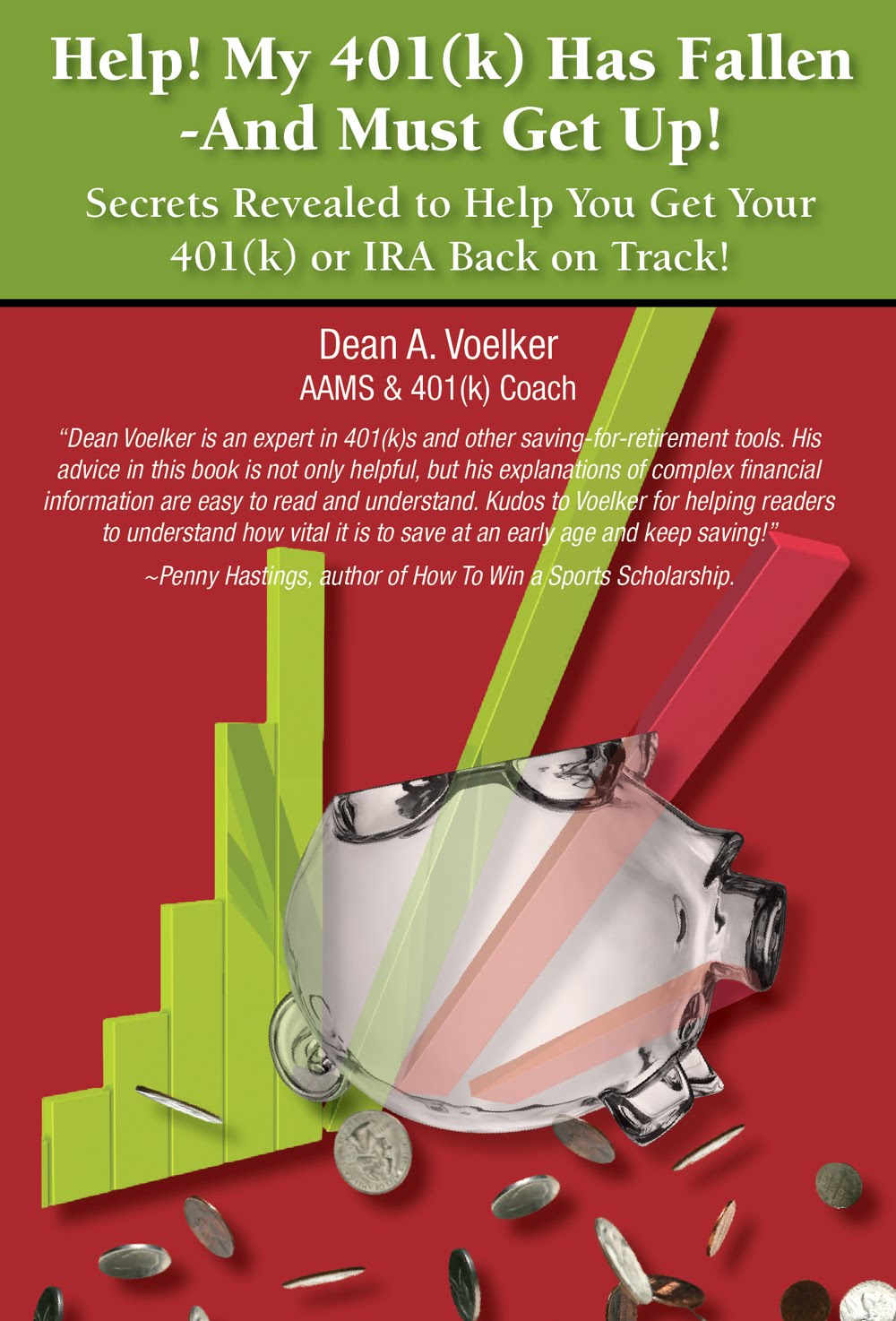
I've been getting a lot of questions about the book, "Help! My 401(k) Has Fallen - And Must Get Up!" The book will be available shortly (end of May) for ordering from Amazon. Since this book was written to help EVERYONE with a 401(k) or 403(b), my biggest concern now is -

How do I make sure that EVERYONE knows about it?

Having a radio program is a real bonus. In fact, on May 29, I am doing a special edition of "Improving Your Financial Health". With so many questions about this unique book, I thought the best way to answer them would be on the air. Be sure to listen to the program Sat. May 29 at 9:00 am on Harvest 103.1 WHME-FM. If you don't live in the South Bend area, or aren't able to listen at that time, no worries. You can still catch the archived recording on my website, www.helpmy401k.us . All previously recorded programs are kept there.

My book website, http://www.my401khasfallen.com/ will also include FAQs and resources which were helpful in writing the book. The new video will be there also, and can currently be seen on You Tube. I will write some more about this, and I've gotten a lot of positive feedback so far on the video.

Most people are thrilled that I didn't strip nude, a la Erykah Badu. (You DON'T want to see this body in the buff!) Although I can't say the same for the pig, who is the main character in the video.

Sooooo, if you want to see a naked piggy bank reading a book, you will like this! (Don't worry the nudity is tastefully done in an 'artsy' way.)

Anything that you can do to help get the word out about the book
"Help! My 401(k) Has Fallen - And Must Get Up!" would be greatly appreciated.

For rolling over a 401(k), or the best rates on tax-free bonds, you can contact me through my website http://www.helpmy401k.us/. You can also follow me on Twitter @deanvoelker or Linked In
"Improving Your Financial Health" is a weekly financial advice radio program, which also showcases interesting guests. This program airs Saturday mornings at 9:00 am on WHME-FM in South Bend, IN and on my website.

Friday, February 5, 2010

Tax Free Interest In Indiana - Shhh, Your Bank Doesn't Want You To Know

Do you live in "The Middle"? Besides unpredictable weather and being referred to as "Hoosiers", there are actually a few perks to living in Indiana.

Indiana offers some tax benefits to investors that are unique to our state. Municipal Bonds are very popular here. These bonds are a great (and Safe) way to earn more interest on your savings. The interest you earn on a bond from ANY STATE is FREE from Federal Tax, State Tax, and Local Taxes!

Municipal Bonds, or Munis have been used for over 200 years as a way to raise money to build or improve schools, hospitals, libraries, and roads. These days, stadiums have also been funded by having bonds issued. Once the bond is issued, you can loan money to the project and be repaid with interest which is free from Federal taxes. When the bond matures, you get the amount back which you loaned to the project.

If the bond is issued by your home state, your interest may also be free from State and Local taxes.

Again, the benefit for us "Hoosiers" living in Indiana is this. It doesn't matter which state the bond came from. We enjoy interest income on any muni bond which is free from Federal, State, and Local Taxes!  
That may be worth an additional 1.5% - 2% or more on your savings, depending on your tax bracket. 
(Check with your advisor when buying bonds to see if you may be subject to Alternative Minimum Tax, depending on your total income.)

Currently, http://www.bankrate.com/ (as of Feb. 4, 2010), shows us what the highest rates are for a 1 Year CD
(1.7%) and a 5 Year CD (3.55%).  Dave Ramsey refers to these as "Certificates of Depression". You can see why!

Did you also know that CDs are RISKY? Why is that, you ask?
Easy - You LOSE Future Buying Power!

Let's do the math, and see which option may be better for long term savings.

5 Year Municipal (Investment Quality) Bond at 5%

$10,000 x .05 = $500/year. 
$500 x 5 years = $2500 (TAX FREE) 
Most Bonds pay interest twice per year, directly to you the investor, so you will get 2 checks each year for
$250 for 5 years. When the bond is due, you get the $10,000 back. That may also happen if the bond is called early, but that's another lesson.

5 Year CD at 3.55%
Remember that was the BEST rate in the US today on http://www.bankrate.com/.

$10,000 x .0355 = $355/year.
$355 x 5 years = $1775, and you WILL PAY TAXES on this.

Hmmmm......let's see.....I can get $2500 in interest that is tax free OR $1775 in interest that is taxable. I wonder which one I should pick......

Did you ever wonder how banks make money? They use your money and either loan it or invest it.
Now you can see why your bank may not share the muni bond idea with you.

If you would like to learn more about Municipal Bonds, please contact me
You may also contact me for more information on 401(k) plans or IRAs at http://www.helpmy401k.us/.
You may also contact me on Linked In at http://www.linkedin.com/in/dvoelker or Twitter at http://www.twitter.com/deanvoelker. I also host a weekly financial advice program, Improving Your Financial Health at http://www.blogtalkradio.com/401kcoach.

Friday, January 8, 2010

Tired of Taxes?


Are you tired of taxes? Tired of hearing about them? Tired of giving your hard-earned dollars to Uncle Sam? Tired of politicians who say they will lower your taxes - then do the opposite?
How would you like a stream of income later in life that you WON'T pay taxes on at all?
That's what the Roth IRA is all about!
The Roth IRA was created as a future Tax Reduction Account in 1997. It's a great way to save for your future retirement. The name "Roth" is in honor of the bill's main creator - late Sen. William Roth of Delaware.
The beauty of the Roth is that there are NO TAXES on either the growth, or withdrawals you take after age 59 1/2. So your income will be TAX FREE!
You can contribute to a Roth IRA for either 2009 or 2010 right now - up to $5000/year. If you are 50 or older, you can put in an extra $1000.
Here are 2 new things in 2010 about the Roth IRA you should know.
* There are no income restrictions for making Roth IRA contributions this year. This allows
more people than ever before to use a Roth.
* You can convert your traditional pre-tax IRA to a Roth by simply paying taxes on the amount
you convert. That isn't new, but what IS new is that you can SPLIT the tax burden over
2 Years - 2011 & 2012.
If you really want less taxes later, set up your Roth IRA (Tax Reduction Account) today. You have until April 15 to contribute for 2009.
You can contact me in South Bend, IN through my website at www.helpmy401k.us. You can also follow my on Twitter at www.twitter.com/deanvoelker. I also host a weekly internet radio program, "Improving Your Financial Health" on Blog Talk Radio www.blogtalkradio.com/401kcoach.


Monday, January 4, 2010

New Years Resolutions

"Now is the accepted time to make your regular annual good resolutions. Next week you can begin paving hell with them as usual." Mark Twain

Here we are - a New Year. Some also say a New Decade.

What 'Financial' Resolutions have you made? Can't think of any? Here are a few tips.

1. Review and Rebalance your Investments and 401(k)
If you have been putting it off for a while to "wait & see", your account is probably seriously out of balance. Sit down with an advisor to review your goals and make your your fund mix matches what your needs are.

2. Increase Contributions to Your 401(k)
Are you putting between 10% and 15% into your 401(k) at work? If not, then at least raise the amount you are putting in. Gradually work yourself up to that level. You will need the nest egg for income later.

3. Pay Off Credit Cards and Other Debt
If you are having trouble with #2, get these paid off and free up some money for yourself.

4. Set Up a Budget and Stick To It
There are a number of places you can find good basic worksheets for setting up a budget. It should be simple. Just make sure all of your money has a place to go - either savings or expenses. Here is a site with some downloadable sheets. http://www.betterbudgeting.com/

5. Contribute to a Roth IRA and Convert Pre-Tax Retirement Savings
You can put up to $5000 into a Roth ($6000 if you are 50 and older). You can still make 2009 contributions up until April 15. The Roth IRA of course grows tax free and allows you to make withdrawals at retirement which are also tax free.

There are no income restrictions for the Roth this year and if you choose to convert any money from your Traditional Pre-Tax IRA to the Roth, you may spread the taxes out over the next 2 years.

You can contact me through my website, http://www.helpmy401k.us/. You may also follow me on Twitter at http://www.twitter.com/deanvoelker. I also host a weekly internet radio program at http://www.blogtalkradio.com/401kcoach.

Wednesday, October 14, 2009

Cut The Fat in your 401(k)

Last week, we asked “Where’s the Beef?” Today, we ask “Where’s the Fat?”
Its very important to trim the ‘fat’ in your 401(k) plan – or fund expenses. Today on my Blog Talk Radio program, I had a listener ask about fund expenses. These can really affect your long term return on your retirement savings.

Expenses come from managing the mutual fund. The fund family charges a percentage of the assets invested to manage the fund – deciding what to buy, what to sell, and how much to buy or sell and when to do it. Less trading = lower expenses. Also the advisor on the plan may be paid from these expenses.

Knowing this, it would make sense to look for funds in your plan which have a lower expense rate. If its about 1%, that isn’t too bad, much more than that can negatively affect your returns over time.

To give you an example, I did some figuring on my financial calculator . Let’s look at a 22 year old college graduate, starting their 401(k) plan. Of course you would expect them to bump up their contributions over time, but lets say they put in $300/month with an 8% average return until age 66. They would have saved $1,340,048 in 44 years.

What if they were using a fund with expenses that were 1% more? In other words, the fund may have averaged 8%, but the real return was 7% due to higher expenses. With all the other factors being the same, we now have a total savings of $993,985, which is a difference of $346,063. OUCH! If you figure on taking 4%/year of the nest egg at retirement for income, that means we would need to live on less income -$13842 per year less. See where 1% can make a big difference?

So look carefully at your statement. Don’t just look at ‘performance’ but also fund expenses, which do affect long term performance. Have an advisor help you with this and also help you determine how much to save, so you can have the type of retirement you want.

You may contact me through my website at http://www.helpmy401k.us. You can also follow me on Twitter at http://www.twitter.com/deanvoelker. I also host a Weekly Internet Radio Broadcast “Improving Your Financial Health on Blog Talk Radio http://www.blogtalkradio.com/401kcoach

Wednesday, September 2, 2009

Raising Arizona (and Arizona State and Others) - SOLUTIONS

In my first part on this, we looked at the problem of rising college costs. I believe we are at a point where students must “do their homework” before taking out a college loan. You want to be sure that you will get a good return on your investment and be able to pay it back easily. Ideally, you’d like to NOT take a loan at all. College is now a “business” decision, not a right.

I wouldn’t be a good advisor to bring up a problem without mentioning some viable solutions. There are enough good ideas, that I will talk about a few now and a few more in my next piece. None of these are magic – but if you apply these common sense ideas you’ll be better off than doing nothing. So here are some ways to Make College More Affordable.

* Saving in a 529 or UTMA plan (regularly)

The key word here is “regularly”. You can set up either of these plans as soon as your baby is born. (And I highly recommend that!) Did you know that if you were to save $100/month for 18 years (216 months) at an average return of 8%, you’d have saved $46,865? And $200/month over the same period = $93,730.

The 2 plans are different, but the idea is the same. The 529 http://en.wikipedia.org/wiki/529_planallows for tax-free withdrawals for college related expenses. Here in Indiana, since 2007, you can also get a 20% tax credit on any contributions to a 529 plan. Put in $5000 and you get $1000 back in the spring. Also, money can be transferred between family members. If it isn’t used for college, you are simply taxed on the growth at withdrawal.

UTMA (U -T – M – A ….you ain’t got no alibi, its UTMA!) OK, so I should give up on ‘cheerleading’ – but I couldn’t resist. This is the Uniform Transfer to Minors Act. A parent or guardian acts as a “custodian” for an account in the child’s name. http://www.fairmark.com/custacct/regret1.htm until the child reaches age 21. At that time, the money is turned over to the child. This is also counted in the child’s assets when you go to apply for financial aid later.

One advantage that someone may see in the UTMA is that it doesn’t matter if the money is used for college or not – although there are no tax benefits. They have full control over the money.
Personally, I prefer the 529 plan (for the tax benefits) and have set one up for both of my daughters. Whichever plan you choose, (talk to your advisor) the most important thing is to save something regularly.

Another note here – a common question I get is whether families should contribute to retirement or college.If you must choose – retirement savings trump college. ‘Nuff said.

* Part Time Work

Wow, real genius stuff here, Dean! I told you this wouldn’t be ‘magic’. But think about this. I believe students should learn the value of a dollar – and appreciate the value of education. When I was in High School, I cleaned tables and washed dishes for a local family restaurant. Part of my pay went into my ‘college’ account.

Currently minimum wage for “flipping burgers” is $7.25/hour. What if Johnny flipped burgers for 3 years at Mc Donald’s and put $400/month into his college savings? In 3 years, Johnny would have saved $14,400. Between this idea and the last one, we’ve put a good dent into Johnny’s college costs, and haven’t even gotten to financial aid yet.

Not able to save as much as we’ve talked about? Getting started ‘late’ with savings? What about putting off college for a year or 2, to build up savings. There is no law that says YOU MUST enter college immediately after high school. (I checked). In fact, chances are very good that Johnny (or Jill) may be more mature at 20 and get more from their college experience, having spent some time in the ”real world”.

I’d much rather see Johnny (or Jill) wait a bit and not be burdened with debt after they graduate. If they do this, they must focus on the idea that college is still in the plan - flipping burgers is only temporary.

* Go to School, Live at Home

Being in the Chamber, I often attend networking events. Recently I had a chance to visit IUSB (Indiana University at South Bend). I was very impressed with the quality of the facilities and was very surprised to learn that their enrollment exceeds 7500 students. http://www.iusb.edu/about/ (You may have heard there is another school here in South Bend).

People are saving quite a bit by having Johnny and Jill live at home while going to college.Because IUSB is affiliated with Indiana University, many programs are similar. For those not living in this area, I would be willing to wager that you have a similar local university nearby.

In the next article I will continue to explore some other ideas which can help make college more affordable.

You can contact me at www.helpmy401k.us and follow me on Twitter at www.twitter.com/deanvoelker.My weekly Blog Talk Radio program, “Improving Your Financial Health” is at http://www.blogtalkradio.com/401kcoach.

Wednesday, April 15, 2009

What Else Do You Know About Munis?

Over the past few days, I have been promoting the value of municipal bonds. Right now, they offer a better bargain for your long term savings than CDs.

One of the things I dislike about CDs is that they are really just a holding place for your money.
Money falls into 2 main categories -
*Liquid Money - Money that can be used now or held in an emergency fund (about $10,000
or 3 -6 months of expenses).
*Invested Money - Money that is invested that you don't have an immediate need for.

Looking at those two groups, CDs are kind of a "tweener" - your money seems tied up, so you
can't get to it. Also, the rates are so low currently that it really isn't invested either. Talk about being caught between a "rock" and a "hard place"!

CD yields are so poor, that you may even consider the idea of early withdrawal to take advantage of better (and tax FREE) yields with munis. The penalty usually is forfeiting some interest (WHAT interest??), as much as 6 months.

If you had $10000 in a CD, paying 2% ($200/year, taxable), you would lose $100 to the bank. If you re-invested it in a 5% muni bond, you would earn $500 on the same amount, and not pay federal taxes (perhaps even no state or local taxes) on the interest.

You do the math.

Here are a couple of other articles which support the idea of using muni bonds.

MARKET WATCH - "Muni Yields Aren't Puny"
http://www.marketwatch.com/news/story/bargains-abound-tax-free-muni-bonds/story.aspx?guid=%7B2A55A5F2-2F94-4181-A51A-7FFA12E1A9D2%7D

KIPLINGERS - "Steals In Tax-Free Bonds"
http://www.kiplinger.com/magazine/archives/2008/05/kinnel.html

Warren Buffett likes munis too, and you could do a lot worse than listening to Mr. Buffett!

For more information on municipal bonds, or any other savings ideas, please contact me at
www.deanvoelker.com .

Monday, April 13, 2009

Tax-Free Bonds - - Are They Safe?

On Friday, we talked about how a municipal bond can pay higher interest then a CD, and its even better when you consider you don't pay Federal taxes on the interest you earn. You may also be free from State & Local taxes depending on where you live, and where the bond(s) was issued.

A common question which I am asked is - "How safe are they?"

Muni bonds are very safe investments. They are backed by the taxing power of the state which issued the bond. Bonds are given ratings based on the credit quality of the issuer.

AAA - Very High Credit Quality
AA - High Quality
A - Good Quality
BBB - Investment Grade (still a safe investment)

For obvious reasons, I would not advise buying bonds with less than a BBB rating. For my clients, I generally prefer at least an A rating or above.

When we say 'safe', it means that you should have a reasonable expectation of receiving your interest payments on time and also receiving your principal investment repaid on time. Think of your car. When you go to start your car, you would have a reasonable expectation that it would start when you turn the key.

On the very slim chance it didn't, of course you would take steps (i.e. jump start, battery change) if needed to get it started, and return to having a 'reasonable expectation' for it to start when you need it. Bonds work much the same way, even if you are worried about the ability of a certain state to repay its loan, the state may simply levy a tax to pay back the bond.

You can also buy muni bonds which are insured for that extra layer of safety. Common insurers are MBIA (Municipal Bond Insurance Association) www.mbia.com, AMBAC (American Municipal Bond Assurance Corporation) www.ambac.com, and FSA (Financial Security Assurance) www.fsa.com .

Tomorrow, we can talk about the 2 main ways to buy muni bonds - individual bonds or mutual funds.

For more information on muni bonds, you may contact me at www.deanvoelker.com .

Friday, April 10, 2009

How To Get Higher Interest and Lower Taxes

Want to get more return on your savings?
What if you didn’t have to pay taxes on the interest you earned?
And you could still sleep at night, knowing that your savings are…..safe?

Sound too good to be true? Well, municipal bonds do all of that. Munis have long provided funding for projects such as libraries, hospitals, schools, airports, and roads. They are a fantastic bargain right now, paying you a much better return on your savings than CDs.

According to www.bankrate.com as of April 9, 2009, the highest CD rate I found was 3.6% for 5 years, and 2.6 for 1 year. Dave Ramsey, Financial Talk-Radio host, likes to refer to CDs as “Certificates of Depression”, and its easy to see why.

You can easily find investment grade (safe, not junk) Municipal Bonds through a good advisor, paying 5% or better, for a period of 5 years or less. When you consider that you don’t have to pay Federal income taxes on the interest, 5% is an excellent return!

If you live in Indiana, where I’m located, you are also exempt from state and local taxes. That can be similar to earning at least 7% on your savings if you paid taxes on the interest.

So why do people still buy CDs? I guess its like the story about the railroad track width measurement. The width is 4 ft 8 1/2 inches. Why? That’s what it was in England. Why? That was the measurement the tramways used before railroads. Why? Tramways were built using the same width as wagons and that was the spacing between wagon wheels. Why? The wagons had to fit the ruts in the road made by Roman Chariots. Chariots were built to accommodate the width of 2 horses. In other words, "We've always done it that way."

If you still believe CDs are better for your savings, ask yourself this -
When you buy a CD, what does your bank do with the money?