"Now is the accepted time to make your regular annual good resolutions. Next week you can begin paving hell with them as usual." Mark Twain
Here we are - a New Year. Some also say a New Decade.
What 'Financial' Resolutions have you made? Can't think of any? Here are a few tips.
1. Review and Rebalance your Investments and 401(k)
If you have been putting it off for a while to "wait & see", your account is probably seriously out of balance. Sit down with an advisor to review your goals and make your your fund mix matches what your needs are.
2. Increase Contributions to Your 401(k)
Are you putting between 10% and 15% into your 401(k) at work? If not, then at least raise the amount you are putting in. Gradually work yourself up to that level. You will need the nest egg for income later.
3. Pay Off Credit Cards and Other Debt
If you are having trouble with #2, get these paid off and free up some money for yourself.
4. Set Up a Budget and Stick To It
There are a number of places you can find good basic worksheets for setting up a budget. It should be simple. Just make sure all of your money has a place to go - either savings or expenses. Here is a site with some downloadable sheets. http://www.betterbudgeting.com/
5. Contribute to a Roth IRA and Convert Pre-Tax Retirement Savings
You can put up to $5000 into a Roth ($6000 if you are 50 and older). You can still make 2009 contributions up until April 15. The Roth IRA of course grows tax free and allows you to make withdrawals at retirement which are also tax free.
There are no income restrictions for the Roth this year and if you choose to convert any money from your Traditional Pre-Tax IRA to the Roth, you may spread the taxes out over the next 2 years.
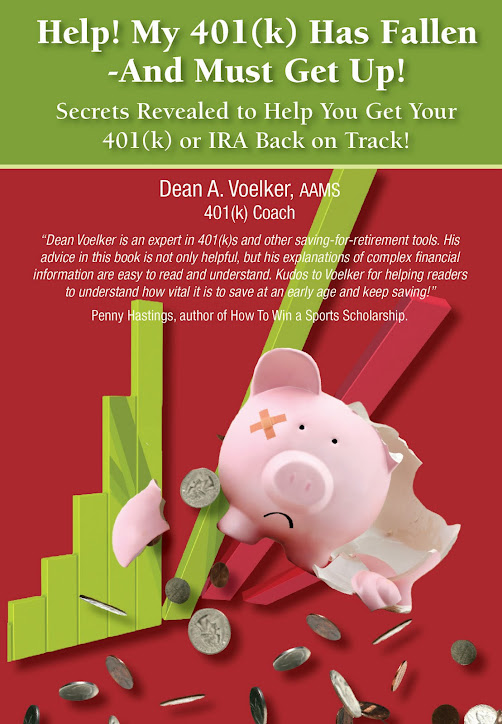
You can contact me through my website, http://www.helpmy401k.us/. You may also follow me on Twitter at http://www.twitter.com/deanvoelker. I also host a weekly internet radio program at http://www.blogtalkradio.com/401kcoach.
Showing posts with label bargain. Show all posts
Showing posts with label bargain. Show all posts
Monday, January 4, 2010


Friday, October 23, 2009
Wipe Out The Fear in South Bend

Feel like you are drowning in today's economy?
Inflation?
Shaky stock market?
Sinking dollar?
Unemployment?
Staggering debt?
Inflation?
Shaky stock market?
Sinking dollar?
Unemployment?
Staggering debt?
Watching the news may seem like an ongoing care wreck - especially if you watch Glenn Beck, who always looks like he will suffer a breakdown right on camera - but as horrifying and overwhelming as the news is, you can't seem to pull yourself away.
We don't suffer from a lack of information - rather TOO MUCH information. Its all so confusing and you can feel like the rag doll being pulled apart from all directions.
How does all of this affect your ability to save for retirement? Is it possible to still have goals and dreams? Can you still retire with dignity?
Dan Rather was once quoted as saying "If all of the difficulties were known at the outset of a long journey, most of us would not start out at all."
Nothing great was ever achieved without hardships along the way. As an advisor, my job is to help you resolve your fears. Let's wipe them out and provide some peace of mind.
This year, when I became an iindependent advisor and opened my own office, I've been learning that most people would rather "not lose anymore" than to win with their long term savings. To quote another great American, Will Rogers - "I'm more concerned with the return OF my money than the return ON my money."
With that in mind, my purpose has been to focus on helping people to find a vehicle that would "not lose" and still let you win. What if I could toss you a "Life Preserver" for your savings? Remember when you first learned to swim? Those kickboards or noodles came in handy, didn't they? You learned eventually that the water is your friend. Once you stopped fighting it, and let it help you, swimming became more fun, right?
Russell Pearlman recently wrote an article titled, "Problems? What Problems?" from the November 2009 issue of "Smart Money" magazine. His article focused on annuities, which have become much more popular with investors as a life preserver for long term savings.
"Don't tell that (regarding annuity cost) to baby boomers looking for retirement security at a time when their 401(k) plans are still hurting; they just keep buying annuities. Through the first six months of the year, total annuity sales were almost $127 billion, only a 3 percent drop from 2008." he writes.
Again, the message I get from my clients and others I meet is "We want SAFETY and Peace of Mind."
Can we get "Guaranteed" growth for our long term savings?
Will it be better than current CD rates?
Can we get "Guaranteed" income when I retire - also better than current CD rates?
Can we make sure the income never goes down?
And lasts for a lifetime - even if we live to 100 or beyond?
And when that lifetime does end, can we leave something for our family and loved ones?
In short - YES! Mr. Pearlman goes on to write "Are annuities for you? Experts say the peace of mind may be worth it."
Another of my favorite articles this year was written by Leslie Scism of the Wall Street Journal. "Long Derided, This Investment Now Looks Wise". "Because of such guarantees, many holders of variable annuities actually saw their accounts increase 6% or more in value last year, when the Standard & Poors 500 stock index dropped nearly 39%." Ms. Scism writes.
Contact me today to learn more about how to get a life preserver (or noodle if you prefer) for your savings. Treat yourself to some Peace of Mind!
You can contact me through my website, http://www.helpmy401k.us and follow me on Twitter at http://www.twitter.com/deanvoelker. I also host a weekly internet radio braodcast, "Improving Your Financial Health" at http://www.blogtalkradio.com/401kcoach.
How does all of this affect your ability to save for retirement? Is it possible to still have goals and dreams? Can you still retire with dignity?
Dan Rather was once quoted as saying "If all of the difficulties were known at the outset of a long journey, most of us would not start out at all."
Nothing great was ever achieved without hardships along the way. As an advisor, my job is to help you resolve your fears. Let's wipe them out and provide some peace of mind.
This year, when I became an iindependent advisor and opened my own office, I've been learning that most people would rather "not lose anymore" than to win with their long term savings. To quote another great American, Will Rogers - "I'm more concerned with the return OF my money than the return ON my money."
With that in mind, my purpose has been to focus on helping people to find a vehicle that would "not lose" and still let you win. What if I could toss you a "Life Preserver" for your savings? Remember when you first learned to swim? Those kickboards or noodles came in handy, didn't they? You learned eventually that the water is your friend. Once you stopped fighting it, and let it help you, swimming became more fun, right?
Russell Pearlman recently wrote an article titled, "Problems? What Problems?" from the November 2009 issue of "Smart Money" magazine. His article focused on annuities, which have become much more popular with investors as a life preserver for long term savings.
"Don't tell that (regarding annuity cost) to baby boomers looking for retirement security at a time when their 401(k) plans are still hurting; they just keep buying annuities. Through the first six months of the year, total annuity sales were almost $127 billion, only a 3 percent drop from 2008." he writes.
Again, the message I get from my clients and others I meet is "We want SAFETY and Peace of Mind."
Can we get "Guaranteed" growth for our long term savings?
Will it be better than current CD rates?
Can we get "Guaranteed" income when I retire - also better than current CD rates?
Can we make sure the income never goes down?
And lasts for a lifetime - even if we live to 100 or beyond?
And when that lifetime does end, can we leave something for our family and loved ones?
In short - YES! Mr. Pearlman goes on to write "Are annuities for you? Experts say the peace of mind may be worth it."
Another of my favorite articles this year was written by Leslie Scism of the Wall Street Journal. "Long Derided, This Investment Now Looks Wise". "Because of such guarantees, many holders of variable annuities actually saw their accounts increase 6% or more in value last year, when the Standard & Poors 500 stock index dropped nearly 39%." Ms. Scism writes.
Contact me today to learn more about how to get a life preserver (or noodle if you prefer) for your savings. Treat yourself to some Peace of Mind!
You can contact me through my website, http://www.helpmy401k.us and follow me on Twitter at http://www.twitter.com/deanvoelker. I also host a weekly internet radio braodcast, "Improving Your Financial Health" at http://www.blogtalkradio.com/401kcoach.
Wednesday, October 14, 2009
Cut The Fat in your 401(k)
Last week, we asked “Where’s the Beef?” Today, we ask “Where’s the Fat?”
Its very important to trim the ‘fat’ in your 401(k) plan – or fund expenses. Today on my Blog Talk Radio program, I had a listener ask about fund expenses. These can really affect your long term return on your retirement savings.
Expenses come from managing the mutual fund. The fund family charges a percentage of the assets invested to manage the fund – deciding what to buy, what to sell, and how much to buy or sell and when to do it. Less trading = lower expenses. Also the advisor on the plan may be paid from these expenses.
Knowing this, it would make sense to look for funds in your plan which have a lower expense rate. If its about 1%, that isn’t too bad, much more than that can negatively affect your returns over time.
To give you an example, I did some figuring on my financial calculator . Let’s look at a 22 year old college graduate, starting their 401(k) plan. Of course you would expect them to bump up their contributions over time, but lets say they put in $300/month with an 8% average return until age 66. They would have saved $1,340,048 in 44 years.
What if they were using a fund with expenses that were 1% more? In other words, the fund may have averaged 8%, but the real return was 7% due to higher expenses. With all the other factors being the same, we now have a total savings of $993,985, which is a difference of $346,063. OUCH! If you figure on taking 4%/year of the nest egg at retirement for income, that means we would need to live on less income -$13842 per year less. See where 1% can make a big difference?
So look carefully at your statement. Don’t just look at ‘performance’ but also fund expenses, which do affect long term performance. Have an advisor help you with this and also help you determine how much to save, so you can have the type of retirement you want.
You may contact me through my website at http://www.helpmy401k.us. You can also follow me on Twitter at http://www.twitter.com/deanvoelker. I also host a Weekly Internet Radio Broadcast “Improving Your Financial Health on Blog Talk Radio http://www.blogtalkradio.com/401kcoach
Its very important to trim the ‘fat’ in your 401(k) plan – or fund expenses. Today on my Blog Talk Radio program, I had a listener ask about fund expenses. These can really affect your long term return on your retirement savings.
Expenses come from managing the mutual fund. The fund family charges a percentage of the assets invested to manage the fund – deciding what to buy, what to sell, and how much to buy or sell and when to do it. Less trading = lower expenses. Also the advisor on the plan may be paid from these expenses.
Knowing this, it would make sense to look for funds in your plan which have a lower expense rate. If its about 1%, that isn’t too bad, much more than that can negatively affect your returns over time.
To give you an example, I did some figuring on my financial calculator . Let’s look at a 22 year old college graduate, starting their 401(k) plan. Of course you would expect them to bump up their contributions over time, but lets say they put in $300/month with an 8% average return until age 66. They would have saved $1,340,048 in 44 years.
What if they were using a fund with expenses that were 1% more? In other words, the fund may have averaged 8%, but the real return was 7% due to higher expenses. With all the other factors being the same, we now have a total savings of $993,985, which is a difference of $346,063. OUCH! If you figure on taking 4%/year of the nest egg at retirement for income, that means we would need to live on less income -$13842 per year less. See where 1% can make a big difference?
So look carefully at your statement. Don’t just look at ‘performance’ but also fund expenses, which do affect long term performance. Have an advisor help you with this and also help you determine how much to save, so you can have the type of retirement you want.
You may contact me through my website at http://www.helpmy401k.us. You can also follow me on Twitter at http://www.twitter.com/deanvoelker. I also host a Weekly Internet Radio Broadcast “Improving Your Financial Health on Blog Talk Radio http://www.blogtalkradio.com/401kcoach
Friday, August 7, 2009
Something's "Fishy"

All this talk about "fishy" comments yesterday got me to thinking.....
Another great American Fast Food chain is Long John Silvers. According to their website, www.ljsilvers.com , the restaurant was inspired by Robert Louis Stevenson's "Treasure Island".
The first restaurant opened in 1969 in Lexington, Kentucky, as a response to other fast food chains which were becoming popular at the time - specializing in quick service seafood. The chain began as a division of Jerrico, Inc., which also operated Jerry's Restaurants, a chain of family restaurants which also began in Lexington, KY throughout the Midwest & South.
In the UK, fish and chips became a cheap food popular among the working classes in the second half of the nineteenth century. http://en.wikipedia.org/wiki/Fish_and_chips Deep-fried "chips" (slices or pieces of potato) as a dish, may have first appeared in Britain in about the same period. There was a mention of "chips" in Charles Dickens' "A Tale of Two Cities" (1859) "Husky chips of potatoes, fried with some reluctant drops of oil".
Earlier Long John Silvers restaurants were known for their Cape-Cod style buildings, blue roofs, small steeples, and nautically-themed decorations such as seats made to look like nautical flags. Most early restaurants also featured separate entrance and exit doors, a corridor-like waiting line area, food heaters that were transparent so customers could see the food waiting to be served, and a bell by the exit which customers could "ring if we did it well." Many of these buildings had dock-like walkways lined with pilings and thick ropes that wrapped around the building exterior.
Until its bankruptcy in 1998, Long John Silvers was a privately owned corporation. It was then acquired by Yorkshire Global Restaurants, which also owned A & W American Food Chains. In March 2002, Yorkshire was purchased by Tricon Global Restaurants, Inc. which had spun off from Pepsico, Inc. Tricon owned Taco Bell, Kentucky Fried Chicken, and Pizza Hut worldwide. Tricon then changed their name to Yum Brands, Inc. (NYSE: YUM)
Until then, Long John Silvers had served Coca-Cola Products. Once the acquistion by Yum Brands was in effect, they switched to Pepsi. Currently, Long John Silvers has more than 1200 restaurants worldwide – and more than 200 additional locations in Yum Brands, Inc. multi-brand restaurants. Nearly four million customers each week "throw boring overboard".
This is NOT an endorsement or an opinion of YUM stock. From 1997, Yum Brands/Tricon has grown from $8.06/share to a high of $41.73 on April 30, 2008. http://finance.aol.com/charts/yum-brands-inc/yum/nys/tech-chart Yesterday, August 6, 2009, YUM closed at 36.05.
This is NOT an endorsement or an opinion of YUM stock. From 1997, Yum Brands/Tricon has grown from $8.06/share to a high of $41.73 on April 30, 2008. http://finance.aol.com/charts/yum-brands-inc/yum/nys/tech-chart Yesterday, August 6, 2009, YUM closed at 36.05.
For more investing information, you may contact me at http://www.deanvoelker.com . You may also follow me on Twitter at www.twitter.com/deanvoelker, or Blog Talk Radio at
Monday, July 27, 2009
Climbing The Mountain

Thanks to my 7 years old daughter, I’ve been exposed (repeatedly) to the music of Miley Cyrus (aka Hannah Montana). Although my musical tastes are more in line with 1970’s & 1980’s Classic Rock, I have to admit that Miley’s music is pretty good.
One of her best songs, “The Climb” is popular right now, and it’s a very inspiring song. Hearing “The Climb” makes me think about how saving for retirement can be much like climbing a mountain. There may be obstacles along the way, but we keep climbing, and the climb is actually the best part of the process.
There are really 2 parts to climbing a mountain, going up and then coming back down. This makes a great analogy when thinking of your retirement savings. “Going up” is building your nest egg. “Coming down” is when you are beginning to take income from the nest egg you’ve built. Both parts are just as important, aren’t they?
If you are in the “Going Up” stage, and trying to build your nest egg, having a year like 2008 can be discouraging. What if you could get at least 7% or more every year on your savings? What if you were able to get even more in years when the market does better then 7%?
How about if I also told you that if you stayed invested for 10 years, you would DOUBLE your original investment? (By the way, according to the Rule of 72, that would be an average compound return of 7.2%.) http://en.wikipedia.org/wiki/Rule_of_72
Lets say you have an account which grows by 10% at the beginning of the year, hits its peak in June, then tails off for the rest of the year. What if I told you that the highest Quarterly Gain (in this case the end of June) would be locked in for you, in helping to build your nest egg?
The next year, the same thing would happen. The benefit base would increase by either 7% OR whatever the highest quarterly gain was.
What about “Coming Down” the mountain and taking income? How about if I told you that beginning at age 63, you would be able to take 5% from the benefit base you built and you could take 5% for life? Wouldn’t it be great to know that your pay can go up, if the account continues to grow - and your pay won’t go down?
And for those who can wait until age 75 to begin taking income, would you like to be able to take 6% FOR LIFE? Sounds pretty good so far? Wouldn’t you feel more comfortable climbing your mountain if you had a “safety net“? For more information, please contact me at http://helpmy401k.us/. You may also follow me on Twitter at www.twitter.com/deanvoelker.
Thursday, July 23, 2009
This Time Its Different - II
Recently I posted an article, titled “This Time It’s Different”. Most people when asked about the idea of investing in the market, have responded that “They are waiting to see what happens” and yes, “This Time It’s Different because…..”
If you read my previous article, “This Time It’s Different”, http://5reasonsyoushouldownaroth.blogspot.com/2009/07/this-time-its-different.html I referred to a study done by Hartford on the Recession of the mid 1970’s (1973 & 1974), arguably the closest parallel to our present economic situation. The low point in the market was Sept. 30, 1974. The Dow closed at 607.87 (not a misprint) This was down more than 40% from its high in 1972, when it crossed the 1000 mark for the first time. http://www.democraticunderground.com/discuss/duboard.php?az=view_all&address=389×4124348
The stock market had gone through back-to-back negative years for the first time since the Great Depression.
We should set the stage a bit at this point. In 1972, we were still heavily involved in the Vietnam War, which was highly unpopular, and dragged on for several years. Also, in 1972, the Watergate scandal began. This resulted in the indictment and conviction of several of Nixon’s closest advisors, and ultimately in the resignation of the President himself, on August 9, 1974. http://en.wikipedia.org/wiki/Watergate_scandal
To make matters worse, the Oil Embargo http://en.wikipedia.org/wiki/1973_oil_crisis was put into effect by OPEC, which refused to ship oil to the US due to their support of Israel at that time. Unemployment had reached a high of 6.7% in 1974. http://www.nytimes.com/2008/12/06/business/economy/06jobs.html
So things in 1974 looked pretty bleak. I recently read a letter written by Jim Fullerton of the Capital Group to shareholders at that time(November 1974). Here are some highlights from Mr. Fullerton’s letter.
“Each economic, market, and financial crisis is different from previous ones. But in their very difference, there is commonality….. Today there are thoughtful, experienced, respected, economists, bankers, investors, and businessmen who can (tell) you why this time the economic problems are different; why this time things are going to get even worse – and hence, why this is NOT a good time to invest in common stocks, even though they may appear low…..This time is a whole new ball game.”
“In 1942 everybody knew it was a whole new ball game…..The Germans had overrun France. The British had been thrown out of Dunkirk. The Pacific Fleet had been disastrously crippled at Pearl Harbor. We had surrendered Bataan, and the British had surrendered Singapore. The U.S. was so ill-prepared for a war that……75% of our field artillery was equipped with horse-drawn, French 75mm guns.” (Mr. Fullerton served in WWII.)
“In April 1942, inflation was rampant…..On April 8, 1942, the lead article in the (Wall Street) Journal was: ‘Home Construction, Total far behind last year’s. Private Builders hardest hit.’…..Washington D.C. also considered more drastic rationing with price fixing, or still higher taxes as a means of filling the ‘inflationary gap’ between increased public buying power and the diminishing supply of consumer goods.”
“A leading stock market commentator wrote: ‘The market remains in the dark as to just what it has to discount. And as yet, the signs are still lacking that the market has reached permanently solid ground for a sustained reversal.”
“Yet on April 28, 1942, in that gloomy environment, in the midst of a war we were losing, faced with excess-profits taxes and wage and price controls, shortages of gasoline and rubber…..and with the virtual certainty…..that once the war was over, we’d face a post-war depression, the market turned around.”
“Now I’d like to close with this: ‘Some people say they want to wait for a clearer view of the future. But when the future is again clear, the present bargains will have vanished. In fact, does anyone think that today’s prices will prevail once full confidence has been restored?’ That comment was made by Dean Witter in May of 1932 – only a few weeks before the end of the worst bear market in history.”
“Have Courage! We have been here before – and we’ve survived and prospered.”
Jim Fullerton
As of today, July 23, 2009, the Dow is up nearly 200 points, crossing the 9000 mark for the first time this year. This is a gain of over 38% from its low point of 6547 on March 9, 2009. Yes, This Time It’s Different.
For more information, you may contact me at http://www.helpmy401k.us. You may also follow me on Twitter at www.twitter.com/deanvoelker.
If you read my previous article, “This Time It’s Different”, http://5reasonsyoushouldownaroth.blogspot.com/2009/07/this-time-its-different.html I referred to a study done by Hartford on the Recession of the mid 1970’s (1973 & 1974), arguably the closest parallel to our present economic situation. The low point in the market was Sept. 30, 1974. The Dow closed at 607.87 (not a misprint) This was down more than 40% from its high in 1972, when it crossed the 1000 mark for the first time. http://www.democraticunderground.com/discuss/duboard.php?az=view_all&address=389×4124348
The stock market had gone through back-to-back negative years for the first time since the Great Depression.
We should set the stage a bit at this point. In 1972, we were still heavily involved in the Vietnam War, which was highly unpopular, and dragged on for several years. Also, in 1972, the Watergate scandal began. This resulted in the indictment and conviction of several of Nixon’s closest advisors, and ultimately in the resignation of the President himself, on August 9, 1974. http://en.wikipedia.org/wiki/Watergate_scandal
To make matters worse, the Oil Embargo http://en.wikipedia.org/wiki/1973_oil_crisis was put into effect by OPEC, which refused to ship oil to the US due to their support of Israel at that time. Unemployment had reached a high of 6.7% in 1974. http://www.nytimes.com/2008/12/06/business/economy/06jobs.html
So things in 1974 looked pretty bleak. I recently read a letter written by Jim Fullerton of the Capital Group to shareholders at that time(November 1974). Here are some highlights from Mr. Fullerton’s letter.
“Each economic, market, and financial crisis is different from previous ones. But in their very difference, there is commonality….. Today there are thoughtful, experienced, respected, economists, bankers, investors, and businessmen who can (tell) you why this time the economic problems are different; why this time things are going to get even worse – and hence, why this is NOT a good time to invest in common stocks, even though they may appear low…..This time is a whole new ball game.”
“In 1942 everybody knew it was a whole new ball game…..The Germans had overrun France. The British had been thrown out of Dunkirk. The Pacific Fleet had been disastrously crippled at Pearl Harbor. We had surrendered Bataan, and the British had surrendered Singapore. The U.S. was so ill-prepared for a war that……75% of our field artillery was equipped with horse-drawn, French 75mm guns.” (Mr. Fullerton served in WWII.)
“In April 1942, inflation was rampant…..On April 8, 1942, the lead article in the (Wall Street) Journal was: ‘Home Construction, Total far behind last year’s. Private Builders hardest hit.’…..Washington D.C. also considered more drastic rationing with price fixing, or still higher taxes as a means of filling the ‘inflationary gap’ between increased public buying power and the diminishing supply of consumer goods.”
“A leading stock market commentator wrote: ‘The market remains in the dark as to just what it has to discount. And as yet, the signs are still lacking that the market has reached permanently solid ground for a sustained reversal.”
“Yet on April 28, 1942, in that gloomy environment, in the midst of a war we were losing, faced with excess-profits taxes and wage and price controls, shortages of gasoline and rubber…..and with the virtual certainty…..that once the war was over, we’d face a post-war depression, the market turned around.”
“Now I’d like to close with this: ‘Some people say they want to wait for a clearer view of the future. But when the future is again clear, the present bargains will have vanished. In fact, does anyone think that today’s prices will prevail once full confidence has been restored?’ That comment was made by Dean Witter in May of 1932 – only a few weeks before the end of the worst bear market in history.”
“Have Courage! We have been here before – and we’ve survived and prospered.”
Jim Fullerton
As of today, July 23, 2009, the Dow is up nearly 200 points, crossing the 9000 mark for the first time this year. This is a gain of over 38% from its low point of 6547 on March 9, 2009. Yes, This Time It’s Different.
For more information, you may contact me at http://www.helpmy401k.us. You may also follow me on Twitter at www.twitter.com/deanvoelker.
Saturday, June 6, 2009
Fixing Your 401(k) - Part 7
Problem #6 - Education
Of all the issues we have been discussing that are plaguing 401(k) plans right now, the biggest is EDUCATION on how it works. Why? Very simple. If proper education was taking place, it would help to solve the other issues, and reduce the liability each employer and plan sponsor currently faces.
Jackson Life did a survey of several passers-by and asked them questions about 401(k)s. (Source Rollover Rx, Jackson National Life Insurance) If you have ever watched Jay Leno do his "Jaywalking" bit on the Tonight Show, you have a pretty good idea of how it went.
Here are a few actual responses when people were asked about education offered by their employers for their 401(k) plans.
"I wasn't aware of any education."
"Don't participate in this. Its on a webinar."
"Information meetings are inconvenient to attend. I'm too busy."
"I think there is on line stuff, but I don't think anyone uses it."
"What can you tell me about it?"
I have personally talked to several clients who tell me that when there are "meetings", the advisor simply hands out his card and runs thru a quick power point presentation, then asks if there are any questions. This is usually met with blank "deer in the headlights" looks.
Education must be done on an INDIVIDUAL BASIS. Everyone's situation is different.
John, the 49 year old manager is in a different spot from Brandon, the 24 year old sales rep, who is new to 401(k) investing - although Brandon needs to know he is in a great place to get started now. Kim, the 35 year old customer service rep, may be thinking about borrowing against her plan, and Sue, the 42 year old customer service manager, is new to the company and wants to know how much she should invest, and what funds to pick.
How can you address individual situations in a "webinar" or "power point"?
A survey done by The Spectrum Group (www.spectrem.com - Source Jackson Life, Rollover Rx) tells us that 85% of employees want professional advice, however only 37% of employers offer any real contact with an advisor. That is not good for the employees, or the employer/sponsors, who are exposing their companies to liability and potential lawsuits. http://accounting.smartpros.com/x40690.xml
So what should you be doing?
Let's review the Problems I've covered so far.
Problem Current Situation Solution
Participation We don't participate & Start participating in your plan don't contribute enough. and max it out.
Portability Too many cash out when Roll the old 401(k) to the plan with
changing jobs. your new job, or to an IRA.
Loans Heavy tax consequences Set up an savings fund of 3-6 mos
and penalties. expenses. Don't borrow on 401(k)
Investments We try to 'advise' ourselves. Diversify. Get professional advice.
Its your money, your future.
Education Not enough advice by Find an advisor you can work with.
employers.
Here are 3 key questions you & your advisor should be asking.
1. Do I have enough money to live through at least 25 years or more in retirement?
How can I make my money last for the rest of my life?
2. Will my savings & income keep up with rapidly rising costs?
3. How can my savings be protected against declines in the stock market?
Let me end with this quote from one of my favorite songs.
"Working so hard to make it easy......got to turn....turn this thing around - Right Now!
Its your tomorrow. Right Now! Its everything." (Van Halen - Right Now)
Bet you never thought you'd see a Van Halen reference in an article on retirement!
Get started on your plan - Right Now! Meet with your advisor today and get started on Improving Your Financial Health. For more information, please contact me at http://www.helpmy401k.us. You can also follow me on Twitter - http://www.twitter.com/DeanVoelker
Of all the issues we have been discussing that are plaguing 401(k) plans right now, the biggest is EDUCATION on how it works. Why? Very simple. If proper education was taking place, it would help to solve the other issues, and reduce the liability each employer and plan sponsor currently faces.
Jackson Life did a survey of several passers-by and asked them questions about 401(k)s. (Source Rollover Rx, Jackson National Life Insurance) If you have ever watched Jay Leno do his "Jaywalking" bit on the Tonight Show, you have a pretty good idea of how it went.
Here are a few actual responses when people were asked about education offered by their employers for their 401(k) plans.
"I wasn't aware of any education."
"Don't participate in this. Its on a webinar."
"Information meetings are inconvenient to attend. I'm too busy."
"I think there is on line stuff, but I don't think anyone uses it."
"What can you tell me about it?"
I have personally talked to several clients who tell me that when there are "meetings", the advisor simply hands out his card and runs thru a quick power point presentation, then asks if there are any questions. This is usually met with blank "deer in the headlights" looks.
Education must be done on an INDIVIDUAL BASIS. Everyone's situation is different.
John, the 49 year old manager is in a different spot from Brandon, the 24 year old sales rep, who is new to 401(k) investing - although Brandon needs to know he is in a great place to get started now. Kim, the 35 year old customer service rep, may be thinking about borrowing against her plan, and Sue, the 42 year old customer service manager, is new to the company and wants to know how much she should invest, and what funds to pick.
How can you address individual situations in a "webinar" or "power point"?
A survey done by The Spectrum Group (www.spectrem.com - Source Jackson Life, Rollover Rx) tells us that 85% of employees want professional advice, however only 37% of employers offer any real contact with an advisor. That is not good for the employees, or the employer/sponsors, who are exposing their companies to liability and potential lawsuits. http://accounting.smartpros.com/x40690.xml
So what should you be doing?
Let's review the Problems I've covered so far.
Problem Current Situation Solution
Participation We don't participate & Start participating in your plan don't contribute enough. and max it out.
Portability Too many cash out when Roll the old 401(k) to the plan with
changing jobs. your new job, or to an IRA.
Loans Heavy tax consequences Set up an savings fund of 3-6 mos
and penalties. expenses. Don't borrow on 401(k)
Investments We try to 'advise' ourselves. Diversify. Get professional advice.
Its your money, your future.
Education Not enough advice by Find an advisor you can work with.
employers.
Here are 3 key questions you & your advisor should be asking.
1. Do I have enough money to live through at least 25 years or more in retirement?
How can I make my money last for the rest of my life?
2. Will my savings & income keep up with rapidly rising costs?
3. How can my savings be protected against declines in the stock market?
Let me end with this quote from one of my favorite songs.
"Working so hard to make it easy......got to turn....turn this thing around - Right Now!
Its your tomorrow. Right Now! Its everything." (Van Halen - Right Now)
Bet you never thought you'd see a Van Halen reference in an article on retirement!
Get started on your plan - Right Now! Meet with your advisor today and get started on Improving Your Financial Health. For more information, please contact me at http://www.helpmy401k.us. You can also follow me on Twitter - http://www.twitter.com/DeanVoelker
Monday, June 1, 2009
Fixing Your 401(k) - Part 5
Problem #5 - Investments
If you have been following me on this blog lately, you might think that I'm against the idea of 401(k) plans. Not so! Let me state this clearly. I LOVE 401(k) plans as a source of saving for retirement. EVERYONE should be participating in a 401(k).
However, there are many potential hazards that you must be aware of in your 401(k) plans.
So my purpose here has been acting as a 'caddy' and letting you know where the bunkers & water hazards are at so we can avoid them. And I certainly want you all to finish the 'course'.
Today, we will look at the problem which most investors find it easiest to point fingers at -
Investments.
How many investment choices are offered in your plan? And how do you choose which ones are right for you? How long do you stay with invesments in your plan before you look for
"greener grass"?
A survey done by Watson Wyatt in January 2008, (Watson Wyatt is the trusted business partner to the world’s leading organizations on people and financial issues)
http://www.watsonwyatt.com/us/pubs/insider/showarticle.asp?ArticleID=18489
gives us this information.
* 30% of all participants have NO equity (stock mutual funds) in their plans.
* 20% of investors at least 45 and older have stopped contributing.
* Too many people are invested heavily in their company stock, some who have at least
50% or more of their plans in company stock.
(Company stock is an issue I will look at in further detail in my next article.)
Dave Ramsey likes to ask this question - If you were CFO of your own finances, would you fire you? Well, the reality is that YES YOU ARE the CFO of your finances & retirement savings!
"Investors Behaving Badly: An Analysis of Investor Trading Patterns in Mutual Funds" is a 2001 article that shows people are holding their funds for shorter and shorter time periods, as short as 2.9 years, and probably even less time these days after all of the challenges recently.
http://spwfe.fpanet.org:10005/public/Unclassified%20Records/FPA%20Journal%20November%202001%20-%20Investors%20Behaving%20Badly_%20An%20Analysis%20of%20Investor%20Trading%20Patt.pdf
This is like moving your boat all around the pond in search of the 'perfect' fishing spot. It usually just scares the fish! This also explains why people finally give up and put everything into "safe" money market funds, because as one gentleman puts it. "At least I'm not losing nothing."
Wayne Gretzky said (during his playing days), "I skate to where the puck is going, not where it has been." How do we know where the 'puck' is going? We don't. That would mean market timing, and as Warren Buffett would say, "I'm not smart enough for that."
How many funds should an employer's plan offer? Anywhere from about 12 - 20 is a good range. Your personal plan should meet these objectives.
* Look for funds which have 10 year (or longer) histories. Established funds give a much
clearer long term picture of what to expect.
* Pay attention to fund expenses. The higher the expenses, the more it can hurt your return.
* Treat the plan as if you are at a "buffet". The plan offers a menu of choices, and it is best to
have somthing from all of the food groups. Just as you wouldn't eat only the fried chicken,
you also need fixed income, dividend paying funds (large companies), medium sized
companies, small companies, and international.
* Meet with an advisor to help you find the mix you should have and how much to put in.
Many good advisors (including myself) offer to do this at no charge to you. Let him or her
help you put a roadmap together which will help you get to (and through) retirement
safely.
Next we will examine the issue of company stock in 401(k) plans. For more information or to contact me, please visit http://www.helpmy401k.us/. You can also follow me on Twitter at
http://twitter.com/DeanVoelker
If you have been following me on this blog lately, you might think that I'm against the idea of 401(k) plans. Not so! Let me state this clearly. I LOVE 401(k) plans as a source of saving for retirement. EVERYONE should be participating in a 401(k).
However, there are many potential hazards that you must be aware of in your 401(k) plans.
So my purpose here has been acting as a 'caddy' and letting you know where the bunkers & water hazards are at so we can avoid them. And I certainly want you all to finish the 'course'.
Today, we will look at the problem which most investors find it easiest to point fingers at -
Investments.
How many investment choices are offered in your plan? And how do you choose which ones are right for you? How long do you stay with invesments in your plan before you look for
"greener grass"?
A survey done by Watson Wyatt in January 2008, (Watson Wyatt is the trusted business partner to the world’s leading organizations on people and financial issues)
http://www.watsonwyatt.com/us/pubs/insider/showarticle.asp?ArticleID=18489
gives us this information.
* 30% of all participants have NO equity (stock mutual funds) in their plans.
* 20% of investors at least 45 and older have stopped contributing.
* Too many people are invested heavily in their company stock, some who have at least
50% or more of their plans in company stock.
(Company stock is an issue I will look at in further detail in my next article.)
Dave Ramsey likes to ask this question - If you were CFO of your own finances, would you fire you? Well, the reality is that YES YOU ARE the CFO of your finances & retirement savings!
"Investors Behaving Badly: An Analysis of Investor Trading Patterns in Mutual Funds" is a 2001 article that shows people are holding their funds for shorter and shorter time periods, as short as 2.9 years, and probably even less time these days after all of the challenges recently.
http://spwfe.fpanet.org:10005/public/Unclassified%20Records/FPA%20Journal%20November%202001%20-%20Investors%20Behaving%20Badly_%20An%20Analysis%20of%20Investor%20Trading%20Patt.pdf
This is like moving your boat all around the pond in search of the 'perfect' fishing spot. It usually just scares the fish! This also explains why people finally give up and put everything into "safe" money market funds, because as one gentleman puts it. "At least I'm not losing nothing."
Wayne Gretzky said (during his playing days), "I skate to where the puck is going, not where it has been." How do we know where the 'puck' is going? We don't. That would mean market timing, and as Warren Buffett would say, "I'm not smart enough for that."
How many funds should an employer's plan offer? Anywhere from about 12 - 20 is a good range. Your personal plan should meet these objectives.
* Look for funds which have 10 year (or longer) histories. Established funds give a much
clearer long term picture of what to expect.
* Pay attention to fund expenses. The higher the expenses, the more it can hurt your return.
* Treat the plan as if you are at a "buffet". The plan offers a menu of choices, and it is best to
have somthing from all of the food groups. Just as you wouldn't eat only the fried chicken,
you also need fixed income, dividend paying funds (large companies), medium sized
companies, small companies, and international.
* Meet with an advisor to help you find the mix you should have and how much to put in.
Many good advisors (including myself) offer to do this at no charge to you. Let him or her
help you put a roadmap together which will help you get to (and through) retirement
safely.
Next we will examine the issue of company stock in 401(k) plans. For more information or to contact me, please visit http://www.helpmy401k.us/. You can also follow me on Twitter at
http://twitter.com/DeanVoelker
Wednesday, May 20, 2009
Fixing Your 401(k) - Part 1
Did you know that over 50% of Americans have a 401(k) plan? For many of us it is our primary funding source of retirement savings. For some, it may be the only source of savings. http://www.gallup.com/poll/16564/Many-Consumers-Lack-Rainy-Day-Fund.aspx
401(k) Plans can be great for helping to fund your retirement - - IF you are saving enough and don't fall into some common traps. I love 401(k)s and have a passion for helping companies and indviduals get more from their plans. With that in mind, I am going to address 5 major issues with 401(k) plans in my next several posts.
Around 1985, 401(k) plans passed pensions as the Primary Retirement Vehicle, as the New York Times states in a recent article.
http://roomfordebate.blogs.nytimes.com/2009/03/25/so-much-for-the-401k-now-what/?scp=4&sq=401k%20passed%20pension&st=cse
Pensions had been dying for a long time, mostly due to cost. 401(k)s require employees to contribute to their own retirement savings. Many companies provide a matching contribution of some sort, although in recent times, those have also been cut back.
http://www.nytimes.com/2008/12/21/your-money/401ks-and-similar-plans/21retire.html?_r=1&scp=5&sq=401k%20passed%20pension&st=cse
How did 401(k)s come into being?
In 1978, the Tax Reform Act passed (Provision Internal Revenue Code Section 401(k)), which allowed employees to receive a portion of their income as tax deferred compensation. Ted Benna
http://pipl.com/directory/people/Ted/Benna then created the first 401(k) in 1979. Also in that year, Johnson & Johnson, Honeywell, and Pepsico established 401(k) plans for their employees.
In my next post, we will look at the first serious issue which needs to be addressed in 401(k)s -
PARTICIPATION.
For more information, please contact me at http://www.helpmy401k.us/.
401(k) Plans can be great for helping to fund your retirement - - IF you are saving enough and don't fall into some common traps. I love 401(k)s and have a passion for helping companies and indviduals get more from their plans. With that in mind, I am going to address 5 major issues with 401(k) plans in my next several posts.
Around 1985, 401(k) plans passed pensions as the Primary Retirement Vehicle, as the New York Times states in a recent article.
http://roomfordebate.blogs.nytimes.com/2009/03/25/so-much-for-the-401k-now-what/?scp=4&sq=401k%20passed%20pension&st=cse
Pensions had been dying for a long time, mostly due to cost. 401(k)s require employees to contribute to their own retirement savings. Many companies provide a matching contribution of some sort, although in recent times, those have also been cut back.
http://www.nytimes.com/2008/12/21/your-money/401ks-and-similar-plans/21retire.html?_r=1&scp=5&sq=401k%20passed%20pension&st=cse
How did 401(k)s come into being?
In 1978, the Tax Reform Act passed (Provision Internal Revenue Code Section 401(k)), which allowed employees to receive a portion of their income as tax deferred compensation. Ted Benna
http://pipl.com/directory/people/Ted/Benna then created the first 401(k) in 1979. Also in that year, Johnson & Johnson, Honeywell, and Pepsico established 401(k) plans for their employees.
In my next post, we will look at the first serious issue which needs to be addressed in 401(k)s -
PARTICIPATION.
For more information, please contact me at http://www.helpmy401k.us/.
Tuesday, April 28, 2009
401(k) Bargains
I've been talking with several clients lately (even in their 30's & 40's) who aren't sure what they should be doing with their 401(k)s. A few of them have even taken money out of the 401(k) or IRA, because they "don't want to lose anymore".
We need to remember that while the market goes up and also goes down, over time IT GOES UP. Putting money into your 401(k) now (while prices are low) can only help, especially if your employer matches your contribution. We MUST get back to thinking big picture, not just what is happening today. As one advisor likes to say, "Short Term thinking is very murky, but Long Term is crystal clear."
Walter Updegrave mentions this in his article "Don't Miss Out on 401(k) Bargains" in Money Magazine. http://finance.yahoo.com/focus-retirement/article/106833/Don't-Miss-Out-on-401k-Bargains;_ylt=Ajq2DWlNpxka9nV4LwU8Qf.VBa1_?mod=fidelity-readytoretire
The best time to invest is when prices are low, and you don't want to take money out if you don't have to. It has the same effect as uprooting a plant - You are killing your money tree, in addition to paying taxes and a 10% penalty.
When would you prefer to buy groceries - at regular price or on sale?
Treat your investing the same way.
Want to lower your risk? How diversified are you?
The one thing missing in most 401(k) plans is professional advice & education for the employees. It's not enough for the guy (or lady) to come out a couple of times a year and ask if anyone has questions. My job as a professional must be to sit down with you and help you with a road map. We need to see where you are now, and where you need to be. The 401(k) is a vehicle which can (and should) be used to help you get there.
Don't miss out on 401(k) bargains!
For more information, please contact me at www.deanvoelker.com .
We need to remember that while the market goes up and also goes down, over time IT GOES UP. Putting money into your 401(k) now (while prices are low) can only help, especially if your employer matches your contribution. We MUST get back to thinking big picture, not just what is happening today. As one advisor likes to say, "Short Term thinking is very murky, but Long Term is crystal clear."
Walter Updegrave mentions this in his article "Don't Miss Out on 401(k) Bargains" in Money Magazine. http://finance.yahoo.com/focus-retirement/article/106833/Don't-Miss-Out-on-401k-Bargains;_ylt=Ajq2DWlNpxka9nV4LwU8Qf.VBa1_?mod=fidelity-readytoretire
The best time to invest is when prices are low, and you don't want to take money out if you don't have to. It has the same effect as uprooting a plant - You are killing your money tree, in addition to paying taxes and a 10% penalty.
When would you prefer to buy groceries - at regular price or on sale?
Treat your investing the same way.
Want to lower your risk? How diversified are you?
The one thing missing in most 401(k) plans is professional advice & education for the employees. It's not enough for the guy (or lady) to come out a couple of times a year and ask if anyone has questions. My job as a professional must be to sit down with you and help you with a road map. We need to see where you are now, and where you need to be. The 401(k) is a vehicle which can (and should) be used to help you get there.
Don't miss out on 401(k) bargains!
For more information, please contact me at www.deanvoelker.com .
Saturday, April 25, 2009
A "Golden" Opportunity?
My job is to help others to grow their savings and improve their financial health. These days, we all need to get healthy. A common question I get is whether or not to invest in gold.
Gold is an investment that can be part of your portfolio. Talk with your advisor to decide how much, part should be.
Warren Buffett likes to say, " We simply attempt to be fearful when others are greedy and to be greedy only when others are fearful."
http://www.brainyquote.com/quotes/authors/w/warren_buffett_2.html
I don't know about you, but when I hear every other commercial on Financial TV & Radio
promoting gold, it sounds pretty "greedy" to me, wouldn't you agree?
Dave Ramsey put on a Town Hall for Hope on Thurs. April 23. Over 6000 watched and decided it was time to put fear aside and start making smart choices with their money. From the site
http://www.townhallforhope.com/ , Dave shares some interesting facts about gold & other investments.
Did you know that gold has only risen an average of 2.14% per year? And that includes a surge since 2001 to present. http://www.townhallforhope.com/index.cfm?event=displayPostStats
Did you also know that the S & P has grown by 1250% since 1974, from 63 to 850? That includes recessions in the 1970's, 1980s, 2001-2002, and the present.
http://www.townhallforhope.com/index.cfm?event=displayPostStats
Check out these other interesting stats at http://www.townhallforhope.com/
Before investing, talk with your advisor to determine your goals, time horizon & risk tolerance.
For more information, or to contact me directly, visit my site at http://www.deanvoelker.com/ .
Gold is an investment that can be part of your portfolio. Talk with your advisor to decide how much, part should be.
Warren Buffett likes to say, " We simply attempt to be fearful when others are greedy and to be greedy only when others are fearful."
http://www.brainyquote.com/quotes/authors/w/warren_buffett_2.html
I don't know about you, but when I hear every other commercial on Financial TV & Radio
promoting gold, it sounds pretty "greedy" to me, wouldn't you agree?
Dave Ramsey put on a Town Hall for Hope on Thurs. April 23. Over 6000 watched and decided it was time to put fear aside and start making smart choices with their money. From the site
http://www.townhallforhope.com/ , Dave shares some interesting facts about gold & other investments.
Did you know that gold has only risen an average of 2.14% per year? And that includes a surge since 2001 to present. http://www.townhallforhope.com/index.cfm?event=displayPostStats
Did you also know that the S & P has grown by 1250% since 1974, from 63 to 850? That includes recessions in the 1970's, 1980s, 2001-2002, and the present.
http://www.townhallforhope.com/index.cfm?event=displayPostStats
Check out these other interesting stats at http://www.townhallforhope.com/
Before investing, talk with your advisor to determine your goals, time horizon & risk tolerance.
For more information, or to contact me directly, visit my site at http://www.deanvoelker.com/ .
Wednesday, April 15, 2009
What Else Do You Know About Munis?
Over the past few days, I have been promoting the value of municipal bonds. Right now, they offer a better bargain for your long term savings than CDs.
One of the things I dislike about CDs is that they are really just a holding place for your money.
Money falls into 2 main categories -
*Liquid Money - Money that can be used now or held in an emergency fund (about $10,000
or 3 -6 months of expenses).
*Invested Money - Money that is invested that you don't have an immediate need for.
Looking at those two groups, CDs are kind of a "tweener" - your money seems tied up, so you
can't get to it. Also, the rates are so low currently that it really isn't invested either. Talk about being caught between a "rock" and a "hard place"!
CD yields are so poor, that you may even consider the idea of early withdrawal to take advantage of better (and tax FREE) yields with munis. The penalty usually is forfeiting some interest (WHAT interest??), as much as 6 months.
If you had $10000 in a CD, paying 2% ($200/year, taxable), you would lose $100 to the bank. If you re-invested it in a 5% muni bond, you would earn $500 on the same amount, and not pay federal taxes (perhaps even no state or local taxes) on the interest.
You do the math.
Here are a couple of other articles which support the idea of using muni bonds.
MARKET WATCH - "Muni Yields Aren't Puny"
http://www.marketwatch.com/news/story/bargains-abound-tax-free-muni-bonds/story.aspx?guid=%7B2A55A5F2-2F94-4181-A51A-7FFA12E1A9D2%7D
KIPLINGERS - "Steals In Tax-Free Bonds"
http://www.kiplinger.com/magazine/archives/2008/05/kinnel.html
Warren Buffett likes munis too, and you could do a lot worse than listening to Mr. Buffett!
For more information on municipal bonds, or any other savings ideas, please contact me at
www.deanvoelker.com .
One of the things I dislike about CDs is that they are really just a holding place for your money.
Money falls into 2 main categories -
*Liquid Money - Money that can be used now or held in an emergency fund (about $10,000
or 3 -6 months of expenses).
*Invested Money - Money that is invested that you don't have an immediate need for.
Looking at those two groups, CDs are kind of a "tweener" - your money seems tied up, so you
can't get to it. Also, the rates are so low currently that it really isn't invested either. Talk about being caught between a "rock" and a "hard place"!
CD yields are so poor, that you may even consider the idea of early withdrawal to take advantage of better (and tax FREE) yields with munis. The penalty usually is forfeiting some interest (WHAT interest??), as much as 6 months.
If you had $10000 in a CD, paying 2% ($200/year, taxable), you would lose $100 to the bank. If you re-invested it in a 5% muni bond, you would earn $500 on the same amount, and not pay federal taxes (perhaps even no state or local taxes) on the interest.
You do the math.
Here are a couple of other articles which support the idea of using muni bonds.
MARKET WATCH - "Muni Yields Aren't Puny"
http://www.marketwatch.com/news/story/bargains-abound-tax-free-muni-bonds/story.aspx?guid=%7B2A55A5F2-2F94-4181-A51A-7FFA12E1A9D2%7D
KIPLINGERS - "Steals In Tax-Free Bonds"
http://www.kiplinger.com/magazine/archives/2008/05/kinnel.html
Warren Buffett likes munis too, and you could do a lot worse than listening to Mr. Buffett!
For more information on municipal bonds, or any other savings ideas, please contact me at
www.deanvoelker.com .
Tuesday, April 14, 2009
Single Bonds or Mutual Funds?
What's the best way to buy municipal bonds? Should I buy single bonds or mutual funds?
Like most decisions, there are pros & cons with both methods. You should talk with you advisor about which method is right for you - possibly a mix of both.
One of the advantages of owning a single bond is that you have a fixed rate of return - you know exactly what you are getting. For example, on a $100,000 muni bond paying a 5% coupon, you will get $5000 per year in interest income. Because you don't have to pay federal taxes and you may not need to pay state taxes, that may be similar to getting 7% or more, depending on your tax bracket.
Interest from a single bond is usually paid ever; 6 months, so you would get $2500 with each installment. You may also ask your advisor to structure your bonds in such a way that you are able to receive income every month.
Another advantage it that while your advisor does get paid, his or her commission is built into the price of the bond when you buy it. This is a common question I am asked.
Think of buying soup at your local grocery store. The grocer buys soup in large bulk quantities, with all brand names & flavors. Because they buy so much soup at once, they can buy at a wholesale price. When a customer buys soup, they pay a retail price and may only buy 1 can, or a few cans at a time.
Bonds work the same way. If you buy a bond worth $10000, you will get $10000 when it comes due. Along the way, you have gotten a great tax free rate of return every 6 months. If you are fortunate enough to be working with a great advisor, you may have even been able to buy the bond at a discount, so that when it does come due, you even had a small gain. (Woo-Hoo!)
Its great when everyone wins!
One more thing about a single bond - You know exactly which project you are supporting.
(Example - St. Joseph Regional Medical Center Bond)
A big disadvantage is that a single bond is not diversified. This is where mutual funds are better. Going back to the "soup" example, a mutual fund allows you to carry all the "flavors" in one investment, which is managed by professionals at a mutual fund family.
Most bond mutual funds also pay interest monthly, because they own hundreds of bonds. This can be helpful if you are counting on monthly income from your investments, and a huge advantage over CDs.
Also, it is much easier to invest a smaller amount. For those who don't have the 5000 or 10000 minimums required by many single bonds, you can establish a mutual fund for as little as 1000.
Once you have a fund, you can add to it or even withdraw money easily.
Sales charges on bond funds purchased through your advisor may be as high as 4.25%, although you may qualify for volume discounts, also known as "breakpoints" if you are able to invest large amounts of money.
For more information on municipal bonds or other investing, please contact me at www.deanvoelker.com
Like most decisions, there are pros & cons with both methods. You should talk with you advisor about which method is right for you - possibly a mix of both.
One of the advantages of owning a single bond is that you have a fixed rate of return - you know exactly what you are getting. For example, on a $100,000 muni bond paying a 5% coupon, you will get $5000 per year in interest income. Because you don't have to pay federal taxes and you may not need to pay state taxes, that may be similar to getting 7% or more, depending on your tax bracket.
Interest from a single bond is usually paid ever; 6 months, so you would get $2500 with each installment. You may also ask your advisor to structure your bonds in such a way that you are able to receive income every month.
Another advantage it that while your advisor does get paid, his or her commission is built into the price of the bond when you buy it. This is a common question I am asked.
Think of buying soup at your local grocery store. The grocer buys soup in large bulk quantities, with all brand names & flavors. Because they buy so much soup at once, they can buy at a wholesale price. When a customer buys soup, they pay a retail price and may only buy 1 can, or a few cans at a time.
Bonds work the same way. If you buy a bond worth $10000, you will get $10000 when it comes due. Along the way, you have gotten a great tax free rate of return every 6 months. If you are fortunate enough to be working with a great advisor, you may have even been able to buy the bond at a discount, so that when it does come due, you even had a small gain. (Woo-Hoo!)
Its great when everyone wins!
One more thing about a single bond - You know exactly which project you are supporting.
(Example - St. Joseph Regional Medical Center Bond)
A big disadvantage is that a single bond is not diversified. This is where mutual funds are better. Going back to the "soup" example, a mutual fund allows you to carry all the "flavors" in one investment, which is managed by professionals at a mutual fund family.
Most bond mutual funds also pay interest monthly, because they own hundreds of bonds. This can be helpful if you are counting on monthly income from your investments, and a huge advantage over CDs.
Also, it is much easier to invest a smaller amount. For those who don't have the 5000 or 10000 minimums required by many single bonds, you can establish a mutual fund for as little as 1000.
Once you have a fund, you can add to it or even withdraw money easily.
Sales charges on bond funds purchased through your advisor may be as high as 4.25%, although you may qualify for volume discounts, also known as "breakpoints" if you are able to invest large amounts of money.
For more information on municipal bonds or other investing, please contact me at www.deanvoelker.com
Friday, April 10, 2009
How To Get Higher Interest and Lower Taxes
Want to get more return on your savings?
What if you didn’t have to pay taxes on the interest you earned?
And you could still sleep at night, knowing that your savings are…..safe?
Sound too good to be true? Well, municipal bonds do all of that. Munis have long provided funding for projects such as libraries, hospitals, schools, airports, and roads. They are a fantastic bargain right now, paying you a much better return on your savings than CDs.
According to www.bankrate.com as of April 9, 2009, the highest CD rate I found was 3.6% for 5 years, and 2.6 for 1 year. Dave Ramsey, Financial Talk-Radio host, likes to refer to CDs as “Certificates of Depression”, and its easy to see why.
You can easily find investment grade (safe, not junk) Municipal Bonds through a good advisor, paying 5% or better, for a period of 5 years or less. When you consider that you don’t have to pay Federal income taxes on the interest, 5% is an excellent return!
If you live in Indiana, where I’m located, you are also exempt from state and local taxes. That can be similar to earning at least 7% on your savings if you paid taxes on the interest.
So why do people still buy CDs? I guess its like the story about the railroad track width measurement. The width is 4 ft 8 1/2 inches. Why? That’s what it was in England. Why? That was the measurement the tramways used before railroads. Why? Tramways were built using the same width as wagons and that was the spacing between wagon wheels. Why? The wagons had to fit the ruts in the road made by Roman Chariots. Chariots were built to accommodate the width of 2 horses. In other words, "We've always done it that way."
If you still believe CDs are better for your savings, ask yourself this -
When you buy a CD, what does your bank do with the money?
What if you didn’t have to pay taxes on the interest you earned?
And you could still sleep at night, knowing that your savings are…..safe?
Sound too good to be true? Well, municipal bonds do all of that. Munis have long provided funding for projects such as libraries, hospitals, schools, airports, and roads. They are a fantastic bargain right now, paying you a much better return on your savings than CDs.
According to www.bankrate.com as of April 9, 2009, the highest CD rate I found was 3.6% for 5 years, and 2.6 for 1 year. Dave Ramsey, Financial Talk-Radio host, likes to refer to CDs as “Certificates of Depression”, and its easy to see why.
You can easily find investment grade (safe, not junk) Municipal Bonds through a good advisor, paying 5% or better, for a period of 5 years or less. When you consider that you don’t have to pay Federal income taxes on the interest, 5% is an excellent return!
If you live in Indiana, where I’m located, you are also exempt from state and local taxes. That can be similar to earning at least 7% on your savings if you paid taxes on the interest.
So why do people still buy CDs? I guess its like the story about the railroad track width measurement. The width is 4 ft 8 1/2 inches. Why? That’s what it was in England. Why? That was the measurement the tramways used before railroads. Why? Tramways were built using the same width as wagons and that was the spacing between wagon wheels. Why? The wagons had to fit the ruts in the road made by Roman Chariots. Chariots were built to accommodate the width of 2 horses. In other words, "We've always done it that way."
If you still believe CDs are better for your savings, ask yourself this -
When you buy a CD, what does your bank do with the money?
Subscribe to:
Posts (Atom)