Probably the biggest question to answer was "How are we going to print this thing anyway?"
The LAST thing I want or need is to print up a bunch of books and have them sitting in my garage. I also know that most publishers have never heard of me. So I started getting all kinds of advice from different people. Also did you know that if you sell books to a "brick and mortar" bookstore, they will send you the unsold or damaged books back and are entitled to a full refund including shipping costs? Its in the 'fine print' of the contract.
People suggested e-books, or partial e-books, or different print houses. In January, I interviewed a man named Len Fox, author of Recipe Investing, a book which was not unlike mine, in terms of size and content. Len had used a division of Amazon called Create Space. Len had liked it because it was connected to Amazon. They handled the ordering through Amazon.com and could print 1 book orders. Once a month, they would then pay Len his cut from the book orders. Len didn't have to handle any of it. He got a statement once a month with the orders and a paycheck. No hassle, no damaged books, no refunds, no crates in his garage, no shipping. All of it was done there, by Create Space.
Hmmm - that sounds good to me. I was still working on the writing part at the time, so I kept it on the back burner and also continued to get ideas from others. A few weeks ago, I sent a copy to Carlos Frank, another friend of mine. I had interviewed Carlos twice for my financial show, "Improving Your Financial Health". Carlos suggested that I talk with John Rizzo, who worked for....Create Space.
John Rizzo called me last week and after speaking with him, I was convinced that this was the right path for me.
Create Space offers all types of services that will help you to self-publish your book. Self-Publishing allows you much more freedom and can really lower your cost. John was extremely helpful in explaining all of the services offered. There are 2 things I really like about using Create Space.
First, the services are all seperate. If you need them to typeset or edit or promote your book, they will do it OR if you already have someone that you are using, you can do that. You have the choice. When it comes to assembling the book, all I have to do is send them my material and cover design, and they do it. This is also impressive, since my index and resource guide are seperate from the main manuscript.
Secondly, because of their affiliation with Amazon, they will take care of posting your book on Amazon's site and handle customer ordering and shipping for you. Not only is this a real time and money saver, it also prevents the possiblity of having crates of books taking up space in my garage! I am really looking forward to working with John Rizzo, and I would certainly recommend Create Space if you are looking to get a book printed.
Showing posts with label life. Show all posts
Showing posts with label life. Show all posts
Monday, March 15, 2010


Thursday, March 11, 2010
Diary of a Wimpy 401(k)
OK, here we go. One of the things I have done so far in the publishing process was to read a book titled "The Well-Fed Self Publisher" by Peter Bowerman. Mr. Bowerman has some very good & practical ideas on why it is better to self publish instead of going through a publisher.
Kudos to my good friend, Nikki Stauffer who recommended the book. Nikki always seems to come through for me when I really need some advice. If her firm was willing to promote the book, I'd hire her in a heartbeat.
Bowerman told several "horror stories" about publishing houses. Most people have a fantasy that they can simply write a book and sell a gazillion copies and then live like John Grisham for the rest of their life. Needless to say, I am pretty grounded in reality. The truth is, many authors have a hard time getting it published. Jack Canfield, author of the "Chicken Soup" books has a favorite word when he was getting multiple rejections - "Next!"
Anyway, even if you finally do get a publisher to take on your book project, and a promotion agent to write a press release, you will still end of doing the promotion leg work yourself. also, the publisher gets to keep most of the money. He shows examples of authors who wrote books that sell for about $15 and their cut is about .50 per book. Now THAT is wimpy!
According to Bowerman, once they write the press release, the publisher is done. On to the next Stephen King wannabe. There is only one person in the whole world who really cares about making sure that your book is promoted regularly - the author. So if you have to promote it yourself, why not publish it yourself.
The whole reason for this book was that I was meeting many people in this area who really weren't getting the most from their 401(k). Northern Indiana is one of the hardest hit areas for unemployment, and many folks simply cashed it in, in spite of taxes and penalties. Others who didn't cash in stopped contributing to their 401(k) especially if their company stopped matching contributions. There is no doubt in my mind that people need to have a much better understanding of how the 401(k) works.
Someone needs to say - This is your retirement plan. It may also be the only savings you have, so you'd better stop being 'wimpy' about it and start saving.
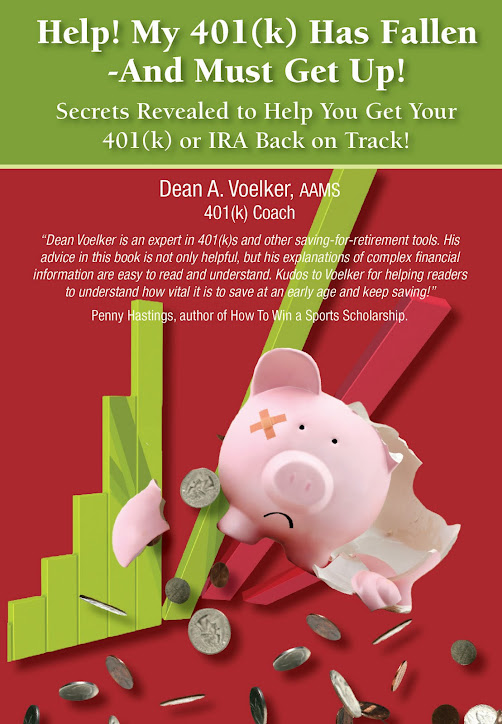
"Help! My 401(k) Has Fallen - And Must Get Up!" reveals little known secrets about 401(k) plans and IRAs. If you read the book, you will understand them and get more from them.
That's all for today. I really apreciate those who have been reading this, and those who have been supporting me. Also thanks to those who have been listening to "Improving Your Financial Health" on either Blog Talk Radio or WHME-FM.
Kudos to my good friend, Nikki Stauffer who recommended the book. Nikki always seems to come through for me when I really need some advice. If her firm was willing to promote the book, I'd hire her in a heartbeat.
Bowerman told several "horror stories" about publishing houses. Most people have a fantasy that they can simply write a book and sell a gazillion copies and then live like John Grisham for the rest of their life. Needless to say, I am pretty grounded in reality. The truth is, many authors have a hard time getting it published. Jack Canfield, author of the "Chicken Soup" books has a favorite word when he was getting multiple rejections - "Next!"
Anyway, even if you finally do get a publisher to take on your book project, and a promotion agent to write a press release, you will still end of doing the promotion leg work yourself. also, the publisher gets to keep most of the money. He shows examples of authors who wrote books that sell for about $15 and their cut is about .50 per book. Now THAT is wimpy!
According to Bowerman, once they write the press release, the publisher is done. On to the next Stephen King wannabe. There is only one person in the whole world who really cares about making sure that your book is promoted regularly - the author. So if you have to promote it yourself, why not publish it yourself.
The whole reason for this book was that I was meeting many people in this area who really weren't getting the most from their 401(k). Northern Indiana is one of the hardest hit areas for unemployment, and many folks simply cashed it in, in spite of taxes and penalties. Others who didn't cash in stopped contributing to their 401(k) especially if their company stopped matching contributions. There is no doubt in my mind that people need to have a much better understanding of how the 401(k) works.
Someone needs to say - This is your retirement plan. It may also be the only savings you have, so you'd better stop being 'wimpy' about it and start saving.
"Help! My 401(k) Has Fallen - And Must Get Up!" reveals little known secrets about 401(k) plans and IRAs. If you read the book, you will understand them and get more from them.
That's all for today. I really apreciate those who have been reading this, and those who have been supporting me. Also thanks to those who have been listening to "Improving Your Financial Health" on either Blog Talk Radio or WHME-FM.
Friday, October 9, 2009
Where's The Beef?

During the 1980’s there was a very popular commercial by Wendy’s. An elderly lady ordered a burger at a generic fast food counter. Upon seeing how puny and pathetic her tiny burger was, she grilled the sales clerk repeatedly - “Where’s the beef?” The commercial was a huge hit and “Where’s the beef?” was a well known catch phrase.
These days “Where’s the beef?” could easily be applied to the 401(k)s & IRAs of many people. In Daniel R. Solin’s book, “The Smartest 401(k) Book You’ll Ever Read”, he points out that “the typical twenty-something only invests 50.4% of his or her account in stock mutual funds.” You can’t keep up with inflation that way! Mr. Solin goes on to say that as we get older, that figure is also pretty timid. “The typical worker in their forties invests only 54.3% in stock funds.”
It doesn’t matter how old you are. Even people on the verge of retirement should be invested in stock mutual funds with a good part of their long term savings. After all, you could be retired for 20-30 years.
Stocks have been the only investment which has beaten inflation over the long term. And we NEED to prepare for inflation! Did you know that in 1989 (20 years ago), a loaf of bread costs an average of 0.67? And a postage stamp was just 0.25?
Mr. Solin also points out that “If you invested $1.00 in blue chip stocks in 1926, it would be worth $3077.33 today. That pencils out to a 10.42 average yearly return.”
Don’t be too fancy trying to pick the “right” fund. Look for mutual funds with long histories (10 years or longer) and low expenses. High management fees can really affect the return on your investment.
We will be looking at a few other ways to put some “Beef” back into your 401(k) in a future article.
You may contact me through my website at http://www.helpmy401k.us. You can also follow me on Twitter at http://www.twitter.com/deanvoelker. I also host a Weekly Internet Radio Broadcast "Improving Your Financial Health on Blog Talk Radio http://www.blogtalkradio.com/401kcoach
Tuesday, September 8, 2009
Raising Arizona - More SOLUTIONS for College Costs
Last time we looked at some solutions for college savings such as a regular savings plan and also working part time during High School.
What if you do those things, but it still isn´t enough to cover college costs? Or perhaps you are getting started late in the game?
Here are some ways to help pay for college even if you haven't saved much. (Besides winning the lottery or robbing a bank.) The first way is actually pretty obvious - although families don´t utilize it as much as they should. Contact the Financial Aid department from your college and make sure you have applied for any and all scholarship money that you have a chance to qualify for. Don´t leave any "free" money on the table.
Going along with this scholarship idea, does Johnny (or Jill) play any sports? Recently, on my Blog Talk Radio program, http://www.blogtalkradio.com/401kCoach/2009/09/02/Improving-Your-Financial-Health
I visited with Charlie Adams, the Senior National Speaker for the National Collegiate Scouting Assocaiation of Chicago. Charlie helps many high school athletes get scholarships to play various sports in college. Normally when I think of athletic scholarships, I would think of football and basketball at large universities.
However, Charlie points out that there are plenty of scholarships given to students who are decent athletes and good students. Colleges offer a wide range of athletic opportunities such as golf, lacrosse, cross country, and rowing. In fact, Charlie´s son Jack earned a scholarship to Millsaps College in Mississippi for cross country.
Charlie also talks about a book, "Athletes Wanted" by Chris Krause. http://www.ncsasports.org/about-ncsa/about-chris-krause The book points out that employers have a growing need to ¨hire quality people for their companies. Recruiters love interviewing candidates who have played collegiate sports. They have learned the value of goal setting, teamwork, time management, and motivation. So if Johnny or Jill have some athletic skills, look into this as an option.
One thing to keep in mind - Johnny and Jill need to keep their grades up. To qualify for scholarships at smaller schools in sports, there is more of an emphasis on the "Student" part of student-athlete. You may contact Charlie Adams at www.stokethefirewithin.com.
What if your child doesn't play sports? Could they be entreprenuers? There are several examples of students who saw a need and figured out a way to fill the need and profit from it. They learn (on their own) valuable skills in sales, marketing, and business management. This would also set them apart from other candidates when its time to leave college and interview for work. Here is an article on "Teen Money Making Ideas". http://teenmoneymakingideas.com/how-college-students-can-make-money-in-the-summer-in-12-of-the-top-home-based-businesses/
If Johnny starts a business and it really takes off, he may find his career in the process. There was once a college student named Bill Gates who actually dropped out of Harvard to focus on his Microsoft business full time. (Of course the reason was that he felt he wasn´t learning anything new about computers.)
If you like this option, you may want to look at books about young men and women who have started successful businesses. A great website for information is http://www.quintcareers.com/college_entrepreneur_resources.html
"OK" you think. "But I´m not Bill Gates or Shaquille O´ Neal.What else can I do?"
There are other ways to learn entrprenuerial skills in organizations which are already established. Looking back on my college years, I had an opportunity to work with the Southwestern Company. www.southwestern.com. Southwestern has been around since 1855. They have a long history of helping college students to earn money for college. Students also learn some valuable lessons in the process - motivation, goal setting, business management, how to sell, and how to deal with all types of people.
Southwestern works with over 3000 students per year in the US and the UK, and the average First Year student earns $2733/mo during the summer months. Like many other opportunities, as a student gains experience, they may become more proficient.
http://www.southwesterninfo.com/FAQ.aspx Please contact Southwestern for more information.
If none of these really work for you, there is one more idea on paying for college, and its also a great one. Talk to a local recruiter about military service. For the student who hasn't yet figured out what they want from college or what they want to do in life (and at 18, who really has it figured out?), the military gives you time to figure things out. Military service also teaches skills such as teamwork, goal setting, perseverance, and time management. And they can help you to pay for school. http://www.military.com/money-for-school/tuition-assistance/army-tuition-assistance
I've met a number of people who have served for 4 years, then went to college with money from the government. As I mentioned in my last article, a 20 year old freshman has a good chance of being more mature than an 18 year old. Wouldn't you agree then that a 22 year old freshman with skills learned in the military would be even more mature and ready to learn? It certainly adds to a resume, and can lead to all types of career choices later.
I hope these have been helpful ideas. None of them involve taking out a loan, and if we can avoid that, we'd all be better off. You can contact me at my website, www.helpmy401k.us or follow me on Twitter at www.twitter.com/deanvoelker. My Blog Talk Radio program airs weekly and the archives may be heard at www.blogtalkradio.com/401kcoach.
What if you do those things, but it still isn´t enough to cover college costs? Or perhaps you are getting started late in the game?
Here are some ways to help pay for college even if you haven't saved much. (Besides winning the lottery or robbing a bank.) The first way is actually pretty obvious - although families don´t utilize it as much as they should. Contact the Financial Aid department from your college and make sure you have applied for any and all scholarship money that you have a chance to qualify for. Don´t leave any "free" money on the table.
Going along with this scholarship idea, does Johnny (or Jill) play any sports? Recently, on my Blog Talk Radio program, http://www.blogtalkradio.com/401kCoach/2009/09/02/Improving-Your-Financial-Health
I visited with Charlie Adams, the Senior National Speaker for the National Collegiate Scouting Assocaiation of Chicago. Charlie helps many high school athletes get scholarships to play various sports in college. Normally when I think of athletic scholarships, I would think of football and basketball at large universities.
However, Charlie points out that there are plenty of scholarships given to students who are decent athletes and good students. Colleges offer a wide range of athletic opportunities such as golf, lacrosse, cross country, and rowing. In fact, Charlie´s son Jack earned a scholarship to Millsaps College in Mississippi for cross country.
Charlie also talks about a book, "Athletes Wanted" by Chris Krause. http://www.ncsasports.org/about-ncsa/about-chris-krause The book points out that employers have a growing need to ¨hire quality people for their companies. Recruiters love interviewing candidates who have played collegiate sports. They have learned the value of goal setting, teamwork, time management, and motivation. So if Johnny or Jill have some athletic skills, look into this as an option.
One thing to keep in mind - Johnny and Jill need to keep their grades up. To qualify for scholarships at smaller schools in sports, there is more of an emphasis on the "Student" part of student-athlete. You may contact Charlie Adams at www.stokethefirewithin.com.
What if your child doesn't play sports? Could they be entreprenuers? There are several examples of students who saw a need and figured out a way to fill the need and profit from it. They learn (on their own) valuable skills in sales, marketing, and business management. This would also set them apart from other candidates when its time to leave college and interview for work. Here is an article on "Teen Money Making Ideas". http://teenmoneymakingideas.com/how-college-students-can-make-money-in-the-summer-in-12-of-the-top-home-based-businesses/
If Johnny starts a business and it really takes off, he may find his career in the process. There was once a college student named Bill Gates who actually dropped out of Harvard to focus on his Microsoft business full time. (Of course the reason was that he felt he wasn´t learning anything new about computers.)
If you like this option, you may want to look at books about young men and women who have started successful businesses. A great website for information is http://www.quintcareers.com/college_entrepreneur_resources.html
"OK" you think. "But I´m not Bill Gates or Shaquille O´ Neal.What else can I do?"
There are other ways to learn entrprenuerial skills in organizations which are already established. Looking back on my college years, I had an opportunity to work with the Southwestern Company. www.southwestern.com. Southwestern has been around since 1855. They have a long history of helping college students to earn money for college. Students also learn some valuable lessons in the process - motivation, goal setting, business management, how to sell, and how to deal with all types of people.
Southwestern works with over 3000 students per year in the US and the UK, and the average First Year student earns $2733/mo during the summer months. Like many other opportunities, as a student gains experience, they may become more proficient.
http://www.southwesterninfo.com/FAQ.aspx Please contact Southwestern for more information.
If none of these really work for you, there is one more idea on paying for college, and its also a great one. Talk to a local recruiter about military service. For the student who hasn't yet figured out what they want from college or what they want to do in life (and at 18, who really has it figured out?), the military gives you time to figure things out. Military service also teaches skills such as teamwork, goal setting, perseverance, and time management. And they can help you to pay for school. http://www.military.com/money-for-school/tuition-assistance/army-tuition-assistance
I've met a number of people who have served for 4 years, then went to college with money from the government. As I mentioned in my last article, a 20 year old freshman has a good chance of being more mature than an 18 year old. Wouldn't you agree then that a 22 year old freshman with skills learned in the military would be even more mature and ready to learn? It certainly adds to a resume, and can lead to all types of career choices later.
I hope these have been helpful ideas. None of them involve taking out a loan, and if we can avoid that, we'd all be better off. You can contact me at my website, www.helpmy401k.us or follow me on Twitter at www.twitter.com/deanvoelker. My Blog Talk Radio program airs weekly and the archives may be heard at www.blogtalkradio.com/401kcoach.
Wednesday, August 26, 2009
Raising Arizona (and Arizona State and Others)
OK, I know - cheap marketing gimmick to get you to read it. Sorry I don't have anything Nicholas Cage here. However this may be more valuable information than the movie.
Inflation affects everything - the price of bread, milk, gasoline etc. But one thing that seems to have gone up even more drastically is the cost of college. When I graduated from the University of Illinois in 1986, I left with about $3000 in student loans, which was easily repaid in a few years.
Today, student loans can reach $19,000 or more for a graduating senior from a public college.
http://encarta.msn.com/encnet/departments/financialaid/?article=averagestudentloans For
private schools that figure may be even higher.
Want to study law or medicine? For as long as I can remember (back to my finger painting days), those were the "good money" jobs. Both professions require years of post graduate education and loans can easily climb into the $100,000 range. Recently, I saw a young female med student on the news questioning President Obama about his healthcare proposal. Her concern was that at graduation, her total student debt would exceed $300,000 - yes that was not a typo. She wasn't sure if her future income would be sufficient to pay it back.
Really?? I think some thought should have gone into this before taking the loans. Its hard to blame either the President or his healthcare bill for that. Out of curiousity, I checked to see what a monthly payment on this would be. To pay off $300,000 in 12 years at 5% interest would require a monthly payment of $2775.00. Now you could take longer or the interest rate may be different, but this gives you an idea. Certainly its out of my ballpark.
Dave Ramsey always encourages his listeners to look at the opportunity cost of buying something - whether its a car, a flat screen TV, or even college. http://www.daveramsey.com/etc/cms/go_to_college_5788.htmlc
What that means is - even if you have the money, what other opportunities might you be missing? What else could the money be used for? When it comes to college, can you really afford it if it means loading yourself down with debt? What is your re-payment plan going to be?
How likely is it to get a career in your chosen field of study that will allow you to re-pay the loan?
I'm not anti-college. I just want us to think and ask questions first before jumping in.
In the early days of the United States, colleges such as Harvard and Yale were primarily for the wealthy. As the country grew and times changed, state schools offered a wider range of programs and more people were able to attend college.
"No qualified student who wants to go to college should be barred by lack of money. That has long been a great American goal. I propose that we achieve it now." Former President Richard M. Nixon said this in a special message to Congress in 1970. A lot has happened in the past 40 years. Are we back to a point where college is only for the wealthiest among us?
As a Financial Advisor, I will say that college does require financial planning and disciplined saving. Flipping burgers for the summer will only scratch the surface.
In my next part on this, we will look at some solutions which can help with college costs.
You can contact me at www.helpmy401k.us and follow me on Twitter at www.twitter.com/deanvoelker. You can also listen to me on Blog Talk Radio at www.blogtalkradio.com/401kcoach.
Inflation affects everything - the price of bread, milk, gasoline etc. But one thing that seems to have gone up even more drastically is the cost of college. When I graduated from the University of Illinois in 1986, I left with about $3000 in student loans, which was easily repaid in a few years.
Today, student loans can reach $19,000 or more for a graduating senior from a public college.
http://encarta.msn.com/encnet/departments/financialaid/?article=averagestudentloans For
private schools that figure may be even higher.
Want to study law or medicine? For as long as I can remember (back to my finger painting days), those were the "good money" jobs. Both professions require years of post graduate education and loans can easily climb into the $100,000 range. Recently, I saw a young female med student on the news questioning President Obama about his healthcare proposal. Her concern was that at graduation, her total student debt would exceed $300,000 - yes that was not a typo. She wasn't sure if her future income would be sufficient to pay it back.
Really?? I think some thought should have gone into this before taking the loans. Its hard to blame either the President or his healthcare bill for that. Out of curiousity, I checked to see what a monthly payment on this would be. To pay off $300,000 in 12 years at 5% interest would require a monthly payment of $2775.00. Now you could take longer or the interest rate may be different, but this gives you an idea. Certainly its out of my ballpark.
Dave Ramsey always encourages his listeners to look at the opportunity cost of buying something - whether its a car, a flat screen TV, or even college. http://www.daveramsey.com/etc/cms/go_to_college_5788.htmlc
What that means is - even if you have the money, what other opportunities might you be missing? What else could the money be used for? When it comes to college, can you really afford it if it means loading yourself down with debt? What is your re-payment plan going to be?
How likely is it to get a career in your chosen field of study that will allow you to re-pay the loan?
I'm not anti-college. I just want us to think and ask questions first before jumping in.
In the early days of the United States, colleges such as Harvard and Yale were primarily for the wealthy. As the country grew and times changed, state schools offered a wider range of programs and more people were able to attend college.
"No qualified student who wants to go to college should be barred by lack of money. That has long been a great American goal. I propose that we achieve it now." Former President Richard M. Nixon said this in a special message to Congress in 1970. A lot has happened in the past 40 years. Are we back to a point where college is only for the wealthiest among us?
As a Financial Advisor, I will say that college does require financial planning and disciplined saving. Flipping burgers for the summer will only scratch the surface.
In my next part on this, we will look at some solutions which can help with college costs.
You can contact me at www.helpmy401k.us and follow me on Twitter at www.twitter.com/deanvoelker. You can also listen to me on Blog Talk Radio at www.blogtalkradio.com/401kcoach.
Tuesday, August 18, 2009
If You Knew You'd Get a "B"

Soon, all the kids will be back in school. My daughter can’t wait to see her friends and show off her new outfits. Back-To-School time usually also means plenty of sales which should get the cash registers ringing in your local retail shops.
Since we are just getting started, it’s too early to think about report cards and grades yet….or is it?
What if you knew at the beginning of the year, that your grade at the end of the year would be at least a “B” and no worse – no matter what? Better still, what if you got an “A” in one quarter, and a “C” in the other quarters – and at the end of the year, you got to keep the “A” as your grade for the year?
If that were true, how would you feel about going to school? Would you be more relaxed? Would you want to learn more? Would school be more fun?
Well, GUESS WHAT!! I can’t do much about Johnny’s math grade, or Susie’s US History Course, but I can provide solutions which may improve your confidence in investing.
How can you do that, you ask? Variable Annuities can provide Safe Growth and Safe Income.
How can you do that, you ask? Variable Annuities can provide Safe Growth and Safe Income.
Recently, Leslie Scism of the Wall Street Journal wrote “Because of such guarantees, many holders of variable annuities actually saw their accounts increase 6% or more in value last year, when the Standard & Poor’s 500-stock index dropped nearly 39%.” in her article “Long Derided, This Investment Now Looks Wise”. http://online.wsj.com/article/SB10001424052970204900904574302270919454880.html
Currently, you can earn as much as 7% or more on your principal base when you aren’t using it for income. That means if you start with $100,000, by the end of the year, you would have $107,000 to draw income from later – no matter what happens in the market. (As long as you leave it there.) And it can grow tax-deferred until you begin to take it out.
What if your account does better than 7%? Also, what if it only does better than 7% for one quarter? Wouldn’t it be great to keep the best quarter and lock it in for the year? Well….you CAN!
What if you could do this every year while you are building your Nest Egg? What if you went into the school year knowing you would at least get a “B”….and might get an “A”?
Then when you begin to take income from your savings, you can take 5% from the nest egg you’ve built for the rest of your life. The check would go up or stay the same, but never go down. (As long as you aren’t taking more than 5%.) Would that be OK?
There are some drawbacks to a Variable Annuity, which Ms. Scism also points out in her article http://online.wsj.com/article/SB10001424052970204900904574302270919454880.html the most obvious being the cost of the extra protection. George Lambert also points this out in his article, “The Cost of Variable Annuities” http://www.investopedia.com/articles/pf/06/variableannuity.asp in which he looks at the different types of protection – Growth Protection, Income Protection, and Death Benefit.
Another drawback is that when you consider investing into a Variable Annuity, you need to take a Long Term approach – like any other investment. Speak with a reliable advisor about whether or not it may be appropriate for you based on your time horizon and income needs at retirement. Early withdrawals may result in steep surrender charges, although many plans allow you to withdraw as much as 10% with no surrender charge.
The main advantage of course is taking the uncertainty over today’s economy out of the picture. And if you knew you’d get at least a “B”, wouldn’t you sleep better at night?
For more information on annuities, or other investment ideas, you may contact me at http://www.helpmy401k.us/. You may also follow me on Twitter at www.twitter.com/deanvoelker. I am also hosting a weekly internet radio podcast at http://www.blogtalkradio.com/401kcoach.
Monday, July 27, 2009
Climbing The Mountain

Thanks to my 7 years old daughter, I’ve been exposed (repeatedly) to the music of Miley Cyrus (aka Hannah Montana). Although my musical tastes are more in line with 1970’s & 1980’s Classic Rock, I have to admit that Miley’s music is pretty good.
One of her best songs, “The Climb” is popular right now, and it’s a very inspiring song. Hearing “The Climb” makes me think about how saving for retirement can be much like climbing a mountain. There may be obstacles along the way, but we keep climbing, and the climb is actually the best part of the process.
There are really 2 parts to climbing a mountain, going up and then coming back down. This makes a great analogy when thinking of your retirement savings. “Going up” is building your nest egg. “Coming down” is when you are beginning to take income from the nest egg you’ve built. Both parts are just as important, aren’t they?
If you are in the “Going Up” stage, and trying to build your nest egg, having a year like 2008 can be discouraging. What if you could get at least 7% or more every year on your savings? What if you were able to get even more in years when the market does better then 7%?
How about if I also told you that if you stayed invested for 10 years, you would DOUBLE your original investment? (By the way, according to the Rule of 72, that would be an average compound return of 7.2%.) http://en.wikipedia.org/wiki/Rule_of_72
Lets say you have an account which grows by 10% at the beginning of the year, hits its peak in June, then tails off for the rest of the year. What if I told you that the highest Quarterly Gain (in this case the end of June) would be locked in for you, in helping to build your nest egg?
The next year, the same thing would happen. The benefit base would increase by either 7% OR whatever the highest quarterly gain was.
What about “Coming Down” the mountain and taking income? How about if I told you that beginning at age 63, you would be able to take 5% from the benefit base you built and you could take 5% for life? Wouldn’t it be great to know that your pay can go up, if the account continues to grow - and your pay won’t go down?
And for those who can wait until age 75 to begin taking income, would you like to be able to take 6% FOR LIFE? Sounds pretty good so far? Wouldn’t you feel more comfortable climbing your mountain if you had a “safety net“? For more information, please contact me at http://helpmy401k.us/. You may also follow me on Twitter at www.twitter.com/deanvoelker.
Subscribe to:
Posts (Atom)