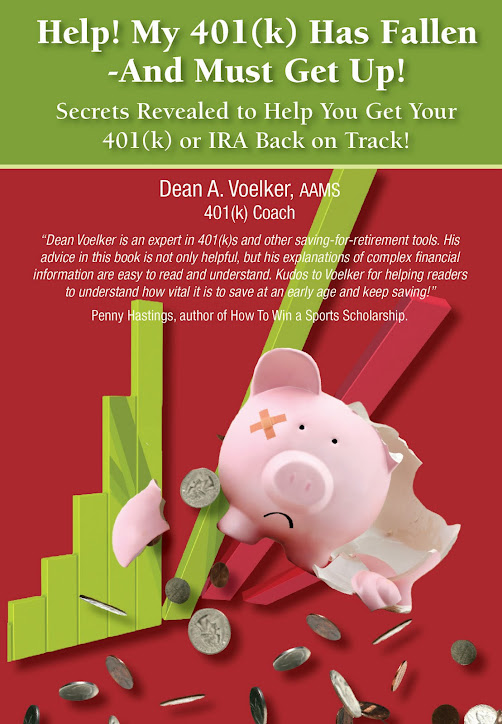
New Book - Coming November 2010

New Book - Coming November 2010
Help! My 401(k) Has Fallen - And Must Get Up!
Showing posts with label nest egg. Show all posts

Thursday, October 7, 2010

The Grand (Money) Illusion

OK, admit it. You've done it too. With the recent rise in the stock market, you've seen your 401(k) balance rise also. You've started to think "Its going up, so everything is fine. It was down for a while, but now its coming back."

Does that sound like you? When you open your 401(k) or IRA statement, do you just look at the total balance and try to figure out if it's up or down? 

Money Magazine has their 2011 Retirement Guide out now. Senior Editor, and Retirement Expert Penelope Wang urges you to think of your retirement differently. Don't just look at the total lump sum. Look at what the future income will be, which the lump sum will generate. This is the Grand Illusion (not the Styx song) when it comes to your 401(k), she says. Remember that your future purchasing power also will be eroded by inflation.

Recently, I had a client ask me if $1,000,000 was enough to retire on. My answer was that we don't know until we look at your income needs, and cash flow. What are your monthly and yearly expenses? 

Let's assume that you have $1,000,000 (I know, I know.....just play along, OK). Let's assume also that you will be drawing 4% per year from the $1,000,000 nest egg. In order to do that, your money needs to be invested so that you are getting at least a 4% real return (after taxes and inflation). That way you can take money out without shrinking your nest egg.

So, using the $1,000,000 figure we can multiply that by .04 and get $40,000. We will take $40,000 per year for income. Will $40,000 meet your expenses? Do you have other debt? How about other sources of income?  

You MUST look at your 401(k) or IRA this way! It is a source of future income for you. The bigger the nest egg, the more income it will generate. But now you know WHY you need a bigger nest egg! "People understand how much money they need each month, so it makes the saving process more relevant," says UCLA behaviorial finance professor Shlomo Benartzi.

By the way, Ms. Wang also shows an illustration in her article on how long we think our money will last. Although most experts asvise retirees to limit their withdrawals to a maximum of 4%/year, there is a myth that you can take out more. According to the Met Life Retirement Income IQ Test (2008), about 26% of those surveyed thought that withdrawing 7%/year from a nest egg was safe. A whopping 43% (nearly HALF) of the respondants believed that it would be OK to withdraw 10% or more per year!!

Picture a small boat with a leak.


At first, you may not notice the leak. As water rushes into the boat, you start to panic. The water pours in
faster and faster, until the boat begins to sink. That's what happens to IRAs when you take out too much money. Eventually you reach a point where you can't keep up.

Let's keep your boat floating!

Help! My 401(k) Has Fallen – And Must Get Up! is my new book. It has several ideas and strategies which will help you in your retirement savings journey. Get your ‘Fallen’ 401(k) back on its feet. Contact me to reserve your copy today. You can also get a FREE report at my website

The 5 Biggest Problems With 401(k) Plans & How To Fix Them.


You may also listen to my weekly radio program – Improving Your Financial Health on WHME-FM in South Bend. Archives can be heard on my website as well. If you live in the South Bend, IN area, I specialize in 401(k) rollovers or IRA reviews. You can also follow me on Twitter, Linked In, or Facebook .

Tuesday, September 28, 2010

Can Facebook Help You Save Money?

As I have been out talking about my new book, Help! My 401(k) Has Fallen - And Must Get Up!, one of the most common questions I am asked is this -

What is the one thing I can do to fix my 401(k)?

Of course, the person asking wants a simple answer, not a lot of broker speak. So here it is. Regardless of age, gender, or income, the simplest best answer I can give is:

Save More Money!  

How's that for simple? Money Magazine released some new information in a study from their Retirement Guide 2011 (Oct. 2010 issue).  If you are 35 years old and earn  $70,000/year and you save 10% of your pay, you'll have saved $936,100 by age 65.*

By waiting just 5 years to start and doing the same - saving 10% at age 40, your nest egg at age 65 will be $697,700.* (*Assumes 3% annual pay increases and 7% average annual returns on investment into a tax-sheltered account - IRA, 401k or 403b.)

While both figures sound like a lot of money, the difference of $238,400 means a difference of what you can potentially use for income. Assuming you take out 5% per year from your nest egg ($238,400 x .05 = $11,920/year) means that by starting at age 40, you could be cutting your future income by nearly $1,000/month!

Ben Franklin often preached on the virtues of compound interest. He called it the 8th wonder of the world.

So how do we save more money? As Nike might say, "Just Do It!"

It is much easier though if you can have someone to hold you accountable. This is where Facebook might come in. What if you posted a notice on your Facebook page to your friends and tell them to hold you to it. You could "tweet" it also.

"I promise, starting TODAY to pay myself first and put 10% of my pay into my 401(k)." 

Honestly, when you see some of the others posts on Facebook (i.e. "I hate rainy days.", "Halloween is coming.", "Out walking the dog."), you'd have to feel a bit proud posting something inteligent that will make a positive difference in your life, wouldn't you? You could start a trend. Have your friends (or at least one or two) hold you accountable.  

You could also set e-mail reminders which are specific. use a personal website such as http://www.mint.com/.
Send a message to your e-mail Inbox such as "Put $1000 into my Roth IRA this month." or "Every 3rd of the month I put $400 into my Roth IRA." You could arrange these to hit your Inbox when you get a bonus or unexpected money.

Don't despair if you've turned 45 and still haven't done much. Remember we had talked about how you could still achieve an added $1000/month of income at retirement by starting now and following a disciplined goal. I'll be reviewing some other ideas from the Money Magazine retirement guide in upcoming posts.

My book, Help! My 401(k) Has Fallen – And Must Get Up! has several ideas and strategies which will help you in your retirement savings journey. Get your ‘Fallen’ 401(k) back on its feet. Contact me to reserve your copy today. You can also get a FREE report at my website. The 5 Biggest Problems With 401(k) Plans – And How To Fix Them. I also host a 30 minute weekly radio program - Improving Your Financial Health on WHME-FM in South Bend. Archives can be heard on my website as well.

If you live in the South Bend, IN area, I am also happy to help with 401(k) rollovers or IRA reviews. You can follow me on Twitter, Linked In, or Facebook.

Friday, December 4, 2009

Retirement Calculators


There are some great tools and calculators you can use for free to help plan for retirement. Some of the best ones are those which you may not even know about.
First, not to toot my own horn, but my website, www.helpmy401k.us has a great tab called Investment Tools .
There are calculators there for almost everything. The most commonly used one is the 401(k) Calculator. You could also use the 457(b) calculator if you are a government employee, but the concept is the same.
Simply go to the 401(k) calculator and plug in your own numbers. For example, lets say you are 29 years old with $1000 in a retirement savings account. Lets also say that you earn $50,000 per year and that you follow Dave Ramsey's advice and put in 10% of your pay into your 401(k) or $5000. If you earn an average return on this 401(k) account of 8% and keep doing this until age 66, you will have saved $1,076,087 for retirement. And that does not include an employer match or a raise in pay - EVER. Personal Finance expert Eric Tyson has an idea which may help provide an incentive to save more in 401(k) or IRAs - instead of calling them those names, we should try calling these "tax-reduction accounts".
What if we did figure those in? Easy - just enter those numbers.
Well, lets say your employer matches your contribution by 50% of whatever you put in up to 4%. If you put in at least 4% or more (and we are doing 10%, remember?), that means you are getting another 2% ($1000) from the employer. Also, lets assume they will raise your pay by
2% per year as a cost of living increase. Keeping the other earlier numbers the same, you will now have saved $1,598,680 for retirement.
Here is another one which my be helpful if you are planning to pay off credit card debt. And you should absolutely do that! It will have you save more in your "tax-reduction accounts."
Let's say you have a balance of $2000 in a credit card account. Your current monthly payment is $125/month and your interest rate on the card is 17.5%. (Ugh!) If you do as Dave Ramsey says and do some "plastic surgery" on your card (cut it up and dont use it anymore!), did you know that you can pay the card off in 12 months by just raising your payment to $183/month? It's true and very easy to figure out using the "Credit Card Payoff" calculator on the site. This can be very helpful to see yourself making progress towards your goal, if you can't pay the entire amount, but know you should pay less than the minimum.
In upcoming blog articles, we will look at a few more of the calculators.
You can see these calculators and many other helpful ideas on my website, www.helpmy401k.us. You can also follow me on Twitter at www.twitter.com/deanvoelker . I also host a weekly internet radio program "Improving Your Financial Health" at http://www.blogtalkradio.com/401kcoach .


Friday, October 23, 2009

Wipe Out The Fear in South Bend


Feel like you are drowning in today's economy?
Inflation?
Shaky stock market?
Sinking dollar?
Unemployment?
Staggering debt?

Watching the news may seem like an ongoing care wreck - especially if you watch Glenn Beck, who always looks like he will suffer a breakdown right on camera - but as horrifying and overwhelming as the news is, you can't seem to pull yourself away.

We don't suffer from a lack of information - rather TOO MUCH information. Its all so confusing and you can feel like the rag doll being pulled apart from all directions.

How does all of this affect your ability to save for retirement? Is it possible to still have goals and dreams? Can you still retire with dignity?

Dan Rather was once quoted as saying "If all of the difficulties were known at the outset of a long journey, most of us would not start out at all."

Nothing great was ever achieved without hardships along the way. As an advisor, my job is to help you resolve your fears. Let's wipe them out and provide some peace of mind.

This year, when I became an iindependent advisor and opened my own office, I've been learning that most people would rather "not lose anymore" than to win with their long term savings. To quote another great American, Will Rogers - "I'm more concerned with the return OF my money than the return ON my money."

With that in mind, my purpose has been to focus on helping people to find a vehicle that would "not lose" and still let you win. What if I could toss you a "Life Preserver" for your savings? Remember when you first learned to swim? Those kickboards or noodles came in handy, didn't they? You learned eventually that the water is your friend. Once you stopped fighting it, and let it help you, swimming became more fun, right?

Russell Pearlman recently wrote an article titled, "Problems? What Problems?" from the November 2009 issue of "Smart Money" magazine. His article focused on annuities, which have become much more popular with investors as a life preserver for long term savings.
"Don't tell that (regarding annuity cost) to baby boomers looking for retirement security at a time when their 401(k) plans are still hurting; they just keep buying annuities. Through the first six months of the year, total annuity sales were almost $127 billion, only a 3 percent drop from 2008." he writes.

Again, the message I get from my clients and others I meet is "We want SAFETY and Peace of Mind."

Can we get "Guaranteed" growth for our long term savings?
Will it be better than current CD rates?
Can we get "Guaranteed" income when I retire - also better than current CD rates?
Can we make sure the income never goes down?
And lasts for a lifetime - even if we live to 100 or beyond?
And when that lifetime does end, can we leave something for our family and loved ones?

In short - YES! Mr. Pearlman goes on to write "Are annuities for you? Experts say the peace of mind may be worth it."

Another of my favorite articles this year was written by Leslie Scism of the Wall Street Journal. "Long Derided, This Investment Now Looks Wise". "Because of such guarantees, many holders of variable annuities actually saw their accounts increase 6% or more in value last year, when the Standard & Poors 500 stock index dropped nearly 39%." Ms. Scism writes.

Contact me today to learn more about how to get a life preserver (or noodle if you prefer) for your savings. Treat yourself to some Peace of Mind!

You can contact me through my website, http://www.helpmy401k.us and follow me on Twitter at http://www.twitter.com/deanvoelker. I also host a weekly internet radio braodcast, "Improving Your Financial Health" at http://www.blogtalkradio.com/401kcoach.


Friday, October 9, 2009

Where's The Beef?


During the 1980’s there was a very popular commercial by Wendy’s. An elderly lady ordered a burger at a generic fast food counter. Upon seeing how puny and pathetic her tiny burger was, she grilled the sales clerk repeatedly - “Where’s the beef?” The commercial was a huge hit and “Where’s the beef?” was a well known catch phrase.

These days “Where’s the beef?” could easily be applied to the 401(k)s & IRAs of many people. In Daniel R. Solin’s book, “The Smartest 401(k) Book You’ll Ever Read”, he points out that “the typical twenty-something only invests 50.4% of his or her account in stock mutual funds.” You can’t keep up with inflation that way! Mr. Solin goes on to say that as we get older, that figure is also pretty timid. “The typical worker in their forties invests only 54.3% in stock funds.”

It doesn’t matter how old you are. Even people on the verge of retirement should be invested in stock mutual funds with a good part of their long term savings. After all, you could be retired for 20-30 years.

Stocks have been the only investment which has beaten inflation over the long term. And we NEED to prepare for inflation! Did you know that in 1989 (20 years ago), a loaf of bread costs an average of 0.67? And a postage stamp was just 0.25?

Mr. Solin also points out that “If you invested $1.00 in blue chip stocks in 1926, it would be worth $3077.33 today. That pencils out to a 10.42 average yearly return.”

Don’t be too fancy trying to pick the “right” fund. Look for mutual funds with long histories (10 years or longer) and low expenses. High management fees can really affect the return on your investment.

We will be looking at a few other ways to put some “Beef” back into your 401(k) in a future article.

You may contact me through my website at http://www.helpmy401k.us. You can also follow me on Twitter at http://www.twitter.com/deanvoelker. I also host a Weekly Internet Radio Broadcast "Improving Your Financial Health on Blog Talk Radio http://www.blogtalkradio.com/401kcoach
 

Saturday, September 26, 2009

How To Find A Financial Advisor in South Bend


So the stock market has rebounded from its low point in March, 2009. As we are wrapping up the 3rd Quarter of this year, I have been reflecting on a few thoughts.
Although we have seen some market recovery, for many of us, 2009 has been more challenging than 2008.

* As I talk with people, I am sensing more uncertainty over the future of the economy and
their plans for retirement.

* Unemployment continues to stay at a high level. Some regions are higher than others
nationally. The Michiana area, with its long ties to the RV and automotive industry, has
experienced higher unemployment than other areas.

* Most recently, according to today’s South Bend Tribune we learned that the Braking
Division of Robert Bosch Corp. will be sold to Akebono Braking Industry of Tokyo, Japan. This
puts more strain on our area’s economy and could result in additional job losses.

* Many of those I have talked with are continuing to look for ways to pinch pennies, cut
corners and make their money last.

The one thing which hasn’t changed is that people still need to live their lives in dignity when they finally retire. And with people living longer than they used to, that takes Savings & Planning. Costs of living will continue to rise as well.

If you are living in the South Bend, IN area, how do you find someone who can help you develop the right strategy for you to reach your goals in these trying times? There are several qualities you should look for when shopping for an advisor, no matter where you live.

* Is he/she a Good Listener? Can you share your dreams & goals with them?

Do they make you feel important? Do they ask you questions such as “What is
important about your savings to you?” and “What would you like your retirement to be
like?” If all they do is tell you about the latest stock tip, or if they do all the talking, it
may be time to look elsewhere.

* Do they have a reasonable amount of experience?

Advisors can sometimes fall into 2 groups. You may not want an advisor that the ink on
their license has not yet dried. Most of us if asked would prefer an experienced advisor,
although you may want to find out if they are accepting new clients, or is there a
minimum amount to invest. There is a great website, http://www.financialadvisormatch.com/.
You can plug in the area you live in and it can give unbiased information on advisors in
that area. Also you can look up an advisor by name.

Another great website to learn information is http://www.linkedin.com/ which is a
professional networking site. This can give you great information about your
Advisor, much like an on-line resume.

* Does he/she have the “heart of a teacher”?

This is a comment often made by financial talk radio show host, Dave Ramsey.
Dave has grown in popularity because people are getting back to basics and
want common sense advice. Most people want investing concepts made simple.
Can your advisor help make this ‘fun’ to learn? Or do they talk in technical jargon?

* Does he/she talk about WHY Investing is so important for all of us?

Can they look at your budget with you and help you determine what type of income
you’ll need at retirement? By helping you know how much income you need (after
Social Security and any other sources of income), you should have a much better idea
for how much you need to be saving - AND put together a plan to do it!

* Will they offer to review your 401(k) and other statements for FREE?

Some advisors are “fee” based and charge by the session or by the hour for advice.
Others work on commission and are only paid when investments are made. For most of
us, this is the fairest method. There will always be times you have a question, and
advice should be free. Depending on how much you invest, you may also qualify for
volume discounts, also known as “breakpoints”.

* Is your advisor independent, or do they work with a larger firm?

This is really a matter of personal preference and there are pros & cons to each. Also
there are great advisors with either side. Many people prefer an established name brand
firm, while others enjoy the personal attention they may get from an independent.
In some ways, you could compare working with an advisor to eating at a restaurant.
There are large national chains, and also individually owned local restaurants which
have found their own niche.

There was a great article earlier this month (Sept 14, 2009)
“Schwab Says Independent Advisers Attract Brokerage Firm Assets”
http://www.bloomberg.com/apps/news?pid=20603037&sid=aYTCv4DGu76Y
by Alexis Leondis of Bloomberg.com. The article shows the results of a survey done by
Charles Schwab about where clients are holding their assets. Ms. Leondis states,
“Almost 90% of the independent Registered Investment Advisors said that they gained
assets in the last 6 months and 45% of the assets came from so-called full-service
brokerage firms.”

Whether he/she works independently, or with a larger firm, your advisor can’t prevent
market declines. However, working with someone you are comfortable with should at
least help you to feel better about the future of your retirement.
Best wishes in your search!

Dean Voelker is an Independent Registered Investment Advisor in South Bend. He has
been licensed in Indiana and Michigan since 2003. You can follow Dean on Twitter, and also find his profile at Linked In and Financial Advisor Match. Dean also hosts a weekly Podcast program
on Blog Talk Radio, "Improving Your Financial Health".  


Tuesday, September 8, 2009

Raising Arizona - More SOLUTIONS for College Costs

Last time we looked at some solutions for college savings such as a regular savings plan and also working part time during High School.

What if you do those things, but it still isn´t enough to cover college costs? Or perhaps you are getting started late in the game?

Here are some ways to help pay for college even if you haven't saved much. (Besides winning the lottery or robbing a bank.) The first way is actually pretty obvious - although families don´t utilize it as much as they should. Contact the Financial Aid department from your college and make sure you have applied for any and all scholarship money that you have a chance to qualify for. Don´t leave any "free" money on the table.

Going along with this scholarship idea, does Johnny (or Jill) play any sports? Recently, on my Blog Talk Radio program, http://www.blogtalkradio.com/401kCoach/2009/09/02/Improving-Your-Financial-Health
I visited with Charlie Adams, the Senior National Speaker for the National Collegiate Scouting Assocaiation of Chicago. Charlie helps many high school athletes get scholarships to play various sports in college. Normally when I think of athletic scholarships, I would think of football and basketball at large universities.

However, Charlie points out that there are plenty of scholarships given to students who are decent athletes and good students. Colleges offer a wide range of athletic opportunities such as golf, lacrosse, cross country, and rowing. In fact, Charlie´s son Jack earned a scholarship to Millsaps College in Mississippi for cross country.

Charlie also talks about a book, "Athletes Wanted" by Chris Krause. http://www.ncsasports.org/about-ncsa/about-chris-krause The book points out that employers have a growing need to ¨hire quality people for their companies. Recruiters love interviewing candidates who have played collegiate sports. They have learned the value of goal setting, teamwork, time management, and motivation. So if Johnny or Jill have some athletic skills, look into this as an option.

One thing to keep in mind - Johnny and Jill need to keep their grades up. To qualify for scholarships at smaller schools in sports, there is more of an emphasis on the "Student" part of student-athlete. You may contact Charlie Adams at www.stokethefirewithin.com.

What if your child doesn't play sports? Could they be entreprenuers? There are several examples of students who saw a need and figured out a way to fill the need and profit from it. They learn (on their own) valuable skills in sales, marketing, and business management. This would also set them apart from other candidates when its time to leave college and interview for work. Here is an article on "Teen Money Making Ideas". http://teenmoneymakingideas.com/how-college-students-can-make-money-in-the-summer-in-12-of-the-top-home-based-businesses/

If Johnny starts a business and it really takes off, he may find his career in the process. There was once a college student named Bill Gates who actually dropped out of Harvard to focus on his Microsoft business full time. (Of course the reason was that he felt he wasn´t learning anything new about computers.)

If you like this option, you may want to look at books about young men and women who have started successful businesses. A great website for information is http://www.quintcareers.com/college_entrepreneur_resources.html

"OK" you think. "But I´m not Bill Gates or Shaquille O´ Neal.What else can I do?"
There are other ways to learn entrprenuerial skills in organizations which are already established. Looking back on my college years, I had an opportunity to work with the Southwestern Company. www.southwestern.com. Southwestern has been around since 1855. They have a long history of helping college students to earn money for college. Students also learn some valuable lessons in the process - motivation, goal setting, business management, how to sell, and how to deal with all types of people.

Southwestern works with over 3000 students per year in the US and the UK, and the average First Year student earns $2733/mo during the summer months. Like many other opportunities, as a student gains experience, they may become more proficient.
http://www.southwesterninfo.com/FAQ.aspx Please contact Southwestern for more information.

If none of these really work for you, there is one more idea on paying for college, and its also a great one. Talk to a local recruiter about military service. For the student who hasn't yet figured out what they want from college or what they want to do in life (and at 18, who really has it figured out?), the military gives you time to figure things out. Military service also teaches skills such as teamwork, goal setting, perseverance, and time management. And they can help you to pay for school. http://www.military.com/money-for-school/tuition-assistance/army-tuition-assistance

I've met a number of people who have served for 4 years, then went to college with money from the government. As I mentioned in my last article, a 20 year old freshman has a good chance of being more mature than an 18 year old. Wouldn't you agree then that a 22 year old freshman with skills learned in the military would be even more mature and ready to learn? It certainly adds to a resume, and can lead to all types of career choices later.

I hope these have been helpful ideas. None of them involve taking out a loan, and if we can avoid that, we'd all be better off. You can contact me at my website, www.helpmy401k.us or follow me on Twitter at www.twitter.com/deanvoelker. My Blog Talk Radio program airs weekly and the archives may be heard at www.blogtalkradio.com/401kcoach.

Tuesday, August 18, 2009

If You Knew You'd Get a "B"


Soon, all the kids will be back in school. My daughter can’t wait to see her friends and show off her new outfits. Back-To-School time usually also means plenty of sales which should get the cash registers ringing in your local retail shops.

Since we are just getting started, it’s too early to think about report cards and grades yet….or is it?

What if you knew at the beginning of the year, that your grade at the end of the year would be at least a “B” and no worse – no matter what? Better still, what if you got an “A” in one quarter, and a “C” in the other quarters – and at the end of the year, you got to keep the “A” as your grade for the year?
If that were true, how would you feel about going to school? Would you be more relaxed? Would you want to learn more? Would school be more fun?
Well, GUESS WHAT!! I can’t do much about Johnny’s math grade, or Susie’s US History Course, but I can provide solutions which may improve your confidence in investing.
How can you do that, you ask? Variable Annuities can provide Safe Growth and Safe Income.
Recently, Leslie Scism of the Wall Street Journal wrote “Because of such guarantees, many holders of variable annuities actually saw their accounts increase 6% or more in value last year, when the Standard & Poor’s 500-stock index dropped nearly 39%.” in her article “Long Derided, This Investment Now Looks Wise”. http://online.wsj.com/article/SB10001424052970204900904574302270919454880.html

Currently, you can earn as much as 7% or more on your principal base when you aren’t using it for income. That means if you start with $100,000, by the end of the year, you would have $107,000 to draw income from later – no matter what happens in the market. (As long as you leave it there.) And it can grow tax-deferred until you begin to take it out.

What if your account does better than 7%? Also, what if it only does better than 7% for one quarter? Wouldn’t it be great to keep the best quarter and lock it in for the year? Well….you CAN!

What if you could do this every year while you are building your Nest Egg? What if you went into the school year knowing you would at least get a “B”….and might get an “A”?

Then when you begin to take income from your savings, you can take 5% from the nest egg you’ve built for the rest of your life. The check would go up or stay the same, but never go down. (As long as you aren’t taking more than 5%.) Would that be OK?

There are some drawbacks to a Variable Annuity, which Ms. Scism also points out in her article http://online.wsj.com/article/SB10001424052970204900904574302270919454880.html the most obvious being the cost of the extra protection. George Lambert also points this out in his article, “The Cost of Variable Annuities” http://www.investopedia.com/articles/pf/06/variableannuity.asp in which he looks at the different types of protection – Growth Protection, Income Protection, and Death Benefit.

Another drawback is that when you consider investing into a Variable Annuity, you need to take a Long Term approach – like any other investment. Speak with a reliable advisor about whether or not it may be appropriate for you based on your time horizon and income needs at retirement. Early withdrawals may result in steep surrender charges, although many plans allow you to withdraw as much as 10% with no surrender charge.

The main advantage of course is taking the uncertainty over today’s economy out of the picture. And if you knew you’d get at least a “B”, wouldn’t you sleep better at night?

For more information on annuities, or other investment ideas, you may contact me at http://www.helpmy401k.us/. You may also follow me on Twitter at www.twitter.com/deanvoelker. I am also hosting a weekly internet radio podcast at http://www.blogtalkradio.com/401kcoach.

Monday, July 27, 2009

Climbing The Mountain


Thanks to my 7 years old daughter, I’ve been exposed (repeatedly) to the music of Miley Cyrus (aka Hannah Montana). Although my musical tastes are more in line with 1970’s & 1980’s Classic Rock, I have to admit that Miley’s music is pretty good.

One of her best songs, “The Climb” is popular right now, and it’s a very inspiring song. Hearing “The Climb” makes me think about how saving for retirement can be much like climbing a mountain. There may be obstacles along the way, but we keep climbing, and the climb is actually the best part of the process.

There are really 2 parts to climbing a mountain, going up and then coming back down. This makes a great analogy when thinking of your retirement savings. “Going up” is building your nest egg. “Coming down” is when you are beginning to take income from the nest egg you’ve built. Both parts are just as important, aren’t they?

If you are in the “Going Up” stage, and trying to build your nest egg, having a year like 2008 can be discouraging. What if you could get at least 7% or more every year on your savings? What if you were able to get even more in years when the market does better then 7%?
How about if I also told you that if you stayed invested for 10 years, you would DOUBLE your original investment? (By the way, according to the Rule of 72, that would be an average compound return of 7.2%.) http://en.wikipedia.org/wiki/Rule_of_72

Lets say you have an account which grows by 10% at the beginning of the year, hits its peak in June, then tails off for the rest of the year. What if I told you that the highest Quarterly Gain (in this case the end of June) would be locked in for you, in helping to build your nest egg?

The next year, the same thing would happen. The benefit base would increase by either 7% OR whatever the highest quarterly gain was.

What about “Coming Down” the mountain and taking income? How about if I told you that beginning at age 63, you would be able to take 5% from the benefit base you built and you could take 5% for life? Wouldn’t it be great to know that your pay can go up, if the account continues to grow - and your pay won’t go down?
And for those who can wait until age 75 to begin taking income, would you like to be able to take 6% FOR LIFE? Sounds pretty good so far? Wouldn’t you feel more comfortable climbing your mountain if you had a “safety net“? For more information, please contact me at http://helpmy401k.us/. You may also follow me on Twitter at www.twitter.com/deanvoelker.


Wednesday, June 3, 2009

Fixing Your 401(k) - Part 6

Problem #5 - Investments (Company Stock)

Do you own stock in your own company? Companies have always encouraged employees to think like an owner. By owning stock, you are a part owner of your own company. There is nothing wrong with that idea, and if you work for a large company which issues stock, that may be an option available to you in your 401(k) plan.

But how much should you own? Not more than 5-10% of the company in your 401(k). There are just too many "Murphys" out there. http://www.murphys-laws.com/murphy/murphy-true.html

Mutual funds are much more recommended as a way to spread your money out so it can grow.
“Money, you should pardon the expression, is a little bit like manure. It doesn’t do any
good unless it’s spread around, encouraging young things to grow.”
Barbra Streisand

One of the worst examples of company stock going sour in a 401(k) is Enron. Enron has been a running joke since 2002 for their collapse due to fraudulent business & accounting practices.
Many of their workers lost their life savings when Enron filed bankruptcy and their stock was rendered worthless. http://www.albionmonitor.com/0202a/enrontimeline.html

Enron's 401(k) plan was enormous - over $1 Billion in total assets, of which $600 Million was in Enron stock - That is 60%! Enron offered a matching plan of up to 6% of an employee's base pay - but paid the match in STOCK, not cash. When the stock plummeted from over $90 per share to less than a $1.00 in 16 months, their employees lost their life savings and any chance at retiring the way they had planned.
http://encarta.msn.com/media_701610605___1___6/the_fall_of_enron_stock.html

Please meet with your advisor if you have more than 10% of your 401(k) or portfolio in company stock. For more information, or to contact me, please visit http://www.helpmy401k.us. You can also follow me on Twitter at http://www.twitter.com/DeanVoelker

Wednesday, May 20, 2009

Fixing Your 401(k) - Part 1

Did you know that over 50% of Americans have a 401(k) plan? For many of us it is our primary funding source of retirement savings. For some, it may be the only source of savings. http://www.gallup.com/poll/16564/Many-Consumers-Lack-Rainy-Day-Fund.aspx

401(k) Plans can be great for helping to fund your retirement - - IF you are saving enough and don't fall into some common traps. I love 401(k)s and have a passion for helping companies and indviduals get more from their plans. With that in mind, I am going to address 5 major issues with 401(k) plans in my next several posts.

Around 1985, 401(k) plans passed pensions as the Primary Retirement Vehicle, as the New York Times states in a recent article.
http://roomfordebate.blogs.nytimes.com/2009/03/25/so-much-for-the-401k-now-what/?scp=4&sq=401k%20passed%20pension&st=cse

Pensions had been dying for a long time, mostly due to cost. 401(k)s require employees to contribute to their own retirement savings. Many companies provide a matching contribution of some sort, although in recent times, those have also been cut back.
http://www.nytimes.com/2008/12/21/your-money/401ks-and-similar-plans/21retire.html?_r=1&scp=5&sq=401k%20passed%20pension&st=cse

How did 401(k)s come into being?

In 1978, the Tax Reform Act passed (Provision Internal Revenue Code Section 401(k)), which allowed employees to receive a portion of their income as tax deferred compensation. Ted Benna
http://pipl.com/directory/people/Ted/Benna then created the first 401(k) in 1979. Also in that year, Johnson & Johnson, Honeywell, and Pepsico established 401(k) plans for their employees.

In my next post, we will look at the first serious issue which needs to be addressed in 401(k)s -
PARTICIPATION.

For more information, please contact me at http://www.helpmy401k.us/.

Monday, April 27, 2009

Are You Saving Enough?

Boston College’s Center for Retirement Research recently found that about 64% of Americans aren’t saving enough to maintain their standard of living in retirement. Some ways to tell if you’re at risk:

Find A Percentage -

The general rule of thumb is that retirees need about 70% to 80% of pre-retirement income to maintain their standard of living. To get a better sense though, consider using software that helps take into account factors like paying college tuition or taking fewer vacations. ESPlanner, which costs $150 and is available at www.esplanner.com , is one place to start.

Map Out Withdrawals -

Many retirees will withdraw 4% of their portfolio in the first year of retirement and adjust that dollar amount each year to account for inflation. Find out if you can live comfortably on that amount plus Social Security payments; if you’ve had heavy portfolio losses, consider skipping the inflation bump initially.

Consider Health Care -

Because lower-income seniors have their long-term care covered by Medicaid, and wealthier seniors can self-fund their care or buy insurance, those in the middle often have the hardest time paying for such services, a big drain on a nest egg. Anthony Webb of Boston College says that non-Medicaid seniors with less than $1 million in assets should plan early for big health costs by cutting expenses elsewhere or delaying retirement.

Figure the Odds -

Financial planners can often do modeling that helps calculate the chances you will still have a nest egg to draw from at a given age. Many retirement experts urge workers to wait to retire until their percentage chance of outliving their nest egg drops to 15% or below. To be safe, it’s good to assume you’ll live to age 90 or 95, especially with longer life spans.

For more information, please contact me at www.deanvoelker.com

(Text reprinted from Smart Money Magazine, March 31, Angie C. Marek)