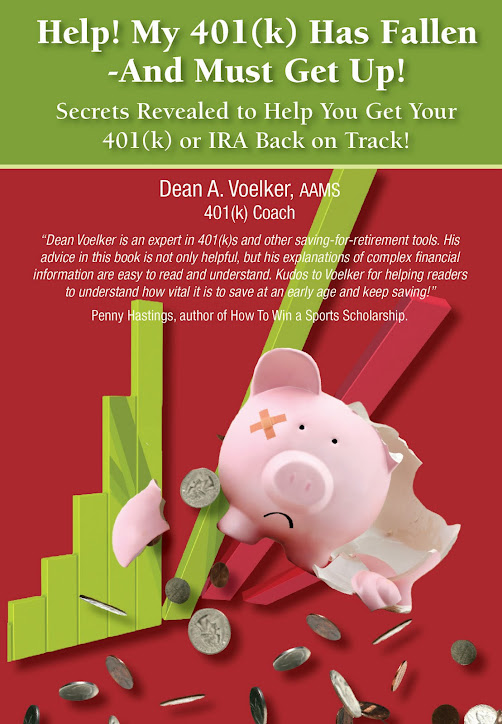
New Book - Coming November 2010

New Book - Coming November 2010
Help! My 401(k) Has Fallen - And Must Get Up!
Showing posts with label annuity. Show all posts

Monday, June 28, 2010

Five Situations for Variable Annuities

According to the Insured Retirement Institute, sales of Variable Annuities grew by 3% from this time last year. VAs aren't for everyone, however in the right circumstances, variable annuities offer solid benefits. There are at least 5 scenarios in which an advisor may consider recommending a variable annuity to clients.

Feel free to add your own to the list! You can contact me for more information on annuties at http://www.helpmy401k.us/

1. Lowering Income Taxes
If you are in the maximum federal and state tax bracket, a VA may help to lower your taxes. Please review your situation with a tax specialist, but a VA can work similarly to an IRA in deferring taxes until money is withdrawn from the acccount.

2. Calming Jittery Investors
This is likely the biggest reason why VA sales are up. If you are nervous about the market but still need your money to grow over time, a VA can act as a "life preserver" for your long term savings.

3. Saving Above Contribution Maximums
If you have maxed out your IRA and 401(k) and still want to save more for retirement, you can put money into a VA. If you are a small business owner, you may also consider a SEP IRA (Simplified Employee Pension). The SEP allows you to save up to 25% of your income and deduct it from your taxes.

4. Guaranteed Income
Annuities have a primary purpose of providing guaranteed income. With people living longer and needing income in retirement, having an annuity can be like setting up a personal pension plan from your savings. Look for plans which offer Lifetime Income.

5. Death Benefit
If you haven't taken income, many annuities will guarantee a death benefit of the amount you invested as a minimum. This is important, and this is where an annuity differs from ordinary mutual funds.

Here's an example. Let's take 2 investors, George and Jerry. Let's say that both of them retire at 65 years old and have 401(k) balances of $100,000. They roll their 401(k) plans over to IRAs. George invests in mutual funds, while Jerry invests in a variable annuity with a guaranteed minimum death benefit. After 4 years, we have another huge loss in the stock market, and their accounts drop to $80,000. Neither of them have taken any income out of their IRAs yet, and are still under the age of 70 1/2 when they would need to take a Required Minimum Distribution.

If George dies, he leaves the balance of his account - $80,000 to his beneficiaries. If Jerry dies, he would leave $100,000, which is what he started with, even if the value of the account is less. Of course, if the account balance in either case is more than $100,000, the death benefit would be the same as the account balance.

Annuities can be beneficial in the right situations. Please contact me and let me know how I may help further.

Wednesday, February 3, 2010

Taking Stock

I'm not a big individual stock fan. For most people, mutual funds are a much better way to invest. Its easier to be diverisfied and its also easier to add money systematically.

However, I did see something recently which I thought my readers may enjoy. If you were going to invest in stocks, which companies would be good ones to own long-term? At least one sign of a great company is one which is able to consistently increase their dividend payment.

If you aren't sure what a dividend is, think of it this way. When you own stock, you own a tiny piece of that company. Your investment rises and falls with the performance of the company. Over time, you would like to think the company will grow, and your money will grow with it. Companies which have established themselves and become profitable will share part of their profits with you as a part owner. Those profit sharing payments are known as dividends and are usually paid once every 3 months.

Again, the sign of a great company is one which has raised its dividend payment consistently, even in tough times. Raising the dividend for shareholders is like giving them a pay raise. (CDs don't do THAT!!) Those companies would be great to own long term.

What if a company were able to raise its dividend 25 years in a row or more?

Here are the ones which have:
Abbott Labs                     (ABT)
Bemis                               (BMS)
Century Tel                     (CTL)
Chubb                               (CB)
Coca-Cola                        (KO)
Exxon-Mobil                    (XOM)
Johnson & Johnson         (JNJ)
Mc Donalds                     (MCD)
3M                                   (MMM)

Pitney Bowes                  (PBI)
PPG                                 (PPG)
Proctor & Gamble          (PG)
Walmart                          (WMT)    

S&P reports that since 1926, dividends have contributed to about 1/3 of the total return on your investment.

Another thing I like about dividends is that when the stock price goes down, the dividend yield goes up. Its a great time to buy more of great companies. That is what Warren Buffett does!

For example, lets look at Proctor & Gamble. Shares of PG are currently (2/3/10) at $62.90. Dividends are paid at $1.76/share, which is divided into 4 quarterly payments. You will get a dividend return of 2.8% on any shares purchased at that price.

What if you had been fortunate enough to buy in March of 2009, when it was selling for around $44/share? Well, you still would have gotten $1.76 per share, but that works out to about a 4% dividend return. (Better than a CD, and with potential to grow!)

Warren Buffett has become extremely wealthy because he buys great companies and holds them, collecting dividends which increase year after year after year.

Again, I am not encouraging people to buy individual stocks. There are plenty of financial stocks such as Citigroup and Bank of America which also had wonderful histories of increased dividends, until 2008.
Dividends are certainly something to consider though for any investment - including mutual funds and annuities.

You can contact me through my website, http://www.helpmy401k.us/. You can also contact me on LinkedIn at http://www.linkedin.com/in/dvoelker, or Twitter at http://www.twitter.com/deanvoelker. I am currently hosting a weekly financial advice program, "Improving Your Financial Health" on Blog Talk Radio at http://www.blogtalkradio.com/401kcoach.  Let me know how I may help you!


Friday, October 23, 2009

Wipe Out The Fear in South Bend


Feel like you are drowning in today's economy?
Inflation?
Shaky stock market?
Sinking dollar?
Unemployment?
Staggering debt?

Watching the news may seem like an ongoing care wreck - especially if you watch Glenn Beck, who always looks like he will suffer a breakdown right on camera - but as horrifying and overwhelming as the news is, you can't seem to pull yourself away.

We don't suffer from a lack of information - rather TOO MUCH information. Its all so confusing and you can feel like the rag doll being pulled apart from all directions.

How does all of this affect your ability to save for retirement? Is it possible to still have goals and dreams? Can you still retire with dignity?

Dan Rather was once quoted as saying "If all of the difficulties were known at the outset of a long journey, most of us would not start out at all."

Nothing great was ever achieved without hardships along the way. As an advisor, my job is to help you resolve your fears. Let's wipe them out and provide some peace of mind.

This year, when I became an iindependent advisor and opened my own office, I've been learning that most people would rather "not lose anymore" than to win with their long term savings. To quote another great American, Will Rogers - "I'm more concerned with the return OF my money than the return ON my money."

With that in mind, my purpose has been to focus on helping people to find a vehicle that would "not lose" and still let you win. What if I could toss you a "Life Preserver" for your savings? Remember when you first learned to swim? Those kickboards or noodles came in handy, didn't they? You learned eventually that the water is your friend. Once you stopped fighting it, and let it help you, swimming became more fun, right?

Russell Pearlman recently wrote an article titled, "Problems? What Problems?" from the November 2009 issue of "Smart Money" magazine. His article focused on annuities, which have become much more popular with investors as a life preserver for long term savings.
"Don't tell that (regarding annuity cost) to baby boomers looking for retirement security at a time when their 401(k) plans are still hurting; they just keep buying annuities. Through the first six months of the year, total annuity sales were almost $127 billion, only a 3 percent drop from 2008." he writes.

Again, the message I get from my clients and others I meet is "We want SAFETY and Peace of Mind."

Can we get "Guaranteed" growth for our long term savings?
Will it be better than current CD rates?
Can we get "Guaranteed" income when I retire - also better than current CD rates?
Can we make sure the income never goes down?
And lasts for a lifetime - even if we live to 100 or beyond?
And when that lifetime does end, can we leave something for our family and loved ones?

In short - YES! Mr. Pearlman goes on to write "Are annuities for you? Experts say the peace of mind may be worth it."

Another of my favorite articles this year was written by Leslie Scism of the Wall Street Journal. "Long Derided, This Investment Now Looks Wise". "Because of such guarantees, many holders of variable annuities actually saw their accounts increase 6% or more in value last year, when the Standard & Poors 500 stock index dropped nearly 39%." Ms. Scism writes.

Contact me today to learn more about how to get a life preserver (or noodle if you prefer) for your savings. Treat yourself to some Peace of Mind!

You can contact me through my website, http://www.helpmy401k.us and follow me on Twitter at http://www.twitter.com/deanvoelker. I also host a weekly internet radio braodcast, "Improving Your Financial Health" at http://www.blogtalkradio.com/401kcoach.


Monday, July 27, 2009

Climbing The Mountain


Thanks to my 7 years old daughter, I’ve been exposed (repeatedly) to the music of Miley Cyrus (aka Hannah Montana). Although my musical tastes are more in line with 1970’s & 1980’s Classic Rock, I have to admit that Miley’s music is pretty good.

One of her best songs, “The Climb” is popular right now, and it’s a very inspiring song. Hearing “The Climb” makes me think about how saving for retirement can be much like climbing a mountain. There may be obstacles along the way, but we keep climbing, and the climb is actually the best part of the process.

There are really 2 parts to climbing a mountain, going up and then coming back down. This makes a great analogy when thinking of your retirement savings. “Going up” is building your nest egg. “Coming down” is when you are beginning to take income from the nest egg you’ve built. Both parts are just as important, aren’t they?

If you are in the “Going Up” stage, and trying to build your nest egg, having a year like 2008 can be discouraging. What if you could get at least 7% or more every year on your savings? What if you were able to get even more in years when the market does better then 7%?
How about if I also told you that if you stayed invested for 10 years, you would DOUBLE your original investment? (By the way, according to the Rule of 72, that would be an average compound return of 7.2%.) http://en.wikipedia.org/wiki/Rule_of_72

Lets say you have an account which grows by 10% at the beginning of the year, hits its peak in June, then tails off for the rest of the year. What if I told you that the highest Quarterly Gain (in this case the end of June) would be locked in for you, in helping to build your nest egg?

The next year, the same thing would happen. The benefit base would increase by either 7% OR whatever the highest quarterly gain was.

What about “Coming Down” the mountain and taking income? How about if I told you that beginning at age 63, you would be able to take 5% from the benefit base you built and you could take 5% for life? Wouldn’t it be great to know that your pay can go up, if the account continues to grow - and your pay won’t go down?
And for those who can wait until age 75 to begin taking income, would you like to be able to take 6% FOR LIFE? Sounds pretty good so far? Wouldn’t you feel more comfortable climbing your mountain if you had a “safety net“? For more information, please contact me at http://helpmy401k.us/. You may also follow me on Twitter at www.twitter.com/deanvoelker.


Tuesday, June 16, 2009

Using Protection?

That should have gotten your attention!

In my last post, I discussed some basics of annuities. Annuities can offer some protection for your savings which other investments, such as stocks or mutual funds do not. Keep in mind that the value of your account may still go down.

Lets talk about a few protections which you may get from an annuity.

GUARANTEED DEATH BENEFIT - The first one, common to most annuities, is the Guranteed Death Benefit. What is means is that if you invested a sum of money into an annuity, your beneficiaries will receive at least that amount (minus any income or withdrawals taken).

For example, lets say that John puts $100,000 into a variable annuity. The market goes south, and the value of the annuity dips to $80,000, when John dies. If he has not taken income, his heirs will get the full $100,000. Now lets say that the market goes up, and the account grows to $120,000. When John dies, his heirs get $120,000. In this case, it would not matter if he has taken income - if the account value has grown from his original investment, his heirs get the account value.

GUARANTEED GROWTH - There are a lot of different insurance brokers who provide annuities, and not all of them offer this. Whichever provider you use, I would certainly recommend using a large, stable, reputable (Name Brand) company. The protection is only as good as the insurance company backing it.

I have become familiar with Jackson National Life, one of the largest annuity providers in the US. They have an AA rating in Financial Strength from Fitch & Standard & Poors, which is Very Strong. What that means to a client is that they should feel secure with the protections they are getting on their money. (Source: Jackson Life http://www.jackson.com/)

Jackson offers a Fixed Account Option on its annuities. The Fixed Option offers a 1 Year Interest Rate, which is reset each year, but is never less than 3% (Special Benefit Value). 3% actually looks pretty good right now, doesn't it?

Lets say that John starts out at age 55 by investing his $100,000 in a Fixed Index Annuity. Assuming that the annuity value has grown by 3% per year, by age 65 (10 years) it will be worth $134,392 minimum. (Source: Jackson Ascender Plus Select Brochure, http://www.jackson.com/).

A Variable Annuity should provide more growth over time, however its performance is related to the stock market. The Standard & Poors Index, also referred to as the S & P 500 represents the largest 500 companies in the USA. It has been the measuring stick for comparing investment performance.

If John had been investing his $100,000 in a Variable Annuity using the S & P Index, Jackson lets you have a "win-win". If the market goes up, the account will also go up. If the market goes down, the account value stays the same. This would have been particularly valuable in 2008 when the S & P declined by 42.9%. The value in John's account would have been the same. Had John kept his money invested over the last 10 years, he would have $145,825 today. (Source: Jackson Ascender Plus Select Brochure, http://www.jackson.com/)

I will look at Guaranteed Income Options in another segment. I will also look at additional charges for these features (where they apply). Please keep in mind that an annuity is not for everyone. You should consult with your advisor to determine if an annuity is right for you.

For more information, you may contact me at http://www.helpmy401k.us/. You may also follow me on Twitter at http://twitter.com/DeanVoelker .

Thursday, June 11, 2009

"OK, Now What?"

The market has performed much better over the past 3 months. From a low on 3/09/09 to now, the S & P has risen over 34%. This is an encouraging sign for investors.....BUT.....(as a friend of mine might say, "That's a mighty big but you have!")

All kidding aside, the question we all face is - "OK, Now WHAT?" As I talk with clients, attitudes range from "Gloom & Doom" expecting yet another downturn in our roller-coaster ride, to "Cautiously Optimistic". A common quote is "I don't want to lose anymore." (Sound familiar?)

We still have the same issues - we are living longer than we used to. Hallmark sold over 85,000 birthday cards last year for individuals who had reached at least their 100th birthday. The 100+ group is our fastest growing demographic and current life expectancies are 85 for males, 87 for females.

Over that time, being retired for 25 or more years, you WILL see inflation. As certain as death & taxes.

* Do you have enough money to live 25 years or more in retirement?
* Are you prepared to keep up with rapidly rising costs?
* Is your money protected well enough to weather another economic storm?

How can you get growth, income, and protection at the same time? One idea is with a variable annuity. Please meet with your advisor to determine if a variable annuity is right for you. There are several benefits (protections) which annuities offer which are appealing. I'll address these in a future article, but for now lets look at the basics.

According to wikipedia http://en.wikipedia.org/wiki/Annuity_(US_financial_products), an annuity contract is created when an individual gives a life insurance company money which may grow on a tax-deferred basis and then can be distributed back to the owner in several ways.

A variable annuity works much like a mutual fund (or funds). The funds, known as subaccounts, are held and backed by an insurance company. The insurance company can provide protections on your investment for income, death benefit, and in some cases they can even provide a minimum rate of growth. The 'catch' is that you pay for the protection thru annual fees and charges.

Annuities (and insurance) has changed much over the past 10 years. New government regulations has made insurers to become more client friendly, easier to understand, with more benefits to clients.

One way to look at the positive changes in annuities is to think of improvements made in other products. Think of cell phones for example. When they first arrived on the scene in the 1980's, phones were heavy (remember the backpacks!), expensive, with poor reception, and few features. Now think of them today - you can do all kinds of activities on a cell phone, even take pictures, videos, and use the internet - and the phone easily fits into your pocket.

I will be covering more on annuities to come. You may contact me at www.helpmy401k.us. You may also follow me on Twitter at www.twitter.com/DeanVoelker.