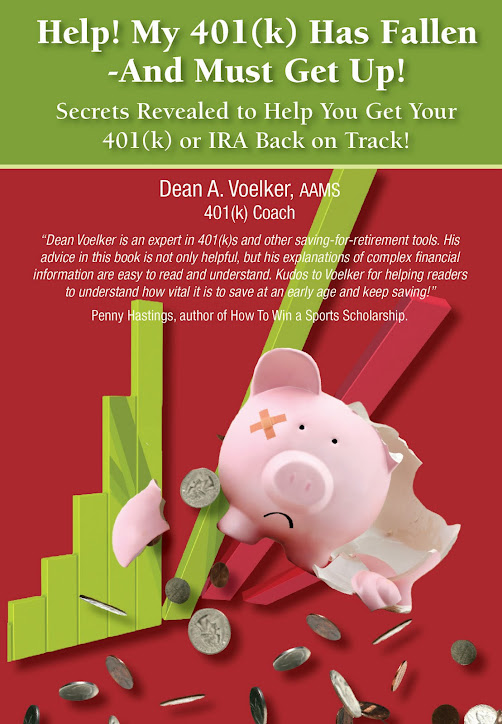
New Book - Coming November 2010

New Book - Coming November 2010
Help! My 401(k) Has Fallen - And Must Get Up!
Showing posts with label portfolio. Show all posts

Saturday, September 26, 2009

How To Find A Financial Advisor in South Bend


So the stock market has rebounded from its low point in March, 2009. As we are wrapping up the 3rd Quarter of this year, I have been reflecting on a few thoughts.
Although we have seen some market recovery, for many of us, 2009 has been more challenging than 2008.

* As I talk with people, I am sensing more uncertainty over the future of the economy and
their plans for retirement.

* Unemployment continues to stay at a high level. Some regions are higher than others
nationally. The Michiana area, with its long ties to the RV and automotive industry, has
experienced higher unemployment than other areas.

* Most recently, according to today’s South Bend Tribune we learned that the Braking
Division of Robert Bosch Corp. will be sold to Akebono Braking Industry of Tokyo, Japan. This
puts more strain on our area’s economy and could result in additional job losses.

* Many of those I have talked with are continuing to look for ways to pinch pennies, cut
corners and make their money last.

The one thing which hasn’t changed is that people still need to live their lives in dignity when they finally retire. And with people living longer than they used to, that takes Savings & Planning. Costs of living will continue to rise as well.

If you are living in the South Bend, IN area, how do you find someone who can help you develop the right strategy for you to reach your goals in these trying times? There are several qualities you should look for when shopping for an advisor, no matter where you live.

* Is he/she a Good Listener? Can you share your dreams & goals with them?

Do they make you feel important? Do they ask you questions such as “What is
important about your savings to you?” and “What would you like your retirement to be
like?” If all they do is tell you about the latest stock tip, or if they do all the talking, it
may be time to look elsewhere.

* Do they have a reasonable amount of experience?

Advisors can sometimes fall into 2 groups. You may not want an advisor that the ink on
their license has not yet dried. Most of us if asked would prefer an experienced advisor,
although you may want to find out if they are accepting new clients, or is there a
minimum amount to invest. There is a great website, http://www.financialadvisormatch.com/.
You can plug in the area you live in and it can give unbiased information on advisors in
that area. Also you can look up an advisor by name.

Another great website to learn information is http://www.linkedin.com/ which is a
professional networking site. This can give you great information about your
Advisor, much like an on-line resume.

* Does he/she have the “heart of a teacher”?

This is a comment often made by financial talk radio show host, Dave Ramsey.
Dave has grown in popularity because people are getting back to basics and
want common sense advice. Most people want investing concepts made simple.
Can your advisor help make this ‘fun’ to learn? Or do they talk in technical jargon?

* Does he/she talk about WHY Investing is so important for all of us?

Can they look at your budget with you and help you determine what type of income
you’ll need at retirement? By helping you know how much income you need (after
Social Security and any other sources of income), you should have a much better idea
for how much you need to be saving - AND put together a plan to do it!

* Will they offer to review your 401(k) and other statements for FREE?

Some advisors are “fee” based and charge by the session or by the hour for advice.
Others work on commission and are only paid when investments are made. For most of
us, this is the fairest method. There will always be times you have a question, and
advice should be free. Depending on how much you invest, you may also qualify for
volume discounts, also known as “breakpoints”.

* Is your advisor independent, or do they work with a larger firm?

This is really a matter of personal preference and there are pros & cons to each. Also
there are great advisors with either side. Many people prefer an established name brand
firm, while others enjoy the personal attention they may get from an independent.
In some ways, you could compare working with an advisor to eating at a restaurant.
There are large national chains, and also individually owned local restaurants which
have found their own niche.

There was a great article earlier this month (Sept 14, 2009)
“Schwab Says Independent Advisers Attract Brokerage Firm Assets”
http://www.bloomberg.com/apps/news?pid=20603037&sid=aYTCv4DGu76Y
by Alexis Leondis of Bloomberg.com. The article shows the results of a survey done by
Charles Schwab about where clients are holding their assets. Ms. Leondis states,
“Almost 90% of the independent Registered Investment Advisors said that they gained
assets in the last 6 months and 45% of the assets came from so-called full-service
brokerage firms.”

Whether he/she works independently, or with a larger firm, your advisor can’t prevent
market declines. However, working with someone you are comfortable with should at
least help you to feel better about the future of your retirement.
Best wishes in your search!

Dean Voelker is an Independent Registered Investment Advisor in South Bend. He has
been licensed in Indiana and Michigan since 2003. You can follow Dean on Twitter, and also find his profile at Linked In and Financial Advisor Match. Dean also hosts a weekly Podcast program
on Blog Talk Radio, "Improving Your Financial Health".  


Friday, August 7, 2009

Something's "Fishy"


All this talk about "fishy" comments yesterday got me to thinking.....
 
Another great American Fast Food chain is Long John Silvers. According to their website, www.ljsilvers.com , the restaurant was inspired by Robert Louis Stevenson's "Treasure Island".
The first restaurant opened in 1969 in Lexington, Kentucky, as a response to other fast food chains which were becoming popular at the time - specializing in quick service seafood. The chain began as a division of Jerrico, Inc., which also operated Jerry's Restaurants, a chain of family restaurants which also began in Lexington, KY throughout the Midwest & South.

In the UK, fish and chips became a cheap food popular among the working classes in the second half of the nineteenth century. http://en.wikipedia.org/wiki/Fish_and_chips Deep-fried "chips" (slices or pieces of potato) as a dish, may have first appeared in Britain in about the same period. There was a mention of "chips" in Charles Dickens' "A Tale of Two Cities" (1859) "Husky chips of potatoes, fried with some reluctant drops of oil".

Earlier Long John Silvers restaurants were known for their Cape-Cod style buildings, blue roofs, small steeples, and nautically-themed decorations such as seats made to look like nautical flags. Most early restaurants also featured separate entrance and exit doors, a corridor-like waiting line area, food heaters that were transparent so customers could see the food waiting to be served, and a bell by the exit which customers could "ring if we did it well." Many of these buildings had dock-like walkways lined with pilings and thick ropes that wrapped around the building exterior.

Until its bankruptcy in 1998, Long John Silvers was a privately owned corporation. It was then acquired by Yorkshire Global Restaurants, which also owned A & W American Food Chains. In March 2002, Yorkshire was purchased by Tricon Global Restaurants, Inc. which had spun off from Pepsico, Inc. Tricon owned Taco Bell, Kentucky Fried Chicken, and Pizza Hut worldwide. Tricon then changed their name to Yum Brands, Inc. (NYSE: YUM)
Until then, Long John Silvers had served Coca-Cola Products. Once the acquistion by Yum Brands was in effect, they switched to Pepsi. Currently, Long John Silvers has more than 1200 restaurants worldwide – and more than 200 additional locations in Yum Brands, Inc. multi-brand restaurants. Nearly four million customers each week "throw boring overboard".
This is NOT an endorsement or an opinion of YUM stock. From 1997, Yum Brands/Tricon has grown from $8.06/share to a high of $41.73 on April 30, 2008. http://finance.aol.com/charts/yum-brands-inc/yum/nys/tech-chart Yesterday, August 6, 2009, YUM closed at 36.05.

For more investing information, you may contact me at http://www.deanvoelker.com . You may also follow me on Twitter at www.twitter.com/deanvoelker, or Blog Talk Radio at

Thursday, July 9, 2009

How Do I Keep My IRA From Being Eroded By Taxes When I Die?

Recently, I have been reading “The Retirement Savings Time Bomb…and How To Diffuse It” by Ed Slott. Ed is a highly renowned CPA and tax advisor. He has written for the Wall Street Journal, the New York Times, and USA Today. His book focuses on strategies to keep money in your savings, and away from the IRS.

One strategy of his, which I also recommend to my high net worth clients is the use of Life Insurance for estate planning. Because Life Insurance proceeds are not taxable, it’s a great way to pass money to your beneficiaries without creating a tax burden for them.

Ed uses a great story to make his point on why insurance is important. With his permission, I have included an excerpt from his book. Ed Slott’s website is www.irahelp.com.
******************************************************************************
If you’re not a baseball fan, then the name Bill Buckner probably doesn’t ring a bell. But if you follow the game, you’ll recognize it as one of the most ignominious names in the history of baseball.

Bill Buckner was the first baseman for the Boston Red Sox in the 1986 World Series when the Sox were matched against the New York Mets. It was Game 6. The Red Sox were an out away from winning a World Series for the first time in 68 years. The ball was pitched, the Mets batter swung and connected with a thunderous c-r-a-c-c-k-k, sending the ball straight to first base and the outstretched arms of Bill Buckner, who flubbed the catch before the stunned but elated crowd in New York’s Shea Stadium, letting the ball roll between his legs!

Thanks to this colossal error, the Mets were able to pull their fanny from the fire, win the game that night, and go on to win Game 7 and the World Series title. The city of Boston has never forgiven Bill Buckner. Last I heard, he’d moved to Idaho, which apparently still wasn’t far enough for Boston fans. To Boston Red Sox fans in particular, and to baseball fans in general, Bill Buckner remains but one thing: The Man Who Dropped the Ball.

Now, what if I told you the Bill Buckner was also one of the best players ever to play the game of baseball? Would you be shocked? Disbelieving? I know I was when I heard that exact statement mad in a recent show about Buckner called “Beyond the Glory” on the Fox Sports Network. Being an accountant by trade, I decided to do my own audit of Buckner’s statistics to see if the show was right.

But how would I find those statistics? Easy. I went to a local baseball card store and asked the owner if he had any Bill Buckner cards for sale. He looked at me like I’d sprouted two heads.
“Why would you want a Bill Buckner card?” he asked. “Nobody wants them. That’s why I don’t carry any. We’d never sell them.” But I persisted, and he said he’d check around the baseball card grapevine to see if he could come up with one.

I went back in a few weeks and, lo and behold, he’d managed to dig up a few old Bill Buckner cards for me. “How much?” I asked.

He said, “They’re worthless. You can have ’em for free.”

I thanked him, took the cards home, and quickly checked Bill Buckner’s statistics. Fox was right. The numbers were astounding!

Bill Buckner played 22 seasons. Only 25 players in the history of baseball have pleyed more games then he did. He’d gotten more hits than 70% of the players currently in the Baseball Hall of Fame, including such superstar names as Mickey Mantle, Ernie Banks, Reggie Jackson, Johnny Bench, and even Ted Williams. He had 500 more hit’s the Joe Di Maggio!

When Buckner played for the Chicago Cubs, he won a National League batting title. He was also an exceptional fielder. He genuinely was one of the greatest players the game of baseball has ever had. And yet he will be forever locked in the Baseball Hall of Shame for that one slip-up at the end of his career that cost the Red Sox the World Series.

As I pondered the ill-fated career of Bill Buckner, I found myself thinking, “He’s a lot like an IRA. He had such a brilliant career, accumulated so much, but in the end lost it all due to one error, and now his name is mud.”

Is that how you want your family to remember you? As the guy (or gal) who dropped the ball?
Most people don’t think about it much, but the combination of estate and income taxes can easily consume an IRA of any size. Combined, estate taxes, along with federal and state income taxes could easily exceed 90%.…..

When it comes to retirement accounts, its not enough to earn great investment returns. Yes, that is important in building the account, but even if you earn 30% per year, every year for 30 years, what good is it if, at the end of the line, up to 90% of the account’s value is lost - which can happen if the funds aren’t there to pay the combined estate and income taxes on an inherited IRA, and so the IRA itself must be used to pay those taxes.

If an IRA must be tapped to pay tax when the IRA owner dies, the result is a cycle of taxation that doesn’t stop until the beneficiaries are so punch drunk that they don’t know what’s happened to them, let alone to their IRA…..

Do something now while you are still alive and options to protect that money for your heirs still exist. Life Insurance is your retirement account’s best defense to offset the tax burden which beneficiaries may face.
******************************************************************************
For more information, please contact me at http://helpmy401k.us. You may also follow me on Twitter at www.twitter.com/deanvoelker

Tuesday, June 30, 2009

Lets Say I Live To 100

People are living much longer these days. With modern medicine, technology, and taking better care of ourselves, reaching 100 is much more common than it used to be. According to a Wall Street Journal article from April 14, 2008, Hallmark sold over 85,000 “Happy 100th Birthday”
cards in 2007. And that is just Hallmark. Currently the average life expectancy for a Female is 87 years, and 85 years for a Male.

Living that long is great, but it can also raise concerns about your savings. What are you doing to make sure your money lasts that long also? Can your savings generate income for the rest of your life, even if you live to 100 or beyond?

Also, how prepared are you to keep up with rising costs? Did you know that 20 years ago (1989), the cost of a postage stamp was 0.25 and a gallon of gas was about 0.97? Compare those prices with today. A stamp is 0.44 and a gallon of gas…..well it fluctuates more than the stock market. As of today, it is about 2.45, and last summer had peaked well over 4.00.

If you are retired for 20 years or more, costs will go up. How can your savings handle that? Can you give yourself “Pay Raises” and still make it last?

One last question for consideration - this past year was one of the most challenging ever for investors. How can you grow your income, make your money last, and do it “Safely”?

Here are some tips that may help answer these burning questions.

* Talk with your advisor. And if you don’t have a strong relationship with your advisor, or
you don’t feel they have your best interests in mind, find a new one. Your advisor needs to be a
great listener, and your partner - NOT just a stockbroker. Tell them what your needs are.
What is most important to you about your money?

* Be Open Minded. If your money is going to last for your lifetime, CDs aren’t going to get it
done. Especially at the current bank rates today. There are other ways you can invest, and
let your money grow over time safely. A good advisor should learn as much about you as
they are able - just like a doctor who will learn your history before prescribing anything.

“Whatever you fear most has no power - it is your fear that has the power.”
Oprah Winfrey

* Be Diversified. I’ve always thought of “diversification” like clothes in your closet.
You need to have clothing for summer, winter, fall, casual wear, dressing up,
working in the yard…..ALL occasions and ALL types of weather. Investing needs to be
the same. Would you like less risk? The best way to do that is by diversifying.

“Money, you should pardon the expression, is a little bit like manure. It doesn’t
do any good unless it’s spread around, encouraging young things to grow.”
Barbra Streisand

For more information on how to make your money last to 100 or beyond, please contact me at
www.helpmy401k.us. You may also follow me on Twitter at www.twitter.com/deanvoelker.

Thursday, June 25, 2009

Income For Life

One of my clients once told me that the biggest lesson he learned in retirement was this. You don't retire on a Lump Sum of Money. Rather, you retire on the INCOME which the Lump Sum of Money can create. Think about that statement for a bit. Let it sink in. In fact, let me repeat it, because this is what retirement means. You don't retire on a Lump Sum of Money. Rather, you retire on the INCOME which the Lump Sum of Money can create. You spend your working career saving, accumulating, investing, and building a "lump sum". At some point, you will want to use it for income.

Soooo.....what exactly is a "Lump Sum of Money"? Is it $100,000? $300,000? How about $1,000,000? More than that?

The best way to answer that is that the amouth may be different for everyone. However, we can help you to narrow down what you amount should be at retirement. Here are 4 steps.

1. Determine your monthly budget. You don't want any debt at retirement. Leave plenty of
room for "Miscellaneous" expenses - travel, kids, hobbies. If you aren't working, you are
spending.

2. Determine your Social Security Income amount. There are 3 categories for Social
Security income - Reduced Benefit (usually age 62), Full Benefit (usually age 66), and
Enhanced Benefit (age 70). As the terms suggest, if you take Social Security at an earlier age,
you are "stuck" with a smaller amount of income - and "Grounded For Life." There has also
been a growing movement for proposed changes in Social Security in order to make the
money last longer. At least one of those changes includes pushing back the age for Full
Retirement Benefits, which would force most of us to work longer. Whatever benefit amount
you select, you need to know the amount so it can be applied to your budget.

3. Do you have other sources of income? These may include rental property, part time
work, or anything else which generates income.

4. Look at your budget again, and deduct your budgeted expenses from your total
income.
This sounds simple - and it is- however you would be surprised at how many people don't do
it. Do you have enough income to cover your expenses? Is there money to do "special" things
you want to do in retirement? Travel? Golf when you want?

If there is a "gap", how much is the gap? Let's assume there is a gap of $800/month. $800 x
12 months = $9600/year. Now let's take $9600 and divide it by .04. (4% is a reasonably
"safe" amount to withdraw from a lump sum.) $9600/.04 = $240,000. Now we have a "lump
sum" goal of saving for retirement. This can be saved in your 401(k), IRA, Roth IRA, or
ordinary savings. Do not retire until you have this amount saved to cover your additional
budgeted expenses.

In a future article we will look further at annuities and how they can provide income for life. We also need to consider the impact of inflation on your savings.

For more income on annuities or on budgeting, please contact me at http://www.helpmy401k.us. You may also follow me on Twitter at www.twitter.com/deanvoelker

Tuesday, June 16, 2009

Using Protection?

That should have gotten your attention!

In my last post, I discussed some basics of annuities. Annuities can offer some protection for your savings which other investments, such as stocks or mutual funds do not. Keep in mind that the value of your account may still go down.

Lets talk about a few protections which you may get from an annuity.

GUARANTEED DEATH BENEFIT - The first one, common to most annuities, is the Guranteed Death Benefit. What is means is that if you invested a sum of money into an annuity, your beneficiaries will receive at least that amount (minus any income or withdrawals taken).

For example, lets say that John puts $100,000 into a variable annuity. The market goes south, and the value of the annuity dips to $80,000, when John dies. If he has not taken income, his heirs will get the full $100,000. Now lets say that the market goes up, and the account grows to $120,000. When John dies, his heirs get $120,000. In this case, it would not matter if he has taken income - if the account value has grown from his original investment, his heirs get the account value.

GUARANTEED GROWTH - There are a lot of different insurance brokers who provide annuities, and not all of them offer this. Whichever provider you use, I would certainly recommend using a large, stable, reputable (Name Brand) company. The protection is only as good as the insurance company backing it.

I have become familiar with Jackson National Life, one of the largest annuity providers in the US. They have an AA rating in Financial Strength from Fitch & Standard & Poors, which is Very Strong. What that means to a client is that they should feel secure with the protections they are getting on their money. (Source: Jackson Life http://www.jackson.com/)

Jackson offers a Fixed Account Option on its annuities. The Fixed Option offers a 1 Year Interest Rate, which is reset each year, but is never less than 3% (Special Benefit Value). 3% actually looks pretty good right now, doesn't it?

Lets say that John starts out at age 55 by investing his $100,000 in a Fixed Index Annuity. Assuming that the annuity value has grown by 3% per year, by age 65 (10 years) it will be worth $134,392 minimum. (Source: Jackson Ascender Plus Select Brochure, http://www.jackson.com/).

A Variable Annuity should provide more growth over time, however its performance is related to the stock market. The Standard & Poors Index, also referred to as the S & P 500 represents the largest 500 companies in the USA. It has been the measuring stick for comparing investment performance.

If John had been investing his $100,000 in a Variable Annuity using the S & P Index, Jackson lets you have a "win-win". If the market goes up, the account will also go up. If the market goes down, the account value stays the same. This would have been particularly valuable in 2008 when the S & P declined by 42.9%. The value in John's account would have been the same. Had John kept his money invested over the last 10 years, he would have $145,825 today. (Source: Jackson Ascender Plus Select Brochure, http://www.jackson.com/)

I will look at Guaranteed Income Options in another segment. I will also look at additional charges for these features (where they apply). Please keep in mind that an annuity is not for everyone. You should consult with your advisor to determine if an annuity is right for you.

For more information, you may contact me at http://www.helpmy401k.us/. You may also follow me on Twitter at http://twitter.com/DeanVoelker .

Wednesday, June 3, 2009

Fixing Your 401(k) - Part 6

Problem #5 - Investments (Company Stock)

Do you own stock in your own company? Companies have always encouraged employees to think like an owner. By owning stock, you are a part owner of your own company. There is nothing wrong with that idea, and if you work for a large company which issues stock, that may be an option available to you in your 401(k) plan.

But how much should you own? Not more than 5-10% of the company in your 401(k). There are just too many "Murphys" out there. http://www.murphys-laws.com/murphy/murphy-true.html

Mutual funds are much more recommended as a way to spread your money out so it can grow.
“Money, you should pardon the expression, is a little bit like manure. It doesn’t do any
good unless it’s spread around, encouraging young things to grow.”
Barbra Streisand

One of the worst examples of company stock going sour in a 401(k) is Enron. Enron has been a running joke since 2002 for their collapse due to fraudulent business & accounting practices.
Many of their workers lost their life savings when Enron filed bankruptcy and their stock was rendered worthless. http://www.albionmonitor.com/0202a/enrontimeline.html

Enron's 401(k) plan was enormous - over $1 Billion in total assets, of which $600 Million was in Enron stock - That is 60%! Enron offered a matching plan of up to 6% of an employee's base pay - but paid the match in STOCK, not cash. When the stock plummeted from over $90 per share to less than a $1.00 in 16 months, their employees lost their life savings and any chance at retiring the way they had planned.
http://encarta.msn.com/media_701610605___1___6/the_fall_of_enron_stock.html

Please meet with your advisor if you have more than 10% of your 401(k) or portfolio in company stock. For more information, or to contact me, please visit http://www.helpmy401k.us. You can also follow me on Twitter at http://www.twitter.com/DeanVoelker

Monday, June 1, 2009

Fixing Your 401(k) - Part 5

Problem #5 - Investments

If you have been following me on this blog lately, you might think that I'm against the idea of 401(k) plans. Not so! Let me state this clearly. I LOVE 401(k) plans as a source of saving for retirement. EVERYONE should be participating in a 401(k).

However, there are many potential hazards that you must be aware of in your 401(k) plans.
So my purpose here has been acting as a 'caddy' and letting you know where the bunkers & water hazards are at so we can avoid them. And I certainly want you all to finish the 'course'.

Today, we will look at the problem which most investors find it easiest to point fingers at -
Investments.

How many investment choices are offered in your plan? And how do you choose which ones are right for you? How long do you stay with invesments in your plan before you look for
"greener grass"?

A survey done by Watson Wyatt in January 2008, (Watson Wyatt is the trusted business partner to the world’s leading organizations on people and financial issues)
http://www.watsonwyatt.com/us/pubs/insider/showarticle.asp?ArticleID=18489
gives us this information.

* 30% of all participants have NO equity (stock mutual funds) in their plans.
* 20% of investors at least 45 and older have stopped contributing.
* Too many people are invested heavily in their company stock, some who have at least
50% or more of their plans in company stock.
(Company stock is an issue I will look at in further detail in my next article.)

Dave Ramsey likes to ask this question - If you were CFO of your own finances, would you fire you? Well, the reality is that YES YOU ARE the CFO of your finances & retirement savings!

"Investors Behaving Badly: An Analysis of Investor Trading Patterns in Mutual Funds" is a 2001 article that shows people are holding their funds for shorter and shorter time periods, as short as 2.9 years, and probably even less time these days after all of the challenges recently.
http://spwfe.fpanet.org:10005/public/Unclassified%20Records/FPA%20Journal%20November%202001%20-%20Investors%20Behaving%20Badly_%20An%20Analysis%20of%20Investor%20Trading%20Patt.pdf

This is like moving your boat all around the pond in search of the 'perfect' fishing spot. It usually just scares the fish! This also explains why people finally give up and put everything into "safe" money market funds, because as one gentleman puts it. "At least I'm not losing nothing."

Wayne Gretzky said (during his playing days), "I skate to where the puck is going, not where it has been." How do we know where the 'puck' is going? We don't. That would mean market timing, and as Warren Buffett would say, "I'm not smart enough for that."

How many funds should an employer's plan offer? Anywhere from about 12 - 20 is a good range. Your personal plan should meet these objectives.
* Look for funds which have 10 year (or longer) histories. Established funds give a much
clearer long term picture of what to expect.
* Pay attention to fund expenses. The higher the expenses, the more it can hurt your return.
* Treat the plan as if you are at a "buffet". The plan offers a menu of choices, and it is best to
have somthing from all of the food groups. Just as you wouldn't eat only the fried chicken,
you also need fixed income, dividend paying funds (large companies), medium sized
companies, small companies, and international.
* Meet with an advisor to help you find the mix you should have and how much to put in.
Many good advisors (including myself) offer to do this at no charge to you. Let him or her
help you put a roadmap together which will help you get to (and through) retirement
safely.

Next we will examine the issue of company stock in 401(k) plans. For more information or to contact me, please visit http://www.helpmy401k.us/. You can also follow me on Twitter at
http://twitter.com/DeanVoelker

Friday, May 29, 2009

Fixing Your 401(k) - Part 4

Problem #3 - Loans

"Brother, Can You Spare A Dime?" (Bing Crosby 1932)
http://www.youtube.com/watch?v=eih67rlGNhU

There has been a popular myth lately that it is OK to borrow against your 401(k) plan. The most common thing I hear from those I talk with is "I'm paying myself interest!"

If you believe that, I've got some GM stock for you that you should buy!

All kidding aside, this could be the worst idea ever with regards to retirement savings plans. Dave Ramsey, nationally syndicated financial expert, has some thoughts on this as well.
"Never, ever borrow on your retirement." Dave says in response to this question. http://www.daveramsey.com/etc/askdave/index.cfm?event=dspAskDave&intContentItemId=7802

Yet, almost 1 in 5 401(k) plans (18%) have a loan against it. This is according to Transamaerica for Retirement Studies in their annual survey. www.transamerica.org
http://www.ebri.org/publications/ib/index.cfm?fa=ibDisp&content_id=3838

Reality is NOT "paying yourself interest", but rather paying credit card interest to borrow your own money. OUCH!

What are the Tax Consequences on a 401(k) Loan?

When you borrow, you have 2 options -
1. Pay it back.
2. Don't pay it back.

Of these, the best of course is to pay it back. However, did you know that when you do, you face DOUBLE TAXATION? You are paying interest with after-tax dollars that will be taxed AGAIN
at withdrawal.

What about not paying it back? Well, obviously your investment takes a hit & you could be taxed up to 35%, and face the early withdrawal penalty of 10% if you are younger than 59 1/2. If you leave the company, the loan is automatically listed as a withdrawal, so it is "repaid".
Again, you are paying interest, not to yourself, but to a lender on your own money.

What does this mean to your investment? It lowers the balance, certainly. How much depends on how many times the loan is taken, what amount, investments, payback and several other factors.

Please don't "Spare a Dime" from your 401(k). You will need this money later!!
For more information, please contact me, Dean Voelker, at www.helpmy401k.us


Tuesday, April 28, 2009

401(k) Bargains

I've been talking with several clients lately (even in their 30's & 40's) who aren't sure what they should be doing with their 401(k)s. A few of them have even taken money out of the 401(k) or IRA, because they "don't want to lose anymore".

We need to remember that while the market goes up and also goes down, over time IT GOES UP. Putting money into your 401(k) now (while prices are low) can only help, especially if your employer matches your contribution. We MUST get back to thinking big picture, not just what is happening today. As one advisor likes to say, "Short Term thinking is very murky, but Long Term is crystal clear."

Walter Updegrave mentions this in his article "Don't Miss Out on 401(k) Bargains" in Money Magazine. http://finance.yahoo.com/focus-retirement/article/106833/Don't-Miss-Out-on-401k-Bargains;_ylt=Ajq2DWlNpxka9nV4LwU8Qf.VBa1_?mod=fidelity-readytoretire

The best time to invest is when prices are low, and you don't want to take money out if you don't have to. It has the same effect as uprooting a plant - You are killing your money tree, in addition to paying taxes and a 10% penalty.

When would you prefer to buy groceries - at regular price or on sale?
Treat your investing the same way.

Want to lower your risk? How diversified are you?

The one thing missing in most 401(k) plans is professional advice & education for the employees. It's not enough for the guy (or lady) to come out a couple of times a year and ask if anyone has questions. My job as a professional must be to sit down with you and help you with a road map. We need to see where you are now, and where you need to be. The 401(k) is a vehicle which can (and should) be used to help you get there.

Don't miss out on 401(k) bargains!

For more information, please contact me at www.deanvoelker.com .

Monday, April 27, 2009

Are You Saving Enough?

Boston College’s Center for Retirement Research recently found that about 64% of Americans aren’t saving enough to maintain their standard of living in retirement. Some ways to tell if you’re at risk:

Find A Percentage -

The general rule of thumb is that retirees need about 70% to 80% of pre-retirement income to maintain their standard of living. To get a better sense though, consider using software that helps take into account factors like paying college tuition or taking fewer vacations. ESPlanner, which costs $150 and is available at www.esplanner.com , is one place to start.

Map Out Withdrawals -

Many retirees will withdraw 4% of their portfolio in the first year of retirement and adjust that dollar amount each year to account for inflation. Find out if you can live comfortably on that amount plus Social Security payments; if you’ve had heavy portfolio losses, consider skipping the inflation bump initially.

Consider Health Care -

Because lower-income seniors have their long-term care covered by Medicaid, and wealthier seniors can self-fund their care or buy insurance, those in the middle often have the hardest time paying for such services, a big drain on a nest egg. Anthony Webb of Boston College says that non-Medicaid seniors with less than $1 million in assets should plan early for big health costs by cutting expenses elsewhere or delaying retirement.

Figure the Odds -

Financial planners can often do modeling that helps calculate the chances you will still have a nest egg to draw from at a given age. Many retirement experts urge workers to wait to retire until their percentage chance of outliving their nest egg drops to 15% or below. To be safe, it’s good to assume you’ll live to age 90 or 95, especially with longer life spans.

For more information, please contact me at www.deanvoelker.com

(Text reprinted from Smart Money Magazine, March 31, Angie C. Marek)

Saturday, April 25, 2009

A "Golden" Opportunity?

My job is to help others to grow their savings and improve their financial health. These days, we all need to get healthy. A common question I get is whether or not to invest in gold.

Gold is an investment that can be part of your portfolio. Talk with your advisor to decide how much, part should be.

Warren Buffett likes to say, " We simply attempt to be fearful when others are greedy and to be greedy only when others are fearful."
http://www.brainyquote.com/quotes/authors/w/warren_buffett_2.html
I don't know about you, but when I hear every other commercial on Financial TV & Radio
promoting gold, it sounds pretty "greedy" to me, wouldn't you agree?

Dave Ramsey put on a Town Hall for Hope on Thurs. April 23. Over 6000 watched and decided it was time to put fear aside and start making smart choices with their money. From the site
http://www.townhallforhope.com/ , Dave shares some interesting facts about gold & other investments.

Did you know that gold has only risen an average of 2.14% per year? And that includes a surge since 2001 to present. http://www.townhallforhope.com/index.cfm?event=displayPostStats

Did you also know that the S & P has grown by 1250% since 1974, from 63 to 850? That includes recessions in the 1970's, 1980s, 2001-2002, and the present.
http://www.townhallforhope.com/index.cfm?event=displayPostStats

Check out these other interesting stats at http://www.townhallforhope.com/

Before investing, talk with your advisor to determine your goals, time horizon & risk tolerance.
For more information, or to contact me directly, visit my site at http://www.deanvoelker.com/ .