Showing posts with label loans. Show all posts
Thursday, June 17, 2010
3 Big 401(k) Mistakes
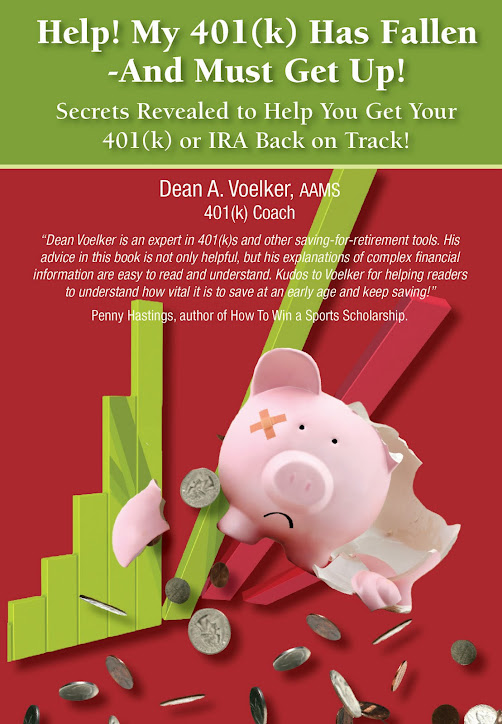
I had a chance to read a great article this week by Joe Mont. Big 401(k) Mistakes That Hurt Savings - June 1, 2010. This article was interesting to me for a few reasons. The facts he outlines tell me that there is definitely a need for my book,
Help! My 401(k) Has Fallen - And Must Get Up!
Mr. Mont agrees with me that "neither the market losses of 2008 nor the robust rally of 2009 have motivated workers to make their 401(k) plans their top priority." This is based on Hewitt Associates annual retirement study.
"While it's encouraging that most workers stayed the course, most did so simply because they were disengaged with the retirement saving process or too paralyzed with fear and confusion to touch their 401(k) plans", says Pamela Hess, Hewitt's director of retirement research. "If employees continue to ignore their 401(k) plans, they're hurting themselves by letting the market dictate their retirement strategy."
Mistake #1 - We Don't Save Enough
We don't save enough in these plans! There STILL needs to be a sense of urgency. Your 401(k) = Your Retirement - PERIOD!
Pensions began to disappear at about the same time leisure suits and Betamax video did - and NONE of these are coming back! When it comes to Social Security, Americans everywhere of all ages are concerned about the Federal Government's ability to continue the program as it currently exists. Also, it was never intended to be anyone's main source of retirement income. However for 1/3 of elderly Americans, it is the source of nearly all their income. This is according to the Center on Budget and Policy Priorities.
Your 401(k) - or 403(b) if you work for a non-profit organization may be ALL YOU HAVE!
Hewitt's study also shows about 28% of participants don't contribute enough to even get the full matching benefit from their employers. That's frightening especially considering that many companies have reduced or eliminated matching contributions over the past year. Penelope Wang reports in her March 2010 article, Make the Best of a Bad 401(k) that "before the financial crisis, only 6% of plans didn't offer workers a matching contribution as an incentive to boost participation. But that number spiked last year, as another 12% of employers reduced or suspended their matches."
Ms. Wang goes on to add - "If you have a missing or reduced match, there's no getting around the fact that you'll have to make up the difference by saving more."
Pamela Hess of Hewitt says, "It was interesting to watch employee reactions to the match suspension. We had expected some really serious impacts to the savings rates, but it didn't change things as much as we thought."
Mistake # 2 - We Don't Rebalance
Here's a question for you. How often do you visit your dentist? What would happen to your teeth if you didn't brush or visit the dentist regularly?
Just like the dentist, you need to review your 401(k) plan with a professional to make sure you are on track with your retirement goals and that you have the right mix. Balance helps you to lower your overal risk. You get your tires re-balanced to keep your car straight, and rebalancing your account serves the same purpose.
With that in mind, target-date funds have become much more popular. A 'target-date fund' is one made up of a blend of several mutual funds. You can easily spot them in your menu of investment choices because they have a year in the name of the fund. "Fidelity Freedom 2040" would be an example of a target-date fund. The year represents the approximate time in which you would wish to retire. With this type of fund, it gradually become more and more conservative as the year approaches.
Hewitt's study from Mr. Mott's article shows that in 2009, 25% of workers use target-date funds in their 401(k) plans. Mr. Mott explains that some of this is due to employers who automatically enroll their new workers into the company 401(k) plan. 69% of these employers use a target-date fund as the default option.
Greg Johnson, president and CEO of Franklin Resources says that "target-date funds will become a bigger and bigger part of the new money that's flowing into 401(k)s."
Even if you do use a target-date fund, please review your account with an advisor. Ask them about the mix. Is it too conservative? too aggressive? or just about right? Are you saving enough to reach your goals? What will your income needs be at retirement? How will your 401(k) be able to meet your income needs? All great questions for an advisor. Don't do your own dental work! Get a pro to prevent 'decay' in your 401(k).
Mistake # 3 - We Kill Our 401(k)s From Withdrawals
Hewitt's study shows that in 2009, 7.1% of participants withdrew from reitrement plans. That is more than in any year since 2002. Loans kill 401(k)s also, and loans automatically become withdrawals once employment ends at the company. Hewitt reports that more than 25% of employees had an existing loan on their 401(k) plan at the end of 2009.
This isn't all that surprising to me. I have spoken with several people who have cashed out 401(k)s. The reasons are varied, but they all boil down to "I need the money right now." It is especially common among younger workers who don't see the future and feel the need to use the money for something else. They don't seem to realize or be concerned that this money may be cut almost IN HALF after taxes and penalties are taken out. A $20,000 account could be reduced to about $11,000 or $12,000 easily when it is withdrawn.
Joe Mont's article is right on time. Please AVOID these big mistakes in your 401(k). I have attempted to contact Mr. Mott after reading this piece and offer him a guest spot on Improving Your Financial Health. As of today, I am waiting to hear back from him.
Please contact me at my website, http://www.helpmy401k.us/ for more information and a FREE REPORT, The Five Biggest Problems With 401(k) Plans - And How To Fix Them! I'm also well equipped to help with 401(k) rollovers or plan reviews.
You can follow me on Twitter, Linked In, or Facebook. I also host a radio program, Improving Your Financial Health, on WHME-FM (103.1) in South Bend, IN.
Friday, December 4, 2009
Retirement Calculators

There are some great tools and calculators you can use for free to help plan for retirement. Some of the best ones are those which you may not even know about.
First, not to toot my own horn, but my website, www.helpmy401k.us has a great tab called Investment Tools .
There are calculators there for almost everything. The most commonly used one is the 401(k) Calculator. You could also use the 457(b) calculator if you are a government employee, but the concept is the same.
Simply go to the 401(k) calculator and plug in your own numbers. For example, lets say you are 29 years old with $1000 in a retirement savings account. Lets also say that you earn $50,000 per year and that you follow Dave Ramsey's advice and put in 10% of your pay into your 401(k) or $5000. If you earn an average return on this 401(k) account of 8% and keep doing this until age 66, you will have saved $1,076,087 for retirement. And that does not include an employer match or a raise in pay - EVER. Personal Finance expert Eric Tyson has an idea which may help provide an incentive to save more in 401(k) or IRAs - instead of calling them those names, we should try calling these "tax-reduction accounts".
What if we did figure those in? Easy - just enter those numbers.
Well, lets say your employer matches your contribution by 50% of whatever you put in up to 4%. If you put in at least 4% or more (and we are doing 10%, remember?), that means you are getting another 2% ($1000) from the employer. Also, lets assume they will raise your pay by
2% per year as a cost of living increase. Keeping the other earlier numbers the same, you will now have saved $1,598,680 for retirement.
Here is another one which my be helpful if you are planning to pay off credit card debt. And you should absolutely do that! It will have you save more in your "tax-reduction accounts."
Let's say you have a balance of $2000 in a credit card account. Your current monthly payment is $125/month and your interest rate on the card is 17.5%. (Ugh!) If you do as Dave Ramsey says and do some "plastic surgery" on your card (cut it up and dont use it anymore!), did you know that you can pay the card off in 12 months by just raising your payment to $183/month? It's true and very easy to figure out using the "Credit Card Payoff" calculator on the site. This can be very helpful to see yourself making progress towards your goal, if you can't pay the entire amount, but know you should pay less than the minimum.
In upcoming blog articles, we will look at a few more of the calculators.
You can see these calculators and many other helpful ideas on my website, www.helpmy401k.us. You can also follow me on Twitter at www.twitter.com/deanvoelker . I also host a weekly internet radio program "Improving Your Financial Health" at http://www.blogtalkradio.com/401kcoach .
Labels:
advisor,
balance,
credit card,
Dave Ramsey,
debt,
financial,
goals,
income,
inflation,
interest,
investment,
IRA,
loans,
money,
nest egg,
rates,
retirement,
savings,
taxes
Tuesday, September 8, 2009
Raising Arizona - More SOLUTIONS for College Costs
Last time we looked at some solutions for college savings such as a regular savings plan and also working part time during High School.
What if you do those things, but it still isn´t enough to cover college costs? Or perhaps you are getting started late in the game?
Here are some ways to help pay for college even if you haven't saved much. (Besides winning the lottery or robbing a bank.) The first way is actually pretty obvious - although families don´t utilize it as much as they should. Contact the Financial Aid department from your college and make sure you have applied for any and all scholarship money that you have a chance to qualify for. Don´t leave any "free" money on the table.
Going along with this scholarship idea, does Johnny (or Jill) play any sports? Recently, on my Blog Talk Radio program, http://www.blogtalkradio.com/401kCoach/2009/09/02/Improving-Your-Financial-Health
I visited with Charlie Adams, the Senior National Speaker for the National Collegiate Scouting Assocaiation of Chicago. Charlie helps many high school athletes get scholarships to play various sports in college. Normally when I think of athletic scholarships, I would think of football and basketball at large universities.
However, Charlie points out that there are plenty of scholarships given to students who are decent athletes and good students. Colleges offer a wide range of athletic opportunities such as golf, lacrosse, cross country, and rowing. In fact, Charlie´s son Jack earned a scholarship to Millsaps College in Mississippi for cross country.
Charlie also talks about a book, "Athletes Wanted" by Chris Krause. http://www.ncsasports.org/about-ncsa/about-chris-krause The book points out that employers have a growing need to ¨hire quality people for their companies. Recruiters love interviewing candidates who have played collegiate sports. They have learned the value of goal setting, teamwork, time management, and motivation. So if Johnny or Jill have some athletic skills, look into this as an option.
One thing to keep in mind - Johnny and Jill need to keep their grades up. To qualify for scholarships at smaller schools in sports, there is more of an emphasis on the "Student" part of student-athlete. You may contact Charlie Adams at www.stokethefirewithin.com.
What if your child doesn't play sports? Could they be entreprenuers? There are several examples of students who saw a need and figured out a way to fill the need and profit from it. They learn (on their own) valuable skills in sales, marketing, and business management. This would also set them apart from other candidates when its time to leave college and interview for work. Here is an article on "Teen Money Making Ideas". http://teenmoneymakingideas.com/how-college-students-can-make-money-in-the-summer-in-12-of-the-top-home-based-businesses/
If Johnny starts a business and it really takes off, he may find his career in the process. There was once a college student named Bill Gates who actually dropped out of Harvard to focus on his Microsoft business full time. (Of course the reason was that he felt he wasn´t learning anything new about computers.)
If you like this option, you may want to look at books about young men and women who have started successful businesses. A great website for information is http://www.quintcareers.com/college_entrepreneur_resources.html
"OK" you think. "But I´m not Bill Gates or Shaquille O´ Neal.What else can I do?"
There are other ways to learn entrprenuerial skills in organizations which are already established. Looking back on my college years, I had an opportunity to work with the Southwestern Company. www.southwestern.com. Southwestern has been around since 1855. They have a long history of helping college students to earn money for college. Students also learn some valuable lessons in the process - motivation, goal setting, business management, how to sell, and how to deal with all types of people.
Southwestern works with over 3000 students per year in the US and the UK, and the average First Year student earns $2733/mo during the summer months. Like many other opportunities, as a student gains experience, they may become more proficient.
http://www.southwesterninfo.com/FAQ.aspx Please contact Southwestern for more information.
If none of these really work for you, there is one more idea on paying for college, and its also a great one. Talk to a local recruiter about military service. For the student who hasn't yet figured out what they want from college or what they want to do in life (and at 18, who really has it figured out?), the military gives you time to figure things out. Military service also teaches skills such as teamwork, goal setting, perseverance, and time management. And they can help you to pay for school. http://www.military.com/money-for-school/tuition-assistance/army-tuition-assistance
I've met a number of people who have served for 4 years, then went to college with money from the government. As I mentioned in my last article, a 20 year old freshman has a good chance of being more mature than an 18 year old. Wouldn't you agree then that a 22 year old freshman with skills learned in the military would be even more mature and ready to learn? It certainly adds to a resume, and can lead to all types of career choices later.
I hope these have been helpful ideas. None of them involve taking out a loan, and if we can avoid that, we'd all be better off. You can contact me at my website, www.helpmy401k.us or follow me on Twitter at www.twitter.com/deanvoelker. My Blog Talk Radio program airs weekly and the archives may be heard at www.blogtalkradio.com/401kcoach.
What if you do those things, but it still isn´t enough to cover college costs? Or perhaps you are getting started late in the game?
Here are some ways to help pay for college even if you haven't saved much. (Besides winning the lottery or robbing a bank.) The first way is actually pretty obvious - although families don´t utilize it as much as they should. Contact the Financial Aid department from your college and make sure you have applied for any and all scholarship money that you have a chance to qualify for. Don´t leave any "free" money on the table.
Going along with this scholarship idea, does Johnny (or Jill) play any sports? Recently, on my Blog Talk Radio program, http://www.blogtalkradio.com/401kCoach/2009/09/02/Improving-Your-Financial-Health
I visited with Charlie Adams, the Senior National Speaker for the National Collegiate Scouting Assocaiation of Chicago. Charlie helps many high school athletes get scholarships to play various sports in college. Normally when I think of athletic scholarships, I would think of football and basketball at large universities.
However, Charlie points out that there are plenty of scholarships given to students who are decent athletes and good students. Colleges offer a wide range of athletic opportunities such as golf, lacrosse, cross country, and rowing. In fact, Charlie´s son Jack earned a scholarship to Millsaps College in Mississippi for cross country.
Charlie also talks about a book, "Athletes Wanted" by Chris Krause. http://www.ncsasports.org/about-ncsa/about-chris-krause The book points out that employers have a growing need to ¨hire quality people for their companies. Recruiters love interviewing candidates who have played collegiate sports. They have learned the value of goal setting, teamwork, time management, and motivation. So if Johnny or Jill have some athletic skills, look into this as an option.
One thing to keep in mind - Johnny and Jill need to keep their grades up. To qualify for scholarships at smaller schools in sports, there is more of an emphasis on the "Student" part of student-athlete. You may contact Charlie Adams at www.stokethefirewithin.com.
What if your child doesn't play sports? Could they be entreprenuers? There are several examples of students who saw a need and figured out a way to fill the need and profit from it. They learn (on their own) valuable skills in sales, marketing, and business management. This would also set them apart from other candidates when its time to leave college and interview for work. Here is an article on "Teen Money Making Ideas". http://teenmoneymakingideas.com/how-college-students-can-make-money-in-the-summer-in-12-of-the-top-home-based-businesses/
If Johnny starts a business and it really takes off, he may find his career in the process. There was once a college student named Bill Gates who actually dropped out of Harvard to focus on his Microsoft business full time. (Of course the reason was that he felt he wasn´t learning anything new about computers.)
If you like this option, you may want to look at books about young men and women who have started successful businesses. A great website for information is http://www.quintcareers.com/college_entrepreneur_resources.html
"OK" you think. "But I´m not Bill Gates or Shaquille O´ Neal.What else can I do?"
There are other ways to learn entrprenuerial skills in organizations which are already established. Looking back on my college years, I had an opportunity to work with the Southwestern Company. www.southwestern.com. Southwestern has been around since 1855. They have a long history of helping college students to earn money for college. Students also learn some valuable lessons in the process - motivation, goal setting, business management, how to sell, and how to deal with all types of people.
Southwestern works with over 3000 students per year in the US and the UK, and the average First Year student earns $2733/mo during the summer months. Like many other opportunities, as a student gains experience, they may become more proficient.
http://www.southwesterninfo.com/FAQ.aspx Please contact Southwestern for more information.
If none of these really work for you, there is one more idea on paying for college, and its also a great one. Talk to a local recruiter about military service. For the student who hasn't yet figured out what they want from college or what they want to do in life (and at 18, who really has it figured out?), the military gives you time to figure things out. Military service also teaches skills such as teamwork, goal setting, perseverance, and time management. And they can help you to pay for school. http://www.military.com/money-for-school/tuition-assistance/army-tuition-assistance
I've met a number of people who have served for 4 years, then went to college with money from the government. As I mentioned in my last article, a 20 year old freshman has a good chance of being more mature than an 18 year old. Wouldn't you agree then that a 22 year old freshman with skills learned in the military would be even more mature and ready to learn? It certainly adds to a resume, and can lead to all types of career choices later.
I hope these have been helpful ideas. None of them involve taking out a loan, and if we can avoid that, we'd all be better off. You can contact me at my website, www.helpmy401k.us or follow me on Twitter at www.twitter.com/deanvoelker. My Blog Talk Radio program airs weekly and the archives may be heard at www.blogtalkradio.com/401kcoach.
Wednesday, September 2, 2009
Raising Arizona (and Arizona State and Others) - SOLUTIONS
In my first part on this, we looked at the problem of rising college costs. I believe we are at a point where students must “do their homework” before taking out a college loan. You want to be sure that you will get a good return on your investment and be able to pay it back easily. Ideally, you’d like to NOT take a loan at all. College is now a “business” decision, not a right.
I wouldn’t be a good advisor to bring up a problem without mentioning some viable solutions. There are enough good ideas, that I will talk about a few now and a few more in my next piece. None of these are magic – but if you apply these common sense ideas you’ll be better off than doing nothing. So here are some ways to Make College More Affordable.
* Saving in a 529 or UTMA plan (regularly)
The key word here is “regularly”. You can set up either of these plans as soon as your baby is born. (And I highly recommend that!) Did you know that if you were to save $100/month for 18 years (216 months) at an average return of 8%, you’d have saved $46,865? And $200/month over the same period = $93,730.
The 2 plans are different, but the idea is the same. The 529 http://en.wikipedia.org/wiki/529_planallows for tax-free withdrawals for college related expenses. Here in Indiana, since 2007, you can also get a 20% tax credit on any contributions to a 529 plan. Put in $5000 and you get $1000 back in the spring. Also, money can be transferred between family members. If it isn’t used for college, you are simply taxed on the growth at withdrawal.
UTMA (U -T – M – A ….you ain’t got no alibi, its UTMA!) OK, so I should give up on ‘cheerleading’ – but I couldn’t resist. This is the Uniform Transfer to Minors Act. A parent or guardian acts as a “custodian” for an account in the child’s name. http://www.fairmark.com/custacct/regret1.htm until the child reaches age 21. At that time, the money is turned over to the child. This is also counted in the child’s assets when you go to apply for financial aid later.
One advantage that someone may see in the UTMA is that it doesn’t matter if the money is used for college or not – although there are no tax benefits. They have full control over the money.
Personally, I prefer the 529 plan (for the tax benefits) and have set one up for both of my daughters. Whichever plan you choose, (talk to your advisor) the most important thing is to save something regularly.
Another note here – a common question I get is whether families should contribute to retirement or college.If you must choose – retirement savings trump college. ‘Nuff said.
* Part Time Work
Wow, real genius stuff here, Dean! I told you this wouldn’t be ‘magic’. But think about this. I believe students should learn the value of a dollar – and appreciate the value of education. When I was in High School, I cleaned tables and washed dishes for a local family restaurant. Part of my pay went into my ‘college’ account.
Currently minimum wage for “flipping burgers” is $7.25/hour. What if Johnny flipped burgers for 3 years at Mc Donald’s and put $400/month into his college savings? In 3 years, Johnny would have saved $14,400. Between this idea and the last one, we’ve put a good dent into Johnny’s college costs, and haven’t even gotten to financial aid yet.
Not able to save as much as we’ve talked about? Getting started ‘late’ with savings? What about putting off college for a year or 2, to build up savings. There is no law that says YOU MUST enter college immediately after high school. (I checked). In fact, chances are very good that Johnny (or Jill) may be more mature at 20 and get more from their college experience, having spent some time in the ”real world”.
I’d much rather see Johnny (or Jill) wait a bit and not be burdened with debt after they graduate. If they do this, they must focus on the idea that college is still in the plan - flipping burgers is only temporary.
* Go to School, Live at Home
Being in the Chamber, I often attend networking events. Recently I had a chance to visit IUSB (Indiana University at South Bend). I was very impressed with the quality of the facilities and was very surprised to learn that their enrollment exceeds 7500 students. http://www.iusb.edu/about/ (You may have heard there is another school here in South Bend).
People are saving quite a bit by having Johnny and Jill live at home while going to college.Because IUSB is affiliated with Indiana University, many programs are similar. For those not living in this area, I would be willing to wager that you have a similar local university nearby.
In the next article I will continue to explore some other ideas which can help make college more affordable.
You can contact me at www.helpmy401k.us and follow me on Twitter at www.twitter.com/deanvoelker.My weekly Blog Talk Radio program, “Improving Your Financial Health” is at http://www.blogtalkradio.com/401kcoach.
I wouldn’t be a good advisor to bring up a problem without mentioning some viable solutions. There are enough good ideas, that I will talk about a few now and a few more in my next piece. None of these are magic – but if you apply these common sense ideas you’ll be better off than doing nothing. So here are some ways to Make College More Affordable.
* Saving in a 529 or UTMA plan (regularly)
The key word here is “regularly”. You can set up either of these plans as soon as your baby is born. (And I highly recommend that!) Did you know that if you were to save $100/month for 18 years (216 months) at an average return of 8%, you’d have saved $46,865? And $200/month over the same period = $93,730.
The 2 plans are different, but the idea is the same. The 529 http://en.wikipedia.org/wiki/529_planallows for tax-free withdrawals for college related expenses. Here in Indiana, since 2007, you can also get a 20% tax credit on any contributions to a 529 plan. Put in $5000 and you get $1000 back in the spring. Also, money can be transferred between family members. If it isn’t used for college, you are simply taxed on the growth at withdrawal.
UTMA (U -T – M – A ….you ain’t got no alibi, its UTMA!) OK, so I should give up on ‘cheerleading’ – but I couldn’t resist. This is the Uniform Transfer to Minors Act. A parent or guardian acts as a “custodian” for an account in the child’s name. http://www.fairmark.com/custacct/regret1.htm until the child reaches age 21. At that time, the money is turned over to the child. This is also counted in the child’s assets when you go to apply for financial aid later.
One advantage that someone may see in the UTMA is that it doesn’t matter if the money is used for college or not – although there are no tax benefits. They have full control over the money.
Personally, I prefer the 529 plan (for the tax benefits) and have set one up for both of my daughters. Whichever plan you choose, (talk to your advisor) the most important thing is to save something regularly.
Another note here – a common question I get is whether families should contribute to retirement or college.If you must choose – retirement savings trump college. ‘Nuff said.
* Part Time Work
Wow, real genius stuff here, Dean! I told you this wouldn’t be ‘magic’. But think about this. I believe students should learn the value of a dollar – and appreciate the value of education. When I was in High School, I cleaned tables and washed dishes for a local family restaurant. Part of my pay went into my ‘college’ account.
Currently minimum wage for “flipping burgers” is $7.25/hour. What if Johnny flipped burgers for 3 years at Mc Donald’s and put $400/month into his college savings? In 3 years, Johnny would have saved $14,400. Between this idea and the last one, we’ve put a good dent into Johnny’s college costs, and haven’t even gotten to financial aid yet.
Not able to save as much as we’ve talked about? Getting started ‘late’ with savings? What about putting off college for a year or 2, to build up savings. There is no law that says YOU MUST enter college immediately after high school. (I checked). In fact, chances are very good that Johnny (or Jill) may be more mature at 20 and get more from their college experience, having spent some time in the ”real world”.
I’d much rather see Johnny (or Jill) wait a bit and not be burdened with debt after they graduate. If they do this, they must focus on the idea that college is still in the plan - flipping burgers is only temporary.
* Go to School, Live at Home
Being in the Chamber, I often attend networking events. Recently I had a chance to visit IUSB (Indiana University at South Bend). I was very impressed with the quality of the facilities and was very surprised to learn that their enrollment exceeds 7500 students. http://www.iusb.edu/about/ (You may have heard there is another school here in South Bend).
People are saving quite a bit by having Johnny and Jill live at home while going to college.Because IUSB is affiliated with Indiana University, many programs are similar. For those not living in this area, I would be willing to wager that you have a similar local university nearby.
In the next article I will continue to explore some other ideas which can help make college more affordable.
You can contact me at www.helpmy401k.us and follow me on Twitter at www.twitter.com/deanvoelker.My weekly Blog Talk Radio program, “Improving Your Financial Health” is at http://www.blogtalkradio.com/401kcoach.
Wednesday, August 26, 2009
Raising Arizona (and Arizona State and Others)
OK, I know - cheap marketing gimmick to get you to read it. Sorry I don't have anything Nicholas Cage here. However this may be more valuable information than the movie.
Inflation affects everything - the price of bread, milk, gasoline etc. But one thing that seems to have gone up even more drastically is the cost of college. When I graduated from the University of Illinois in 1986, I left with about $3000 in student loans, which was easily repaid in a few years.
Today, student loans can reach $19,000 or more for a graduating senior from a public college.
http://encarta.msn.com/encnet/departments/financialaid/?article=averagestudentloans For
private schools that figure may be even higher.
Want to study law or medicine? For as long as I can remember (back to my finger painting days), those were the "good money" jobs. Both professions require years of post graduate education and loans can easily climb into the $100,000 range. Recently, I saw a young female med student on the news questioning President Obama about his healthcare proposal. Her concern was that at graduation, her total student debt would exceed $300,000 - yes that was not a typo. She wasn't sure if her future income would be sufficient to pay it back.
Really?? I think some thought should have gone into this before taking the loans. Its hard to blame either the President or his healthcare bill for that. Out of curiousity, I checked to see what a monthly payment on this would be. To pay off $300,000 in 12 years at 5% interest would require a monthly payment of $2775.00. Now you could take longer or the interest rate may be different, but this gives you an idea. Certainly its out of my ballpark.
Dave Ramsey always encourages his listeners to look at the opportunity cost of buying something - whether its a car, a flat screen TV, or even college. http://www.daveramsey.com/etc/cms/go_to_college_5788.htmlc
What that means is - even if you have the money, what other opportunities might you be missing? What else could the money be used for? When it comes to college, can you really afford it if it means loading yourself down with debt? What is your re-payment plan going to be?
How likely is it to get a career in your chosen field of study that will allow you to re-pay the loan?
I'm not anti-college. I just want us to think and ask questions first before jumping in.
In the early days of the United States, colleges such as Harvard and Yale were primarily for the wealthy. As the country grew and times changed, state schools offered a wider range of programs and more people were able to attend college.
"No qualified student who wants to go to college should be barred by lack of money. That has long been a great American goal. I propose that we achieve it now." Former President Richard M. Nixon said this in a special message to Congress in 1970. A lot has happened in the past 40 years. Are we back to a point where college is only for the wealthiest among us?
As a Financial Advisor, I will say that college does require financial planning and disciplined saving. Flipping burgers for the summer will only scratch the surface.
In my next part on this, we will look at some solutions which can help with college costs.
You can contact me at www.helpmy401k.us and follow me on Twitter at www.twitter.com/deanvoelker. You can also listen to me on Blog Talk Radio at www.blogtalkradio.com/401kcoach.
Inflation affects everything - the price of bread, milk, gasoline etc. But one thing that seems to have gone up even more drastically is the cost of college. When I graduated from the University of Illinois in 1986, I left with about $3000 in student loans, which was easily repaid in a few years.
Today, student loans can reach $19,000 or more for a graduating senior from a public college.
http://encarta.msn.com/encnet/departments/financialaid/?article=averagestudentloans For
private schools that figure may be even higher.
Want to study law or medicine? For as long as I can remember (back to my finger painting days), those were the "good money" jobs. Both professions require years of post graduate education and loans can easily climb into the $100,000 range. Recently, I saw a young female med student on the news questioning President Obama about his healthcare proposal. Her concern was that at graduation, her total student debt would exceed $300,000 - yes that was not a typo. She wasn't sure if her future income would be sufficient to pay it back.
Really?? I think some thought should have gone into this before taking the loans. Its hard to blame either the President or his healthcare bill for that. Out of curiousity, I checked to see what a monthly payment on this would be. To pay off $300,000 in 12 years at 5% interest would require a monthly payment of $2775.00. Now you could take longer or the interest rate may be different, but this gives you an idea. Certainly its out of my ballpark.
Dave Ramsey always encourages his listeners to look at the opportunity cost of buying something - whether its a car, a flat screen TV, or even college. http://www.daveramsey.com/etc/cms/go_to_college_5788.htmlc
What that means is - even if you have the money, what other opportunities might you be missing? What else could the money be used for? When it comes to college, can you really afford it if it means loading yourself down with debt? What is your re-payment plan going to be?
How likely is it to get a career in your chosen field of study that will allow you to re-pay the loan?
I'm not anti-college. I just want us to think and ask questions first before jumping in.
In the early days of the United States, colleges such as Harvard and Yale were primarily for the wealthy. As the country grew and times changed, state schools offered a wider range of programs and more people were able to attend college.
"No qualified student who wants to go to college should be barred by lack of money. That has long been a great American goal. I propose that we achieve it now." Former President Richard M. Nixon said this in a special message to Congress in 1970. A lot has happened in the past 40 years. Are we back to a point where college is only for the wealthiest among us?
As a Financial Advisor, I will say that college does require financial planning and disciplined saving. Flipping burgers for the summer will only scratch the surface.
In my next part on this, we will look at some solutions which can help with college costs.
You can contact me at www.helpmy401k.us and follow me on Twitter at www.twitter.com/deanvoelker. You can also listen to me on Blog Talk Radio at www.blogtalkradio.com/401kcoach.
Monday, July 20, 2009
Credit Myths
There is an old saying that if you tell a lie loud enough and long enough, then over time, the lie will become accepted as truth.
Like many of you, I had bought into the credit card myth. I believed that having a credit card was aprt of life and that you "needed" one to rent a hotel room or make other purchases.
Recently, I've discovered that one of the best ways to Improve Your Financial Health is to perform some "Plastic Surgery". There is an overwhelming feeling of freedom and relief when you take a pair of scissors to that piece of plastic in your purse or wallet.
Dave Ramsey discusses this in further detail in his Financial Peace University course.
www.daveramsey.com
Imagine how much simpler your life would be without credit card payments or other loan payments. Imagine being totally debt free, or at lest debt free except for your home.
How much money could you save if that were your situation?
If you had $10,000 or more in a savings account, to be used only for emergencies, would you be able to worry less about the possibility of something happening?
One of the best definitions I have heard of "Financial Security" is this:
Financial Security means being able to afford almost anything you want - AND wanting very little.
When you tell a lie or spread a myth long enough, it will eventually be accepted as truth.
Here are a few "myths" about credit which have been told to us over & over again through marketing and the media.
Myth: You need a credit card to build credit.
Truth: A credit card does not "build" credit. In mnay cases, it can even destroy credit.
There is NO positive side to credit card use. You will spend more if you use credit cards. Even by paying the bills on time, you are not beating the system! Most families don't pay on time. The average family today carries $8,000 in credit card debt according to the American Bankers' Association.
When you pay cash for a purchase, you can "feel pain" of the money leaving your hand. This is not true with credit cards. Flipping a credit card up on a counter registers nothing emotionally. If you use credit cards instead of cash you will spend 12-18% more. This is money you could have saved.
Myth: What about my credit score or FICO score? Don't I need a good score for getting a job,
getting loans.
Truth: The FICO score (Fair Issac Corporation) was created in 1958 as a way of determining the likelyhood that a person will pay their debts. http://en.wikipedia.org/wiki/Credit_score_(United_States)
In other words, it is a debt score. It measures what debts you have and how likely you are to pay them. People with no debt over a period of several years actually have a ZERO score. Wouldn't it be better to have ZERO debt as a measurement of managing your money, than a 'score'?
Myth: Wouldn't it help to get a debt consolidation loan? That is a good way to get out of debt.
Truth: When you do a debt consolidation, you just move the debt from one place to another. 88 percent of the time people do debt consolidation, they don’t change their behavior and go right back into debt. You can't borrow your way out.
The best way to eliminate debt is by putting together a budget, and putting your debts on a sheet and knocking them out one by one, starting with the smallest balance.
Myth: 90 Days Same as Cash or 0% Financing is a good deal.
Truth: This is an advertising gimmick. Businesses are in business to make a profit.
When companies use this method, they simply build the extra right into the price. Then when you don't pay it off in 90 days, they can charge you interest on top of it at rates from 24-35%. Worse, they will backcharge the rate all the way back to the date of purchase. And they know that most of the time, people won't pay it off on time. Again, the reason for doing this is to make a profit - once when they sell the item, and again when they can charge you interest.
Please contact me for more information. You may reach me through my web site. www.helpmy401k.us. You may also follow me on Twitter. www.twitter.com/deanvoelker
Like many of you, I had bought into the credit card myth. I believed that having a credit card was aprt of life and that you "needed" one to rent a hotel room or make other purchases.
Recently, I've discovered that one of the best ways to Improve Your Financial Health is to perform some "Plastic Surgery". There is an overwhelming feeling of freedom and relief when you take a pair of scissors to that piece of plastic in your purse or wallet.
Dave Ramsey discusses this in further detail in his Financial Peace University course.
www.daveramsey.com
Imagine how much simpler your life would be without credit card payments or other loan payments. Imagine being totally debt free, or at lest debt free except for your home.
How much money could you save if that were your situation?
If you had $10,000 or more in a savings account, to be used only for emergencies, would you be able to worry less about the possibility of something happening?
One of the best definitions I have heard of "Financial Security" is this:
Financial Security means being able to afford almost anything you want - AND wanting very little.
When you tell a lie or spread a myth long enough, it will eventually be accepted as truth.
Here are a few "myths" about credit which have been told to us over & over again through marketing and the media.
Myth: You need a credit card to build credit.
Truth: A credit card does not "build" credit. In mnay cases, it can even destroy credit.
There is NO positive side to credit card use. You will spend more if you use credit cards. Even by paying the bills on time, you are not beating the system! Most families don't pay on time. The average family today carries $8,000 in credit card debt according to the American Bankers' Association.
When you pay cash for a purchase, you can "feel pain" of the money leaving your hand. This is not true with credit cards. Flipping a credit card up on a counter registers nothing emotionally. If you use credit cards instead of cash you will spend 12-18% more. This is money you could have saved.
Myth: What about my credit score or FICO score? Don't I need a good score for getting a job,
getting loans.
Truth: The FICO score (Fair Issac Corporation) was created in 1958 as a way of determining the likelyhood that a person will pay their debts. http://en.wikipedia.org/wiki/Credit_score_(United_States)
In other words, it is a debt score. It measures what debts you have and how likely you are to pay them. People with no debt over a period of several years actually have a ZERO score. Wouldn't it be better to have ZERO debt as a measurement of managing your money, than a 'score'?
Myth: Wouldn't it help to get a debt consolidation loan? That is a good way to get out of debt.
Truth: When you do a debt consolidation, you just move the debt from one place to another. 88 percent of the time people do debt consolidation, they don’t change their behavior and go right back into debt. You can't borrow your way out.
The best way to eliminate debt is by putting together a budget, and putting your debts on a sheet and knocking them out one by one, starting with the smallest balance.
Myth: 90 Days Same as Cash or 0% Financing is a good deal.
Truth: This is an advertising gimmick. Businesses are in business to make a profit.
When companies use this method, they simply build the extra right into the price. Then when you don't pay it off in 90 days, they can charge you interest on top of it at rates from 24-35%. Worse, they will backcharge the rate all the way back to the date of purchase. And they know that most of the time, people won't pay it off on time. Again, the reason for doing this is to make a profit - once when they sell the item, and again when they can charge you interest.
Please contact me for more information. You may reach me through my web site. www.helpmy401k.us. You may also follow me on Twitter. www.twitter.com/deanvoelker
Labels:
balance,
credit card,
Dave Ramsey,
debt,
economy,
financial,
free,
interest,
investment,
loans,
money,
rates,
retirement,
savings
Saturday, June 6, 2009
Fixing Your 401(k) - Part 7
Problem #6 - Education
Of all the issues we have been discussing that are plaguing 401(k) plans right now, the biggest is EDUCATION on how it works. Why? Very simple. If proper education was taking place, it would help to solve the other issues, and reduce the liability each employer and plan sponsor currently faces.
Jackson Life did a survey of several passers-by and asked them questions about 401(k)s. (Source Rollover Rx, Jackson National Life Insurance) If you have ever watched Jay Leno do his "Jaywalking" bit on the Tonight Show, you have a pretty good idea of how it went.
Here are a few actual responses when people were asked about education offered by their employers for their 401(k) plans.
"I wasn't aware of any education."
"Don't participate in this. Its on a webinar."
"Information meetings are inconvenient to attend. I'm too busy."
"I think there is on line stuff, but I don't think anyone uses it."
"What can you tell me about it?"
I have personally talked to several clients who tell me that when there are "meetings", the advisor simply hands out his card and runs thru a quick power point presentation, then asks if there are any questions. This is usually met with blank "deer in the headlights" looks.
Education must be done on an INDIVIDUAL BASIS. Everyone's situation is different.
John, the 49 year old manager is in a different spot from Brandon, the 24 year old sales rep, who is new to 401(k) investing - although Brandon needs to know he is in a great place to get started now. Kim, the 35 year old customer service rep, may be thinking about borrowing against her plan, and Sue, the 42 year old customer service manager, is new to the company and wants to know how much she should invest, and what funds to pick.
How can you address individual situations in a "webinar" or "power point"?
A survey done by The Spectrum Group (www.spectrem.com - Source Jackson Life, Rollover Rx) tells us that 85% of employees want professional advice, however only 37% of employers offer any real contact with an advisor. That is not good for the employees, or the employer/sponsors, who are exposing their companies to liability and potential lawsuits. http://accounting.smartpros.com/x40690.xml
So what should you be doing?
Let's review the Problems I've covered so far.
Problem Current Situation Solution
Participation We don't participate & Start participating in your plan don't contribute enough. and max it out.
Portability Too many cash out when Roll the old 401(k) to the plan with
changing jobs. your new job, or to an IRA.
Loans Heavy tax consequences Set up an savings fund of 3-6 mos
and penalties. expenses. Don't borrow on 401(k)
Investments We try to 'advise' ourselves. Diversify. Get professional advice.
Its your money, your future.
Education Not enough advice by Find an advisor you can work with.
employers.
Here are 3 key questions you & your advisor should be asking.
1. Do I have enough money to live through at least 25 years or more in retirement?
How can I make my money last for the rest of my life?
2. Will my savings & income keep up with rapidly rising costs?
3. How can my savings be protected against declines in the stock market?
Let me end with this quote from one of my favorite songs.
"Working so hard to make it easy......got to turn....turn this thing around - Right Now!
Its your tomorrow. Right Now! Its everything." (Van Halen - Right Now)
Bet you never thought you'd see a Van Halen reference in an article on retirement!
Get started on your plan - Right Now! Meet with your advisor today and get started on Improving Your Financial Health. For more information, please contact me at http://www.helpmy401k.us. You can also follow me on Twitter - http://www.twitter.com/DeanVoelker
Of all the issues we have been discussing that are plaguing 401(k) plans right now, the biggest is EDUCATION on how it works. Why? Very simple. If proper education was taking place, it would help to solve the other issues, and reduce the liability each employer and plan sponsor currently faces.
Jackson Life did a survey of several passers-by and asked them questions about 401(k)s. (Source Rollover Rx, Jackson National Life Insurance) If you have ever watched Jay Leno do his "Jaywalking" bit on the Tonight Show, you have a pretty good idea of how it went.
Here are a few actual responses when people were asked about education offered by their employers for their 401(k) plans.
"I wasn't aware of any education."
"Don't participate in this. Its on a webinar."
"Information meetings are inconvenient to attend. I'm too busy."
"I think there is on line stuff, but I don't think anyone uses it."
"What can you tell me about it?"
I have personally talked to several clients who tell me that when there are "meetings", the advisor simply hands out his card and runs thru a quick power point presentation, then asks if there are any questions. This is usually met with blank "deer in the headlights" looks.
Education must be done on an INDIVIDUAL BASIS. Everyone's situation is different.
John, the 49 year old manager is in a different spot from Brandon, the 24 year old sales rep, who is new to 401(k) investing - although Brandon needs to know he is in a great place to get started now. Kim, the 35 year old customer service rep, may be thinking about borrowing against her plan, and Sue, the 42 year old customer service manager, is new to the company and wants to know how much she should invest, and what funds to pick.
How can you address individual situations in a "webinar" or "power point"?
A survey done by The Spectrum Group (www.spectrem.com - Source Jackson Life, Rollover Rx) tells us that 85% of employees want professional advice, however only 37% of employers offer any real contact with an advisor. That is not good for the employees, or the employer/sponsors, who are exposing their companies to liability and potential lawsuits. http://accounting.smartpros.com/x40690.xml
So what should you be doing?
Let's review the Problems I've covered so far.
Problem Current Situation Solution
Participation We don't participate & Start participating in your plan don't contribute enough. and max it out.
Portability Too many cash out when Roll the old 401(k) to the plan with
changing jobs. your new job, or to an IRA.
Loans Heavy tax consequences Set up an savings fund of 3-6 mos
and penalties. expenses. Don't borrow on 401(k)
Investments We try to 'advise' ourselves. Diversify. Get professional advice.
Its your money, your future.
Education Not enough advice by Find an advisor you can work with.
employers.
Here are 3 key questions you & your advisor should be asking.
1. Do I have enough money to live through at least 25 years or more in retirement?
How can I make my money last for the rest of my life?
2. Will my savings & income keep up with rapidly rising costs?
3. How can my savings be protected against declines in the stock market?
Let me end with this quote from one of my favorite songs.
"Working so hard to make it easy......got to turn....turn this thing around - Right Now!
Its your tomorrow. Right Now! Its everything." (Van Halen - Right Now)
Bet you never thought you'd see a Van Halen reference in an article on retirement!
Get started on your plan - Right Now! Meet with your advisor today and get started on Improving Your Financial Health. For more information, please contact me at http://www.helpmy401k.us. You can also follow me on Twitter - http://www.twitter.com/DeanVoelker
Labels:
advisor,
bargain,
diversification,
economy,
financial,
goals,
inflation,
interest,
investment,
IRA,
loans,
money,
participation,
portability,
rates,
retirement,
risk,
savings,
smart,
taxes
Friday, May 29, 2009
Fixing Your 401(k) - Part 4
Problem #3 - Loans
"Brother, Can You Spare A Dime?" (Bing Crosby 1932)
http://www.youtube.com/watch?v=eih67rlGNhU
There has been a popular myth lately that it is OK to borrow against your 401(k) plan. The most common thing I hear from those I talk with is "I'm paying myself interest!"
If you believe that, I've got some GM stock for you that you should buy!
All kidding aside, this could be the worst idea ever with regards to retirement savings plans. Dave Ramsey, nationally syndicated financial expert, has some thoughts on this as well.
"Never, ever borrow on your retirement." Dave says in response to this question. http://www.daveramsey.com/etc/askdave/index.cfm?event=dspAskDave&intContentItemId=7802
Yet, almost 1 in 5 401(k) plans (18%) have a loan against it. This is according to Transamaerica for Retirement Studies in their annual survey. www.transamerica.org
http://www.ebri.org/publications/ib/index.cfm?fa=ibDisp&content_id=3838
Reality is NOT "paying yourself interest", but rather paying credit card interest to borrow your own money. OUCH!
What are the Tax Consequences on a 401(k) Loan?
When you borrow, you have 2 options -
1. Pay it back.
2. Don't pay it back.
Of these, the best of course is to pay it back. However, did you know that when you do, you face DOUBLE TAXATION? You are paying interest with after-tax dollars that will be taxed AGAIN
at withdrawal.
What about not paying it back? Well, obviously your investment takes a hit & you could be taxed up to 35%, and face the early withdrawal penalty of 10% if you are younger than 59 1/2. If you leave the company, the loan is automatically listed as a withdrawal, so it is "repaid".
Again, you are paying interest, not to yourself, but to a lender on your own money.
What does this mean to your investment? It lowers the balance, certainly. How much depends on how many times the loan is taken, what amount, investments, payback and several other factors.
Please don't "Spare a Dime" from your 401(k). You will need this money later!!
For more information, please contact me, Dean Voelker, at www.helpmy401k.us
"Brother, Can You Spare A Dime?" (Bing Crosby 1932)
http://www.youtube.com/watch?v=eih67rlGNhU
There has been a popular myth lately that it is OK to borrow against your 401(k) plan. The most common thing I hear from those I talk with is "I'm paying myself interest!"
If you believe that, I've got some GM stock for you that you should buy!
All kidding aside, this could be the worst idea ever with regards to retirement savings plans. Dave Ramsey, nationally syndicated financial expert, has some thoughts on this as well.
"Never, ever borrow on your retirement." Dave says in response to this question. http://www.daveramsey.com/etc/askdave/index.cfm?event=dspAskDave&intContentItemId=7802
Yet, almost 1 in 5 401(k) plans (18%) have a loan against it. This is according to Transamaerica for Retirement Studies in their annual survey. www.transamerica.org
http://www.ebri.org/publications/ib/index.cfm?fa=ibDisp&content_id=3838
Reality is NOT "paying yourself interest", but rather paying credit card interest to borrow your own money. OUCH!
What are the Tax Consequences on a 401(k) Loan?
When you borrow, you have 2 options -
1. Pay it back.
2. Don't pay it back.
Of these, the best of course is to pay it back. However, did you know that when you do, you face DOUBLE TAXATION? You are paying interest with after-tax dollars that will be taxed AGAIN
at withdrawal.
What about not paying it back? Well, obviously your investment takes a hit & you could be taxed up to 35%, and face the early withdrawal penalty of 10% if you are younger than 59 1/2. If you leave the company, the loan is automatically listed as a withdrawal, so it is "repaid".
Again, you are paying interest, not to yourself, but to a lender on your own money.
What does this mean to your investment? It lowers the balance, certainly. How much depends on how many times the loan is taken, what amount, investments, payback and several other factors.
Please don't "Spare a Dime" from your 401(k). You will need this money later!!
For more information, please contact me, Dean Voelker, at www.helpmy401k.us
Labels:
advisor,
balance,
bank,
credit card,
Dave Ramsey,
debt,
financial,
goals,
interest,
investment,
loans,
money,
portfolio,
rates,
retirement,
savings,
taxes
Subscribe to:
Posts (Atom)