Happy 30th Birthday!
Did you know that the 401(k) plan is 30 this year? In 1980, Ted Benna, a Human Resources representative for Johnson & Johnson was asked to put together a new retirement savings plan for the employees there. The plan he devised was based on a new section of the Federal Tax Code, section 401(k).
Section 401(k) allowed corporate employees to direct a portion of their income into a special savings plan for their retirement. There are very similar sections in the code for employees of non-profit organizations - 403(b), and for governement workers - 457(b). Employees were encouraged to do this to create their own savings AND lower their taxable income. For example, if you had a salary of $40,000/year and you were able to put $4000 into your plan, your taxable income automatically drops to $36,000. Savings plans quickly became known as "401(k) plans" from this part of the tax code.
Mr. Benna realized that pensions could not continue effectively. People were living much longer than they did in the 1930's and 1940's. Because people were living longer on average, it created a serious cash flow problem for companies. They simply could not afford to pay retirees for 20 or 30 years. We are also seeing the same problem with Social Security, which is our national 'pension' plan.
What the 401(k) plan did was to shift the responsibility of retirement savings from the employer to the employee. That changed everything!
Once Mr. Benna's new savings plan was in place at Johnson & Johnson, this idea spread like crazy around the country. Companies saw that they could save millions of dollars by eliminating pensions and having workers fund their own retirement. Companies were able to acheive even greater tax savings by making matching contributions on behalf of their employees.
So what does the 401(k) mean to you?
Why do you need one as a corporate worker?
That's simple. No one else (including your employer) will help you to save for your future! For years, financial advisors have thought of retirement income as a three-legged stool - Pension Income, Social Security Income, and income from personal savings.
Well, these days 2 of the 3 legs are broken! If you have no savings, the whole stool is collapsed. For many people I know, the 401(k) at work may be the only real savings they have. Because "life happens", as I have seen on a bumper sticker, it can be very tempting to stop putting money into your 401(k). You may also be tempted because of the doom & gloom we see on the news. Some people have also taken money out which can significantly affect your taxes.
Even after 30 years, the biggest concern with 401(k) plans is that companies don't really do much to inform their employees on how to properly use their 401(k). It's just not enough to have a guy come out twice a year and hand out packets.
Remember, this is your future savings after all! Ask questions. Work out a plan for how much you should save based on your age, income needs, and willingness to take risk.
You need to build a solid 401(k) to give yourself a chance in retirement. Without it, your future vocabulary may include the sentence "Welcome to Walmart."
Those who are unwilling to take risk should listen to what Gen. Douglas Mac Arthur says on the subject. "There is no security on this earth; there is only opportunity."
There is a difference though between taking educated and uneducated risks.
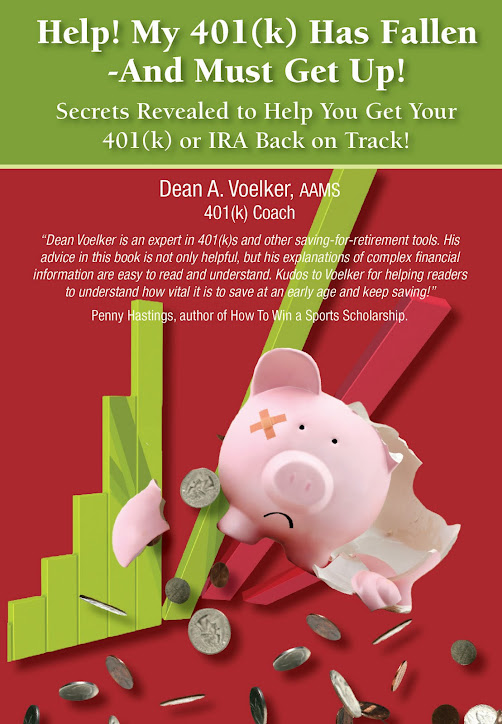
My book, Help! My 401(k) Has Fallen - And Must Get Up! will help with this. In the book, I will share secrets with you about your 401(k) which will let you get more out of the plan. For about the price of a pizza, you can learn about how to get your 401(k) back on its feet. Please contact me at my website, http://www.helpmy401k.us/ for more information and a FREE REPORT, The Five Biggest Problems With 401(k) Plans - And How To Fix Them!
You can follow me on Twitter, Linked In, or Facebook. I also host a radio program, Improving Your Financial Health, on WHME-FM (103.1) in South Bend, IN.
Showing posts with label risk. Show all posts
Showing posts with label risk. Show all posts
Thursday, June 10, 2010


Wednesday, March 17, 2010
Diary of a Wimpy 401(k) - Wimpy Friends
The interesting thing about writing a book - I am learning who my friends are.
One of the things I had wanted was to get testimonials from people from all walks of life. The book was written in simple language with plenty of stories to make it easy for anyone to understand.
We all have a 401(k) or 403(b) - almost all of us anyway. Unless you are self-employed or one of the rare few who still have a pension.
So about a month ago, I sent requests for testimonials to about 65 people. Some I knew better than others. Some were financial experts who I had interviewed on "Improving Your Financial Health". Some were friends in the financial industry. Some were friends and clients I knew locally, or small business owners. Still others were people who were involved in the project in some way.
A few were celebs who I didn't know, but I wanted to get a testimonial from them.
In asking for testimonials, I believe that we are all very busy. I am willing to be patient and follow up a few times to get testimonials. These 'blurbs' from others can help to promote the book.
If you have a 401(k) and you aren't happy with it, and you are nervous about the future, you should read this book!
One guy (a writer whom I won't name) turned me down, but was very nice about it. He explained that he gets many similar requests and he simply does not have time to answer them all. He also didn't believe that his testimonial would carry much weight, with him not having a financial background.
Although I was slightly disappointed, I appreciated his sincerity and his prompt response.
I've also had a few of my financial heroes tell me that although they like the book and see its value, they aren't allowed to respond due to compliance constraints. Again, I respect this.
That's one way to do it. Here's the WRONG WAY!
Another previous guest on my program (I won't name her - but I promise she WON'T BE BACK!) had her assistant send this "snooty form letter" remark. "As a policy, our team focuses on content that is being published by a major imprint. We don’t read or consider unsolicited material. Should your book get picked up by a major imprint, please do feel free to reach out to me at that time, and I’ll do my best to get it to (her) for a possible endorsement."
Again, this type of chilly response really alienated me. I've lost a lot of respect for this person and needless to say, she won't be back as a guest on my program.
I am still looking for testimonials. I've gotten several very ones so far. Let me kinow if you'd like a copy of the book for review. If you want to learn more about 401(k)s and think you can write a couple of kind words - contact me and I will gladly send you a copy of the draft.
Here are some of my favorite testimonials so far.
"Unless you plan to work till you drop, the 401(k) is your eventual ticket to freedom. Your plan may have fallen in 2008 and Dean Voelker is just the person to help get it back up." -
Jonathan Chevreau, Financial Post columnist, and author of Findependence Day.
“Dean Voelker does a great job of laying out the case for aggressively pursuing your 401(k). This book presents compelling reasons for getting involved in your future TODAY, rather than tomorrow. Dean’s story telling approach takes the 401(k) from its birth through today in an easy to read and storytelling manner.” - Len Fox, author of Recipe Investing.
“Dean Voelker is a real pro. He reveals some things about the Social Security system and how
401(k)s work that I never knew. This book is short, sweet and to the point. Everyone needs to read it quickly to see if they are doing what they should to get their retirement plans back on track. Thanks, Dean for putting this together for us.” - John S. Cohoat, President of Cohoat Business Growth Advisors, and author of No Thank You, Mr. President.
Go ahead, don't be "wimpy". Contact me today. You can also get a copy of a free report on my website -
"The 5 Biggest Problems With 401(k) Plans - And How to Fix Them"
You may also contact me on Linked In at http://www.linkedin.com/in/dvoelker or Twitter at http://www.twitter.com/deanvoelker. I also host a weekly financial advice program, Improving Your Financial Health at http://www.blogtalkradio.com/401kcoach.
One of the things I had wanted was to get testimonials from people from all walks of life. The book was written in simple language with plenty of stories to make it easy for anyone to understand.
We all have a 401(k) or 403(b) - almost all of us anyway. Unless you are self-employed or one of the rare few who still have a pension.
So about a month ago, I sent requests for testimonials to about 65 people. Some I knew better than others. Some were financial experts who I had interviewed on "Improving Your Financial Health". Some were friends in the financial industry. Some were friends and clients I knew locally, or small business owners. Still others were people who were involved in the project in some way.
A few were celebs who I didn't know, but I wanted to get a testimonial from them.
In asking for testimonials, I believe that we are all very busy. I am willing to be patient and follow up a few times to get testimonials. These 'blurbs' from others can help to promote the book.
If you have a 401(k) and you aren't happy with it, and you are nervous about the future, you should read this book!
One guy (a writer whom I won't name) turned me down, but was very nice about it. He explained that he gets many similar requests and he simply does not have time to answer them all. He also didn't believe that his testimonial would carry much weight, with him not having a financial background.
Although I was slightly disappointed, I appreciated his sincerity and his prompt response.
I've also had a few of my financial heroes tell me that although they like the book and see its value, they aren't allowed to respond due to compliance constraints. Again, I respect this.
That's one way to do it. Here's the WRONG WAY!
Another previous guest on my program (I won't name her - but I promise she WON'T BE BACK!) had her assistant send this "snooty form letter" remark. "As a policy, our team focuses on content that is being published by a major imprint. We don’t read or consider unsolicited material. Should your book get picked up by a major imprint, please do feel free to reach out to me at that time, and I’ll do my best to get it to (her) for a possible endorsement."
Again, this type of chilly response really alienated me. I've lost a lot of respect for this person and needless to say, she won't be back as a guest on my program.
I am still looking for testimonials. I've gotten several very ones so far. Let me kinow if you'd like a copy of the book for review. If you want to learn more about 401(k)s and think you can write a couple of kind words - contact me and I will gladly send you a copy of the draft.
Here are some of my favorite testimonials so far.
"Unless you plan to work till you drop, the 401(k) is your eventual ticket to freedom. Your plan may have fallen in 2008 and Dean Voelker is just the person to help get it back up." -
Jonathan Chevreau, Financial Post columnist, and author of Findependence Day.
“Dean Voelker does a great job of laying out the case for aggressively pursuing your 401(k). This book presents compelling reasons for getting involved in your future TODAY, rather than tomorrow. Dean’s story telling approach takes the 401(k) from its birth through today in an easy to read and storytelling manner.” - Len Fox, author of Recipe Investing.
“Dean Voelker is a real pro. He reveals some things about the Social Security system and how
401(k)s work that I never knew. This book is short, sweet and to the point. Everyone needs to read it quickly to see if they are doing what they should to get their retirement plans back on track. Thanks, Dean for putting this together for us.” - John S. Cohoat, President of Cohoat Business Growth Advisors, and author of No Thank You, Mr. President.
Go ahead, don't be "wimpy". Contact me today. You can also get a copy of a free report on my website -
"The 5 Biggest Problems With 401(k) Plans - And How to Fix Them"
You may also contact me on Linked In at http://www.linkedin.com/in/dvoelker or Twitter at http://www.twitter.com/deanvoelker. I also host a weekly financial advice program, Improving Your Financial Health at http://www.blogtalkradio.com/401kcoach.
Friday, February 5, 2010
Tax Free Interest In Indiana - Shhh, Your Bank Doesn't Want You To Know

Indiana offers some tax benefits to investors that are unique to our state. Municipal Bonds are very popular here. These bonds are a great (and Safe) way to earn more interest on your savings. The interest you earn on a bond from ANY STATE is FREE from Federal Tax, State Tax, and Local Taxes!
Municipal Bonds, or Munis have been used for over 200 years as a way to raise money to build or improve schools, hospitals, libraries, and roads. These days, stadiums have also been funded by having bonds issued. Once the bond is issued, you can loan money to the project and be repaid with interest which is free from Federal taxes. When the bond matures, you get the amount back which you loaned to the project.
If the bond is issued by your home state, your interest may also be free from State and Local taxes.
Again, the benefit for us "Hoosiers" living in Indiana is this. It doesn't matter which state the bond came from. We enjoy interest income on any muni bond which is free from Federal, State, and Local Taxes!
That may be worth an additional 1.5% - 2% or more on your savings, depending on your tax bracket.
(Check with your advisor when buying bonds to see if you may be subject to Alternative Minimum Tax, depending on your total income.)
Currently, http://www.bankrate.com/ (as of Feb. 4, 2010), shows us what the highest rates are for a 1 Year CD
(1.7%) and a 5 Year CD (3.55%). Dave Ramsey refers to these as "Certificates of Depression". You can see why!
Did you also know that CDs are RISKY? Why is that, you ask?
Easy - You LOSE Future Buying Power!
Let's do the math, and see which option may be better for long term savings.
5 Year Municipal (Investment Quality) Bond at 5%
$10,000 x .05 = $500/year.
$500 x 5 years = $2500 (TAX FREE)
Most Bonds pay interest twice per year, directly to you the investor, so you will get 2 checks each year for
$250 for 5 years. When the bond is due, you get the $10,000 back. That may also happen if the bond is called early, but that's another lesson.
5 Year CD at 3.55%
Remember that was the BEST rate in the US today on http://www.bankrate.com/.
$10,000 x .0355 = $355/year.
$355 x 5 years = $1775, and you WILL PAY TAXES on this.
Hmmmm......let's see.....I can get $2500 in interest that is tax free OR $1775 in interest that is taxable. I wonder which one I should pick......
Did you ever wonder how banks make money? They use your money and either loan it or invest it.
Now you can see why your bank may not share the muni bond idea with you.
If you would like to learn more about Municipal Bonds, please contact me.
You may also contact me for more information on 401(k) plans or IRAs at http://www.helpmy401k.us/.
You may also contact me on Linked In at http://www.linkedin.com/in/dvoelker or Twitter at http://www.twitter.com/deanvoelker. I also host a weekly financial advice program, Improving Your Financial Health at http://www.blogtalkradio.com/401kcoach.
Wednesday, October 14, 2009
Cut The Fat in your 401(k)
Last week, we asked “Where’s the Beef?” Today, we ask “Where’s the Fat?”
Its very important to trim the ‘fat’ in your 401(k) plan – or fund expenses. Today on my Blog Talk Radio program, I had a listener ask about fund expenses. These can really affect your long term return on your retirement savings.
Expenses come from managing the mutual fund. The fund family charges a percentage of the assets invested to manage the fund – deciding what to buy, what to sell, and how much to buy or sell and when to do it. Less trading = lower expenses. Also the advisor on the plan may be paid from these expenses.
Knowing this, it would make sense to look for funds in your plan which have a lower expense rate. If its about 1%, that isn’t too bad, much more than that can negatively affect your returns over time.
To give you an example, I did some figuring on my financial calculator . Let’s look at a 22 year old college graduate, starting their 401(k) plan. Of course you would expect them to bump up their contributions over time, but lets say they put in $300/month with an 8% average return until age 66. They would have saved $1,340,048 in 44 years.
What if they were using a fund with expenses that were 1% more? In other words, the fund may have averaged 8%, but the real return was 7% due to higher expenses. With all the other factors being the same, we now have a total savings of $993,985, which is a difference of $346,063. OUCH! If you figure on taking 4%/year of the nest egg at retirement for income, that means we would need to live on less income -$13842 per year less. See where 1% can make a big difference?
So look carefully at your statement. Don’t just look at ‘performance’ but also fund expenses, which do affect long term performance. Have an advisor help you with this and also help you determine how much to save, so you can have the type of retirement you want.
You may contact me through my website at http://www.helpmy401k.us. You can also follow me on Twitter at http://www.twitter.com/deanvoelker. I also host a Weekly Internet Radio Broadcast “Improving Your Financial Health on Blog Talk Radio http://www.blogtalkradio.com/401kcoach
Its very important to trim the ‘fat’ in your 401(k) plan – or fund expenses. Today on my Blog Talk Radio program, I had a listener ask about fund expenses. These can really affect your long term return on your retirement savings.
Expenses come from managing the mutual fund. The fund family charges a percentage of the assets invested to manage the fund – deciding what to buy, what to sell, and how much to buy or sell and when to do it. Less trading = lower expenses. Also the advisor on the plan may be paid from these expenses.
Knowing this, it would make sense to look for funds in your plan which have a lower expense rate. If its about 1%, that isn’t too bad, much more than that can negatively affect your returns over time.
To give you an example, I did some figuring on my financial calculator . Let’s look at a 22 year old college graduate, starting their 401(k) plan. Of course you would expect them to bump up their contributions over time, but lets say they put in $300/month with an 8% average return until age 66. They would have saved $1,340,048 in 44 years.
What if they were using a fund with expenses that were 1% more? In other words, the fund may have averaged 8%, but the real return was 7% due to higher expenses. With all the other factors being the same, we now have a total savings of $993,985, which is a difference of $346,063. OUCH! If you figure on taking 4%/year of the nest egg at retirement for income, that means we would need to live on less income -$13842 per year less. See where 1% can make a big difference?
So look carefully at your statement. Don’t just look at ‘performance’ but also fund expenses, which do affect long term performance. Have an advisor help you with this and also help you determine how much to save, so you can have the type of retirement you want.
You may contact me through my website at http://www.helpmy401k.us. You can also follow me on Twitter at http://www.twitter.com/deanvoelker. I also host a Weekly Internet Radio Broadcast “Improving Your Financial Health on Blog Talk Radio http://www.blogtalkradio.com/401kcoach
Friday, October 9, 2009
Where's The Beef?

During the 1980’s there was a very popular commercial by Wendy’s. An elderly lady ordered a burger at a generic fast food counter. Upon seeing how puny and pathetic her tiny burger was, she grilled the sales clerk repeatedly - “Where’s the beef?” The commercial was a huge hit and “Where’s the beef?” was a well known catch phrase.
These days “Where’s the beef?” could easily be applied to the 401(k)s & IRAs of many people. In Daniel R. Solin’s book, “The Smartest 401(k) Book You’ll Ever Read”, he points out that “the typical twenty-something only invests 50.4% of his or her account in stock mutual funds.” You can’t keep up with inflation that way! Mr. Solin goes on to say that as we get older, that figure is also pretty timid. “The typical worker in their forties invests only 54.3% in stock funds.”
It doesn’t matter how old you are. Even people on the verge of retirement should be invested in stock mutual funds with a good part of their long term savings. After all, you could be retired for 20-30 years.
Stocks have been the only investment which has beaten inflation over the long term. And we NEED to prepare for inflation! Did you know that in 1989 (20 years ago), a loaf of bread costs an average of 0.67? And a postage stamp was just 0.25?
Mr. Solin also points out that “If you invested $1.00 in blue chip stocks in 1926, it would be worth $3077.33 today. That pencils out to a 10.42 average yearly return.”
Don’t be too fancy trying to pick the “right” fund. Look for mutual funds with long histories (10 years or longer) and low expenses. High management fees can really affect the return on your investment.
We will be looking at a few other ways to put some “Beef” back into your 401(k) in a future article.
You may contact me through my website at http://www.helpmy401k.us. You can also follow me on Twitter at http://www.twitter.com/deanvoelker. I also host a Weekly Internet Radio Broadcast "Improving Your Financial Health on Blog Talk Radio http://www.blogtalkradio.com/401kcoach
Saturday, September 26, 2009
How To Find A Financial Advisor in South Bend


So the stock market has rebounded from its low point in March, 2009. As we are wrapping up the 3rd Quarter of this year, I have been reflecting on a few thoughts.
Although we have seen some market recovery, for many of us, 2009 has been more challenging than 2008.
* As I talk with people, I am sensing more uncertainty over the future of the economy and
their plans for retirement.
* Unemployment continues to stay at a high level. Some regions are higher than others
nationally. The Michiana area, with its long ties to the RV and automotive industry, has
experienced higher unemployment than other areas.
* Most recently, according to today’s South Bend Tribune we learned that the Braking
Division of Robert Bosch Corp. will be sold to Akebono Braking Industry of Tokyo, Japan. This
puts more strain on our area’s economy and could result in additional job losses.
* Many of those I have talked with are continuing to look for ways to pinch pennies, cut
corners and make their money last.
The one thing which hasn’t changed is that people still need to live their lives in dignity when they finally retire. And with people living longer than they used to, that takes Savings & Planning. Costs of living will continue to rise as well.
If you are living in the South Bend, IN area, how do you find someone who can help you develop the right strategy for you to reach your goals in these trying times? There are several qualities you should look for when shopping for an advisor, no matter where you live.
* Is he/she a Good Listener? Can you share your dreams & goals with them?
Do they make you feel important? Do they ask you questions such as “What is
important about your savings to you?” and “What would you like your retirement to be
like?” If all they do is tell you about the latest stock tip, or if they do all the talking, it
may be time to look elsewhere.
* Do they have a reasonable amount of experience?
Advisors can sometimes fall into 2 groups. You may not want an advisor that the ink on
their license has not yet dried. Most of us if asked would prefer an experienced advisor,
although you may want to find out if they are accepting new clients, or is there a
minimum amount to invest. There is a great website, http://www.financialadvisormatch.com/.
You can plug in the area you live in and it can give unbiased information on advisors in
that area. Also you can look up an advisor by name.
Another great website to learn information is http://www.linkedin.com/ which is a
professional networking site. This can give you great information about your
Advisor, much like an on-line resume.
* Does he/she have the “heart of a teacher”?
This is a comment often made by financial talk radio show host, Dave Ramsey.
Dave has grown in popularity because people are getting back to basics and
want common sense advice. Most people want investing concepts made simple.
Can your advisor help make this ‘fun’ to learn? Or do they talk in technical jargon?
want common sense advice. Most people want investing concepts made simple.
Can your advisor help make this ‘fun’ to learn? Or do they talk in technical jargon?
* Does he/she talk about WHY Investing is so important for all of us?
Can they look at your budget with you and help you determine what type of income
you’ll need at retirement? By helping you know how much income you need (after
Social Security and any other sources of income), you should have a much better idea
for how much you need to be saving - AND put together a plan to do it!
* Will they offer to review your 401(k) and other statements for FREE?
Some advisors are “fee” based and charge by the session or by the hour for advice.
Others work on commission and are only paid when investments are made. For most of
us, this is the fairest method. There will always be times you have a question, and
advice should be free. Depending on how much you invest, you may also qualify for
volume discounts, also known as “breakpoints”.
* Is your advisor independent, or do they work with a larger firm?
This is really a matter of personal preference and there are pros & cons to each. Also
there are great advisors with either side. Many people prefer an established name brand
firm, while others enjoy the personal attention they may get from an independent.
In some ways, you could compare working with an advisor to eating at a restaurant.
There are large national chains, and also individually owned local restaurants which
have found their own niche.
There was a great article earlier this month (Sept 14, 2009)
“Schwab Says Independent Advisers Attract Brokerage Firm Assets”
http://www.bloomberg.com/apps/news?pid=20603037&sid=aYTCv4DGu76Y
by Alexis Leondis of Bloomberg.com. The article shows the results of a survey done by
Charles Schwab about where clients are holding their assets. Ms. Leondis states,
“Almost 90% of the independent Registered Investment Advisors said that they gained
assets in the last 6 months and 45% of the assets came from so-called full-service
brokerage firms.”
Whether he/she works independently, or with a larger firm, your advisor can’t prevent
market declines. However, working with someone you are comfortable with should at
least help you to feel better about the future of your retirement.
Best wishes in your search!
Dean Voelker is an Independent Registered Investment Advisor in South Bend. He has
been licensed in Indiana and Michigan since 2003. You can follow Dean on Twitter, and also find his profile at Linked In and Financial Advisor Match. Dean also hosts a weekly Podcast program
Friday, August 14, 2009
Most Magical Place

Having 2 very young daughters, I’ve become quite familiar with the Disney Channel, but its amazing to think of how large this company is and how it affects our lives in many ways, known world wide for family friendly products.
This is NOT an opinion or endorsement of Disney Stock - simply a few interesting facts about its history. The Walt Disney Company (DIS) has been part of the Dow Jones Industrial Average since May 6, 1991.
The Walt Disney Company started in 1923 in the rear of a small office occupied by Holly-Vermont Realty in Los Angeles. It was there that Walt Disney, and his brother Roy, produced a series of short live-action/animated films collectively called the ALICE COMEDIES. http://studioservices.go.com/disneystudios/history.html
“Mickey Mouse” which still serves as the logo and mascot for Disney was originated in 1928, as one of the short animated films.
In 1937, Disney's innovative first full length animated feature, SNOW WHITE AND THE SEVEN DWARFS, was released. Walt Disney saw a need to increase the size of his studio, and moved it to Burbank, CA. He was involved with all aspects of the design, even the animators chairs. More movies such as FANTASIA, BAMBI, CINDERELLA, ALICE IN WONDERLAND, and PETER PAN were produced in the 1940’s and 1950s.
In 1954, Walt Disney had a vision of creating a Family Theme Park. Disneyland was completed in July, 1955. Disney World Magic Kingdom opened in Orlando, FL in October, 1971. To this day, Disneyland and Disney World are the standard for cleanliness, customer service, and family fun in theme parks. Sadly Walt Disney died in 1966, and did not see the opening of Disney World.
Today, the Disney entertainment empire includes Disney movies, the ABC family of networks, ESPN, the E! Entertainment Network, and of course the Disney Channel. Disney has helped launch the acting and musical careers of such recent stars as Justin Timberlake, Britney Spears, Christina Aguilera, Miley Cyrus, and the Jonas Brothers to name a few.
Disney issued its first public stock on November 12,1957. http://corporate.disney.go.com/investors/stockinfo/quote_1957.pdf The stock closed on its first day at $13.88. It has split 7 times since then, the last split happened in 1998. http://corporate.disney.go.com/investors/split_history.html. One share of DIS stock over that time due to splits & spinoffs would be worth close to $6000 today.
For more information, you can contact me directly at http://www.helpmy401k.us and you may also follow me on Twitter at www.twitter.com/deanvoelker.
Friday, August 7, 2009
Something's "Fishy"

All this talk about "fishy" comments yesterday got me to thinking.....
Another great American Fast Food chain is Long John Silvers. According to their website, www.ljsilvers.com , the restaurant was inspired by Robert Louis Stevenson's "Treasure Island".
The first restaurant opened in 1969 in Lexington, Kentucky, as a response to other fast food chains which were becoming popular at the time - specializing in quick service seafood. The chain began as a division of Jerrico, Inc., which also operated Jerry's Restaurants, a chain of family restaurants which also began in Lexington, KY throughout the Midwest & South.
In the UK, fish and chips became a cheap food popular among the working classes in the second half of the nineteenth century. http://en.wikipedia.org/wiki/Fish_and_chips Deep-fried "chips" (slices or pieces of potato) as a dish, may have first appeared in Britain in about the same period. There was a mention of "chips" in Charles Dickens' "A Tale of Two Cities" (1859) "Husky chips of potatoes, fried with some reluctant drops of oil".
Earlier Long John Silvers restaurants were known for their Cape-Cod style buildings, blue roofs, small steeples, and nautically-themed decorations such as seats made to look like nautical flags. Most early restaurants also featured separate entrance and exit doors, a corridor-like waiting line area, food heaters that were transparent so customers could see the food waiting to be served, and a bell by the exit which customers could "ring if we did it well." Many of these buildings had dock-like walkways lined with pilings and thick ropes that wrapped around the building exterior.
Until its bankruptcy in 1998, Long John Silvers was a privately owned corporation. It was then acquired by Yorkshire Global Restaurants, which also owned A & W American Food Chains. In March 2002, Yorkshire was purchased by Tricon Global Restaurants, Inc. which had spun off from Pepsico, Inc. Tricon owned Taco Bell, Kentucky Fried Chicken, and Pizza Hut worldwide. Tricon then changed their name to Yum Brands, Inc. (NYSE: YUM)
Until then, Long John Silvers had served Coca-Cola Products. Once the acquistion by Yum Brands was in effect, they switched to Pepsi. Currently, Long John Silvers has more than 1200 restaurants worldwide – and more than 200 additional locations in Yum Brands, Inc. multi-brand restaurants. Nearly four million customers each week "throw boring overboard".
This is NOT an endorsement or an opinion of YUM stock. From 1997, Yum Brands/Tricon has grown from $8.06/share to a high of $41.73 on April 30, 2008. http://finance.aol.com/charts/yum-brands-inc/yum/nys/tech-chart Yesterday, August 6, 2009, YUM closed at 36.05.
This is NOT an endorsement or an opinion of YUM stock. From 1997, Yum Brands/Tricon has grown from $8.06/share to a high of $41.73 on April 30, 2008. http://finance.aol.com/charts/yum-brands-inc/yum/nys/tech-chart Yesterday, August 6, 2009, YUM closed at 36.05.
For more investing information, you may contact me at http://www.deanvoelker.com . You may also follow me on Twitter at www.twitter.com/deanvoelker, or Blog Talk Radio at
Thursday, July 23, 2009
This Time Its Different - II
Recently I posted an article, titled “This Time It’s Different”. Most people when asked about the idea of investing in the market, have responded that “They are waiting to see what happens” and yes, “This Time It’s Different because…..”
If you read my previous article, “This Time It’s Different”, http://5reasonsyoushouldownaroth.blogspot.com/2009/07/this-time-its-different.html I referred to a study done by Hartford on the Recession of the mid 1970’s (1973 & 1974), arguably the closest parallel to our present economic situation. The low point in the market was Sept. 30, 1974. The Dow closed at 607.87 (not a misprint) This was down more than 40% from its high in 1972, when it crossed the 1000 mark for the first time. http://www.democraticunderground.com/discuss/duboard.php?az=view_all&address=389×4124348
The stock market had gone through back-to-back negative years for the first time since the Great Depression.
We should set the stage a bit at this point. In 1972, we were still heavily involved in the Vietnam War, which was highly unpopular, and dragged on for several years. Also, in 1972, the Watergate scandal began. This resulted in the indictment and conviction of several of Nixon’s closest advisors, and ultimately in the resignation of the President himself, on August 9, 1974. http://en.wikipedia.org/wiki/Watergate_scandal
To make matters worse, the Oil Embargo http://en.wikipedia.org/wiki/1973_oil_crisis was put into effect by OPEC, which refused to ship oil to the US due to their support of Israel at that time. Unemployment had reached a high of 6.7% in 1974. http://www.nytimes.com/2008/12/06/business/economy/06jobs.html
So things in 1974 looked pretty bleak. I recently read a letter written by Jim Fullerton of the Capital Group to shareholders at that time(November 1974). Here are some highlights from Mr. Fullerton’s letter.
“Each economic, market, and financial crisis is different from previous ones. But in their very difference, there is commonality….. Today there are thoughtful, experienced, respected, economists, bankers, investors, and businessmen who can (tell) you why this time the economic problems are different; why this time things are going to get even worse – and hence, why this is NOT a good time to invest in common stocks, even though they may appear low…..This time is a whole new ball game.”
“In 1942 everybody knew it was a whole new ball game…..The Germans had overrun France. The British had been thrown out of Dunkirk. The Pacific Fleet had been disastrously crippled at Pearl Harbor. We had surrendered Bataan, and the British had surrendered Singapore. The U.S. was so ill-prepared for a war that……75% of our field artillery was equipped with horse-drawn, French 75mm guns.” (Mr. Fullerton served in WWII.)
“In April 1942, inflation was rampant…..On April 8, 1942, the lead article in the (Wall Street) Journal was: ‘Home Construction, Total far behind last year’s. Private Builders hardest hit.’…..Washington D.C. also considered more drastic rationing with price fixing, or still higher taxes as a means of filling the ‘inflationary gap’ between increased public buying power and the diminishing supply of consumer goods.”
“A leading stock market commentator wrote: ‘The market remains in the dark as to just what it has to discount. And as yet, the signs are still lacking that the market has reached permanently solid ground for a sustained reversal.”
“Yet on April 28, 1942, in that gloomy environment, in the midst of a war we were losing, faced with excess-profits taxes and wage and price controls, shortages of gasoline and rubber…..and with the virtual certainty…..that once the war was over, we’d face a post-war depression, the market turned around.”
“Now I’d like to close with this: ‘Some people say they want to wait for a clearer view of the future. But when the future is again clear, the present bargains will have vanished. In fact, does anyone think that today’s prices will prevail once full confidence has been restored?’ That comment was made by Dean Witter in May of 1932 – only a few weeks before the end of the worst bear market in history.”
“Have Courage! We have been here before – and we’ve survived and prospered.”
Jim Fullerton
As of today, July 23, 2009, the Dow is up nearly 200 points, crossing the 9000 mark for the first time this year. This is a gain of over 38% from its low point of 6547 on March 9, 2009. Yes, This Time It’s Different.
For more information, you may contact me at http://www.helpmy401k.us. You may also follow me on Twitter at www.twitter.com/deanvoelker.
If you read my previous article, “This Time It’s Different”, http://5reasonsyoushouldownaroth.blogspot.com/2009/07/this-time-its-different.html I referred to a study done by Hartford on the Recession of the mid 1970’s (1973 & 1974), arguably the closest parallel to our present economic situation. The low point in the market was Sept. 30, 1974. The Dow closed at 607.87 (not a misprint) This was down more than 40% from its high in 1972, when it crossed the 1000 mark for the first time. http://www.democraticunderground.com/discuss/duboard.php?az=view_all&address=389×4124348
The stock market had gone through back-to-back negative years for the first time since the Great Depression.
We should set the stage a bit at this point. In 1972, we were still heavily involved in the Vietnam War, which was highly unpopular, and dragged on for several years. Also, in 1972, the Watergate scandal began. This resulted in the indictment and conviction of several of Nixon’s closest advisors, and ultimately in the resignation of the President himself, on August 9, 1974. http://en.wikipedia.org/wiki/Watergate_scandal
To make matters worse, the Oil Embargo http://en.wikipedia.org/wiki/1973_oil_crisis was put into effect by OPEC, which refused to ship oil to the US due to their support of Israel at that time. Unemployment had reached a high of 6.7% in 1974. http://www.nytimes.com/2008/12/06/business/economy/06jobs.html
So things in 1974 looked pretty bleak. I recently read a letter written by Jim Fullerton of the Capital Group to shareholders at that time(November 1974). Here are some highlights from Mr. Fullerton’s letter.
“Each economic, market, and financial crisis is different from previous ones. But in their very difference, there is commonality….. Today there are thoughtful, experienced, respected, economists, bankers, investors, and businessmen who can (tell) you why this time the economic problems are different; why this time things are going to get even worse – and hence, why this is NOT a good time to invest in common stocks, even though they may appear low…..This time is a whole new ball game.”
“In 1942 everybody knew it was a whole new ball game…..The Germans had overrun France. The British had been thrown out of Dunkirk. The Pacific Fleet had been disastrously crippled at Pearl Harbor. We had surrendered Bataan, and the British had surrendered Singapore. The U.S. was so ill-prepared for a war that……75% of our field artillery was equipped with horse-drawn, French 75mm guns.” (Mr. Fullerton served in WWII.)
“In April 1942, inflation was rampant…..On April 8, 1942, the lead article in the (Wall Street) Journal was: ‘Home Construction, Total far behind last year’s. Private Builders hardest hit.’…..Washington D.C. also considered more drastic rationing with price fixing, or still higher taxes as a means of filling the ‘inflationary gap’ between increased public buying power and the diminishing supply of consumer goods.”
“A leading stock market commentator wrote: ‘The market remains in the dark as to just what it has to discount. And as yet, the signs are still lacking that the market has reached permanently solid ground for a sustained reversal.”
“Yet on April 28, 1942, in that gloomy environment, in the midst of a war we were losing, faced with excess-profits taxes and wage and price controls, shortages of gasoline and rubber…..and with the virtual certainty…..that once the war was over, we’d face a post-war depression, the market turned around.”
“Now I’d like to close with this: ‘Some people say they want to wait for a clearer view of the future. But when the future is again clear, the present bargains will have vanished. In fact, does anyone think that today’s prices will prevail once full confidence has been restored?’ That comment was made by Dean Witter in May of 1932 – only a few weeks before the end of the worst bear market in history.”
“Have Courage! We have been here before – and we’ve survived and prospered.”
Jim Fullerton
As of today, July 23, 2009, the Dow is up nearly 200 points, crossing the 9000 mark for the first time this year. This is a gain of over 38% from its low point of 6547 on March 9, 2009. Yes, This Time It’s Different.
For more information, you may contact me at http://www.helpmy401k.us. You may also follow me on Twitter at www.twitter.com/deanvoelker.
Thursday, July 2, 2009
This Time Its Different
Last year (2008), the Dow Jones Industrial Average fell about 34% (www.djindexes.com), then dropped ANOTHER 20% in the first 2 months of 2009.
It is estimated that investors accounts have declined in value by about $10 TRILLION DOLLARS TOTAL. http://www.businessweek.com/mediacenter/podcasts/cover_stories/covercast_03_05_09.htm
Severe recessions such as this one can test the resolve of even the most experienced investors.
It is easy to say "This time its different." Many people are still feeling that way.
However, it is important to keep in mind a few points.
* Financial decisions (any financial decisions) should not be based on emotion.
* Historically, after every past recession, the market has gone on to hit new highs.
* Declines in the market & economy, even our most severe ones, have been temporary.
* Since 1926, the Dow Jones has had TWICE AS MANY positive returns as negative ones.
Despite more than 12 recessions dating back to 1926, $1.00 invested in the Dow in 1926
would have been worth $2045.00 at the end of 2008.
The late Sir John Templeton, founder of Franklin Templeton Investments liked to say, "The Four most expensive words in the English Language are 'This time it's Different.' "
The National Bureau of Economic Research www.nber.com http://www.nber.org/cycles/
states that the United States has weathered a recession EVERY decade since the 1920's. https://financialprofessional.hartfordinvestor.com/planco/om/P7135.pdf - Page 4.
As painful as the recessions are, when we are experiencing one, they have always been short lived, about 11 months on average. It can be difficult to predict when one will end, and announcing the "end" may take a while. According to NBER, they have waited an average of 15 months before declaring an "end". This way they avoid confusion. If there is further economic turmoil, it can be linked to a new recession, rather than the old one.
While we are "waiting to see what will happen" rebounds are often quick and robust. Stocks tend to recover about 6 months before the economy does. According to Morningstar www.morningstar.com, stocks are referred to as a leading indicator. On average, stocks have returned about 25% from market lows to the "end of the recession".
Did you know that the Dow Jones has increased by nearly 30% since its low point on
March 9, 2009? Have you been "in" the whole time, or did you go to something "safe"?
3/9/2009 - 6547
7/1/2009 - 8504
"The most expensive words in the English Language are 'This time it's different'."
Sir John Templeton
If you went to cash, thinking you were being "smart", think again. Cash can actually slow your recovery, and make it much harder to get your savings back.
In a recent study, Hartford shows data from the recession of 1973-1974, which had been our most severe until the present one. The study (please contact me at www.helpmy401k.us for more information) shows 4 seperate scenarios, each starting with $100,000 invested in equities on Dec. 31, 1972.
(Equities are represented by the S & P 500 Index. Cash is represented by the 30 Day Treasury Bill Index.)
In the study, they wanted to see how long it would take to recover the original $100,000 for the Low Point in the Market (Sept. 30, 1974)
Investor A (stayed in Equities) - back to $100,000 in July 1976 (1.75 years)
Investor B (moved to cash for 6 months, starting 9/30/1974) (5.3 years, or Jan. 1980)
Investor C (moved to cash for 12 months, starting 9/30/1974) (also 5.3 years)
Investor D (moved to cash for 18 months, starting 9/30/1974) (6.2 years, or Nov. 1980)
Yogi Berra sometimes said, "Its deja vu all over again."
In a challenging economy such as this one, isn't this precisely when you need a financial professional working side by side with you?
For more information, please contact me at http://www.helpmy401k.us. You may also follow me on Twitter at www.twitter.com/deanvoelker.
It is estimated that investors accounts have declined in value by about $10 TRILLION DOLLARS TOTAL. http://www.businessweek.com/mediacenter/podcasts/cover_stories/covercast_03_05_09.htm
Severe recessions such as this one can test the resolve of even the most experienced investors.
It is easy to say "This time its different." Many people are still feeling that way.
However, it is important to keep in mind a few points.
* Financial decisions (any financial decisions) should not be based on emotion.
* Historically, after every past recession, the market has gone on to hit new highs.
* Declines in the market & economy, even our most severe ones, have been temporary.
* Since 1926, the Dow Jones has had TWICE AS MANY positive returns as negative ones.
Despite more than 12 recessions dating back to 1926, $1.00 invested in the Dow in 1926
would have been worth $2045.00 at the end of 2008.
The late Sir John Templeton, founder of Franklin Templeton Investments liked to say, "The Four most expensive words in the English Language are 'This time it's Different.' "
The National Bureau of Economic Research www.nber.com http://www.nber.org/cycles/
states that the United States has weathered a recession EVERY decade since the 1920's. https://financialprofessional.hartfordinvestor.com/planco/om/P7135.pdf - Page 4.
As painful as the recessions are, when we are experiencing one, they have always been short lived, about 11 months on average. It can be difficult to predict when one will end, and announcing the "end" may take a while. According to NBER, they have waited an average of 15 months before declaring an "end". This way they avoid confusion. If there is further economic turmoil, it can be linked to a new recession, rather than the old one.
While we are "waiting to see what will happen" rebounds are often quick and robust. Stocks tend to recover about 6 months before the economy does. According to Morningstar www.morningstar.com, stocks are referred to as a leading indicator. On average, stocks have returned about 25% from market lows to the "end of the recession".
Did you know that the Dow Jones has increased by nearly 30% since its low point on
March 9, 2009? Have you been "in" the whole time, or did you go to something "safe"?
3/9/2009 - 6547
7/1/2009 - 8504
"The most expensive words in the English Language are 'This time it's different'."
Sir John Templeton
If you went to cash, thinking you were being "smart", think again. Cash can actually slow your recovery, and make it much harder to get your savings back.
In a recent study, Hartford shows data from the recession of 1973-1974, which had been our most severe until the present one. The study (please contact me at www.helpmy401k.us for more information) shows 4 seperate scenarios, each starting with $100,000 invested in equities on Dec. 31, 1972.
(Equities are represented by the S & P 500 Index. Cash is represented by the 30 Day Treasury Bill Index.)
In the study, they wanted to see how long it would take to recover the original $100,000 for the Low Point in the Market (Sept. 30, 1974)
Investor A (stayed in Equities) - back to $100,000 in July 1976 (1.75 years)
Investor B (moved to cash for 6 months, starting 9/30/1974) (5.3 years, or Jan. 1980)
Investor C (moved to cash for 12 months, starting 9/30/1974) (also 5.3 years)
Investor D (moved to cash for 18 months, starting 9/30/1974) (6.2 years, or Nov. 1980)
Yogi Berra sometimes said, "Its deja vu all over again."
In a challenging economy such as this one, isn't this precisely when you need a financial professional working side by side with you?
For more information, please contact me at http://www.helpmy401k.us. You may also follow me on Twitter at www.twitter.com/deanvoelker.
Tuesday, June 30, 2009
Lets Say I Live To 100
People are living much longer these days. With modern medicine, technology, and taking better care of ourselves, reaching 100 is much more common than it used to be. According to a Wall Street Journal article from April 14, 2008, Hallmark sold over 85,000 “Happy 100th Birthday”
cards in 2007. And that is just Hallmark. Currently the average life expectancy for a Female is 87 years, and 85 years for a Male.
Living that long is great, but it can also raise concerns about your savings. What are you doing to make sure your money lasts that long also? Can your savings generate income for the rest of your life, even if you live to 100 or beyond?
Also, how prepared are you to keep up with rising costs? Did you know that 20 years ago (1989), the cost of a postage stamp was 0.25 and a gallon of gas was about 0.97? Compare those prices with today. A stamp is 0.44 and a gallon of gas…..well it fluctuates more than the stock market. As of today, it is about 2.45, and last summer had peaked well over 4.00.
If you are retired for 20 years or more, costs will go up. How can your savings handle that? Can you give yourself “Pay Raises” and still make it last?
One last question for consideration - this past year was one of the most challenging ever for investors. How can you grow your income, make your money last, and do it “Safely”?
Here are some tips that may help answer these burning questions.
* Talk with your advisor. And if you don’t have a strong relationship with your advisor, or
you don’t feel they have your best interests in mind, find a new one. Your advisor needs to be a
great listener, and your partner - NOT just a stockbroker. Tell them what your needs are.
What is most important to you about your money?
* Be Open Minded. If your money is going to last for your lifetime, CDs aren’t going to get it
done. Especially at the current bank rates today. There are other ways you can invest, and
let your money grow over time safely. A good advisor should learn as much about you as
they are able - just like a doctor who will learn your history before prescribing anything.
“Whatever you fear most has no power - it is your fear that has the power.”
Oprah Winfrey
* Be Diversified. I’ve always thought of “diversification” like clothes in your closet.
You need to have clothing for summer, winter, fall, casual wear, dressing up,
working in the yard…..ALL occasions and ALL types of weather. Investing needs to be
the same. Would you like less risk? The best way to do that is by diversifying.
“Money, you should pardon the expression, is a little bit like manure. It doesn’t
do any good unless it’s spread around, encouraging young things to grow.”
Barbra Streisand
For more information on how to make your money last to 100 or beyond, please contact me at
www.helpmy401k.us. You may also follow me on Twitter at www.twitter.com/deanvoelker.
cards in 2007. And that is just Hallmark. Currently the average life expectancy for a Female is 87 years, and 85 years for a Male.
Living that long is great, but it can also raise concerns about your savings. What are you doing to make sure your money lasts that long also? Can your savings generate income for the rest of your life, even if you live to 100 or beyond?
Also, how prepared are you to keep up with rising costs? Did you know that 20 years ago (1989), the cost of a postage stamp was 0.25 and a gallon of gas was about 0.97? Compare those prices with today. A stamp is 0.44 and a gallon of gas…..well it fluctuates more than the stock market. As of today, it is about 2.45, and last summer had peaked well over 4.00.
If you are retired for 20 years or more, costs will go up. How can your savings handle that? Can you give yourself “Pay Raises” and still make it last?
One last question for consideration - this past year was one of the most challenging ever for investors. How can you grow your income, make your money last, and do it “Safely”?
Here are some tips that may help answer these burning questions.
* Talk with your advisor. And if you don’t have a strong relationship with your advisor, or
you don’t feel they have your best interests in mind, find a new one. Your advisor needs to be a
great listener, and your partner - NOT just a stockbroker. Tell them what your needs are.
What is most important to you about your money?
* Be Open Minded. If your money is going to last for your lifetime, CDs aren’t going to get it
done. Especially at the current bank rates today. There are other ways you can invest, and
let your money grow over time safely. A good advisor should learn as much about you as
they are able - just like a doctor who will learn your history before prescribing anything.
“Whatever you fear most has no power - it is your fear that has the power.”
Oprah Winfrey
* Be Diversified. I’ve always thought of “diversification” like clothes in your closet.
You need to have clothing for summer, winter, fall, casual wear, dressing up,
working in the yard…..ALL occasions and ALL types of weather. Investing needs to be
the same. Would you like less risk? The best way to do that is by diversifying.
“Money, you should pardon the expression, is a little bit like manure. It doesn’t
do any good unless it’s spread around, encouraging young things to grow.”
Barbra Streisand
For more information on how to make your money last to 100 or beyond, please contact me at
www.helpmy401k.us. You may also follow me on Twitter at www.twitter.com/deanvoelker.
Saturday, June 6, 2009
Fixing Your 401(k) - Part 7
Problem #6 - Education
Of all the issues we have been discussing that are plaguing 401(k) plans right now, the biggest is EDUCATION on how it works. Why? Very simple. If proper education was taking place, it would help to solve the other issues, and reduce the liability each employer and plan sponsor currently faces.
Jackson Life did a survey of several passers-by and asked them questions about 401(k)s. (Source Rollover Rx, Jackson National Life Insurance) If you have ever watched Jay Leno do his "Jaywalking" bit on the Tonight Show, you have a pretty good idea of how it went.
Here are a few actual responses when people were asked about education offered by their employers for their 401(k) plans.
"I wasn't aware of any education."
"Don't participate in this. Its on a webinar."
"Information meetings are inconvenient to attend. I'm too busy."
"I think there is on line stuff, but I don't think anyone uses it."
"What can you tell me about it?"
I have personally talked to several clients who tell me that when there are "meetings", the advisor simply hands out his card and runs thru a quick power point presentation, then asks if there are any questions. This is usually met with blank "deer in the headlights" looks.
Education must be done on an INDIVIDUAL BASIS. Everyone's situation is different.
John, the 49 year old manager is in a different spot from Brandon, the 24 year old sales rep, who is new to 401(k) investing - although Brandon needs to know he is in a great place to get started now. Kim, the 35 year old customer service rep, may be thinking about borrowing against her plan, and Sue, the 42 year old customer service manager, is new to the company and wants to know how much she should invest, and what funds to pick.
How can you address individual situations in a "webinar" or "power point"?
A survey done by The Spectrum Group (www.spectrem.com - Source Jackson Life, Rollover Rx) tells us that 85% of employees want professional advice, however only 37% of employers offer any real contact with an advisor. That is not good for the employees, or the employer/sponsors, who are exposing their companies to liability and potential lawsuits. http://accounting.smartpros.com/x40690.xml
So what should you be doing?
Let's review the Problems I've covered so far.
Problem Current Situation Solution
Participation We don't participate & Start participating in your plan don't contribute enough. and max it out.
Portability Too many cash out when Roll the old 401(k) to the plan with
changing jobs. your new job, or to an IRA.
Loans Heavy tax consequences Set up an savings fund of 3-6 mos
and penalties. expenses. Don't borrow on 401(k)
Investments We try to 'advise' ourselves. Diversify. Get professional advice.
Its your money, your future.
Education Not enough advice by Find an advisor you can work with.
employers.
Here are 3 key questions you & your advisor should be asking.
1. Do I have enough money to live through at least 25 years or more in retirement?
How can I make my money last for the rest of my life?
2. Will my savings & income keep up with rapidly rising costs?
3. How can my savings be protected against declines in the stock market?
Let me end with this quote from one of my favorite songs.
"Working so hard to make it easy......got to turn....turn this thing around - Right Now!
Its your tomorrow. Right Now! Its everything." (Van Halen - Right Now)
Bet you never thought you'd see a Van Halen reference in an article on retirement!
Get started on your plan - Right Now! Meet with your advisor today and get started on Improving Your Financial Health. For more information, please contact me at http://www.helpmy401k.us. You can also follow me on Twitter - http://www.twitter.com/DeanVoelker
Of all the issues we have been discussing that are plaguing 401(k) plans right now, the biggest is EDUCATION on how it works. Why? Very simple. If proper education was taking place, it would help to solve the other issues, and reduce the liability each employer and plan sponsor currently faces.
Jackson Life did a survey of several passers-by and asked them questions about 401(k)s. (Source Rollover Rx, Jackson National Life Insurance) If you have ever watched Jay Leno do his "Jaywalking" bit on the Tonight Show, you have a pretty good idea of how it went.
Here are a few actual responses when people were asked about education offered by their employers for their 401(k) plans.
"I wasn't aware of any education."
"Don't participate in this. Its on a webinar."
"Information meetings are inconvenient to attend. I'm too busy."
"I think there is on line stuff, but I don't think anyone uses it."
"What can you tell me about it?"
I have personally talked to several clients who tell me that when there are "meetings", the advisor simply hands out his card and runs thru a quick power point presentation, then asks if there are any questions. This is usually met with blank "deer in the headlights" looks.
Education must be done on an INDIVIDUAL BASIS. Everyone's situation is different.
John, the 49 year old manager is in a different spot from Brandon, the 24 year old sales rep, who is new to 401(k) investing - although Brandon needs to know he is in a great place to get started now. Kim, the 35 year old customer service rep, may be thinking about borrowing against her plan, and Sue, the 42 year old customer service manager, is new to the company and wants to know how much she should invest, and what funds to pick.
How can you address individual situations in a "webinar" or "power point"?
A survey done by The Spectrum Group (www.spectrem.com - Source Jackson Life, Rollover Rx) tells us that 85% of employees want professional advice, however only 37% of employers offer any real contact with an advisor. That is not good for the employees, or the employer/sponsors, who are exposing their companies to liability and potential lawsuits. http://accounting.smartpros.com/x40690.xml
So what should you be doing?
Let's review the Problems I've covered so far.
Problem Current Situation Solution
Participation We don't participate & Start participating in your plan don't contribute enough. and max it out.
Portability Too many cash out when Roll the old 401(k) to the plan with
changing jobs. your new job, or to an IRA.
Loans Heavy tax consequences Set up an savings fund of 3-6 mos
and penalties. expenses. Don't borrow on 401(k)
Investments We try to 'advise' ourselves. Diversify. Get professional advice.
Its your money, your future.
Education Not enough advice by Find an advisor you can work with.
employers.
Here are 3 key questions you & your advisor should be asking.
1. Do I have enough money to live through at least 25 years or more in retirement?
How can I make my money last for the rest of my life?
2. Will my savings & income keep up with rapidly rising costs?
3. How can my savings be protected against declines in the stock market?
Let me end with this quote from one of my favorite songs.
"Working so hard to make it easy......got to turn....turn this thing around - Right Now!
Its your tomorrow. Right Now! Its everything." (Van Halen - Right Now)
Bet you never thought you'd see a Van Halen reference in an article on retirement!
Get started on your plan - Right Now! Meet with your advisor today and get started on Improving Your Financial Health. For more information, please contact me at http://www.helpmy401k.us. You can also follow me on Twitter - http://www.twitter.com/DeanVoelker
Wednesday, June 3, 2009
Fixing Your 401(k) - Part 6
Problem #5 - Investments (Company Stock)
Do you own stock in your own company? Companies have always encouraged employees to think like an owner. By owning stock, you are a part owner of your own company. There is nothing wrong with that idea, and if you work for a large company which issues stock, that may be an option available to you in your 401(k) plan.
But how much should you own? Not more than 5-10% of the company in your 401(k). There are just too many "Murphys" out there. http://www.murphys-laws.com/murphy/murphy-true.html
Mutual funds are much more recommended as a way to spread your money out so it can grow.
“Money, you should pardon the expression, is a little bit like manure. It doesn’t do any
good unless it’s spread around, encouraging young things to grow.” Barbra Streisand
One of the worst examples of company stock going sour in a 401(k) is Enron. Enron has been a running joke since 2002 for their collapse due to fraudulent business & accounting practices.
Many of their workers lost their life savings when Enron filed bankruptcy and their stock was rendered worthless. http://www.albionmonitor.com/0202a/enrontimeline.html
Enron's 401(k) plan was enormous - over $1 Billion in total assets, of which $600 Million was in Enron stock - That is 60%! Enron offered a matching plan of up to 6% of an employee's base pay - but paid the match in STOCK, not cash. When the stock plummeted from over $90 per share to less than a $1.00 in 16 months, their employees lost their life savings and any chance at retiring the way they had planned.
http://encarta.msn.com/media_701610605___1___6/the_fall_of_enron_stock.html
Please meet with your advisor if you have more than 10% of your 401(k) or portfolio in company stock. For more information, or to contact me, please visit http://www.helpmy401k.us. You can also follow me on Twitter at http://www.twitter.com/DeanVoelker
Do you own stock in your own company? Companies have always encouraged employees to think like an owner. By owning stock, you are a part owner of your own company. There is nothing wrong with that idea, and if you work for a large company which issues stock, that may be an option available to you in your 401(k) plan.
But how much should you own? Not more than 5-10% of the company in your 401(k). There are just too many "Murphys" out there. http://www.murphys-laws.com/murphy/murphy-true.html
Mutual funds are much more recommended as a way to spread your money out so it can grow.
“Money, you should pardon the expression, is a little bit like manure. It doesn’t do any
good unless it’s spread around, encouraging young things to grow.” Barbra Streisand
One of the worst examples of company stock going sour in a 401(k) is Enron. Enron has been a running joke since 2002 for their collapse due to fraudulent business & accounting practices.
Many of their workers lost their life savings when Enron filed bankruptcy and their stock was rendered worthless. http://www.albionmonitor.com/0202a/enrontimeline.html
Enron's 401(k) plan was enormous - over $1 Billion in total assets, of which $600 Million was in Enron stock - That is 60%! Enron offered a matching plan of up to 6% of an employee's base pay - but paid the match in STOCK, not cash. When the stock plummeted from over $90 per share to less than a $1.00 in 16 months, their employees lost their life savings and any chance at retiring the way they had planned.
http://encarta.msn.com/media_701610605___1___6/the_fall_of_enron_stock.html
Please meet with your advisor if you have more than 10% of your 401(k) or portfolio in company stock. For more information, or to contact me, please visit http://www.helpmy401k.us. You can also follow me on Twitter at http://www.twitter.com/DeanVoelker
Tuesday, April 28, 2009
401(k) Bargains
I've been talking with several clients lately (even in their 30's & 40's) who aren't sure what they should be doing with their 401(k)s. A few of them have even taken money out of the 401(k) or IRA, because they "don't want to lose anymore".
We need to remember that while the market goes up and also goes down, over time IT GOES UP. Putting money into your 401(k) now (while prices are low) can only help, especially if your employer matches your contribution. We MUST get back to thinking big picture, not just what is happening today. As one advisor likes to say, "Short Term thinking is very murky, but Long Term is crystal clear."
Walter Updegrave mentions this in his article "Don't Miss Out on 401(k) Bargains" in Money Magazine. http://finance.yahoo.com/focus-retirement/article/106833/Don't-Miss-Out-on-401k-Bargains;_ylt=Ajq2DWlNpxka9nV4LwU8Qf.VBa1_?mod=fidelity-readytoretire
The best time to invest is when prices are low, and you don't want to take money out if you don't have to. It has the same effect as uprooting a plant - You are killing your money tree, in addition to paying taxes and a 10% penalty.
When would you prefer to buy groceries - at regular price or on sale?
Treat your investing the same way.
Want to lower your risk? How diversified are you?
The one thing missing in most 401(k) plans is professional advice & education for the employees. It's not enough for the guy (or lady) to come out a couple of times a year and ask if anyone has questions. My job as a professional must be to sit down with you and help you with a road map. We need to see where you are now, and where you need to be. The 401(k) is a vehicle which can (and should) be used to help you get there.
Don't miss out on 401(k) bargains!
For more information, please contact me at www.deanvoelker.com .
We need to remember that while the market goes up and also goes down, over time IT GOES UP. Putting money into your 401(k) now (while prices are low) can only help, especially if your employer matches your contribution. We MUST get back to thinking big picture, not just what is happening today. As one advisor likes to say, "Short Term thinking is very murky, but Long Term is crystal clear."
Walter Updegrave mentions this in his article "Don't Miss Out on 401(k) Bargains" in Money Magazine. http://finance.yahoo.com/focus-retirement/article/106833/Don't-Miss-Out-on-401k-Bargains;_ylt=Ajq2DWlNpxka9nV4LwU8Qf.VBa1_?mod=fidelity-readytoretire
The best time to invest is when prices are low, and you don't want to take money out if you don't have to. It has the same effect as uprooting a plant - You are killing your money tree, in addition to paying taxes and a 10% penalty.
When would you prefer to buy groceries - at regular price or on sale?
Treat your investing the same way.
Want to lower your risk? How diversified are you?
The one thing missing in most 401(k) plans is professional advice & education for the employees. It's not enough for the guy (or lady) to come out a couple of times a year and ask if anyone has questions. My job as a professional must be to sit down with you and help you with a road map. We need to see where you are now, and where you need to be. The 401(k) is a vehicle which can (and should) be used to help you get there.
Don't miss out on 401(k) bargains!
For more information, please contact me at www.deanvoelker.com .
Wednesday, April 22, 2009
How Should I Invest?
Everyone has beeen asking lately - "How should I be investing my money?" or "What's Good Right Now"?
The answers to those questions should provoke several other questions from your advisor.
I could say "Depends", which doesn't mean to invest in adult diapers, but you should give your advisor more information.
How you should invest your money really does depend on you.
* What are your goals?
Is it to be 'debt free'? Is it to own a 60 foot yacht? Golf everyday? Spend time with grandkids?
What does having money mean to YOU? Once you figure that out and communicate that with an advisor, he or she can help to give you the right place to put your money.
* What are your financial circumstances?
Someone with $100,000 in savings and no debt is in a different place in their life than someone who has $500 to "play with", but no other savings. As an advisor, I do not want to "gamble" with anyone's money. I look to provide appropriate long term solutions to help you reach your goals.
My job is to give you the "Map" you need to get from where you are now, to where you want to be - and make sure you are happily involved every step of the way.
* What is your tolerance for Risk?
OK I said it - the "R" word. To which you may say "I don't want any risk."
It's important to understand that ALL investments have risk. Even your savings account which
is FDIC insured has risk.
"How is that?" you ask.
Savings & CDs have "inflation risk", which means they are not good long term vehicles to keep up with the rising cost of living - inflation.
The best way to minimize risk is to use a mix of different investments that have different purposes - like different clothes in your closet - or "Diversification". There are also questions which your advisor may ask you to help you understand what risk means.
It all boils down to one question - Money means different things to different people.
What is important about money to you?
For more information, or to contact me directly, please visit www.deanvoelker.com
The answers to those questions should provoke several other questions from your advisor.
I could say "Depends", which doesn't mean to invest in adult diapers, but you should give your advisor more information.
How you should invest your money really does depend on you.
* What are your goals?
Is it to be 'debt free'? Is it to own a 60 foot yacht? Golf everyday? Spend time with grandkids?
What does having money mean to YOU? Once you figure that out and communicate that with an advisor, he or she can help to give you the right place to put your money.
* What are your financial circumstances?
Someone with $100,000 in savings and no debt is in a different place in their life than someone who has $500 to "play with", but no other savings. As an advisor, I do not want to "gamble" with anyone's money. I look to provide appropriate long term solutions to help you reach your goals.
My job is to give you the "Map" you need to get from where you are now, to where you want to be - and make sure you are happily involved every step of the way.
* What is your tolerance for Risk?
OK I said it - the "R" word. To which you may say "I don't want any risk."
It's important to understand that ALL investments have risk. Even your savings account which
is FDIC insured has risk.
"How is that?" you ask.
Savings & CDs have "inflation risk", which means they are not good long term vehicles to keep up with the rising cost of living - inflation.
The best way to minimize risk is to use a mix of different investments that have different purposes - like different clothes in your closet - or "Diversification". There are also questions which your advisor may ask you to help you understand what risk means.
It all boils down to one question - Money means different things to different people.
What is important about money to you?
For more information, or to contact me directly, please visit www.deanvoelker.com
Subscribe to:
Posts (Atom)