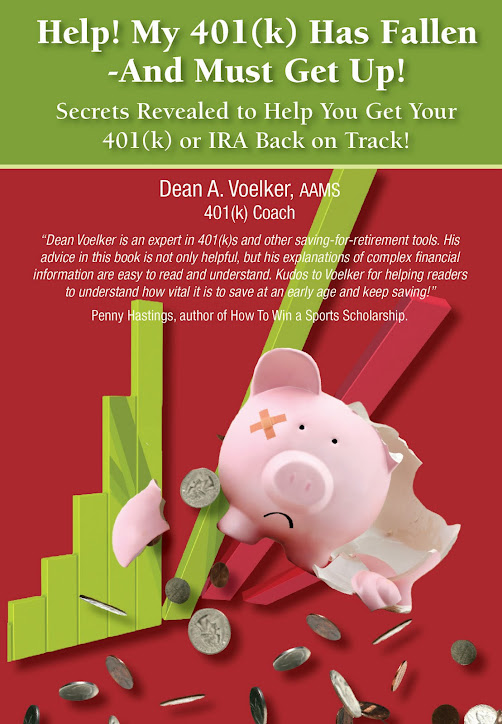
New Book - Coming November 2010

New Book - Coming November 2010
Help! My 401(k) Has Fallen - And Must Get Up!
Showing posts with label expenses. Show all posts

Thursday, October 7, 2010

The Grand (Money) Illusion

OK, admit it. You've done it too. With the recent rise in the stock market, you've seen your 401(k) balance rise also. You've started to think "Its going up, so everything is fine. It was down for a while, but now its coming back."

Does that sound like you? When you open your 401(k) or IRA statement, do you just look at the total balance and try to figure out if it's up or down? 

Money Magazine has their 2011 Retirement Guide out now. Senior Editor, and Retirement Expert Penelope Wang urges you to think of your retirement differently. Don't just look at the total lump sum. Look at what the future income will be, which the lump sum will generate. This is the Grand Illusion (not the Styx song) when it comes to your 401(k), she says. Remember that your future purchasing power also will be eroded by inflation.

Recently, I had a client ask me if $1,000,000 was enough to retire on. My answer was that we don't know until we look at your income needs, and cash flow. What are your monthly and yearly expenses? 

Let's assume that you have $1,000,000 (I know, I know.....just play along, OK). Let's assume also that you will be drawing 4% per year from the $1,000,000 nest egg. In order to do that, your money needs to be invested so that you are getting at least a 4% real return (after taxes and inflation). That way you can take money out without shrinking your nest egg.

So, using the $1,000,000 figure we can multiply that by .04 and get $40,000. We will take $40,000 per year for income. Will $40,000 meet your expenses? Do you have other debt? How about other sources of income?  

You MUST look at your 401(k) or IRA this way! It is a source of future income for you. The bigger the nest egg, the more income it will generate. But now you know WHY you need a bigger nest egg! "People understand how much money they need each month, so it makes the saving process more relevant," says UCLA behaviorial finance professor Shlomo Benartzi.

By the way, Ms. Wang also shows an illustration in her article on how long we think our money will last. Although most experts asvise retirees to limit their withdrawals to a maximum of 4%/year, there is a myth that you can take out more. According to the Met Life Retirement Income IQ Test (2008), about 26% of those surveyed thought that withdrawing 7%/year from a nest egg was safe. A whopping 43% (nearly HALF) of the respondants believed that it would be OK to withdraw 10% or more per year!!

Picture a small boat with a leak.


At first, you may not notice the leak. As water rushes into the boat, you start to panic. The water pours in
faster and faster, until the boat begins to sink. That's what happens to IRAs when you take out too much money. Eventually you reach a point where you can't keep up.

Let's keep your boat floating!

Help! My 401(k) Has Fallen – And Must Get Up! is my new book. It has several ideas and strategies which will help you in your retirement savings journey. Get your ‘Fallen’ 401(k) back on its feet. Contact me to reserve your copy today. You can also get a FREE report at my website

The 5 Biggest Problems With 401(k) Plans & How To Fix Them.


You may also listen to my weekly radio program – Improving Your Financial Health on WHME-FM in South Bend. Archives can be heard on my website as well. If you live in the South Bend, IN area, I specialize in 401(k) rollovers or IRA reviews. You can also follow me on Twitter, Linked In, or Facebook .

Wednesday, February 10, 2010

Tax Credit For Small Businesses

Are you a small business owner? If not, do you know any?


These days its hard enough to make ends meet and keep your business going. Small businesses like yours are the key to reviving our economy.

Would you like an idea that will help you and your employees to save money and reduce your taxes?

Did you know that when you establish a 401(k) or other kind of qualified retirement plan, you may be eligible for a tax credit equal to 50% of the cost of starting up and administering the plan? The maximum allowable credit is $500 per year for each of the first 3 years of the retirement program. This is according to EGTRRA (Economic Growth and Tax Relief Reconciliation Act of 2001) .

Other types of retirement plans for small businesses which qualify for the tax credit are the SEP IRA (Simplified Employee Pension Plan) and the SIMPLE IRA (Savings Incentive Match Plan for Employees) .

To qualify for the tax credit:

* The plan sponsor must incur qualified startup costs. These would be expenses for setting up or maintaining the plan, or for retirement-related employee education.

* The plan must be a new plan established AFTER December 31, 2001.

* The plan must have at least one non-highly compensated employee. Usually this would be someone who is not an owner and has earned less than $105,000 in the prior year.

* The plan sponsor must have employed 100 people or less who received at least $5000 or more in compensation during the prior year.

Does this sound like your business so far? If I can help you & your employees to save money for your future needs and lower your taxes, please contact me today. This will be part of my upcoming book as well – “Help! My 401(k) Has Fallen and Can’t Get Up!”

I should also mention that unless the current law changes, EGTRRA is set to expire at the end of 2010.

Please contact me for more information on 401(k) plans or IRAs at http://www.helpmy401k.us/.

You may also contact me on Linked In at http://www.linkedin.com/in/dvoelker or Twitter at http://www.twitter.com/deanvoelker.  I also host a weekly financial advice program, Improving Your Financial Health at http://www.blogtalkradio.com/401kcoach.

Monday, January 4, 2010

New Years Resolutions

"Now is the accepted time to make your regular annual good resolutions. Next week you can begin paving hell with them as usual." Mark Twain

Here we are - a New Year. Some also say a New Decade.

What 'Financial' Resolutions have you made? Can't think of any? Here are a few tips.

1. Review and Rebalance your Investments and 401(k)
If you have been putting it off for a while to "wait & see", your account is probably seriously out of balance. Sit down with an advisor to review your goals and make your your fund mix matches what your needs are.

2. Increase Contributions to Your 401(k)
Are you putting between 10% and 15% into your 401(k) at work? If not, then at least raise the amount you are putting in. Gradually work yourself up to that level. You will need the nest egg for income later.

3. Pay Off Credit Cards and Other Debt
If you are having trouble with #2, get these paid off and free up some money for yourself.

4. Set Up a Budget and Stick To It
There are a number of places you can find good basic worksheets for setting up a budget. It should be simple. Just make sure all of your money has a place to go - either savings or expenses. Here is a site with some downloadable sheets. http://www.betterbudgeting.com/

5. Contribute to a Roth IRA and Convert Pre-Tax Retirement Savings
You can put up to $5000 into a Roth ($6000 if you are 50 and older). You can still make 2009 contributions up until April 15. The Roth IRA of course grows tax free and allows you to make withdrawals at retirement which are also tax free.

There are no income restrictions for the Roth this year and if you choose to convert any money from your Traditional Pre-Tax IRA to the Roth, you may spread the taxes out over the next 2 years.

You can contact me through my website, http://www.helpmy401k.us/. You may also follow me on Twitter at http://www.twitter.com/deanvoelker. I also host a weekly internet radio program at http://www.blogtalkradio.com/401kcoach.

Wednesday, October 14, 2009

Cut The Fat in your 401(k)

Last week, we asked “Where’s the Beef?” Today, we ask “Where’s the Fat?”
Its very important to trim the ‘fat’ in your 401(k) plan – or fund expenses. Today on my Blog Talk Radio program, I had a listener ask about fund expenses. These can really affect your long term return on your retirement savings.

Expenses come from managing the mutual fund. The fund family charges a percentage of the assets invested to manage the fund – deciding what to buy, what to sell, and how much to buy or sell and when to do it. Less trading = lower expenses. Also the advisor on the plan may be paid from these expenses.

Knowing this, it would make sense to look for funds in your plan which have a lower expense rate. If its about 1%, that isn’t too bad, much more than that can negatively affect your returns over time.

To give you an example, I did some figuring on my financial calculator . Let’s look at a 22 year old college graduate, starting their 401(k) plan. Of course you would expect them to bump up their contributions over time, but lets say they put in $300/month with an 8% average return until age 66. They would have saved $1,340,048 in 44 years.

What if they were using a fund with expenses that were 1% more? In other words, the fund may have averaged 8%, but the real return was 7% due to higher expenses. With all the other factors being the same, we now have a total savings of $993,985, which is a difference of $346,063. OUCH! If you figure on taking 4%/year of the nest egg at retirement for income, that means we would need to live on less income -$13842 per year less. See where 1% can make a big difference?

So look carefully at your statement. Don’t just look at ‘performance’ but also fund expenses, which do affect long term performance. Have an advisor help you with this and also help you determine how much to save, so you can have the type of retirement you want.

You may contact me through my website at http://www.helpmy401k.us. You can also follow me on Twitter at http://www.twitter.com/deanvoelker. I also host a Weekly Internet Radio Broadcast “Improving Your Financial Health on Blog Talk Radio http://www.blogtalkradio.com/401kcoach