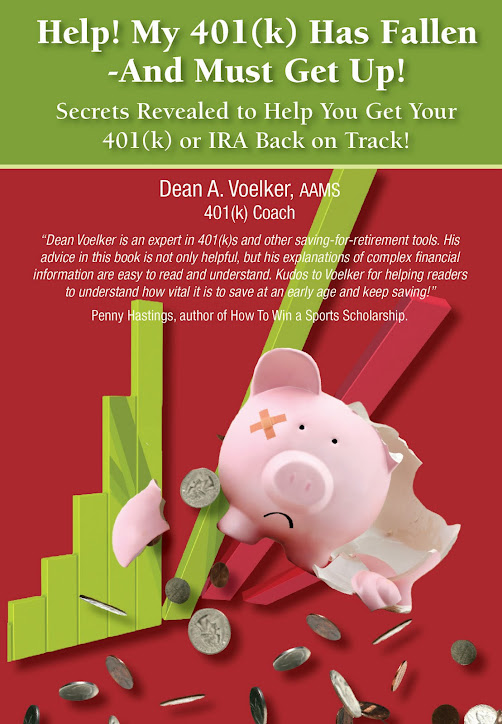
New Book - Coming November 2010

New Book - Coming November 2010
Help! My 401(k) Has Fallen - And Must Get Up!
Showing posts with label Roth IRA. Show all posts

Friday, September 3, 2010

It's Not Much But It's All I Have

Probably the most common response I get when people talk about their long term savings or retirement money is this. "It's not much, but it's all I have. I can't afford to lose it."

Well, I certainly understand how you feel. I am investing and saving for my retirement as well. Author Robert Gignac writes that people are "afraid of money" in his book, Rich Is A State Of Mind. Mr. Gignac will be an upcoming guest on Improving Your Financial Health to discuss his book. He goes on to make a very interesting observation. If money was meant to make us happy, we should have better looking people - or at least smiling faces.

With all due respect to George Washington, would something like this encourage you to save a little more?


"It's not much, but it's all I have. I can't afford to lose it."

If that is true, then wouldn't it make sense to PROTECT it? To truly PROTECT your money, you also need to protect your purchasing power. Your money must be able to keep up with rising costs. Just how much interest is that Folger's coffee can or cookie jar paying these days? Perhaps you keep it under a mattress so you can 'sleep on it'. (Last time I checked, the First National Bank of "Sealy" was paying CD rates 0.25 % higher than the national average.) However, we all know that your money won't grow under the Sealy, or in the Folger's can.

"It's not much, but it's all I have. I can't afford to lose it."

This type of thinking practically guarantees that you WILL LOSE IT! Author Rhonda Byrne says that we transmit thoughts as if our brain was a powerful radio signal. In her book The Secret, she writes that we always get what we visualize. If you say you don't want to be late for a meeting, guess what almost always happens?

"It's not much, but it's all I have. I can't afford to lose it."

Perhaps you have heard this story before.

The kingdom of heaven is like a man traveling to a far country, who called his own servants and delivered his goods to them. And to one he gave five gold coins, to another two, and to another one, to each according to his own ability; and immediately he went on a journey. 

Then he who had received the five gold coins went and traded with them, and made another five coins. And likewise he who had received two gold coins gained two more also.


But he who had received one went and dug in the ground, and hid the money there.


After a long time the man came home and settled accounts with his servants. He who had received five coins came and brought five other coins, saying, 'Lord, you gave to me five gold coins. Look, I have gained five more.' The man said to him, 'Well done, good and faithful servant; you were faithful over a few things, I will make you ruler over many things.'


He also who had received two talents came and said, 'Lord, you gave to me two gold coins. Look, I have gained two more.' The man said to him, 'Well done, good and faithful servant; you have been faithful over a few things, I will make you ruler over many things.'


Then he who had received the one coin came and said, 'Lord, I was afraid, and went and hid your coin in the ground. Look, there you have what is yours.'


His lord answered and said to him, 'You wicked and lazy servant, you ought to have deposited my money with the bankers, and at my coming I would have received back my own with interest. Take the coin from him, and give it to him who has ten gold coins.


For to everyone who has, more will be given, and he will have abundance; but from him who does not have, even what he has will be taken away.

This is the story from Matthew 25: 14-29. The moral is of course to use what we are given. We strengthen and grow our financial muscles from using them. Not using them makes us weak.

"It's not much, but it's all I have. I can't afford to lose it."


One other thought I am having today on this theme, from 1 Kings.

Elijah the prophet told the woman. “Please bring me some bread to eat.”


The widow stopped, turned around, and looked at him in surprise. The widow answered Elijah, “As the Lord your God lives, I do not have bread, only a handful of flour in a bin, and a little oil in a jar; and see, I am gathering a couple of sticks that I may go in and prepare it for myself and my son, that we may eat it, and then we will die.”


Elijah then said to her, “Do not fear; go and do as you have said, but make me a small loaf from it first, and bring it to me; and afterward make some for yourself and your son. For thus says the Lord God of Israel: ‘The bin of flour shall not be used up, nor shall the jar of oil run dry, until the day the Lord sends rain on the earth.’”

She took the last of her flour and oil and made some bread for Elijah to eat.


Here is what happened; “She and her household ate for many days. The bin of flour was not used up, nor did the jar of oil run dry, according to the word of the Lord which He spoke by Elijah.”

USE it - or LOSE it!

Keep your money HAPPY!

Please Contact Me for more information on how to protect your long term savings and USE your money wisely. I can help you create lifetime income from an IRA or Roth IRA. If you live in the South Bend, IN area, I am also happy to help with 401(k) rollovers or IRA reviews. You can follow me on Twitter, Linked In, or Facebook.

My weekly radio show is Improving Your Financial Health on WHME-FM in South Bend, and archives are available for listening on my website. My book, Help My 401(k) Has Fallen - And Must Get Up is helping everyday people to get their 401(k) plan back on its feet and working harder. Contact me about how to get a copy.





Friday, January 8, 2010

Tired of Taxes?


Are you tired of taxes? Tired of hearing about them? Tired of giving your hard-earned dollars to Uncle Sam? Tired of politicians who say they will lower your taxes - then do the opposite?
How would you like a stream of income later in life that you WON'T pay taxes on at all?
That's what the Roth IRA is all about!
The Roth IRA was created as a future Tax Reduction Account in 1997. It's a great way to save for your future retirement. The name "Roth" is in honor of the bill's main creator - late Sen. William Roth of Delaware.
The beauty of the Roth is that there are NO TAXES on either the growth, or withdrawals you take after age 59 1/2. So your income will be TAX FREE!
You can contribute to a Roth IRA for either 2009 or 2010 right now - up to $5000/year. If you are 50 or older, you can put in an extra $1000.
Here are 2 new things in 2010 about the Roth IRA you should know.
* There are no income restrictions for making Roth IRA contributions this year. This allows
more people than ever before to use a Roth.
* You can convert your traditional pre-tax IRA to a Roth by simply paying taxes on the amount
you convert. That isn't new, but what IS new is that you can SPLIT the tax burden over
2 Years - 2011 & 2012.
If you really want less taxes later, set up your Roth IRA (Tax Reduction Account) today. You have until April 15 to contribute for 2009.
You can contact me in South Bend, IN through my website at www.helpmy401k.us. You can also follow my on Twitter at www.twitter.com/deanvoelker. I also host a weekly internet radio program, "Improving Your Financial Health" on Blog Talk Radio www.blogtalkradio.com/401kcoach.


Monday, January 4, 2010

New Years Resolutions

"Now is the accepted time to make your regular annual good resolutions. Next week you can begin paving hell with them as usual." Mark Twain

Here we are - a New Year. Some also say a New Decade.

What 'Financial' Resolutions have you made? Can't think of any? Here are a few tips.

1. Review and Rebalance your Investments and 401(k)
If you have been putting it off for a while to "wait & see", your account is probably seriously out of balance. Sit down with an advisor to review your goals and make your your fund mix matches what your needs are.

2. Increase Contributions to Your 401(k)
Are you putting between 10% and 15% into your 401(k) at work? If not, then at least raise the amount you are putting in. Gradually work yourself up to that level. You will need the nest egg for income later.

3. Pay Off Credit Cards and Other Debt
If you are having trouble with #2, get these paid off and free up some money for yourself.

4. Set Up a Budget and Stick To It
There are a number of places you can find good basic worksheets for setting up a budget. It should be simple. Just make sure all of your money has a place to go - either savings or expenses. Here is a site with some downloadable sheets. http://www.betterbudgeting.com/

5. Contribute to a Roth IRA and Convert Pre-Tax Retirement Savings
You can put up to $5000 into a Roth ($6000 if you are 50 and older). You can still make 2009 contributions up until April 15. The Roth IRA of course grows tax free and allows you to make withdrawals at retirement which are also tax free.

There are no income restrictions for the Roth this year and if you choose to convert any money from your Traditional Pre-Tax IRA to the Roth, you may spread the taxes out over the next 2 years.

You can contact me through my website, http://www.helpmy401k.us/. You may also follow me on Twitter at http://www.twitter.com/deanvoelker. I also host a weekly internet radio program at http://www.blogtalkradio.com/401kcoach.

Thursday, June 25, 2009

Income For Life

One of my clients once told me that the biggest lesson he learned in retirement was this. You don't retire on a Lump Sum of Money. Rather, you retire on the INCOME which the Lump Sum of Money can create. Think about that statement for a bit. Let it sink in. In fact, let me repeat it, because this is what retirement means. You don't retire on a Lump Sum of Money. Rather, you retire on the INCOME which the Lump Sum of Money can create. You spend your working career saving, accumulating, investing, and building a "lump sum". At some point, you will want to use it for income.

Soooo.....what exactly is a "Lump Sum of Money"? Is it $100,000? $300,000? How about $1,000,000? More than that?

The best way to answer that is that the amouth may be different for everyone. However, we can help you to narrow down what you amount should be at retirement. Here are 4 steps.

1. Determine your monthly budget. You don't want any debt at retirement. Leave plenty of
room for "Miscellaneous" expenses - travel, kids, hobbies. If you aren't working, you are
spending.

2. Determine your Social Security Income amount. There are 3 categories for Social
Security income - Reduced Benefit (usually age 62), Full Benefit (usually age 66), and
Enhanced Benefit (age 70). As the terms suggest, if you take Social Security at an earlier age,
you are "stuck" with a smaller amount of income - and "Grounded For Life." There has also
been a growing movement for proposed changes in Social Security in order to make the
money last longer. At least one of those changes includes pushing back the age for Full
Retirement Benefits, which would force most of us to work longer. Whatever benefit amount
you select, you need to know the amount so it can be applied to your budget.

3. Do you have other sources of income? These may include rental property, part time
work, or anything else which generates income.

4. Look at your budget again, and deduct your budgeted expenses from your total
income.
This sounds simple - and it is- however you would be surprised at how many people don't do
it. Do you have enough income to cover your expenses? Is there money to do "special" things
you want to do in retirement? Travel? Golf when you want?

If there is a "gap", how much is the gap? Let's assume there is a gap of $800/month. $800 x
12 months = $9600/year. Now let's take $9600 and divide it by .04. (4% is a reasonably
"safe" amount to withdraw from a lump sum.) $9600/.04 = $240,000. Now we have a "lump
sum" goal of saving for retirement. This can be saved in your 401(k), IRA, Roth IRA, or
ordinary savings. Do not retire until you have this amount saved to cover your additional
budgeted expenses.

In a future article we will look further at annuities and how they can provide income for life. We also need to consider the impact of inflation on your savings.

For more income on annuities or on budgeting, please contact me at http://www.helpmy401k.us. You may also follow me on Twitter at www.twitter.com/deanvoelker

Tuesday, May 5, 2009

College Savings Plans

With school winding down here in May, it may be a good time to bring up College Savings Plans.

College costs have increased wildly over the past 30 years due to improvements in technology,
modernizing campus facilities, and demand for those who want to attend college.
http://www.nytimes.com/2007/10/22/education/21cnd-tuition.html?hp

There isn't much you can do to bring college costs down, however, you can certainly help defray the expense with a good savings plan. The most popular Savings Plan for college right now is the 529 plan, which allows money saved in the plan to be invested in mutual funds. The money can grow tax free, and it can be withdrawn tax free also if the account is being used for educational
expenses. Think of it as a Roth IRA for college.

In Indiana, the 529 plan by U Promise www.collegechoiceplan.com is even sweeter. You can get 20% of your contribution refunded to you in the form of a tax credit. (up to $5000 per IN resident). In other words, if you contribute $5000, you get $1000 back the following spring on your Indiana state tax return.

I am also proud to see that U Promise made the list of best 529 plans according to Business Week and Morningstar.
http://www.businessweek.com/investing/insights/blog/archives/2009/04/best_and_worst.html

If you are an Indiana resident, and you would like more information on saving for your child's college education, please contact me at www.deanvoelker.com.