The late Sir John Templeton, founder of Franklin Templeton Investments liked to say, "The Four most expensive words in the English Language are ‘This time it’s Different.’"
Is it really?
The National Bureau of Economic Research states that the United States has weathered a recession in EVERY decade since the 1920′s.
It is easy to say “This time its different.” Many people are still feeling that way.
However, it is important to keep in mind a few points.
* Financial decisions (any financial decisions) should not be based on emotion.
* Historically, after every past recession, the market has gone on to hit new highs.
* Declines in the market & economy, even our most severe ones, have been temporary.
* Since 1926, the Dow Jones has had TWICE AS MANY positive returns as negative ones.
Despite more than 12 recessions dating back to 1926, $1.00 invested in the Dow in 1926 would have been worth $2045.00 at the end of 2008.
It was two years ago this week (Oct. 16, 2008), that Warren Buffett wrote his “Buy America, I Am” article in the New York Times. Buffett encouraged investors to “be fearful when others are greedy, and be greedy when others are fearful.” Since Mr. Buffett wrote this letter, the S&P 500 Index has gained 29.1% on a total return basis through the close of business on Friday October 8, 2010, according to the New York Times.
“This time it’s different?” Warren Buffett didn’t think so. Neither did Sir John Templeton. Neither should we. Investing is a long term process. Recessions are opportunities. My job as an advisor is to provide you with a beacon of hope, and see the light at the end of the dark tunnel.
Let me know how I may be of service. Contact me about the IRA Security Blanket!
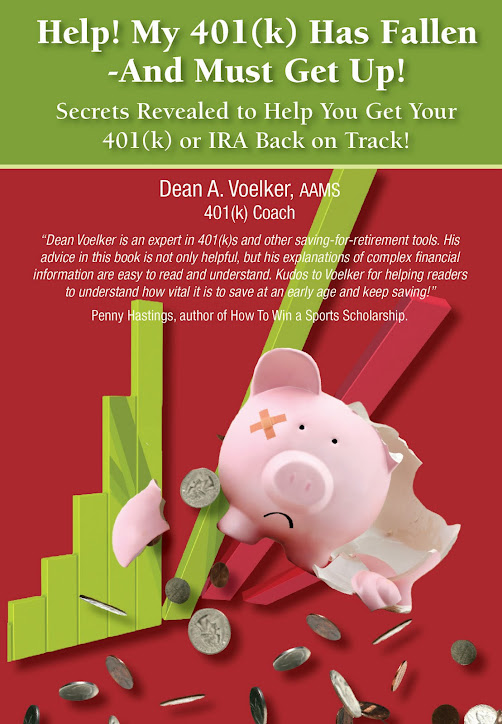
Help! My 401(k) Has Fallen – And Must Get Up! is my new book. It has several ideas and strategies which will help you in your retirement savings journey. Get your ‘Fallen’ 401(k) back on its feet. Contact me to reserve your copy today. You can also get a FREE report at my website – The 5 Biggest Problems With 401(k) Plans – And How To Fix Them.
You may also listen to my weekly radio program – Improving Your Financial Health on WHME-FM in South Bend. Archives can be heard on my website as well. If you live in the South Bend, IN area, I specialize in 401(k) rollovers or IRA reviews. You can also follow me on Twitter, Linked In, or Facebook.
Showing posts with label economy. Show all posts
Wednesday, October 13, 2010
Friday, October 8, 2010
The Grand (Money) Illusion - Why Grow?
Recently, I wrote an article here titled, It's Not Much, But It's All I Have . This has been a very common reaction among people when talking (or not talking) about their money. We continue to deal with economic uncertainty, and its human nature to be afraid of losing it. However when we let fear control our thoughts, we also prevent growth. Money closed inside of a fist serves no purpose and can't grow. To grow your funds, you have to open your hand - and your mind.
"Hold on loosely....but don't let go. If you cling too tightly....you're gonna lose control." (.38 Special)
Why do we need to grow our money? One word - INFLATION!
According to the US Bureau of Labor Studies, $400,000 of taxable income in 1953 is equivalent to $2.8 Million in today's dollars.
When you decide to retire, you could easily be retired for 20 years or more. Do you believe that the costs of living for you will go up - or stay the same? Consider this - in 1990, a loaf of bread costs about $1.00. Today, we pay an average of $2.69 for the same loaf. A postage stamp was only .08 in 1990, while today it's .44....and climbing.
If you have been on a fixed income for the last 20 years, you have suffered a 40% loss of purchasing power. Plain and simple - your money must continue to grow over the long term to keep up with rising costs. You just can't keep stuffing it under a mattress, which is paying about the same interest as a CD today.

Please Contact Me for more information on how to protect your long term savings and USE your money wisely. I can help you create lifetime income from an IRA or Roth IRA. If you live in the South Bend, IN area, I am also happy to help with 401(k) rollovers or IRA reviews. You can follow me on Twitter, Linked In, or Facebook.
You can also listen to my weekly radio show, Improving Your Financial Health on WHME-FM in South Bend, and archives are available for listening on my website. My book, Help My 401(k) Has Fallen – And Must Get Up is helping everyday people to get their 401(k) plan back on its feet and working harder. Contact me about how to get a copy.
"Hold on loosely....but don't let go. If you cling too tightly....you're gonna lose control." (.38 Special)
Why do we need to grow our money? One word - INFLATION!
According to the US Bureau of Labor Studies, $400,000 of taxable income in 1953 is equivalent to $2.8 Million in today's dollars.
When you decide to retire, you could easily be retired for 20 years or more. Do you believe that the costs of living for you will go up - or stay the same? Consider this - in 1990, a loaf of bread costs about $1.00. Today, we pay an average of $2.69 for the same loaf. A postage stamp was only .08 in 1990, while today it's .44....and climbing.
If you have been on a fixed income for the last 20 years, you have suffered a 40% loss of purchasing power. Plain and simple - your money must continue to grow over the long term to keep up with rising costs. You just can't keep stuffing it under a mattress, which is paying about the same interest as a CD today.

So what can you do?
Start by putting more money into your 401(k) plan or IRA. Look at your cash flow, and give yourself a pay raise! Pay yourself first - 10% of your income should go into your 401(k) plan. Meet with an advisor to set up an ongoing program for you. Talk with them about which investments are most appropriate for you in your 401(k) or IRA, based on your time horizon, risk tolerance and future income.
“Some people say they want to wait for a clearer view of the future. But when the future is again clear, the present bargains will have vanished. In fact, does anyone think that today’s prices will prevail once full confidence has been restored?” (Dean Witter, May 1932)
Please Contact Me for more information on how to protect your long term savings and USE your money wisely. I can help you create lifetime income from an IRA or Roth IRA. If you live in the South Bend, IN area, I am also happy to help with 401(k) rollovers or IRA reviews. You can follow me on Twitter, Linked In, or Facebook.
You can also listen to my weekly radio show, Improving Your Financial Health on WHME-FM in South Bend, and archives are available for listening on my website. My book, Help My 401(k) Has Fallen – And Must Get Up is helping everyday people to get their 401(k) plan back on its feet and working harder. Contact me about how to get a copy.
Monday, October 4, 2010
Its the Great Security Blanket Charlie Brown!
Get A Blanket!
Did you have a "blankie" as a child? Was the "blankie" your contstant companion, protecting you from the forces of evil? No matter what happened, your blanket was there for you.
The late cartoonist, Charles Schulz popularized the image of Linus and his blanket in his Peanuts comic strips and cartoons. You may even remember that Linus was quite skilled at using it. He could catch fly balls, use it as a parachute, and even revive a sickly Christmas tree.
If you are like most people, your 401(k) or IRA has taken quite a beating the last few years.
What if I told you that you could have your very own IRA Security Blanket?
* Protect yourself against future market disasters.
* Protect yourself from inflation and rising costs.
* Protect yourself from the uncertain future of Social (In)Security.
To learn more about how to get your IRA Security Blanket, you can contact me at http://www.helpmy401k.us/.
Help! My 401(k) Has Fallen – And Must Get Up! is my new book. It has several ideas and strategies which will help you in your retirement savings journey. Get your ‘Fallen’ 401(k) back on its feet. Contact me to reserve your copy today. You can also get a FREE report at my website - The 5 Biggest Problems With 401(k) Plans – And How To Fix Them.
You may also listen to my weekly radio program – Improving Your Financial Health on WHME-FM in South Bend. Archives can be heard on my website as well.
If you live in the South Bend, IN area, I specialize in 401(k) rollovers or IRA reviews. You can also follow me on Twitter, Linked In, or Facebook.
Did you have a "blankie" as a child? Was the "blankie" your contstant companion, protecting you from the forces of evil? No matter what happened, your blanket was there for you.
The late cartoonist, Charles Schulz popularized the image of Linus and his blanket in his Peanuts comic strips and cartoons. You may even remember that Linus was quite skilled at using it. He could catch fly balls, use it as a parachute, and even revive a sickly Christmas tree.
If you are like most people, your 401(k) or IRA has taken quite a beating the last few years.
What if I told you that you could have your very own IRA Security Blanket?
* Protect yourself against future market disasters.
* Protect yourself from inflation and rising costs.
* Protect yourself from the uncertain future of Social (In)Security.
To learn more about how to get your IRA Security Blanket, you can contact me at http://www.helpmy401k.us/.
Help! My 401(k) Has Fallen – And Must Get Up! is my new book. It has several ideas and strategies which will help you in your retirement savings journey. Get your ‘Fallen’ 401(k) back on its feet. Contact me to reserve your copy today. You can also get a FREE report at my website - The 5 Biggest Problems With 401(k) Plans – And How To Fix Them.
You may also listen to my weekly radio program – Improving Your Financial Health on WHME-FM in South Bend. Archives can be heard on my website as well.
If you live in the South Bend, IN area, I specialize in 401(k) rollovers or IRA reviews. You can also follow me on Twitter, Linked In, or Facebook.
Monday, June 28, 2010
Five Situations for Variable Annuities
According to the Insured Retirement Institute, sales of Variable Annuities grew by 3% from this time last year. VAs aren't for everyone, however in the right circumstances, variable annuities offer solid benefits. There are at least 5 scenarios in which an advisor may consider recommending a variable annuity to clients.
Feel free to add your own to the list! You can contact me for more information on annuties at http://www.helpmy401k.us/
1. Lowering Income Taxes
If you are in the maximum federal and state tax bracket, a VA may help to lower your taxes. Please review your situation with a tax specialist, but a VA can work similarly to an IRA in deferring taxes until money is withdrawn from the acccount.
2. Calming Jittery Investors
This is likely the biggest reason why VA sales are up. If you are nervous about the market but still need your money to grow over time, a VA can act as a "life preserver" for your long term savings.
3. Saving Above Contribution Maximums
If you have maxed out your IRA and 401(k) and still want to save more for retirement, you can put money into a VA. If you are a small business owner, you may also consider a SEP IRA (Simplified Employee Pension). The SEP allows you to save up to 25% of your income and deduct it from your taxes.
4. Guaranteed Income
Annuities have a primary purpose of providing guaranteed income. With people living longer and needing income in retirement, having an annuity can be like setting up a personal pension plan from your savings. Look for plans which offer Lifetime Income.
5. Death Benefit
If you haven't taken income, many annuities will guarantee a death benefit of the amount you invested as a minimum. This is important, and this is where an annuity differs from ordinary mutual funds.
Here's an example. Let's take 2 investors, George and Jerry. Let's say that both of them retire at 65 years old and have 401(k) balances of $100,000. They roll their 401(k) plans over to IRAs. George invests in mutual funds, while Jerry invests in a variable annuity with a guaranteed minimum death benefit. After 4 years, we have another huge loss in the stock market, and their accounts drop to $80,000. Neither of them have taken any income out of their IRAs yet, and are still under the age of 70 1/2 when they would need to take a Required Minimum Distribution.
If George dies, he leaves the balance of his account - $80,000 to his beneficiaries. If Jerry dies, he would leave $100,000, which is what he started with, even if the value of the account is less. Of course, if the account balance in either case is more than $100,000, the death benefit would be the same as the account balance.
Annuities can be beneficial in the right situations. Please contact me and let me know how I may help further.
Feel free to add your own to the list! You can contact me for more information on annuties at http://www.helpmy401k.us/
1. Lowering Income Taxes
If you are in the maximum federal and state tax bracket, a VA may help to lower your taxes. Please review your situation with a tax specialist, but a VA can work similarly to an IRA in deferring taxes until money is withdrawn from the acccount.
2. Calming Jittery Investors
This is likely the biggest reason why VA sales are up. If you are nervous about the market but still need your money to grow over time, a VA can act as a "life preserver" for your long term savings.
3. Saving Above Contribution Maximums
If you have maxed out your IRA and 401(k) and still want to save more for retirement, you can put money into a VA. If you are a small business owner, you may also consider a SEP IRA (Simplified Employee Pension). The SEP allows you to save up to 25% of your income and deduct it from your taxes.
4. Guaranteed Income
Annuities have a primary purpose of providing guaranteed income. With people living longer and needing income in retirement, having an annuity can be like setting up a personal pension plan from your savings. Look for plans which offer Lifetime Income.
5. Death Benefit
If you haven't taken income, many annuities will guarantee a death benefit of the amount you invested as a minimum. This is important, and this is where an annuity differs from ordinary mutual funds.
Here's an example. Let's take 2 investors, George and Jerry. Let's say that both of them retire at 65 years old and have 401(k) balances of $100,000. They roll their 401(k) plans over to IRAs. George invests in mutual funds, while Jerry invests in a variable annuity with a guaranteed minimum death benefit. After 4 years, we have another huge loss in the stock market, and their accounts drop to $80,000. Neither of them have taken any income out of their IRAs yet, and are still under the age of 70 1/2 when they would need to take a Required Minimum Distribution.
If George dies, he leaves the balance of his account - $80,000 to his beneficiaries. If Jerry dies, he would leave $100,000, which is what he started with, even if the value of the account is less. Of course, if the account balance in either case is more than $100,000, the death benefit would be the same as the account balance.
Annuities can be beneficial in the right situations. Please contact me and let me know how I may help further.
Thursday, June 24, 2010
Ageism
Ever heard of ageism? Ageism is a term coined by Dr. Robert Butler which refers to discrimination against the elderly. How does this affect you?
As a nation, we are getting older. People are living longer than they did in previous generations. According to http://www.socialsecurity.gov/ a male who lives to age 65 can reasonably expect to live until age 82. A female at age 65 can reasonably expect to live until age 85. Earlier this year, Federal Reserve Chairman Ben Bernanke discussed the effects of aging on the U.S. economy. Mr. Bernanke stated that "the U.S. must begin now to prepare for this coming demographic transition."
Dr. Robert Butler, 83 is in charge of the National Institute on Aging. Dr. Butler, a Pulitzer Prize winner, has also written six books about aging issues and is the the founder of the International Longevity Center. In a recent article in Investment Advisor magazine, Dr. Butler discusses his thoughts on aging. Did you know that in 2025, only 15 years from now, more than 1 in 5 persons will be 65 or older?
Dr. Butler says that older people "should probably plan to work longer than they envisioned." He adds that regarding Social Security and our workforce, "It's very obvious and striking that if people stay in the workforce longer, they put more money into the system and take less money out."
What does this mean for you?
For those in my generation (I am 46 at this time.) we need to think seriously about working longer. Also, we need to prepare for changer in Social Security. We must do a better job of saving and investing in our 401(k) or 403(b) plans. Since we don't have pensions and can't count on Social Security for our future income, the 401(k) has to be our main method for retirement savings.
Saving in a 401(k) means you have to do the work. No one else will care about your future the way you do. My book, Help! My 401(k) Has Fallen - And Must Get Up! has several ideas and strategies which will help you in your journey. Get your 'Fallen' 401(k) back on its feet. Contact me to reserve your copy today, or visit http://www.my401khasfallen.com/.
You can also get a FREE report at my website, http://www.helpmy401k.us/ The 5 Biggest Problems With 401(k) Plans - And How To Fix Them. If you live in the South Bend, IN area, I am also happy to help with 401(k) rollovers or IRA reviews. You can follow me on Twitter, Linked In, or Facebook.
My weekly radio show is Improving Your Financial Health on WHME-FM in South Bend, and archives are available for listening on my website.
As a nation, we are getting older. People are living longer than they did in previous generations. According to http://www.socialsecurity.gov/ a male who lives to age 65 can reasonably expect to live until age 82. A female at age 65 can reasonably expect to live until age 85. Earlier this year, Federal Reserve Chairman Ben Bernanke discussed the effects of aging on the U.S. economy. Mr. Bernanke stated that "the U.S. must begin now to prepare for this coming demographic transition."
Dr. Robert Butler, 83 is in charge of the National Institute on Aging. Dr. Butler, a Pulitzer Prize winner, has also written six books about aging issues and is the the founder of the International Longevity Center. In a recent article in Investment Advisor magazine, Dr. Butler discusses his thoughts on aging. Did you know that in 2025, only 15 years from now, more than 1 in 5 persons will be 65 or older?
Dr. Butler says that older people "should probably plan to work longer than they envisioned." He adds that regarding Social Security and our workforce, "It's very obvious and striking that if people stay in the workforce longer, they put more money into the system and take less money out."
What does this mean for you?
For those in my generation (I am 46 at this time.) we need to think seriously about working longer. Also, we need to prepare for changer in Social Security. We must do a better job of saving and investing in our 401(k) or 403(b) plans. Since we don't have pensions and can't count on Social Security for our future income, the 401(k) has to be our main method for retirement savings.
Saving in a 401(k) means you have to do the work. No one else will care about your future the way you do. My book, Help! My 401(k) Has Fallen - And Must Get Up! has several ideas and strategies which will help you in your journey. Get your 'Fallen' 401(k) back on its feet. Contact me to reserve your copy today, or visit http://www.my401khasfallen.com/.
You can also get a FREE report at my website, http://www.helpmy401k.us/ The 5 Biggest Problems With 401(k) Plans - And How To Fix Them. If you live in the South Bend, IN area, I am also happy to help with 401(k) rollovers or IRA reviews. You can follow me on Twitter, Linked In, or Facebook.
My weekly radio show is Improving Your Financial Health on WHME-FM in South Bend, and archives are available for listening on my website.
Monday, March 22, 2010
Diary of a Wimpy 401(k) - Movie
Well, my daughter wanted to see the "Wimpy Kid" movie yesterday. I know she likes the book series and they are pretty funny so we went.
The movie was pretty funny, a bit different from the book with several new adventures for the Wimpy Kid, Greg Heffley, as he deals with surviving middle school. You really don't want to know about the "cheese touch".
I'm not planning a "movie" for my book "Help! My 401(k) Has Fallen - And Must Get Up!" Although if Bruce Willis' agent will return my calls, I may change my mind. James Gandolfini might be interesting also......
a 'mafia' financial advisor......hmmmmm.
Seriously, don't look for a movie with either of these guys. Although I am still planning a short video clip with Pentavision. I'm supposed to meet with them again this week.When we put up the new website, the video will be there and we can direct orders to the page on Amazon.
I'm also getting more book cover ideas this week, which I hope to be able to post and get feedback.
My other project is to find blogs on 401(k)s and IRAs and post responses to questions. I have several which I know of.
If any readers want to send me links for 401(k) blogs, please contact me.
You can get a copy of a free report on my website – "The 5 Biggest Problems With 401(k) Plans – And How to Fix Them".
You may also contact me on Linked In or Twitter at http://www.twitter.com/deanvoelker. I also host a weekly financial advice program, Improving Your Financial Health on Blog Talk Radio and WHME-FM.
The movie was pretty funny, a bit different from the book with several new adventures for the Wimpy Kid, Greg Heffley, as he deals with surviving middle school. You really don't want to know about the "cheese touch".
I'm not planning a "movie" for my book "Help! My 401(k) Has Fallen - And Must Get Up!" Although if Bruce Willis' agent will return my calls, I may change my mind. James Gandolfini might be interesting also......
a 'mafia' financial advisor......hmmmmm.
Seriously, don't look for a movie with either of these guys. Although I am still planning a short video clip with Pentavision. I'm supposed to meet with them again this week.When we put up the new website, the video will be there and we can direct orders to the page on Amazon.
I'm also getting more book cover ideas this week, which I hope to be able to post and get feedback.
My other project is to find blogs on 401(k)s and IRAs and post responses to questions. I have several which I know of.
If any readers want to send me links for 401(k) blogs, please contact me.
You can get a copy of a free report on my website – "The 5 Biggest Problems With 401(k) Plans – And How to Fix Them".
You may also contact me on Linked In or Twitter at http://www.twitter.com/deanvoelker. I also host a weekly financial advice program, Improving Your Financial Health on Blog Talk Radio and WHME-FM.
Labels:
advisor,
bank,
Blog Talk Radio,
book,
debt,
economy,
financial,
Improving your Financial Health,
income,
investment,
Linked In,
money,
retirement,
savings,
Twitter,
Wimpy Kid
Friday, March 19, 2010
Diary of a Wimpy 401(k) - Wimpy Cost Explanation
When I go to buy something – a new pair of shoes, furniture, or dinner at a restaurant – I want to know exactly what I am paying for. You probably do also, unless your name is Bill Gates. Fee clarity is more important than ever.
Since I have been an advisor in South Bend, I’ve gotten to know a lot of people. I’ve been asked on several occasions to join marketing or networking groups. Recently I was invited to join a group which focused on marketing ideas. The ideas seemed good, and I saw some value in joining the group. I thought it may be a great way to plug the upcoming book as well.
However, this week I decided absolutely not to join this marketing group.
Why not ? The group leader did a poor job of explaining all of the costs involved (wimpy?). I went to 3 different meetings, I was bombarded with marketing information, but never once saw cost explained either verbally or in print. When I finally did find out HOW MUCH, it was quite a lot more than what I was originally told. Whatever credibility he had worked to build was gone.
“No B.S.”?…….Yeah, Riiiiiiiiight. One of my first sales managers told me “A confused prospect never buys.”
What does this have to do with 401(k) plans? Simple. One of the biggest problems with plans now is that fees aren’t clearly explained. Employers don’t know costs, and therefore can’t explain them to employees, who are really picking up the bill. Federal law has made it mandatory that all fees for 401(k) plans are clearly itemized and easy to understand.
If a contractor came to my house and told me he would fix my roof for $10,000, and then due to “unforseen expenses” the tab came to $15,000 or more, I’d be upset. You would be too! By the same token, when I review plans for employers, I want to make sure they know all of the fees in the plan. I have also stumbled onto plans which are badly in need of an update. They are still paying for the plan as a ’small’ business, when in fact they could be saving a lot of money once they have reached certain dollar amounts, or breakpoints.
In my book, “Help! My 401(k) Has Fallen – And Must Get Up!” I use an example of cell phones to explain this.
Why would you still pay for a “1980’s backpack style” cell phone, when newer, better, and cheaper models are available?
As an employer, you need to review your 401(k) plan and update it. Don’t be ‘wimpy’. Make sure you know all the costs and your people do too.
You can also get a copy of a free report on my website – “The 5 Biggest Problems With 401(k) Plans – And How to Fix Them”.
You may also contact me on Linked In at http://www.linkedin.com/in/dvoelker or Twitter at http://www.twitter.com/deanvoelker. I also host a weekly financial advice program, Improving Your Financial Health at http://www.blogtalkradio.com/401kcoach.
Since I have been an advisor in South Bend, I’ve gotten to know a lot of people. I’ve been asked on several occasions to join marketing or networking groups. Recently I was invited to join a group which focused on marketing ideas. The ideas seemed good, and I saw some value in joining the group. I thought it may be a great way to plug the upcoming book as well.
However, this week I decided absolutely not to join this marketing group.
Why not ? The group leader did a poor job of explaining all of the costs involved (wimpy?). I went to 3 different meetings, I was bombarded with marketing information, but never once saw cost explained either verbally or in print. When I finally did find out HOW MUCH, it was quite a lot more than what I was originally told. Whatever credibility he had worked to build was gone.
“No B.S.”?…….Yeah, Riiiiiiiiight. One of my first sales managers told me “A confused prospect never buys.”
What does this have to do with 401(k) plans? Simple. One of the biggest problems with plans now is that fees aren’t clearly explained. Employers don’t know costs, and therefore can’t explain them to employees, who are really picking up the bill. Federal law has made it mandatory that all fees for 401(k) plans are clearly itemized and easy to understand.
If a contractor came to my house and told me he would fix my roof for $10,000, and then due to “unforseen expenses” the tab came to $15,000 or more, I’d be upset. You would be too! By the same token, when I review plans for employers, I want to make sure they know all of the fees in the plan. I have also stumbled onto plans which are badly in need of an update. They are still paying for the plan as a ’small’ business, when in fact they could be saving a lot of money once they have reached certain dollar amounts, or breakpoints.
In my book, “Help! My 401(k) Has Fallen – And Must Get Up!” I use an example of cell phones to explain this.
Why would you still pay for a “1980’s backpack style” cell phone, when newer, better, and cheaper models are available?
As an employer, you need to review your 401(k) plan and update it. Don’t be ‘wimpy’. Make sure you know all the costs and your people do too.
You can also get a copy of a free report on my website – “The 5 Biggest Problems With 401(k) Plans – And How to Fix Them”.
You may also contact me on Linked In at http://www.linkedin.com/in/dvoelker or Twitter at http://www.twitter.com/deanvoelker. I also host a weekly financial advice program, Improving Your Financial Health at http://www.blogtalkradio.com/401kcoach.
Labels:
advisor,
Blog Talk Radio,
book,
cash,
economy,
financial,
Improving your Financial Health,
inflation,
investment,
money,
retirement,
savings,
wimpy
Wednesday, March 17, 2010
Diary of a Wimpy 401(k) - Wimpy Friends
The interesting thing about writing a book - I am learning who my friends are.
One of the things I had wanted was to get testimonials from people from all walks of life. The book was written in simple language with plenty of stories to make it easy for anyone to understand.
We all have a 401(k) or 403(b) - almost all of us anyway. Unless you are self-employed or one of the rare few who still have a pension.
So about a month ago, I sent requests for testimonials to about 65 people. Some I knew better than others. Some were financial experts who I had interviewed on "Improving Your Financial Health". Some were friends in the financial industry. Some were friends and clients I knew locally, or small business owners. Still others were people who were involved in the project in some way.
A few were celebs who I didn't know, but I wanted to get a testimonial from them.
In asking for testimonials, I believe that we are all very busy. I am willing to be patient and follow up a few times to get testimonials. These 'blurbs' from others can help to promote the book.
If you have a 401(k) and you aren't happy with it, and you are nervous about the future, you should read this book!
One guy (a writer whom I won't name) turned me down, but was very nice about it. He explained that he gets many similar requests and he simply does not have time to answer them all. He also didn't believe that his testimonial would carry much weight, with him not having a financial background.
Although I was slightly disappointed, I appreciated his sincerity and his prompt response.
I've also had a few of my financial heroes tell me that although they like the book and see its value, they aren't allowed to respond due to compliance constraints. Again, I respect this.
That's one way to do it. Here's the WRONG WAY!
Another previous guest on my program (I won't name her - but I promise she WON'T BE BACK!) had her assistant send this "snooty form letter" remark. "As a policy, our team focuses on content that is being published by a major imprint. We don’t read or consider unsolicited material. Should your book get picked up by a major imprint, please do feel free to reach out to me at that time, and I’ll do my best to get it to (her) for a possible endorsement."
Again, this type of chilly response really alienated me. I've lost a lot of respect for this person and needless to say, she won't be back as a guest on my program.
I am still looking for testimonials. I've gotten several very ones so far. Let me kinow if you'd like a copy of the book for review. If you want to learn more about 401(k)s and think you can write a couple of kind words - contact me and I will gladly send you a copy of the draft.
Here are some of my favorite testimonials so far.
"Unless you plan to work till you drop, the 401(k) is your eventual ticket to freedom. Your plan may have fallen in 2008 and Dean Voelker is just the person to help get it back up." -
Jonathan Chevreau, Financial Post columnist, and author of Findependence Day.
“Dean Voelker does a great job of laying out the case for aggressively pursuing your 401(k). This book presents compelling reasons for getting involved in your future TODAY, rather than tomorrow. Dean’s story telling approach takes the 401(k) from its birth through today in an easy to read and storytelling manner.” - Len Fox, author of Recipe Investing.
“Dean Voelker is a real pro. He reveals some things about the Social Security system and how
401(k)s work that I never knew. This book is short, sweet and to the point. Everyone needs to read it quickly to see if they are doing what they should to get their retirement plans back on track. Thanks, Dean for putting this together for us.” - John S. Cohoat, President of Cohoat Business Growth Advisors, and author of No Thank You, Mr. President.
Go ahead, don't be "wimpy". Contact me today. You can also get a copy of a free report on my website -
"The 5 Biggest Problems With 401(k) Plans - And How to Fix Them"
You may also contact me on Linked In at http://www.linkedin.com/in/dvoelker or Twitter at http://www.twitter.com/deanvoelker. I also host a weekly financial advice program, Improving Your Financial Health at http://www.blogtalkradio.com/401kcoach.
One of the things I had wanted was to get testimonials from people from all walks of life. The book was written in simple language with plenty of stories to make it easy for anyone to understand.
We all have a 401(k) or 403(b) - almost all of us anyway. Unless you are self-employed or one of the rare few who still have a pension.
So about a month ago, I sent requests for testimonials to about 65 people. Some I knew better than others. Some were financial experts who I had interviewed on "Improving Your Financial Health". Some were friends in the financial industry. Some were friends and clients I knew locally, or small business owners. Still others were people who were involved in the project in some way.
A few were celebs who I didn't know, but I wanted to get a testimonial from them.
In asking for testimonials, I believe that we are all very busy. I am willing to be patient and follow up a few times to get testimonials. These 'blurbs' from others can help to promote the book.
If you have a 401(k) and you aren't happy with it, and you are nervous about the future, you should read this book!
One guy (a writer whom I won't name) turned me down, but was very nice about it. He explained that he gets many similar requests and he simply does not have time to answer them all. He also didn't believe that his testimonial would carry much weight, with him not having a financial background.
Although I was slightly disappointed, I appreciated his sincerity and his prompt response.
I've also had a few of my financial heroes tell me that although they like the book and see its value, they aren't allowed to respond due to compliance constraints. Again, I respect this.
That's one way to do it. Here's the WRONG WAY!
Another previous guest on my program (I won't name her - but I promise she WON'T BE BACK!) had her assistant send this "snooty form letter" remark. "As a policy, our team focuses on content that is being published by a major imprint. We don’t read or consider unsolicited material. Should your book get picked up by a major imprint, please do feel free to reach out to me at that time, and I’ll do my best to get it to (her) for a possible endorsement."
Again, this type of chilly response really alienated me. I've lost a lot of respect for this person and needless to say, she won't be back as a guest on my program.
I am still looking for testimonials. I've gotten several very ones so far. Let me kinow if you'd like a copy of the book for review. If you want to learn more about 401(k)s and think you can write a couple of kind words - contact me and I will gladly send you a copy of the draft.
Here are some of my favorite testimonials so far.
"Unless you plan to work till you drop, the 401(k) is your eventual ticket to freedom. Your plan may have fallen in 2008 and Dean Voelker is just the person to help get it back up." -
Jonathan Chevreau, Financial Post columnist, and author of Findependence Day.
“Dean Voelker does a great job of laying out the case for aggressively pursuing your 401(k). This book presents compelling reasons for getting involved in your future TODAY, rather than tomorrow. Dean’s story telling approach takes the 401(k) from its birth through today in an easy to read and storytelling manner.” - Len Fox, author of Recipe Investing.
“Dean Voelker is a real pro. He reveals some things about the Social Security system and how
401(k)s work that I never knew. This book is short, sweet and to the point. Everyone needs to read it quickly to see if they are doing what they should to get their retirement plans back on track. Thanks, Dean for putting this together for us.” - John S. Cohoat, President of Cohoat Business Growth Advisors, and author of No Thank You, Mr. President.
Go ahead, don't be "wimpy". Contact me today. You can also get a copy of a free report on my website -
"The 5 Biggest Problems With 401(k) Plans - And How to Fix Them"
You may also contact me on Linked In at http://www.linkedin.com/in/dvoelker or Twitter at http://www.twitter.com/deanvoelker. I also host a weekly financial advice program, Improving Your Financial Health at http://www.blogtalkradio.com/401kcoach.
Labels:
401k,
advisor,
Blog Talk Radio,
book,
diversification,
economy,
financial,
goals,
Improving your Financial Health,
investment,
IRA,
money,
retirement,
risk,
savings,
wimpy
Monday, March 15, 2010
Diary of a Wimpy 401(k) - Getting It Printed
Probably the biggest question to answer was "How are we going to print this thing anyway?"
The LAST thing I want or need is to print up a bunch of books and have them sitting in my garage. I also know that most publishers have never heard of me. So I started getting all kinds of advice from different people. Also did you know that if you sell books to a "brick and mortar" bookstore, they will send you the unsold or damaged books back and are entitled to a full refund including shipping costs? Its in the 'fine print' of the contract.
People suggested e-books, or partial e-books, or different print houses. In January, I interviewed a man named Len Fox, author of Recipe Investing, a book which was not unlike mine, in terms of size and content. Len had used a division of Amazon called Create Space. Len had liked it because it was connected to Amazon. They handled the ordering through Amazon.com and could print 1 book orders. Once a month, they would then pay Len his cut from the book orders. Len didn't have to handle any of it. He got a statement once a month with the orders and a paycheck. No hassle, no damaged books, no refunds, no crates in his garage, no shipping. All of it was done there, by Create Space.
Hmmm - that sounds good to me. I was still working on the writing part at the time, so I kept it on the back burner and also continued to get ideas from others. A few weeks ago, I sent a copy to Carlos Frank, another friend of mine. I had interviewed Carlos twice for my financial show, "Improving Your Financial Health". Carlos suggested that I talk with John Rizzo, who worked for....Create Space.
John Rizzo called me last week and after speaking with him, I was convinced that this was the right path for me.
Create Space offers all types of services that will help you to self-publish your book. Self-Publishing allows you much more freedom and can really lower your cost. John was extremely helpful in explaining all of the services offered. There are 2 things I really like about using Create Space.
First, the services are all seperate. If you need them to typeset or edit or promote your book, they will do it OR if you already have someone that you are using, you can do that. You have the choice. When it comes to assembling the book, all I have to do is send them my material and cover design, and they do it. This is also impressive, since my index and resource guide are seperate from the main manuscript.
Secondly, because of their affiliation with Amazon, they will take care of posting your book on Amazon's site and handle customer ordering and shipping for you. Not only is this a real time and money saver, it also prevents the possiblity of having crates of books taking up space in my garage! I am really looking forward to working with John Rizzo, and I would certainly recommend Create Space if you are looking to get a book printed.
The LAST thing I want or need is to print up a bunch of books and have them sitting in my garage. I also know that most publishers have never heard of me. So I started getting all kinds of advice from different people. Also did you know that if you sell books to a "brick and mortar" bookstore, they will send you the unsold or damaged books back and are entitled to a full refund including shipping costs? Its in the 'fine print' of the contract.
People suggested e-books, or partial e-books, or different print houses. In January, I interviewed a man named Len Fox, author of Recipe Investing, a book which was not unlike mine, in terms of size and content. Len had used a division of Amazon called Create Space. Len had liked it because it was connected to Amazon. They handled the ordering through Amazon.com and could print 1 book orders. Once a month, they would then pay Len his cut from the book orders. Len didn't have to handle any of it. He got a statement once a month with the orders and a paycheck. No hassle, no damaged books, no refunds, no crates in his garage, no shipping. All of it was done there, by Create Space.
Hmmm - that sounds good to me. I was still working on the writing part at the time, so I kept it on the back burner and also continued to get ideas from others. A few weeks ago, I sent a copy to Carlos Frank, another friend of mine. I had interviewed Carlos twice for my financial show, "Improving Your Financial Health". Carlos suggested that I talk with John Rizzo, who worked for....Create Space.
John Rizzo called me last week and after speaking with him, I was convinced that this was the right path for me.
Create Space offers all types of services that will help you to self-publish your book. Self-Publishing allows you much more freedom and can really lower your cost. John was extremely helpful in explaining all of the services offered. There are 2 things I really like about using Create Space.
First, the services are all seperate. If you need them to typeset or edit or promote your book, they will do it OR if you already have someone that you are using, you can do that. You have the choice. When it comes to assembling the book, all I have to do is send them my material and cover design, and they do it. This is also impressive, since my index and resource guide are seperate from the main manuscript.
Secondly, because of their affiliation with Amazon, they will take care of posting your book on Amazon's site and handle customer ordering and shipping for you. Not only is this a real time and money saver, it also prevents the possiblity of having crates of books taking up space in my garage! I am really looking forward to working with John Rizzo, and I would certainly recommend Create Space if you are looking to get a book printed.
Labels:
advisor,
amazon,
Blog Talk Radio,
cash,
economy,
financial,
investment,
life,
money,
retirement,
savings,
Wimpy Kid
Thursday, March 11, 2010
Diary of a Wimpy 401(k)
OK, here we go. One of the things I have done so far in the publishing process was to read a book titled "The Well-Fed Self Publisher" by Peter Bowerman. Mr. Bowerman has some very good & practical ideas on why it is better to self publish instead of going through a publisher.
Kudos to my good friend, Nikki Stauffer who recommended the book. Nikki always seems to come through for me when I really need some advice. If her firm was willing to promote the book, I'd hire her in a heartbeat.
Bowerman told several "horror stories" about publishing houses. Most people have a fantasy that they can simply write a book and sell a gazillion copies and then live like John Grisham for the rest of their life. Needless to say, I am pretty grounded in reality. The truth is, many authors have a hard time getting it published. Jack Canfield, author of the "Chicken Soup" books has a favorite word when he was getting multiple rejections - "Next!"
Anyway, even if you finally do get a publisher to take on your book project, and a promotion agent to write a press release, you will still end of doing the promotion leg work yourself. also, the publisher gets to keep most of the money. He shows examples of authors who wrote books that sell for about $15 and their cut is about .50 per book. Now THAT is wimpy!
According to Bowerman, once they write the press release, the publisher is done. On to the next Stephen King wannabe. There is only one person in the whole world who really cares about making sure that your book is promoted regularly - the author. So if you have to promote it yourself, why not publish it yourself.
The whole reason for this book was that I was meeting many people in this area who really weren't getting the most from their 401(k). Northern Indiana is one of the hardest hit areas for unemployment, and many folks simply cashed it in, in spite of taxes and penalties. Others who didn't cash in stopped contributing to their 401(k) especially if their company stopped matching contributions. There is no doubt in my mind that people need to have a much better understanding of how the 401(k) works.
Someone needs to say - This is your retirement plan. It may also be the only savings you have, so you'd better stop being 'wimpy' about it and start saving.
"Help! My 401(k) Has Fallen - And Must Get Up!" reveals little known secrets about 401(k) plans and IRAs. If you read the book, you will understand them and get more from them.
That's all for today. I really apreciate those who have been reading this, and those who have been supporting me. Also thanks to those who have been listening to "Improving Your Financial Health" on either Blog Talk Radio or WHME-FM.
Kudos to my good friend, Nikki Stauffer who recommended the book. Nikki always seems to come through for me when I really need some advice. If her firm was willing to promote the book, I'd hire her in a heartbeat.
Bowerman told several "horror stories" about publishing houses. Most people have a fantasy that they can simply write a book and sell a gazillion copies and then live like John Grisham for the rest of their life. Needless to say, I am pretty grounded in reality. The truth is, many authors have a hard time getting it published. Jack Canfield, author of the "Chicken Soup" books has a favorite word when he was getting multiple rejections - "Next!"
Anyway, even if you finally do get a publisher to take on your book project, and a promotion agent to write a press release, you will still end of doing the promotion leg work yourself. also, the publisher gets to keep most of the money. He shows examples of authors who wrote books that sell for about $15 and their cut is about .50 per book. Now THAT is wimpy!
According to Bowerman, once they write the press release, the publisher is done. On to the next Stephen King wannabe. There is only one person in the whole world who really cares about making sure that your book is promoted regularly - the author. So if you have to promote it yourself, why not publish it yourself.
The whole reason for this book was that I was meeting many people in this area who really weren't getting the most from their 401(k). Northern Indiana is one of the hardest hit areas for unemployment, and many folks simply cashed it in, in spite of taxes and penalties. Others who didn't cash in stopped contributing to their 401(k) especially if their company stopped matching contributions. There is no doubt in my mind that people need to have a much better understanding of how the 401(k) works.
Someone needs to say - This is your retirement plan. It may also be the only savings you have, so you'd better stop being 'wimpy' about it and start saving.
"Help! My 401(k) Has Fallen - And Must Get Up!" reveals little known secrets about 401(k) plans and IRAs. If you read the book, you will understand them and get more from them.
That's all for today. I really apreciate those who have been reading this, and those who have been supporting me. Also thanks to those who have been listening to "Improving Your Financial Health" on either Blog Talk Radio or WHME-FM.
Labels:
401k,
advisor,
bank,
Blog Talk Radio,
cash,
economy,
financial,
goals,
investment,
Jeff Kinney,
life,
Peter Bowerman,
publisher,
savings,
Wimpy Kid
Sunday, February 21, 2010
Blog Talk Radio - Be Our Guest
I've been a bit busy this week, working on my upcoming book, "Help! My 401(k) Has Fallen - And Must Get Up!" . This is an "everyman's" (and everywoman's) guide to getting more from your 401(k) plan. Most books I have seen on 401(k) plans really are geared more to advisors and financial people, which is what inspired me to write it.
For most of us, the 401(k) is a major source of our savings, and for some it may be the ONLY source of savings. We need to get more out of it if we want to retire someday and have our money last the rest of our lives. I'm very excited to contribute something unique - and hope others find it helpful.
Anyway, I plan on doing more with the blog and hope that my message finds the right people. Last week I wrote about Blog Talk Radio. My experience with Blog Talk Radio has been great. I began using it in July 2009 on the advice of a friend of mine, Brian Seim, a radio veteran.
Although I have made a TON of mistakes (and still do!), I must have done a few things right also. A few weeks ago I began an affiliation with WHME-FM in South Bend (103.1) . We agreed to replay my interviews from Blog Talk Radio as a 30 minute program on Saturday mornings - "Improving Your Financial Health" .
If I had to pick the one factor which has made the show appealing - its the GUESTS! My guests have mostly been financial experts and authors, although some have been very interesting people with great personalities with no financial background at all. Even so, they had something of value to share with listeners and wer a lot of fun to talk with. Some examples would be Ruben Gonzalez, a 4 time Olympian who has written 3 books on staying motivated, or Charlie Adams, who is also a professional speaker and helps High School athletes to get college scholarships. Kristen Harmel who has written 6 novels and has a passion for helping kids with reading, Kay Yasin who overcame personal tragedies to change her life and is now an expert trainer and bodybuilder, and Darin Pritchett who is well known in the South Bend area for his Weekday Sportsbeat show. These and many others are wonderful people and gave fun & interesting interviews. All would all be welcome guests in the future.
Once I committed myself to doing the program, I have always been on the lookout for people who would make great guests . When I find someone I like, I contact them and and tell them about the program and try to schedule a time for them to be on. Always let them know that you are doing this regularly (for me once a week) and tell them names of other guests I've interviewed.
Whatever you choose to do a program about - for business or for fun - I would certainly recommend having interesting guests that fit in with your message. Again, the guests make the show fun. (Who would want to listen to just me for 30 minutes?)
People have often asked me where I find my guests. You can find guests in several places. My main source would be searching the internet for financial blogs or articles I also subscribe to Money and Smart Money magazines and have found great articles there.
Referrals can be a great source also once you tell others what you are doing. My friend, Nikki Stauffer in Ada, MI deserves a special mention. She has referred 2 nationally recognized financial experts and authors to me who are guests. Eric Tyson (author of "Investing for Dummies" and "Personal Finance for Dummies") was one. There aren't many financial advisors out there who can say they have their own "jingle" written by Paul Shaffer of the David Letterman band. Another is Robert Krakower, who has graciously agreed to be interviewed on March 23. His new book is titled "Redefining Retirement for a New Generation".
By the way, Nikki Stauffer has a great weekly show of her own, "Gather Round the Table" . She has also done pretty well with guests, including Megyn Price (Rules of Engagement), Maria Canals-Barrera (Wizards of Waverly Place), and Mayim Bialik (Blossom), among others. This program promotes the importance of family values by eating meals together, and Nikki's guests normally share one of their favorite recipes. Check out her site and archived interviews at http://www.gatherroundthetable.com/.
I also need to thank Erica Sandberg one of my early guests, and author of "Expecting Money", for her referral of a colleague of hers, Sally Herigstad, CPA, and author of "Help! I Can't Pay My Bills!". Both ladies were wonderful guests and I look to have them on Blog Talk Radio again.
Pam Batcho of Express Pros, also has been a great referral source. She referred Ruben Gonzalez, whom I mentioned earlier and also her boss, Norm Robertson, owner of the local Express Pros branch.
Sometimes, it pays to be persistant. Anya Kamenetz was a young lady I had really admired from reading her first book, "Generation Debt" a few years ago. It highlights the challenges of being young today, especially with the high costs of college and student loans. Anya was nominated for a Pulitzer Prize for her efforts.
She is also a nationally recognized speaker, and has appeared on college campuses nationwide.
I knew Anya would make a great guest, and tried to e-mail her (4 times over 6 weeks) with no reply. Finally one day out of the blue, I got a very kind note from her. She apologized that she had been out of town and wasn't getting her e-mails. She also sent me her personal e-mail and agreed to an interview. The interview went great and it was quite an honor for me.
Whoever the guest is, I really try to be respectful of their time. I really want to make sure the experience goes well for them - I may want to have them back sometime, or want their help with a project.
Before doing a program, I send the guest specific instructions confirming the date and time and Call-In phone number. Since some of my guests live in different parts of the country, I also make sure I note EST - and whatever time it may be for them. 1:00 pm here is 10:00 am in California. That may seem like a small thing, but trust me - its important!
Another habit of mine is to send the guest a list of questions personally tailored to them. Some guests have even suggested questions that the like to be asked. By reviewing their website or reading their books, it has helped me quite a bit to learn about them. It helps the interview to go more smoothly.
My objective is to build them up as an expert which (I hope) makes me look like a good guy as well. Speaking of building up, its also very important to use a proper introduction. A good introduction should be at least 3 sentences, highlighting their achievements. You are telling your listeners why you chose this person to be on your show and why their advice will be valuable to them.
One last point on guests - You can't say "Thank You" enough. I always thank them at the end of the program and give them a chance to give contact information and promote their book or services . After the show, I also send an e-mail thanking them for their time once more.
Blog Talk Radio has been a great venue for me. I plan on writing one more article about Blog Talk Radio, which includes tips and techniques. You can contact me through my website, http://www.helpmy401k.us/ and
through Linked In or Twitter.
There is a Free Report now available through my website, "The 5 Biggest Problems With 401(k)s - And How To Fix Them". Please contact me to receive your free copy. This is a sample of my upcoming book, "Help! My 401(k) Has Fallen - And Must Get Up!"
For most of us, the 401(k) is a major source of our savings, and for some it may be the ONLY source of savings. We need to get more out of it if we want to retire someday and have our money last the rest of our lives. I'm very excited to contribute something unique - and hope others find it helpful.
Anyway, I plan on doing more with the blog and hope that my message finds the right people. Last week I wrote about Blog Talk Radio. My experience with Blog Talk Radio has been great. I began using it in July 2009 on the advice of a friend of mine, Brian Seim, a radio veteran.
Although I have made a TON of mistakes (and still do!), I must have done a few things right also. A few weeks ago I began an affiliation with WHME-FM in South Bend (103.1) . We agreed to replay my interviews from Blog Talk Radio as a 30 minute program on Saturday mornings - "Improving Your Financial Health" .
If I had to pick the one factor which has made the show appealing - its the GUESTS! My guests have mostly been financial experts and authors, although some have been very interesting people with great personalities with no financial background at all. Even so, they had something of value to share with listeners and wer a lot of fun to talk with. Some examples would be Ruben Gonzalez, a 4 time Olympian who has written 3 books on staying motivated, or Charlie Adams, who is also a professional speaker and helps High School athletes to get college scholarships. Kristen Harmel who has written 6 novels and has a passion for helping kids with reading, Kay Yasin who overcame personal tragedies to change her life and is now an expert trainer and bodybuilder, and Darin Pritchett who is well known in the South Bend area for his Weekday Sportsbeat show. These and many others are wonderful people and gave fun & interesting interviews. All would all be welcome guests in the future.
Once I committed myself to doing the program, I have always been on the lookout for people who would make great guests . When I find someone I like, I contact them and and tell them about the program and try to schedule a time for them to be on. Always let them know that you are doing this regularly (for me once a week) and tell them names of other guests I've interviewed.
Whatever you choose to do a program about - for business or for fun - I would certainly recommend having interesting guests that fit in with your message. Again, the guests make the show fun. (Who would want to listen to just me for 30 minutes?)
People have often asked me where I find my guests. You can find guests in several places. My main source would be searching the internet for financial blogs or articles I also subscribe to Money and Smart Money magazines and have found great articles there.
Referrals can be a great source also once you tell others what you are doing. My friend, Nikki Stauffer in Ada, MI deserves a special mention. She has referred 2 nationally recognized financial experts and authors to me who are guests. Eric Tyson (author of "Investing for Dummies" and "Personal Finance for Dummies") was one. There aren't many financial advisors out there who can say they have their own "jingle" written by Paul Shaffer of the David Letterman band. Another is Robert Krakower, who has graciously agreed to be interviewed on March 23. His new book is titled "Redefining Retirement for a New Generation".
By the way, Nikki Stauffer has a great weekly show of her own, "Gather Round the Table" . She has also done pretty well with guests, including Megyn Price (Rules of Engagement), Maria Canals-Barrera (Wizards of Waverly Place), and Mayim Bialik (Blossom), among others. This program promotes the importance of family values by eating meals together, and Nikki's guests normally share one of their favorite recipes. Check out her site and archived interviews at http://www.gatherroundthetable.com/.
I also need to thank Erica Sandberg one of my early guests, and author of "Expecting Money", for her referral of a colleague of hers, Sally Herigstad, CPA, and author of "Help! I Can't Pay My Bills!". Both ladies were wonderful guests and I look to have them on Blog Talk Radio again.
Pam Batcho of Express Pros, also has been a great referral source. She referred Ruben Gonzalez, whom I mentioned earlier and also her boss, Norm Robertson, owner of the local Express Pros branch.
Sometimes, it pays to be persistant. Anya Kamenetz was a young lady I had really admired from reading her first book, "Generation Debt" a few years ago. It highlights the challenges of being young today, especially with the high costs of college and student loans. Anya was nominated for a Pulitzer Prize for her efforts.
She is also a nationally recognized speaker, and has appeared on college campuses nationwide.
I knew Anya would make a great guest, and tried to e-mail her (4 times over 6 weeks) with no reply. Finally one day out of the blue, I got a very kind note from her. She apologized that she had been out of town and wasn't getting her e-mails. She also sent me her personal e-mail and agreed to an interview. The interview went great and it was quite an honor for me.
Whoever the guest is, I really try to be respectful of their time. I really want to make sure the experience goes well for them - I may want to have them back sometime, or want their help with a project.
Before doing a program, I send the guest specific instructions confirming the date and time and Call-In phone number. Since some of my guests live in different parts of the country, I also make sure I note EST - and whatever time it may be for them. 1:00 pm here is 10:00 am in California. That may seem like a small thing, but trust me - its important!
Another habit of mine is to send the guest a list of questions personally tailored to them. Some guests have even suggested questions that the like to be asked. By reviewing their website or reading their books, it has helped me quite a bit to learn about them. It helps the interview to go more smoothly.
My objective is to build them up as an expert which (I hope) makes me look like a good guy as well. Speaking of building up, its also very important to use a proper introduction. A good introduction should be at least 3 sentences, highlighting their achievements. You are telling your listeners why you chose this person to be on your show and why their advice will be valuable to them.
One last point on guests - You can't say "Thank You" enough. I always thank them at the end of the program and give them a chance to give contact information and promote their book or services . After the show, I also send an e-mail thanking them for their time once more.
Blog Talk Radio has been a great venue for me. I plan on writing one more article about Blog Talk Radio, which includes tips and techniques. You can contact me through my website, http://www.helpmy401k.us/ and
through Linked In or Twitter.
There is a Free Report now available through my website, "The 5 Biggest Problems With 401(k)s - And How To Fix Them". Please contact me to receive your free copy. This is a sample of my upcoming book, "Help! My 401(k) Has Fallen - And Must Get Up!"
Labels:
advisor,
bank,
Blog Talk Radio,
debt,
economy,
goals,
investment,
IRA,
Linked In,
money,
savings,
Twitter,
Wall St Journal
Wednesday, February 10, 2010
Tax Credit For Small Businesses
Are you a small business owner? If not, do you know any?
These days its hard enough to make ends meet and keep your business going. Small businesses like yours are the key to reviving our economy.
Would you like an idea that will help you and your employees to save money and reduce your taxes?
Did you know that when you establish a 401(k) or other kind of qualified retirement plan, you may be eligible for a tax credit equal to 50% of the cost of starting up and administering the plan? The maximum allowable credit is $500 per year for each of the first 3 years of the retirement program. This is according to EGTRRA (Economic Growth and Tax Relief Reconciliation Act of 2001) .
Other types of retirement plans for small businesses which qualify for the tax credit are the SEP IRA (Simplified Employee Pension Plan) and the SIMPLE IRA (Savings Incentive Match Plan for Employees) .
To qualify for the tax credit:
* The plan sponsor must incur qualified startup costs. These would be expenses for setting up or maintaining the plan, or for retirement-related employee education.
* The plan must be a new plan established AFTER December 31, 2001.
* The plan must have at least one non-highly compensated employee. Usually this would be someone who is not an owner and has earned less than $105,000 in the prior year.
* The plan sponsor must have employed 100 people or less who received at least $5000 or more in compensation during the prior year.
Does this sound like your business so far? If I can help you & your employees to save money for your future needs and lower your taxes, please contact me today. This will be part of my upcoming book as well – “Help! My 401(k) Has Fallen and Can’t Get Up!”
I should also mention that unless the current law changes, EGTRRA is set to expire at the end of 2010.
Please contact me for more information on 401(k) plans or IRAs at http://www.helpmy401k.us/.
You may also contact me on Linked In at http://www.linkedin.com/in/dvoelker or Twitter at http://www.twitter.com/deanvoelker. I also host a weekly financial advice program, Improving Your Financial Health at http://www.blogtalkradio.com/401kcoach.
These days its hard enough to make ends meet and keep your business going. Small businesses like yours are the key to reviving our economy.
Would you like an idea that will help you and your employees to save money and reduce your taxes?
Did you know that when you establish a 401(k) or other kind of qualified retirement plan, you may be eligible for a tax credit equal to 50% of the cost of starting up and administering the plan? The maximum allowable credit is $500 per year for each of the first 3 years of the retirement program. This is according to EGTRRA (Economic Growth and Tax Relief Reconciliation Act of 2001) .
Other types of retirement plans for small businesses which qualify for the tax credit are the SEP IRA (Simplified Employee Pension Plan) and the SIMPLE IRA (Savings Incentive Match Plan for Employees) .
To qualify for the tax credit:
* The plan sponsor must incur qualified startup costs. These would be expenses for setting up or maintaining the plan, or for retirement-related employee education.
* The plan must be a new plan established AFTER December 31, 2001.
* The plan must have at least one non-highly compensated employee. Usually this would be someone who is not an owner and has earned less than $105,000 in the prior year.
* The plan sponsor must have employed 100 people or less who received at least $5000 or more in compensation during the prior year.
Does this sound like your business so far? If I can help you & your employees to save money for your future needs and lower your taxes, please contact me today. This will be part of my upcoming book as well – “Help! My 401(k) Has Fallen and Can’t Get Up!”
I should also mention that unless the current law changes, EGTRRA is set to expire at the end of 2010.
Please contact me for more information on 401(k) plans or IRAs at http://www.helpmy401k.us/.
You may also contact me on Linked In at http://www.linkedin.com/in/dvoelker or Twitter at http://www.twitter.com/deanvoelker. I also host a weekly financial advice program, Improving Your Financial Health at http://www.blogtalkradio.com/401kcoach.
Labels:
advisor,
business,
economy,
expenses,
financial,
investment,
IRA,
money,
retirement,
savings,
SEP IRA,
SIMPLE IRA,
taxes
Friday, February 5, 2010
Tax Free Interest In Indiana - Shhh, Your Bank Doesn't Want You To Know
Do you live in "The Middle"? Besides unpredictable weather and being referred to as "Hoosiers", there are actually a few perks to living in Indiana.
Indiana offers some tax benefits to investors that are unique to our state. Municipal Bonds are very popular here. These bonds are a great (and Safe) way to earn more interest on your savings. The interest you earn on a bond from ANY STATE is FREE from Federal Tax, State Tax, and Local Taxes!
Municipal Bonds, or Munis have been used for over 200 years as a way to raise money to build or improve schools, hospitals, libraries, and roads. These days, stadiums have also been funded by having bonds issued. Once the bond is issued, you can loan money to the project and be repaid with interest which is free from Federal taxes. When the bond matures, you get the amount back which you loaned to the project.
If the bond is issued by your home state, your interest may also be free from State and Local taxes.
Again, the benefit for us "Hoosiers" living in Indiana is this. It doesn't matter which state the bond came from. We enjoy interest income on any muni bond which is free from Federal, State, and Local Taxes!
That may be worth an additional 1.5% - 2% or more on your savings, depending on your tax bracket.
(Check with your advisor when buying bonds to see if you may be subject to Alternative Minimum Tax, depending on your total income.)
Currently, http://www.bankrate.com/ (as of Feb. 4, 2010), shows us what the highest rates are for a 1 Year CD
(1.7%) and a 5 Year CD (3.55%). Dave Ramsey refers to these as "Certificates of Depression". You can see why!
Did you also know that CDs are RISKY? Why is that, you ask?
Easy - You LOSE Future Buying Power!
Let's do the math, and see which option may be better for long term savings.
5 Year Municipal (Investment Quality) Bond at 5%
$10,000 x .05 = $500/year.
$500 x 5 years = $2500 (TAX FREE)
Most Bonds pay interest twice per year, directly to you the investor, so you will get 2 checks each year for
$250 for 5 years. When the bond is due, you get the $10,000 back. That may also happen if the bond is called early, but that's another lesson.
5 Year CD at 3.55%
Remember that was the BEST rate in the US today on http://www.bankrate.com/.
$10,000 x .0355 = $355/year.
$355 x 5 years = $1775, and you WILL PAY TAXES on this.
Hmmmm......let's see.....I can get $2500 in interest that is tax free OR $1775 in interest that is taxable. I wonder which one I should pick......
Did you ever wonder how banks make money? They use your money and either loan it or invest it.
Now you can see why your bank may not share the muni bond idea with you.
If you would like to learn more about Municipal Bonds, please contact me.
You may also contact me for more information on 401(k) plans or IRAs at http://www.helpmy401k.us/.
You may also contact me on Linked In at http://www.linkedin.com/in/dvoelker or Twitter at http://www.twitter.com/deanvoelker. I also host a weekly financial advice program, Improving Your Financial Health at http://www.blogtalkradio.com/401kcoach.
Indiana offers some tax benefits to investors that are unique to our state. Municipal Bonds are very popular here. These bonds are a great (and Safe) way to earn more interest on your savings. The interest you earn on a bond from ANY STATE is FREE from Federal Tax, State Tax, and Local Taxes!
Municipal Bonds, or Munis have been used for over 200 years as a way to raise money to build or improve schools, hospitals, libraries, and roads. These days, stadiums have also been funded by having bonds issued. Once the bond is issued, you can loan money to the project and be repaid with interest which is free from Federal taxes. When the bond matures, you get the amount back which you loaned to the project.
If the bond is issued by your home state, your interest may also be free from State and Local taxes.
Again, the benefit for us "Hoosiers" living in Indiana is this. It doesn't matter which state the bond came from. We enjoy interest income on any muni bond which is free from Federal, State, and Local Taxes!
That may be worth an additional 1.5% - 2% or more on your savings, depending on your tax bracket.
(Check with your advisor when buying bonds to see if you may be subject to Alternative Minimum Tax, depending on your total income.)
Currently, http://www.bankrate.com/ (as of Feb. 4, 2010), shows us what the highest rates are for a 1 Year CD
(1.7%) and a 5 Year CD (3.55%). Dave Ramsey refers to these as "Certificates of Depression". You can see why!
Did you also know that CDs are RISKY? Why is that, you ask?
Easy - You LOSE Future Buying Power!
Let's do the math, and see which option may be better for long term savings.
5 Year Municipal (Investment Quality) Bond at 5%
$10,000 x .05 = $500/year.
$500 x 5 years = $2500 (TAX FREE)
Most Bonds pay interest twice per year, directly to you the investor, so you will get 2 checks each year for
$250 for 5 years. When the bond is due, you get the $10,000 back. That may also happen if the bond is called early, but that's another lesson.
5 Year CD at 3.55%
Remember that was the BEST rate in the US today on http://www.bankrate.com/.
$10,000 x .0355 = $355/year.
$355 x 5 years = $1775, and you WILL PAY TAXES on this.
Hmmmm......let's see.....I can get $2500 in interest that is tax free OR $1775 in interest that is taxable. I wonder which one I should pick......
Did you ever wonder how banks make money? They use your money and either loan it or invest it.
Now you can see why your bank may not share the muni bond idea with you.
If you would like to learn more about Municipal Bonds, please contact me.
You may also contact me for more information on 401(k) plans or IRAs at http://www.helpmy401k.us/.
You may also contact me on Linked In at http://www.linkedin.com/in/dvoelker or Twitter at http://www.twitter.com/deanvoelker. I also host a weekly financial advice program, Improving Your Financial Health at http://www.blogtalkradio.com/401kcoach.
Wednesday, February 3, 2010
Taking Stock
I'm not a big individual stock fan. For most people, mutual funds are a much better way to invest. Its easier to be diverisfied and its also easier to add money systematically.
However, I did see something recently which I thought my readers may enjoy. If you were going to invest in stocks, which companies would be good ones to own long-term? At least one sign of a great company is one which is able to consistently increase their dividend payment.
If you aren't sure what a dividend is, think of it this way. When you own stock, you own a tiny piece of that company. Your investment rises and falls with the performance of the company. Over time, you would like to think the company will grow, and your money will grow with it. Companies which have established themselves and become profitable will share part of their profits with you as a part owner. Those profit sharing payments are known as dividends and are usually paid once every 3 months.
Again, the sign of a great company is one which has raised its dividend payment consistently, even in tough times. Raising the dividend for shareholders is like giving them a pay raise. (CDs don't do THAT!!) Those companies would be great to own long term.
What if a company were able to raise its dividend 25 years in a row or more?
Here are the ones which have:
Abbott Labs (ABT)
Bemis (BMS)
Century Tel (CTL)
Chubb (CB)
Coca-Cola (KO)
Exxon-Mobil (XOM)
Johnson & Johnson (JNJ)
Mc Donalds (MCD)
3M (MMM)
Pitney Bowes (PBI)
PPG (PPG)
Proctor & Gamble (PG)
Walmart (WMT)
S&P reports that since 1926, dividends have contributed to about 1/3 of the total return on your investment.
Another thing I like about dividends is that when the stock price goes down, the dividend yield goes up. Its a great time to buy more of great companies. That is what Warren Buffett does!
For example, lets look at Proctor & Gamble. Shares of PG are currently (2/3/10) at $62.90. Dividends are paid at $1.76/share, which is divided into 4 quarterly payments. You will get a dividend return of 2.8% on any shares purchased at that price.
What if you had been fortunate enough to buy in March of 2009, when it was selling for around $44/share? Well, you still would have gotten $1.76 per share, but that works out to about a 4% dividend return. (Better than a CD, and with potential to grow!)
Warren Buffett has become extremely wealthy because he buys great companies and holds them, collecting dividends which increase year after year after year.
Again, I am not encouraging people to buy individual stocks. There are plenty of financial stocks such as Citigroup and Bank of America which also had wonderful histories of increased dividends, until 2008.
Dividends are certainly something to consider though for any investment - including mutual funds and annuities.
You can contact me through my website, http://www.helpmy401k.us/. You can also contact me on LinkedIn at http://www.linkedin.com/in/dvoelker, or Twitter at http://www.twitter.com/deanvoelker. I am currently hosting a weekly financial advice program, "Improving Your Financial Health" on Blog Talk Radio at http://www.blogtalkradio.com/401kcoach. Let me know how I may help you!
However, I did see something recently which I thought my readers may enjoy. If you were going to invest in stocks, which companies would be good ones to own long-term? At least one sign of a great company is one which is able to consistently increase their dividend payment.
If you aren't sure what a dividend is, think of it this way. When you own stock, you own a tiny piece of that company. Your investment rises and falls with the performance of the company. Over time, you would like to think the company will grow, and your money will grow with it. Companies which have established themselves and become profitable will share part of their profits with you as a part owner. Those profit sharing payments are known as dividends and are usually paid once every 3 months.
Again, the sign of a great company is one which has raised its dividend payment consistently, even in tough times. Raising the dividend for shareholders is like giving them a pay raise. (CDs don't do THAT!!) Those companies would be great to own long term.
What if a company were able to raise its dividend 25 years in a row or more?
Here are the ones which have:
Abbott Labs (ABT)
Bemis (BMS)
Century Tel (CTL)
Chubb (CB)
Coca-Cola (KO)
Exxon-Mobil (XOM)
Johnson & Johnson (JNJ)
Mc Donalds (MCD)
3M (MMM)
Pitney Bowes (PBI)
PPG (PPG)
Proctor & Gamble (PG)
Walmart (WMT)
S&P reports that since 1926, dividends have contributed to about 1/3 of the total return on your investment.
Another thing I like about dividends is that when the stock price goes down, the dividend yield goes up. Its a great time to buy more of great companies. That is what Warren Buffett does!
For example, lets look at Proctor & Gamble. Shares of PG are currently (2/3/10) at $62.90. Dividends are paid at $1.76/share, which is divided into 4 quarterly payments. You will get a dividend return of 2.8% on any shares purchased at that price.
What if you had been fortunate enough to buy in March of 2009, when it was selling for around $44/share? Well, you still would have gotten $1.76 per share, but that works out to about a 4% dividend return. (Better than a CD, and with potential to grow!)
Warren Buffett has become extremely wealthy because he buys great companies and holds them, collecting dividends which increase year after year after year.
Again, I am not encouraging people to buy individual stocks. There are plenty of financial stocks such as Citigroup and Bank of America which also had wonderful histories of increased dividends, until 2008.
Dividends are certainly something to consider though for any investment - including mutual funds and annuities.
You can contact me through my website, http://www.helpmy401k.us/. You can also contact me on LinkedIn at http://www.linkedin.com/in/dvoelker, or Twitter at http://www.twitter.com/deanvoelker. I am currently hosting a weekly financial advice program, "Improving Your Financial Health" on Blog Talk Radio at http://www.blogtalkradio.com/401kcoach. Let me know how I may help you!
Labels:
advisor,
annuity,
bank,
CD,
diversification,
dividend,
economy,
financial,
income,
investment,
Linked In,
money,
mutual funds,
rates,
returns,
S and P,
savings,
South Bend,
Warren Buffett,
wealth
Friday, January 29, 2010
Are You Linked In?
Are you "LinkedIn" to social media? LinkedIn http://www.linkedin.com/ is a professional business networking website, which launched in May 2003.
Wikipedia states that Linked In has over 50 Million users in more than 200 countries and territories. According to LinkedIn, a new member joins the site every minute. You can learn some of the basics of LinkedIn at http://press.linkedin.com/about. There is an orientation video here which may help you to utilize some of the site's features.
My first exposure to LinkedIn was in 2006. I was invited to connect by Debra Gould, an acquaintance of mine, whom I had met at networking events a few times. I figured it wouldn't hurt, so I set up my profile, and "Voila!" - I was now part of social media and the internet!
Of course, I could say that my financial advisory business and LinkedIn page grew like wildfire from there, but that wouldn't be true. Several months went by before I even added a second connection. It can can a while for the "lights to come on". Even as I look through my contacts today, I counted 21 who have only 1 connection (me), and 87 (including the onesies) who have 10 or less. This tells me that LinkedIn is still a largely untapped resource.
After I finally did add a few more people in 2007, I started looking at LinkedIn as a good resource for networking. I could see some value in the site and started looking for ways to utilize it better. I started to join groups and also looked for companies in the South Bend, IN area that I wanted to build relationships with, especially for 401(k) marketing and employee education. Using LinkedIn gave me a chance to show them my 'online resume'.
Of all the Social Media sites, LinkedIn has been viewed by many as the most professional and businesslike. I know of a few people who have effectively used LinkedIn in their career search. (Maybe THAT should have been referred to in the "State Of The Union" address with the topic of 'Job Creation'.)
Before I digress too far - Here are a few basic ways you can use LinkedIn as an effective marketing tool and networking resource for your business.
* Add People - That seems like a no-brainer, but sometimes we need to figure out how to get started. Don't be shy. When you get business cards from others at networking events or other places, invite them to
connect. Most cards include an e-mail, which makes it easy. LinkedIn has also done many things to make
the site more user friendly. One of them is "People You May Know", which is a bit similar to Facebook's friend suggestions. If you know them, it is easy to invite and add them as contacts.
In fact, invite your Facebook friends also. You may be surprised at how many of them may view you in a
different light when they see your professional profile on LinkedIn. You can also go through your e-mail contacts and import the list into LinkedIn. This will tell you which of your friends already has a profile here. Again, you will be surprised.
* Enhance Your Profile - LinkedIn should be your online resume. Keep it real, and be yourself, but be your BEST self. Don't just fill in the boxes. Tell others up front what makes you unique and what you can do to help them. Why should they work with you? Do you write a blog? Manage a scout troop? Sing in the church choir? Put those things in your profile, along with previous jobs. You never know what may catch someone's eye and attract them to your business.
* Recommendations - These are your testimonials. Ask people you trust to write one for you. (They may ask for one in return.) My only rule of thumb on giving or receiving is - Make it specific and sincere! The testimonial must mention special skills or services you have performed. "John is a great guy." doesn't cut it. Only sincere, well thought out recommendations will make your profile stand out.
* Join A Group - What topics are you interested in? You can probably find a group that discusses them.
Participate in the discussions by asking and answering questions. Some of my current groups include
Chamber of Commerce of St. Joseph County, Indiana Small Business Development Center, Linking Indiana,
and the Economic Club of Michiana. I have also created 2 of my own, Help My 401(k), and Always Illinois.
A great way to add contacts is to look through the members list. Just click on their profile and send them an invite.
* What Are You Reading? - If you have read something recently which you think others may find interesting, add this to your profile. You may see others also who have read the same book, and that can be common ground for a new connection. If you write a blog on Wordpress, you can also have the blog connected to LinkedIn.
* Search - You can search for people or companies. Are there any companies you'd like to call on, but don't know where to start? Look for them on LinkedIn. More and more companies are on LinkedIn everyday. A company search can tell you everyone who is with that company who has a profile. One word of caution - if the person is no longer with the company, and they aren't an active LinkedIn user, the profile may not be current. But profiles do offer great contact information, including e-mail addresses. The search feature is very easy to use.
I hope these tips help you get started with LinkedIn, or help you utilize the site more effectively.
You can contact me through my website, http://www.helpmy401k.us/. You can also contact me on LinkedIn at http://www.linkedin.com/in/dvoelker, or Twitter at http://www.twitter.com/deanvoelker. I am currently hosting a weekly financial advice program, "Improving Your Financial Health" on Blog Talk Radio at http://www.blogtalkradio.com/401kcoach. Let me know how I may help you!
Wikipedia states that Linked In has over 50 Million users in more than 200 countries and territories. According to LinkedIn, a new member joins the site every minute. You can learn some of the basics of LinkedIn at http://press.linkedin.com/about. There is an orientation video here which may help you to utilize some of the site's features.
My first exposure to LinkedIn was in 2006. I was invited to connect by Debra Gould, an acquaintance of mine, whom I had met at networking events a few times. I figured it wouldn't hurt, so I set up my profile, and "Voila!" - I was now part of social media and the internet!
Of course, I could say that my financial advisory business and LinkedIn page grew like wildfire from there, but that wouldn't be true. Several months went by before I even added a second connection. It can can a while for the "lights to come on". Even as I look through my contacts today, I counted 21 who have only 1 connection (me), and 87 (including the onesies) who have 10 or less. This tells me that LinkedIn is still a largely untapped resource.
After I finally did add a few more people in 2007, I started looking at LinkedIn as a good resource for networking. I could see some value in the site and started looking for ways to utilize it better. I started to join groups and also looked for companies in the South Bend, IN area that I wanted to build relationships with, especially for 401(k) marketing and employee education. Using LinkedIn gave me a chance to show them my 'online resume'.
Of all the Social Media sites, LinkedIn has been viewed by many as the most professional and businesslike. I know of a few people who have effectively used LinkedIn in their career search. (Maybe THAT should have been referred to in the "State Of The Union" address with the topic of 'Job Creation'.)
Before I digress too far - Here are a few basic ways you can use LinkedIn as an effective marketing tool and networking resource for your business.
* Add People - That seems like a no-brainer, but sometimes we need to figure out how to get started. Don't be shy. When you get business cards from others at networking events or other places, invite them to
connect. Most cards include an e-mail, which makes it easy. LinkedIn has also done many things to make
the site more user friendly. One of them is "People You May Know", which is a bit similar to Facebook's friend suggestions. If you know them, it is easy to invite and add them as contacts.
In fact, invite your Facebook friends also. You may be surprised at how many of them may view you in a
different light when they see your professional profile on LinkedIn. You can also go through your e-mail contacts and import the list into LinkedIn. This will tell you which of your friends already has a profile here. Again, you will be surprised.
* Enhance Your Profile - LinkedIn should be your online resume. Keep it real, and be yourself, but be your BEST self. Don't just fill in the boxes. Tell others up front what makes you unique and what you can do to help them. Why should they work with you? Do you write a blog? Manage a scout troop? Sing in the church choir? Put those things in your profile, along with previous jobs. You never know what may catch someone's eye and attract them to your business.
* Recommendations - These are your testimonials. Ask people you trust to write one for you. (They may ask for one in return.) My only rule of thumb on giving or receiving is - Make it specific and sincere! The testimonial must mention special skills or services you have performed. "John is a great guy." doesn't cut it. Only sincere, well thought out recommendations will make your profile stand out.
* Join A Group - What topics are you interested in? You can probably find a group that discusses them.
Participate in the discussions by asking and answering questions. Some of my current groups include
Chamber of Commerce of St. Joseph County, Indiana Small Business Development Center, Linking Indiana,
and the Economic Club of Michiana. I have also created 2 of my own, Help My 401(k), and Always Illinois.
A great way to add contacts is to look through the members list. Just click on their profile and send them an invite.
* What Are You Reading? - If you have read something recently which you think others may find interesting, add this to your profile. You may see others also who have read the same book, and that can be common ground for a new connection. If you write a blog on Wordpress, you can also have the blog connected to LinkedIn.
* Search - You can search for people or companies. Are there any companies you'd like to call on, but don't know where to start? Look for them on LinkedIn. More and more companies are on LinkedIn everyday. A company search can tell you everyone who is with that company who has a profile. One word of caution - if the person is no longer with the company, and they aren't an active LinkedIn user, the profile may not be current. But profiles do offer great contact information, including e-mail addresses. The search feature is very easy to use.
I hope these tips help you get started with LinkedIn, or help you utilize the site more effectively.
You can contact me through my website, http://www.helpmy401k.us/. You can also contact me on LinkedIn at http://www.linkedin.com/in/dvoelker, or Twitter at http://www.twitter.com/deanvoelker. I am currently hosting a weekly financial advice program, "Improving Your Financial Health" on Blog Talk Radio at http://www.blogtalkradio.com/401kcoach. Let me know how I may help you!
Labels:
advisor,
careers,
economy,
financial,
goals,
investment,
Linked In,
money,
networking,
retirement,
savings,
social media,
Twitter
Sunday, January 24, 2010
Farmville Gift Request

If you have been on Facebook for any period of time at all, you've seen this.
"John (or Jane) Doe sent a request using Farmville." John or Jane sends you a cow or a tree, and courtesy suggests that you send them one back.
I confess that I am not the best 'Farmville neighbor', and really don't play.
Who knew it was such big business?
The latest issue of Smart Money magazine includes an article by Dyan Machan - "Virtual Goods, Real Profits".
Ms. Machan tells us that "this nascent industry is sucking in staggering amounts of capital. In one 30-day span, Playfish, creator of Pet Society, sold for $400 Million. Playdom, with its game Sorority Life, raised $43 Million in financing; and sector leader Zynga raised $180 Million."
(I kind of feel like Dr. Evil with his pinky finger - "$180 Miiiilllllllion Dollars".)
These virtual games don't have to fight for shelf space. They are passed along through Facebook from friend to friend and market themselves. "If the game is a hit, revenue expands exponentially, but not costs." she says.
Ironically, the bulk of social-gaming revenue comes from selling stuff that doesn't really exist - virtual goods.
Playfish claims in the article that it sells 60 million items per day. These items are for players to reach new levels and get more from their games. The game itself is free, but to do well, you need to buy things. Aaaahhhh!!
I guess I'm not really a "social gamer". Numbers like these do make you wonder though.
In case you are curious, Playfish was aquired by Electronic Arts on Nov 9, 2009 for $275 Million. "EA" as it is known, produces a smorgasboard of games for Playstation and X-Box.
Their stock symbol is ERTS and trades on NASDAQ.
Zynga, the "leader" in social media games with Farmville, Cafe World, and Mafia Wars, is not yet publicly traded. Digital Sky Corporation, based in Moscow, Russia purchased its stake in Zynga in December, 2009 for $180 Million.
Keep trading virtual "cows" and "apple trees". It may be keeping the economy going!
You can contact me through my website, http://www.helpmy401k.us. You can also follow me on Twitter at http://www.twitter.com/deanvoelker. I host a weekly internet radio program also, "Improving Your Financial Health" at http://www.blogtalkradio.com/401kcoach.
Friday, January 8, 2010
Tired of Taxes?

Are you tired of taxes? Tired of hearing about them? Tired of giving your hard-earned dollars to Uncle Sam? Tired of politicians who say they will lower your taxes - then do the opposite?
How would you like a stream of income later in life that you WON'T pay taxes on at all?
That's what the Roth IRA is all about!
The Roth IRA was created as a future Tax Reduction Account in 1997. It's a great way to save for your future retirement. The name "Roth" is in honor of the bill's main creator - late Sen. William Roth of Delaware.
The beauty of the Roth is that there are NO TAXES on either the growth, or withdrawals you take after age 59 1/2. So your income will be TAX FREE!
You can contribute to a Roth IRA for either 2009 or 2010 right now - up to $5000/year. If you are 50 or older, you can put in an extra $1000.
Here are 2 new things in 2010 about the Roth IRA you should know.
* There are no income restrictions for making Roth IRA contributions this year. This allows
more people than ever before to use a Roth.
* You can convert your traditional pre-tax IRA to a Roth by simply paying taxes on the amount
you convert. That isn't new, but what IS new is that you can SPLIT the tax burden over
2 Years - 2011 & 2012.
If you really want less taxes later, set up your Roth IRA (Tax Reduction Account) today. You have until April 15 to contribute for 2009.
You can contact me in South Bend, IN through my website at www.helpmy401k.us. You can also follow my on Twitter at www.twitter.com/deanvoelker. I also host a weekly internet radio program, "Improving Your Financial Health" on Blog Talk Radio www.blogtalkradio.com/401kcoach.
Labels:
bank,
economy,
financial,
goals,
investment,
IRA,
money,
rates,
retirement,
Roth IRA,
savings,
South Bend,
tax free,
taxes
Friday, October 23, 2009
Wipe Out The Fear in South Bend

Feel like you are drowning in today's economy?
Inflation?
Shaky stock market?
Sinking dollar?
Unemployment?
Staggering debt?
Inflation?
Shaky stock market?
Sinking dollar?
Unemployment?
Staggering debt?
Watching the news may seem like an ongoing care wreck - especially if you watch Glenn Beck, who always looks like he will suffer a breakdown right on camera - but as horrifying and overwhelming as the news is, you can't seem to pull yourself away.
We don't suffer from a lack of information - rather TOO MUCH information. Its all so confusing and you can feel like the rag doll being pulled apart from all directions.
How does all of this affect your ability to save for retirement? Is it possible to still have goals and dreams? Can you still retire with dignity?
Dan Rather was once quoted as saying "If all of the difficulties were known at the outset of a long journey, most of us would not start out at all."
Nothing great was ever achieved without hardships along the way. As an advisor, my job is to help you resolve your fears. Let's wipe them out and provide some peace of mind.
This year, when I became an iindependent advisor and opened my own office, I've been learning that most people would rather "not lose anymore" than to win with their long term savings. To quote another great American, Will Rogers - "I'm more concerned with the return OF my money than the return ON my money."
With that in mind, my purpose has been to focus on helping people to find a vehicle that would "not lose" and still let you win. What if I could toss you a "Life Preserver" for your savings? Remember when you first learned to swim? Those kickboards or noodles came in handy, didn't they? You learned eventually that the water is your friend. Once you stopped fighting it, and let it help you, swimming became more fun, right?
Russell Pearlman recently wrote an article titled, "Problems? What Problems?" from the November 2009 issue of "Smart Money" magazine. His article focused on annuities, which have become much more popular with investors as a life preserver for long term savings.
"Don't tell that (regarding annuity cost) to baby boomers looking for retirement security at a time when their 401(k) plans are still hurting; they just keep buying annuities. Through the first six months of the year, total annuity sales were almost $127 billion, only a 3 percent drop from 2008." he writes.
Again, the message I get from my clients and others I meet is "We want SAFETY and Peace of Mind."
Can we get "Guaranteed" growth for our long term savings?
Will it be better than current CD rates?
Can we get "Guaranteed" income when I retire - also better than current CD rates?
Can we make sure the income never goes down?
And lasts for a lifetime - even if we live to 100 or beyond?
And when that lifetime does end, can we leave something for our family and loved ones?
In short - YES! Mr. Pearlman goes on to write "Are annuities for you? Experts say the peace of mind may be worth it."
Another of my favorite articles this year was written by Leslie Scism of the Wall Street Journal. "Long Derided, This Investment Now Looks Wise". "Because of such guarantees, many holders of variable annuities actually saw their accounts increase 6% or more in value last year, when the Standard & Poors 500 stock index dropped nearly 39%." Ms. Scism writes.
Contact me today to learn more about how to get a life preserver (or noodle if you prefer) for your savings. Treat yourself to some Peace of Mind!
You can contact me through my website, http://www.helpmy401k.us and follow me on Twitter at http://www.twitter.com/deanvoelker. I also host a weekly internet radio braodcast, "Improving Your Financial Health" at http://www.blogtalkradio.com/401kcoach.
How does all of this affect your ability to save for retirement? Is it possible to still have goals and dreams? Can you still retire with dignity?
Dan Rather was once quoted as saying "If all of the difficulties were known at the outset of a long journey, most of us would not start out at all."
Nothing great was ever achieved without hardships along the way. As an advisor, my job is to help you resolve your fears. Let's wipe them out and provide some peace of mind.
This year, when I became an iindependent advisor and opened my own office, I've been learning that most people would rather "not lose anymore" than to win with their long term savings. To quote another great American, Will Rogers - "I'm more concerned with the return OF my money than the return ON my money."
With that in mind, my purpose has been to focus on helping people to find a vehicle that would "not lose" and still let you win. What if I could toss you a "Life Preserver" for your savings? Remember when you first learned to swim? Those kickboards or noodles came in handy, didn't they? You learned eventually that the water is your friend. Once you stopped fighting it, and let it help you, swimming became more fun, right?
Russell Pearlman recently wrote an article titled, "Problems? What Problems?" from the November 2009 issue of "Smart Money" magazine. His article focused on annuities, which have become much more popular with investors as a life preserver for long term savings.
"Don't tell that (regarding annuity cost) to baby boomers looking for retirement security at a time when their 401(k) plans are still hurting; they just keep buying annuities. Through the first six months of the year, total annuity sales were almost $127 billion, only a 3 percent drop from 2008." he writes.
Again, the message I get from my clients and others I meet is "We want SAFETY and Peace of Mind."
Can we get "Guaranteed" growth for our long term savings?
Will it be better than current CD rates?
Can we get "Guaranteed" income when I retire - also better than current CD rates?
Can we make sure the income never goes down?
And lasts for a lifetime - even if we live to 100 or beyond?
And when that lifetime does end, can we leave something for our family and loved ones?
In short - YES! Mr. Pearlman goes on to write "Are annuities for you? Experts say the peace of mind may be worth it."
Another of my favorite articles this year was written by Leslie Scism of the Wall Street Journal. "Long Derided, This Investment Now Looks Wise". "Because of such guarantees, many holders of variable annuities actually saw their accounts increase 6% or more in value last year, when the Standard & Poors 500 stock index dropped nearly 39%." Ms. Scism writes.
Contact me today to learn more about how to get a life preserver (or noodle if you prefer) for your savings. Treat yourself to some Peace of Mind!
You can contact me through my website, http://www.helpmy401k.us and follow me on Twitter at http://www.twitter.com/deanvoelker. I also host a weekly internet radio braodcast, "Improving Your Financial Health" at http://www.blogtalkradio.com/401kcoach.
Labels:
advisor,
annuity,
bargain,
CD,
economy,
financial,
goals,
income,
inflation,
insurance,
investment,
money,
nest egg,
retirement,
returns,
safe,
savings,
South Bend,
Wall St Journal
Wednesday, October 14, 2009
Cut The Fat in your 401(k)
Last week, we asked “Where’s the Beef?” Today, we ask “Where’s the Fat?”
Its very important to trim the ‘fat’ in your 401(k) plan – or fund expenses. Today on my Blog Talk Radio program, I had a listener ask about fund expenses. These can really affect your long term return on your retirement savings.
Expenses come from managing the mutual fund. The fund family charges a percentage of the assets invested to manage the fund – deciding what to buy, what to sell, and how much to buy or sell and when to do it. Less trading = lower expenses. Also the advisor on the plan may be paid from these expenses.
Knowing this, it would make sense to look for funds in your plan which have a lower expense rate. If its about 1%, that isn’t too bad, much more than that can negatively affect your returns over time.
To give you an example, I did some figuring on my financial calculator . Let’s look at a 22 year old college graduate, starting their 401(k) plan. Of course you would expect them to bump up their contributions over time, but lets say they put in $300/month with an 8% average return until age 66. They would have saved $1,340,048 in 44 years.
What if they were using a fund with expenses that were 1% more? In other words, the fund may have averaged 8%, but the real return was 7% due to higher expenses. With all the other factors being the same, we now have a total savings of $993,985, which is a difference of $346,063. OUCH! If you figure on taking 4%/year of the nest egg at retirement for income, that means we would need to live on less income -$13842 per year less. See where 1% can make a big difference?
So look carefully at your statement. Don’t just look at ‘performance’ but also fund expenses, which do affect long term performance. Have an advisor help you with this and also help you determine how much to save, so you can have the type of retirement you want.
You may contact me through my website at http://www.helpmy401k.us. You can also follow me on Twitter at http://www.twitter.com/deanvoelker. I also host a Weekly Internet Radio Broadcast “Improving Your Financial Health on Blog Talk Radio http://www.blogtalkradio.com/401kcoach
Its very important to trim the ‘fat’ in your 401(k) plan – or fund expenses. Today on my Blog Talk Radio program, I had a listener ask about fund expenses. These can really affect your long term return on your retirement savings.
Expenses come from managing the mutual fund. The fund family charges a percentage of the assets invested to manage the fund – deciding what to buy, what to sell, and how much to buy or sell and when to do it. Less trading = lower expenses. Also the advisor on the plan may be paid from these expenses.
Knowing this, it would make sense to look for funds in your plan which have a lower expense rate. If its about 1%, that isn’t too bad, much more than that can negatively affect your returns over time.
To give you an example, I did some figuring on my financial calculator . Let’s look at a 22 year old college graduate, starting their 401(k) plan. Of course you would expect them to bump up their contributions over time, but lets say they put in $300/month with an 8% average return until age 66. They would have saved $1,340,048 in 44 years.
What if they were using a fund with expenses that were 1% more? In other words, the fund may have averaged 8%, but the real return was 7% due to higher expenses. With all the other factors being the same, we now have a total savings of $993,985, which is a difference of $346,063. OUCH! If you figure on taking 4%/year of the nest egg at retirement for income, that means we would need to live on less income -$13842 per year less. See where 1% can make a big difference?
So look carefully at your statement. Don’t just look at ‘performance’ but also fund expenses, which do affect long term performance. Have an advisor help you with this and also help you determine how much to save, so you can have the type of retirement you want.
You may contact me through my website at http://www.helpmy401k.us. You can also follow me on Twitter at http://www.twitter.com/deanvoelker. I also host a Weekly Internet Radio Broadcast “Improving Your Financial Health on Blog Talk Radio http://www.blogtalkradio.com/401kcoach
Labels:
advisor,
balance,
bargain,
diversification,
economy,
expenses,
financial,
goals,
income,
inflation,
investment,
money,
mutual funds,
retirement,
returns,
risk,
savings,
South Bend,
tax free
Friday, October 9, 2009
Where's The Beef?

During the 1980’s there was a very popular commercial by Wendy’s. An elderly lady ordered a burger at a generic fast food counter. Upon seeing how puny and pathetic her tiny burger was, she grilled the sales clerk repeatedly - “Where’s the beef?” The commercial was a huge hit and “Where’s the beef?” was a well known catch phrase.
These days “Where’s the beef?” could easily be applied to the 401(k)s & IRAs of many people. In Daniel R. Solin’s book, “The Smartest 401(k) Book You’ll Ever Read”, he points out that “the typical twenty-something only invests 50.4% of his or her account in stock mutual funds.” You can’t keep up with inflation that way! Mr. Solin goes on to say that as we get older, that figure is also pretty timid. “The typical worker in their forties invests only 54.3% in stock funds.”
It doesn’t matter how old you are. Even people on the verge of retirement should be invested in stock mutual funds with a good part of their long term savings. After all, you could be retired for 20-30 years.
Stocks have been the only investment which has beaten inflation over the long term. And we NEED to prepare for inflation! Did you know that in 1989 (20 years ago), a loaf of bread costs an average of 0.67? And a postage stamp was just 0.25?
Mr. Solin also points out that “If you invested $1.00 in blue chip stocks in 1926, it would be worth $3077.33 today. That pencils out to a 10.42 average yearly return.”
Don’t be too fancy trying to pick the “right” fund. Look for mutual funds with long histories (10 years or longer) and low expenses. High management fees can really affect the return on your investment.
We will be looking at a few other ways to put some “Beef” back into your 401(k) in a future article.
You may contact me through my website at http://www.helpmy401k.us. You can also follow me on Twitter at http://www.twitter.com/deanvoelker. I also host a Weekly Internet Radio Broadcast "Improving Your Financial Health on Blog Talk Radio http://www.blogtalkradio.com/401kcoach
Labels:
advisor,
bank,
diversification,
economy,
financial,
inflation,
investment,
life,
money,
mutual funds,
nest egg,
retirement,
risk,
South Bend
Subscribe to:
Posts (Atom)