The late Sir John Templeton, founder of Franklin Templeton Investments liked to say, "The Four most expensive words in the English Language are ‘This time it’s Different.’"
Is it really?
The National Bureau of Economic Research states that the United States has weathered a recession in EVERY decade since the 1920′s.
It is easy to say “This time its different.” Many people are still feeling that way.
However, it is important to keep in mind a few points.
* Financial decisions (any financial decisions) should not be based on emotion.
* Historically, after every past recession, the market has gone on to hit new highs.
* Declines in the market & economy, even our most severe ones, have been temporary.
* Since 1926, the Dow Jones has had TWICE AS MANY positive returns as negative ones.
Despite more than 12 recessions dating back to 1926, $1.00 invested in the Dow in 1926 would have been worth $2045.00 at the end of 2008.
It was two years ago this week (Oct. 16, 2008), that Warren Buffett wrote his “Buy America, I Am” article in the New York Times. Buffett encouraged investors to “be fearful when others are greedy, and be greedy when others are fearful.” Since Mr. Buffett wrote this letter, the S&P 500 Index has gained 29.1% on a total return basis through the close of business on Friday October 8, 2010, according to the New York Times.
“This time it’s different?” Warren Buffett didn’t think so. Neither did Sir John Templeton. Neither should we. Investing is a long term process. Recessions are opportunities. My job as an advisor is to provide you with a beacon of hope, and see the light at the end of the dark tunnel.
Let me know how I may be of service. Contact me about the IRA Security Blanket!
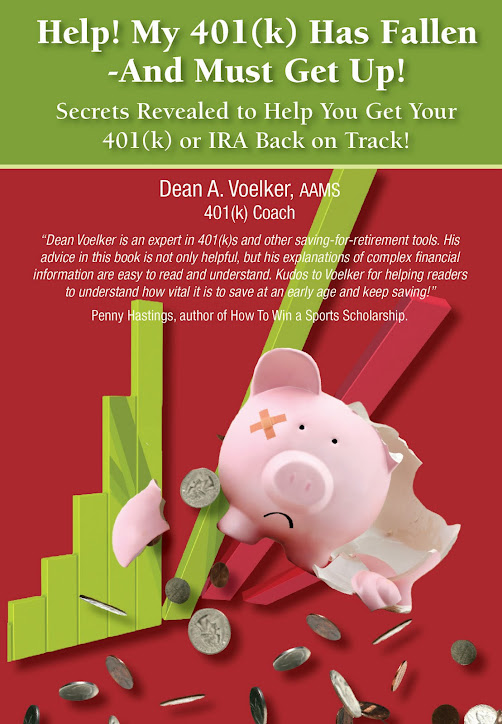
Help! My 401(k) Has Fallen – And Must Get Up! is my new book. It has several ideas and strategies which will help you in your retirement savings journey. Get your ‘Fallen’ 401(k) back on its feet. Contact me to reserve your copy today. You can also get a FREE report at my website – The 5 Biggest Problems With 401(k) Plans – And How To Fix Them.
You may also listen to my weekly radio program – Improving Your Financial Health on WHME-FM in South Bend. Archives can be heard on my website as well. If you live in the South Bend, IN area, I specialize in 401(k) rollovers or IRA reviews. You can also follow me on Twitter, Linked In, or Facebook.
Showing posts with label S and P. Show all posts
Wednesday, October 13, 2010
Wednesday, February 3, 2010
Taking Stock
I'm not a big individual stock fan. For most people, mutual funds are a much better way to invest. Its easier to be diverisfied and its also easier to add money systematically.
However, I did see something recently which I thought my readers may enjoy. If you were going to invest in stocks, which companies would be good ones to own long-term? At least one sign of a great company is one which is able to consistently increase their dividend payment.
If you aren't sure what a dividend is, think of it this way. When you own stock, you own a tiny piece of that company. Your investment rises and falls with the performance of the company. Over time, you would like to think the company will grow, and your money will grow with it. Companies which have established themselves and become profitable will share part of their profits with you as a part owner. Those profit sharing payments are known as dividends and are usually paid once every 3 months.
Again, the sign of a great company is one which has raised its dividend payment consistently, even in tough times. Raising the dividend for shareholders is like giving them a pay raise. (CDs don't do THAT!!) Those companies would be great to own long term.
What if a company were able to raise its dividend 25 years in a row or more?
Here are the ones which have:
Abbott Labs (ABT)
Bemis (BMS)
Century Tel (CTL)
Chubb (CB)
Coca-Cola (KO)
Exxon-Mobil (XOM)
Johnson & Johnson (JNJ)
Mc Donalds (MCD)
3M (MMM)
Pitney Bowes (PBI)
PPG (PPG)
Proctor & Gamble (PG)
Walmart (WMT)
S&P reports that since 1926, dividends have contributed to about 1/3 of the total return on your investment.
Another thing I like about dividends is that when the stock price goes down, the dividend yield goes up. Its a great time to buy more of great companies. That is what Warren Buffett does!
For example, lets look at Proctor & Gamble. Shares of PG are currently (2/3/10) at $62.90. Dividends are paid at $1.76/share, which is divided into 4 quarterly payments. You will get a dividend return of 2.8% on any shares purchased at that price.
What if you had been fortunate enough to buy in March of 2009, when it was selling for around $44/share? Well, you still would have gotten $1.76 per share, but that works out to about a 4% dividend return. (Better than a CD, and with potential to grow!)
Warren Buffett has become extremely wealthy because he buys great companies and holds them, collecting dividends which increase year after year after year.
Again, I am not encouraging people to buy individual stocks. There are plenty of financial stocks such as Citigroup and Bank of America which also had wonderful histories of increased dividends, until 2008.
Dividends are certainly something to consider though for any investment - including mutual funds and annuities.
You can contact me through my website, http://www.helpmy401k.us/. You can also contact me on LinkedIn at http://www.linkedin.com/in/dvoelker, or Twitter at http://www.twitter.com/deanvoelker. I am currently hosting a weekly financial advice program, "Improving Your Financial Health" on Blog Talk Radio at http://www.blogtalkradio.com/401kcoach. Let me know how I may help you!
However, I did see something recently which I thought my readers may enjoy. If you were going to invest in stocks, which companies would be good ones to own long-term? At least one sign of a great company is one which is able to consistently increase their dividend payment.
If you aren't sure what a dividend is, think of it this way. When you own stock, you own a tiny piece of that company. Your investment rises and falls with the performance of the company. Over time, you would like to think the company will grow, and your money will grow with it. Companies which have established themselves and become profitable will share part of their profits with you as a part owner. Those profit sharing payments are known as dividends and are usually paid once every 3 months.
Again, the sign of a great company is one which has raised its dividend payment consistently, even in tough times. Raising the dividend for shareholders is like giving them a pay raise. (CDs don't do THAT!!) Those companies would be great to own long term.
What if a company were able to raise its dividend 25 years in a row or more?
Here are the ones which have:
Abbott Labs (ABT)
Bemis (BMS)
Century Tel (CTL)
Chubb (CB)
Coca-Cola (KO)
Exxon-Mobil (XOM)
Johnson & Johnson (JNJ)
Mc Donalds (MCD)
3M (MMM)
Pitney Bowes (PBI)
PPG (PPG)
Proctor & Gamble (PG)
Walmart (WMT)
S&P reports that since 1926, dividends have contributed to about 1/3 of the total return on your investment.
Another thing I like about dividends is that when the stock price goes down, the dividend yield goes up. Its a great time to buy more of great companies. That is what Warren Buffett does!
For example, lets look at Proctor & Gamble. Shares of PG are currently (2/3/10) at $62.90. Dividends are paid at $1.76/share, which is divided into 4 quarterly payments. You will get a dividend return of 2.8% on any shares purchased at that price.
What if you had been fortunate enough to buy in March of 2009, when it was selling for around $44/share? Well, you still would have gotten $1.76 per share, but that works out to about a 4% dividend return. (Better than a CD, and with potential to grow!)
Warren Buffett has become extremely wealthy because he buys great companies and holds them, collecting dividends which increase year after year after year.
Again, I am not encouraging people to buy individual stocks. There are plenty of financial stocks such as Citigroup and Bank of America which also had wonderful histories of increased dividends, until 2008.
Dividends are certainly something to consider though for any investment - including mutual funds and annuities.
You can contact me through my website, http://www.helpmy401k.us/. You can also contact me on LinkedIn at http://www.linkedin.com/in/dvoelker, or Twitter at http://www.twitter.com/deanvoelker. I am currently hosting a weekly financial advice program, "Improving Your Financial Health" on Blog Talk Radio at http://www.blogtalkradio.com/401kcoach. Let me know how I may help you!
Labels:
advisor,
annuity,
bank,
CD,
diversification,
dividend,
economy,
financial,
income,
investment,
Linked In,
money,
mutual funds,
rates,
returns,
S and P,
savings,
South Bend,
Warren Buffett,
wealth
Thursday, July 2, 2009
This Time Its Different
Last year (2008), the Dow Jones Industrial Average fell about 34% (www.djindexes.com), then dropped ANOTHER 20% in the first 2 months of 2009.
It is estimated that investors accounts have declined in value by about $10 TRILLION DOLLARS TOTAL. http://www.businessweek.com/mediacenter/podcasts/cover_stories/covercast_03_05_09.htm
Severe recessions such as this one can test the resolve of even the most experienced investors.
It is easy to say "This time its different." Many people are still feeling that way.
However, it is important to keep in mind a few points.
* Financial decisions (any financial decisions) should not be based on emotion.
* Historically, after every past recession, the market has gone on to hit new highs.
* Declines in the market & economy, even our most severe ones, have been temporary.
* Since 1926, the Dow Jones has had TWICE AS MANY positive returns as negative ones.
Despite more than 12 recessions dating back to 1926, $1.00 invested in the Dow in 1926
would have been worth $2045.00 at the end of 2008.
The late Sir John Templeton, founder of Franklin Templeton Investments liked to say, "The Four most expensive words in the English Language are 'This time it's Different.' "
The National Bureau of Economic Research www.nber.com http://www.nber.org/cycles/
states that the United States has weathered a recession EVERY decade since the 1920's. https://financialprofessional.hartfordinvestor.com/planco/om/P7135.pdf - Page 4.
As painful as the recessions are, when we are experiencing one, they have always been short lived, about 11 months on average. It can be difficult to predict when one will end, and announcing the "end" may take a while. According to NBER, they have waited an average of 15 months before declaring an "end". This way they avoid confusion. If there is further economic turmoil, it can be linked to a new recession, rather than the old one.
While we are "waiting to see what will happen" rebounds are often quick and robust. Stocks tend to recover about 6 months before the economy does. According to Morningstar www.morningstar.com, stocks are referred to as a leading indicator. On average, stocks have returned about 25% from market lows to the "end of the recession".
Did you know that the Dow Jones has increased by nearly 30% since its low point on
March 9, 2009? Have you been "in" the whole time, or did you go to something "safe"?
3/9/2009 - 6547
7/1/2009 - 8504
"The most expensive words in the English Language are 'This time it's different'."
Sir John Templeton
If you went to cash, thinking you were being "smart", think again. Cash can actually slow your recovery, and make it much harder to get your savings back.
In a recent study, Hartford shows data from the recession of 1973-1974, which had been our most severe until the present one. The study (please contact me at www.helpmy401k.us for more information) shows 4 seperate scenarios, each starting with $100,000 invested in equities on Dec. 31, 1972.
(Equities are represented by the S & P 500 Index. Cash is represented by the 30 Day Treasury Bill Index.)
In the study, they wanted to see how long it would take to recover the original $100,000 for the Low Point in the Market (Sept. 30, 1974)
Investor A (stayed in Equities) - back to $100,000 in July 1976 (1.75 years)
Investor B (moved to cash for 6 months, starting 9/30/1974) (5.3 years, or Jan. 1980)
Investor C (moved to cash for 12 months, starting 9/30/1974) (also 5.3 years)
Investor D (moved to cash for 18 months, starting 9/30/1974) (6.2 years, or Nov. 1980)
Yogi Berra sometimes said, "Its deja vu all over again."
In a challenging economy such as this one, isn't this precisely when you need a financial professional working side by side with you?
For more information, please contact me at http://www.helpmy401k.us. You may also follow me on Twitter at www.twitter.com/deanvoelker.
It is estimated that investors accounts have declined in value by about $10 TRILLION DOLLARS TOTAL. http://www.businessweek.com/mediacenter/podcasts/cover_stories/covercast_03_05_09.htm
Severe recessions such as this one can test the resolve of even the most experienced investors.
It is easy to say "This time its different." Many people are still feeling that way.
However, it is important to keep in mind a few points.
* Financial decisions (any financial decisions) should not be based on emotion.
* Historically, after every past recession, the market has gone on to hit new highs.
* Declines in the market & economy, even our most severe ones, have been temporary.
* Since 1926, the Dow Jones has had TWICE AS MANY positive returns as negative ones.
Despite more than 12 recessions dating back to 1926, $1.00 invested in the Dow in 1926
would have been worth $2045.00 at the end of 2008.
The late Sir John Templeton, founder of Franklin Templeton Investments liked to say, "The Four most expensive words in the English Language are 'This time it's Different.' "
The National Bureau of Economic Research www.nber.com http://www.nber.org/cycles/
states that the United States has weathered a recession EVERY decade since the 1920's. https://financialprofessional.hartfordinvestor.com/planco/om/P7135.pdf - Page 4.
As painful as the recessions are, when we are experiencing one, they have always been short lived, about 11 months on average. It can be difficult to predict when one will end, and announcing the "end" may take a while. According to NBER, they have waited an average of 15 months before declaring an "end". This way they avoid confusion. If there is further economic turmoil, it can be linked to a new recession, rather than the old one.
While we are "waiting to see what will happen" rebounds are often quick and robust. Stocks tend to recover about 6 months before the economy does. According to Morningstar www.morningstar.com, stocks are referred to as a leading indicator. On average, stocks have returned about 25% from market lows to the "end of the recession".
Did you know that the Dow Jones has increased by nearly 30% since its low point on
March 9, 2009? Have you been "in" the whole time, or did you go to something "safe"?
3/9/2009 - 6547
7/1/2009 - 8504
"The most expensive words in the English Language are 'This time it's different'."
Sir John Templeton
If you went to cash, thinking you were being "smart", think again. Cash can actually slow your recovery, and make it much harder to get your savings back.
In a recent study, Hartford shows data from the recession of 1973-1974, which had been our most severe until the present one. The study (please contact me at www.helpmy401k.us for more information) shows 4 seperate scenarios, each starting with $100,000 invested in equities on Dec. 31, 1972.
(Equities are represented by the S & P 500 Index. Cash is represented by the 30 Day Treasury Bill Index.)
In the study, they wanted to see how long it would take to recover the original $100,000 for the Low Point in the Market (Sept. 30, 1974)
Investor A (stayed in Equities) - back to $100,000 in July 1976 (1.75 years)
Investor B (moved to cash for 6 months, starting 9/30/1974) (5.3 years, or Jan. 1980)
Investor C (moved to cash for 12 months, starting 9/30/1974) (also 5.3 years)
Investor D (moved to cash for 18 months, starting 9/30/1974) (6.2 years, or Nov. 1980)
Yogi Berra sometimes said, "Its deja vu all over again."
In a challenging economy such as this one, isn't this precisely when you need a financial professional working side by side with you?
For more information, please contact me at http://www.helpmy401k.us. You may also follow me on Twitter at www.twitter.com/deanvoelker.
Tuesday, June 16, 2009
Using Protection?
That should have gotten your attention!
In my last post, I discussed some basics of annuities. Annuities can offer some protection for your savings which other investments, such as stocks or mutual funds do not. Keep in mind that the value of your account may still go down.
Lets talk about a few protections which you may get from an annuity.
GUARANTEED DEATH BENEFIT - The first one, common to most annuities, is the Guranteed Death Benefit. What is means is that if you invested a sum of money into an annuity, your beneficiaries will receive at least that amount (minus any income or withdrawals taken).
For example, lets say that John puts $100,000 into a variable annuity. The market goes south, and the value of the annuity dips to $80,000, when John dies. If he has not taken income, his heirs will get the full $100,000. Now lets say that the market goes up, and the account grows to $120,000. When John dies, his heirs get $120,000. In this case, it would not matter if he has taken income - if the account value has grown from his original investment, his heirs get the account value.
GUARANTEED GROWTH - There are a lot of different insurance brokers who provide annuities, and not all of them offer this. Whichever provider you use, I would certainly recommend using a large, stable, reputable (Name Brand) company. The protection is only as good as the insurance company backing it.
I have become familiar with Jackson National Life, one of the largest annuity providers in the US. They have an AA rating in Financial Strength from Fitch & Standard & Poors, which is Very Strong. What that means to a client is that they should feel secure with the protections they are getting on their money. (Source: Jackson Life http://www.jackson.com/)
Jackson offers a Fixed Account Option on its annuities. The Fixed Option offers a 1 Year Interest Rate, which is reset each year, but is never less than 3% (Special Benefit Value). 3% actually looks pretty good right now, doesn't it?
Lets say that John starts out at age 55 by investing his $100,000 in a Fixed Index Annuity. Assuming that the annuity value has grown by 3% per year, by age 65 (10 years) it will be worth $134,392 minimum. (Source: Jackson Ascender Plus Select Brochure, http://www.jackson.com/).
A Variable Annuity should provide more growth over time, however its performance is related to the stock market. The Standard & Poors Index, also referred to as the S & P 500 represents the largest 500 companies in the USA. It has been the measuring stick for comparing investment performance.
If John had been investing his $100,000 in a Variable Annuity using the S & P Index, Jackson lets you have a "win-win". If the market goes up, the account will also go up. If the market goes down, the account value stays the same. This would have been particularly valuable in 2008 when the S & P declined by 42.9%. The value in John's account would have been the same. Had John kept his money invested over the last 10 years, he would have $145,825 today. (Source: Jackson Ascender Plus Select Brochure, http://www.jackson.com/)
I will look at Guaranteed Income Options in another segment. I will also look at additional charges for these features (where they apply). Please keep in mind that an annuity is not for everyone. You should consult with your advisor to determine if an annuity is right for you.
For more information, you may contact me at http://www.helpmy401k.us/. You may also follow me on Twitter at http://twitter.com/DeanVoelker .
In my last post, I discussed some basics of annuities. Annuities can offer some protection for your savings which other investments, such as stocks or mutual funds do not. Keep in mind that the value of your account may still go down.
Lets talk about a few protections which you may get from an annuity.
GUARANTEED DEATH BENEFIT - The first one, common to most annuities, is the Guranteed Death Benefit. What is means is that if you invested a sum of money into an annuity, your beneficiaries will receive at least that amount (minus any income or withdrawals taken).
For example, lets say that John puts $100,000 into a variable annuity. The market goes south, and the value of the annuity dips to $80,000, when John dies. If he has not taken income, his heirs will get the full $100,000. Now lets say that the market goes up, and the account grows to $120,000. When John dies, his heirs get $120,000. In this case, it would not matter if he has taken income - if the account value has grown from his original investment, his heirs get the account value.
GUARANTEED GROWTH - There are a lot of different insurance brokers who provide annuities, and not all of them offer this. Whichever provider you use, I would certainly recommend using a large, stable, reputable (Name Brand) company. The protection is only as good as the insurance company backing it.
I have become familiar with Jackson National Life, one of the largest annuity providers in the US. They have an AA rating in Financial Strength from Fitch & Standard & Poors, which is Very Strong. What that means to a client is that they should feel secure with the protections they are getting on their money. (Source: Jackson Life http://www.jackson.com/)
Jackson offers a Fixed Account Option on its annuities. The Fixed Option offers a 1 Year Interest Rate, which is reset each year, but is never less than 3% (Special Benefit Value). 3% actually looks pretty good right now, doesn't it?
Lets say that John starts out at age 55 by investing his $100,000 in a Fixed Index Annuity. Assuming that the annuity value has grown by 3% per year, by age 65 (10 years) it will be worth $134,392 minimum. (Source: Jackson Ascender Plus Select Brochure, http://www.jackson.com/).
A Variable Annuity should provide more growth over time, however its performance is related to the stock market. The Standard & Poors Index, also referred to as the S & P 500 represents the largest 500 companies in the USA. It has been the measuring stick for comparing investment performance.
If John had been investing his $100,000 in a Variable Annuity using the S & P Index, Jackson lets you have a "win-win". If the market goes up, the account will also go up. If the market goes down, the account value stays the same. This would have been particularly valuable in 2008 when the S & P declined by 42.9%. The value in John's account would have been the same. Had John kept his money invested over the last 10 years, he would have $145,825 today. (Source: Jackson Ascender Plus Select Brochure, http://www.jackson.com/)
I will look at Guaranteed Income Options in another segment. I will also look at additional charges for these features (where they apply). Please keep in mind that an annuity is not for everyone. You should consult with your advisor to determine if an annuity is right for you.
For more information, you may contact me at http://www.helpmy401k.us/. You may also follow me on Twitter at http://twitter.com/DeanVoelker .
Thursday, June 11, 2009
"OK, Now What?"
The market has performed much better over the past 3 months. From a low on 3/09/09 to now, the S & P has risen over 34%. This is an encouraging sign for investors.....BUT.....(as a friend of mine might say, "That's a mighty big but you have!")
All kidding aside, the question we all face is - "OK, Now WHAT?" As I talk with clients, attitudes range from "Gloom & Doom" expecting yet another downturn in our roller-coaster ride, to "Cautiously Optimistic". A common quote is "I don't want to lose anymore." (Sound familiar?)
We still have the same issues - we are living longer than we used to. Hallmark sold over 85,000 birthday cards last year for individuals who had reached at least their 100th birthday. The 100+ group is our fastest growing demographic and current life expectancies are 85 for males, 87 for females.
Over that time, being retired for 25 or more years, you WILL see inflation. As certain as death & taxes.
* Do you have enough money to live 25 years or more in retirement?
* Are you prepared to keep up with rapidly rising costs?
* Is your money protected well enough to weather another economic storm?
How can you get growth, income, and protection at the same time? One idea is with a variable annuity. Please meet with your advisor to determine if a variable annuity is right for you. There are several benefits (protections) which annuities offer which are appealing. I'll address these in a future article, but for now lets look at the basics.
According to wikipedia http://en.wikipedia.org/wiki/Annuity_(US_financial_products), an annuity contract is created when an individual gives a life insurance company money which may grow on a tax-deferred basis and then can be distributed back to the owner in several ways.
A variable annuity works much like a mutual fund (or funds). The funds, known as subaccounts, are held and backed by an insurance company. The insurance company can provide protections on your investment for income, death benefit, and in some cases they can even provide a minimum rate of growth. The 'catch' is that you pay for the protection thru annual fees and charges.
Annuities (and insurance) has changed much over the past 10 years. New government regulations has made insurers to become more client friendly, easier to understand, with more benefits to clients.
One way to look at the positive changes in annuities is to think of improvements made in other products. Think of cell phones for example. When they first arrived on the scene in the 1980's, phones were heavy (remember the backpacks!), expensive, with poor reception, and few features. Now think of them today - you can do all kinds of activities on a cell phone, even take pictures, videos, and use the internet - and the phone easily fits into your pocket.
I will be covering more on annuities to come. You may contact me at www.helpmy401k.us. You may also follow me on Twitter at www.twitter.com/DeanVoelker.
All kidding aside, the question we all face is - "OK, Now WHAT?" As I talk with clients, attitudes range from "Gloom & Doom" expecting yet another downturn in our roller-coaster ride, to "Cautiously Optimistic". A common quote is "I don't want to lose anymore." (Sound familiar?)
We still have the same issues - we are living longer than we used to. Hallmark sold over 85,000 birthday cards last year for individuals who had reached at least their 100th birthday. The 100+ group is our fastest growing demographic and current life expectancies are 85 for males, 87 for females.
Over that time, being retired for 25 or more years, you WILL see inflation. As certain as death & taxes.
* Do you have enough money to live 25 years or more in retirement?
* Are you prepared to keep up with rapidly rising costs?
* Is your money protected well enough to weather another economic storm?
How can you get growth, income, and protection at the same time? One idea is with a variable annuity. Please meet with your advisor to determine if a variable annuity is right for you. There are several benefits (protections) which annuities offer which are appealing. I'll address these in a future article, but for now lets look at the basics.
According to wikipedia http://en.wikipedia.org/wiki/Annuity_(US_financial_products), an annuity contract is created when an individual gives a life insurance company money which may grow on a tax-deferred basis and then can be distributed back to the owner in several ways.
A variable annuity works much like a mutual fund (or funds). The funds, known as subaccounts, are held and backed by an insurance company. The insurance company can provide protections on your investment for income, death benefit, and in some cases they can even provide a minimum rate of growth. The 'catch' is that you pay for the protection thru annual fees and charges.
Annuities (and insurance) has changed much over the past 10 years. New government regulations has made insurers to become more client friendly, easier to understand, with more benefits to clients.
One way to look at the positive changes in annuities is to think of improvements made in other products. Think of cell phones for example. When they first arrived on the scene in the 1980's, phones were heavy (remember the backpacks!), expensive, with poor reception, and few features. Now think of them today - you can do all kinds of activities on a cell phone, even take pictures, videos, and use the internet - and the phone easily fits into your pocket.
I will be covering more on annuities to come. You may contact me at www.helpmy401k.us. You may also follow me on Twitter at www.twitter.com/DeanVoelker.
Labels:
advisor,
annuity,
diversification,
economy,
financial,
inflation,
interest,
investment,
money,
mutual funds,
rates,
retirement,
returns,
S and P,
savings,
taxes
Saturday, April 25, 2009
A "Golden" Opportunity?
My job is to help others to grow their savings and improve their financial health. These days, we all need to get healthy. A common question I get is whether or not to invest in gold.
Gold is an investment that can be part of your portfolio. Talk with your advisor to decide how much, part should be.
Warren Buffett likes to say, " We simply attempt to be fearful when others are greedy and to be greedy only when others are fearful."
http://www.brainyquote.com/quotes/authors/w/warren_buffett_2.html
I don't know about you, but when I hear every other commercial on Financial TV & Radio
promoting gold, it sounds pretty "greedy" to me, wouldn't you agree?
Dave Ramsey put on a Town Hall for Hope on Thurs. April 23. Over 6000 watched and decided it was time to put fear aside and start making smart choices with their money. From the site
http://www.townhallforhope.com/ , Dave shares some interesting facts about gold & other investments.
Did you know that gold has only risen an average of 2.14% per year? And that includes a surge since 2001 to present. http://www.townhallforhope.com/index.cfm?event=displayPostStats
Did you also know that the S & P has grown by 1250% since 1974, from 63 to 850? That includes recessions in the 1970's, 1980s, 2001-2002, and the present.
http://www.townhallforhope.com/index.cfm?event=displayPostStats
Check out these other interesting stats at http://www.townhallforhope.com/
Before investing, talk with your advisor to determine your goals, time horizon & risk tolerance.
For more information, or to contact me directly, visit my site at http://www.deanvoelker.com/ .
Gold is an investment that can be part of your portfolio. Talk with your advisor to decide how much, part should be.
Warren Buffett likes to say, " We simply attempt to be fearful when others are greedy and to be greedy only when others are fearful."
http://www.brainyquote.com/quotes/authors/w/warren_buffett_2.html
I don't know about you, but when I hear every other commercial on Financial TV & Radio
promoting gold, it sounds pretty "greedy" to me, wouldn't you agree?
Dave Ramsey put on a Town Hall for Hope on Thurs. April 23. Over 6000 watched and decided it was time to put fear aside and start making smart choices with their money. From the site
http://www.townhallforhope.com/ , Dave shares some interesting facts about gold & other investments.
Did you know that gold has only risen an average of 2.14% per year? And that includes a surge since 2001 to present. http://www.townhallforhope.com/index.cfm?event=displayPostStats
Did you also know that the S & P has grown by 1250% since 1974, from 63 to 850? That includes recessions in the 1970's, 1980s, 2001-2002, and the present.
http://www.townhallforhope.com/index.cfm?event=displayPostStats
Check out these other interesting stats at http://www.townhallforhope.com/
Before investing, talk with your advisor to determine your goals, time horizon & risk tolerance.
For more information, or to contact me directly, visit my site at http://www.deanvoelker.com/ .
Labels:
advisor,
bargain,
Dave Ramsey,
diversification,
economy,
financial,
goals,
gold,
hope,
inflation,
investment,
portfolio,
returns,
S and P,
town hall,
Warren Buffett
Subscribe to:
Posts (Atom)