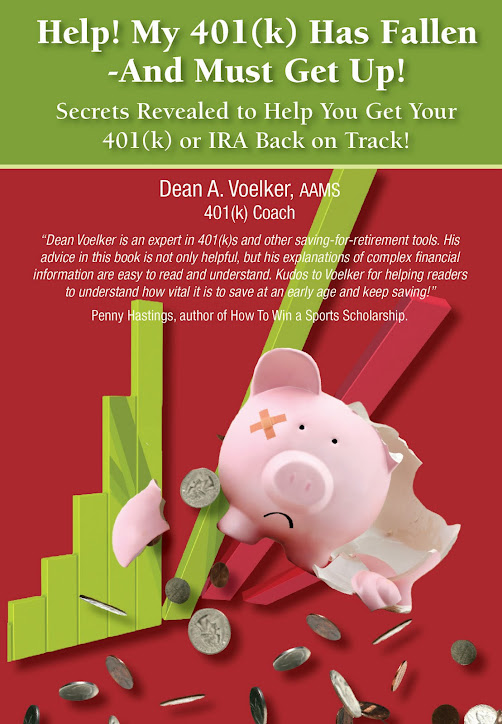
New Book - Coming November 2010

New Book - Coming November 2010
Help! My 401(k) Has Fallen - And Must Get Up!
Showing posts with label SEP IRA. Show all posts

Monday, June 28, 2010

Five Situations for Variable Annuities

According to the Insured Retirement Institute, sales of Variable Annuities grew by 3% from this time last year. VAs aren't for everyone, however in the right circumstances, variable annuities offer solid benefits. There are at least 5 scenarios in which an advisor may consider recommending a variable annuity to clients.

Feel free to add your own to the list! You can contact me for more information on annuties at http://www.helpmy401k.us/

1. Lowering Income Taxes
If you are in the maximum federal and state tax bracket, a VA may help to lower your taxes. Please review your situation with a tax specialist, but a VA can work similarly to an IRA in deferring taxes until money is withdrawn from the acccount.

2. Calming Jittery Investors
This is likely the biggest reason why VA sales are up. If you are nervous about the market but still need your money to grow over time, a VA can act as a "life preserver" for your long term savings.

3. Saving Above Contribution Maximums
If you have maxed out your IRA and 401(k) and still want to save more for retirement, you can put money into a VA. If you are a small business owner, you may also consider a SEP IRA (Simplified Employee Pension). The SEP allows you to save up to 25% of your income and deduct it from your taxes.

4. Guaranteed Income
Annuities have a primary purpose of providing guaranteed income. With people living longer and needing income in retirement, having an annuity can be like setting up a personal pension plan from your savings. Look for plans which offer Lifetime Income.

5. Death Benefit
If you haven't taken income, many annuities will guarantee a death benefit of the amount you invested as a minimum. This is important, and this is where an annuity differs from ordinary mutual funds.

Here's an example. Let's take 2 investors, George and Jerry. Let's say that both of them retire at 65 years old and have 401(k) balances of $100,000. They roll their 401(k) plans over to IRAs. George invests in mutual funds, while Jerry invests in a variable annuity with a guaranteed minimum death benefit. After 4 years, we have another huge loss in the stock market, and their accounts drop to $80,000. Neither of them have taken any income out of their IRAs yet, and are still under the age of 70 1/2 when they would need to take a Required Minimum Distribution.

If George dies, he leaves the balance of his account - $80,000 to his beneficiaries. If Jerry dies, he would leave $100,000, which is what he started with, even if the value of the account is less. Of course, if the account balance in either case is more than $100,000, the death benefit would be the same as the account balance.

Annuities can be beneficial in the right situations. Please contact me and let me know how I may help further.

Wednesday, February 10, 2010

Tax Credit For Small Businesses

Are you a small business owner? If not, do you know any?


These days its hard enough to make ends meet and keep your business going. Small businesses like yours are the key to reviving our economy.

Would you like an idea that will help you and your employees to save money and reduce your taxes?

Did you know that when you establish a 401(k) or other kind of qualified retirement plan, you may be eligible for a tax credit equal to 50% of the cost of starting up and administering the plan? The maximum allowable credit is $500 per year for each of the first 3 years of the retirement program. This is according to EGTRRA (Economic Growth and Tax Relief Reconciliation Act of 2001) .

Other types of retirement plans for small businesses which qualify for the tax credit are the SEP IRA (Simplified Employee Pension Plan) and the SIMPLE IRA (Savings Incentive Match Plan for Employees) .

To qualify for the tax credit:

* The plan sponsor must incur qualified startup costs. These would be expenses for setting up or maintaining the plan, or for retirement-related employee education.

* The plan must be a new plan established AFTER December 31, 2001.

* The plan must have at least one non-highly compensated employee. Usually this would be someone who is not an owner and has earned less than $105,000 in the prior year.

* The plan sponsor must have employed 100 people or less who received at least $5000 or more in compensation during the prior year.

Does this sound like your business so far? If I can help you & your employees to save money for your future needs and lower your taxes, please contact me today. This will be part of my upcoming book as well – “Help! My 401(k) Has Fallen and Can’t Get Up!”

I should also mention that unless the current law changes, EGTRRA is set to expire at the end of 2010.

Please contact me for more information on 401(k) plans or IRAs at http://www.helpmy401k.us/.

You may also contact me on Linked In at http://www.linkedin.com/in/dvoelker or Twitter at http://www.twitter.com/deanvoelker.  I also host a weekly financial advice program, Improving Your Financial Health at http://www.blogtalkradio.com/401kcoach.