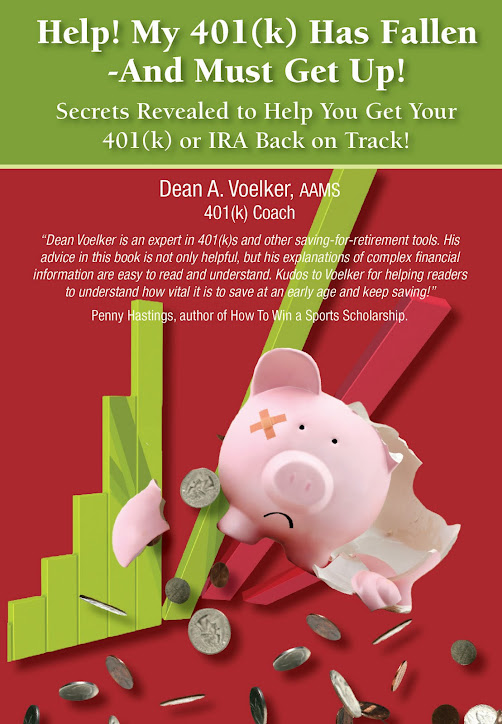
New Book - Coming November 2010

New Book - Coming November 2010
Help! My 401(k) Has Fallen - And Must Get Up!

Thursday, October 7, 2010

The Grand (Money) Illusion

OK, admit it. You've done it too. With the recent rise in the stock market, you've seen your 401(k) balance rise also. You've started to think "Its going up, so everything is fine. It was down for a while, but now its coming back."

Does that sound like you? When you open your 401(k) or IRA statement, do you just look at the total balance and try to figure out if it's up or down? 

Money Magazine has their 2011 Retirement Guide out now. Senior Editor, and Retirement Expert Penelope Wang urges you to think of your retirement differently. Don't just look at the total lump sum. Look at what the future income will be, which the lump sum will generate. This is the Grand Illusion (not the Styx song) when it comes to your 401(k), she says. Remember that your future purchasing power also will be eroded by inflation.

Recently, I had a client ask me if $1,000,000 was enough to retire on. My answer was that we don't know until we look at your income needs, and cash flow. What are your monthly and yearly expenses? 

Let's assume that you have $1,000,000 (I know, I know.....just play along, OK). Let's assume also that you will be drawing 4% per year from the $1,000,000 nest egg. In order to do that, your money needs to be invested so that you are getting at least a 4% real return (after taxes and inflation). That way you can take money out without shrinking your nest egg.

So, using the $1,000,000 figure we can multiply that by .04 and get $40,000. We will take $40,000 per year for income. Will $40,000 meet your expenses? Do you have other debt? How about other sources of income?  

You MUST look at your 401(k) or IRA this way! It is a source of future income for you. The bigger the nest egg, the more income it will generate. But now you know WHY you need a bigger nest egg! "People understand how much money they need each month, so it makes the saving process more relevant," says UCLA behaviorial finance professor Shlomo Benartzi.

By the way, Ms. Wang also shows an illustration in her article on how long we think our money will last. Although most experts asvise retirees to limit their withdrawals to a maximum of 4%/year, there is a myth that you can take out more. According to the Met Life Retirement Income IQ Test (2008), about 26% of those surveyed thought that withdrawing 7%/year from a nest egg was safe. A whopping 43% (nearly HALF) of the respondants believed that it would be OK to withdraw 10% or more per year!!

Picture a small boat with a leak.


At first, you may not notice the leak. As water rushes into the boat, you start to panic. The water pours in
faster and faster, until the boat begins to sink. That's what happens to IRAs when you take out too much money. Eventually you reach a point where you can't keep up.

Let's keep your boat floating!

Help! My 401(k) Has Fallen – And Must Get Up! is my new book. It has several ideas and strategies which will help you in your retirement savings journey. Get your ‘Fallen’ 401(k) back on its feet. Contact me to reserve your copy today. You can also get a FREE report at my website

The 5 Biggest Problems With 401(k) Plans & How To Fix Them.


You may also listen to my weekly radio program – Improving Your Financial Health on WHME-FM in South Bend. Archives can be heard on my website as well. If you live in the South Bend, IN area, I specialize in 401(k) rollovers or IRA reviews. You can also follow me on Twitter, Linked In, or Facebook .

Monday, October 4, 2010

Its the Great Security Blanket Charlie Brown!

Get A Blanket!

Did you have a "blankie" as a child? Was the "blankie" your contstant companion, protecting you from the forces of evil? No matter what happened, your blanket was there for you.

The late cartoonist, Charles Schulz popularized the image of Linus and his blanket in his Peanuts comic strips and cartoons. You may even remember that Linus was quite skilled at using it. He could catch fly balls, use it as a parachute, and even revive a sickly Christmas tree.

If you are like most people, your 401(k) or IRA has taken quite a beating the last few years.

What if I told you that you could have your very own IRA Security Blanket?

* Protect yourself against future market disasters.

* Protect yourself from inflation and rising costs.

* Protect yourself from the uncertain future of Social (In)Security.

To learn more about how to get your IRA Security Blanket, you can contact me at http://www.helpmy401k.us/.

Help! My 401(k) Has Fallen – And Must Get Up! is my new book. It has several ideas and strategies which will help you in your retirement savings journey. Get your ‘Fallen’ 401(k) back on its feet. Contact me to reserve your copy today. You can also get a FREE report at my website - The 5 Biggest Problems With 401(k) Plans – And How To Fix Them.

You may also listen to my weekly radio program – Improving Your Financial Health on WHME-FM in South Bend. Archives can be heard on my website as well.


If you live in the South Bend, IN area, I specialize in 401(k) rollovers or IRA reviews. You can also follow me on Twitter, Linked In, or Facebook.

Tuesday, September 28, 2010

Can Facebook Help You Save Money?

As I have been out talking about my new book, Help! My 401(k) Has Fallen - And Must Get Up!, one of the most common questions I am asked is this -

What is the one thing I can do to fix my 401(k)?

Of course, the person asking wants a simple answer, not a lot of broker speak. So here it is. Regardless of age, gender, or income, the simplest best answer I can give is:

Save More Money!  

How's that for simple? Money Magazine released some new information in a study from their Retirement Guide 2011 (Oct. 2010 issue).  If you are 35 years old and earn  $70,000/year and you save 10% of your pay, you'll have saved $936,100 by age 65.*

By waiting just 5 years to start and doing the same - saving 10% at age 40, your nest egg at age 65 will be $697,700.* (*Assumes 3% annual pay increases and 7% average annual returns on investment into a tax-sheltered account - IRA, 401k or 403b.)

While both figures sound like a lot of money, the difference of $238,400 means a difference of what you can potentially use for income. Assuming you take out 5% per year from your nest egg ($238,400 x .05 = $11,920/year) means that by starting at age 40, you could be cutting your future income by nearly $1,000/month!

Ben Franklin often preached on the virtues of compound interest. He called it the 8th wonder of the world.

So how do we save more money? As Nike might say, "Just Do It!"

It is much easier though if you can have someone to hold you accountable. This is where Facebook might come in. What if you posted a notice on your Facebook page to your friends and tell them to hold you to it. You could "tweet" it also.

"I promise, starting TODAY to pay myself first and put 10% of my pay into my 401(k)." 

Honestly, when you see some of the others posts on Facebook (i.e. "I hate rainy days.", "Halloween is coming.", "Out walking the dog."), you'd have to feel a bit proud posting something inteligent that will make a positive difference in your life, wouldn't you? You could start a trend. Have your friends (or at least one or two) hold you accountable.  

You could also set e-mail reminders which are specific. use a personal website such as http://www.mint.com/.
Send a message to your e-mail Inbox such as "Put $1000 into my Roth IRA this month." or "Every 3rd of the month I put $400 into my Roth IRA." You could arrange these to hit your Inbox when you get a bonus or unexpected money.

Don't despair if you've turned 45 and still haven't done much. Remember we had talked about how you could still achieve an added $1000/month of income at retirement by starting now and following a disciplined goal. I'll be reviewing some other ideas from the Money Magazine retirement guide in upcoming posts.

My book, Help! My 401(k) Has Fallen – And Must Get Up! has several ideas and strategies which will help you in your retirement savings journey. Get your ‘Fallen’ 401(k) back on its feet. Contact me to reserve your copy today. You can also get a FREE report at my website. The 5 Biggest Problems With 401(k) Plans – And How To Fix Them. I also host a 30 minute weekly radio program - Improving Your Financial Health on WHME-FM in South Bend. Archives can be heard on my website as well.

If you live in the South Bend, IN area, I am also happy to help with 401(k) rollovers or IRA reviews. You can follow me on Twitter, Linked In, or Facebook.

Tuesday, September 21, 2010

Seven Things You Should Knew About SIMPLE IRAs

Most people have never heard of a SIMPLE IRA before, and are curious to know how it differs from a 401(k). A SIMPLE IRA stands for Savings Investment Match PLan for Employees.


One of the key differences of why your employer may have a SIMPLE IRA versus a 401(k), is that SIMPLE IRAs are geared for employers with less than a 100 employees. In addition to that, the administrative cost of a SIMPLE IRA for your employer is considerably much less than what a 401(k) would be. (It’s shortened to SIMPLE because it’s…..SIMPLE for small businesses.)

1. Your Employer’s Contributions Are 100% Vested

With some 401(k)s you need to have worked for the employer for a certain number of years to be vested. That means that if you were to leave that employer you could take that employer’s matching contribution. With 401(k)s, you have anywhere from three to five years to where you’re 100% vested. Anything you put in is yours, but anything which they put in may be subject to a vesting schedule. With a SIMPLE IRA, you are 100% vested whenever the employer deposits that into your account. There is no vesting schedule at all.

2. Employers Have To Match In A SIMPLE IRA

Each year, the employer is required to make a contribution to your SIMPLE IRA account whether it be in the form of a match or what’s called a non-elected contribution. Matching contribution states that the employer has to match at least what you match. So, if you’re matching 3%, the employer has to match 3% as well. Note that 3% is the most that the employer has to match, which could be considerably different than compared to a 401(k).

If the employer chooses to not do a match, then they may do what is called a non-elect contribution and what that means is that they will contribute 2% of your salary no matter what. Even if you are contributing 3% of your salary, they will only contribute the 2%.

To sum this up, the employer can choose:

* Match contributions up to 3% of salaries for any employees who choose to participate in the
   SIMPLE IRA.


* Contribute 2% of salaries for ALL employees, whether or not they participate.

The decision should be based on which option provides the most benefits and tax savings to the employer.

3. Employees Control The Investments

With most 401(k)s, you are limited to the investment options that you have. This is considerably different when compared to the SIMPLE IRA. Being a self-directed retirement plan, the SIMPLE IRA gives you the discretion of what exactly you want your money invested into. That means that if you want to buy individual stocks, mutual funds, ETFs, or CDs, you are allowed.

To keep things “simple”, it is most common to work with an established family of mutual funds which offers a wide variety of investments.

4. Employees Can Contribute 100% Of Income Into A
    SIMPLE IRA

As of 2010, you are allowed to contribute up to $11,500 per year in a SIMPLE IRA. For those who are age 50 and older, you are allowed a catch-up contribution, which is currently $2,500, for a maximum total of $14,000 in 2010. To do this, you must have at least $14,000 in earned income. Currently, the maximum contribution for a 401(k) is $16,500 with a catch-up of $5,500 for ages 50 and up. The SIMPLE IRA is tax-deferred similar to a 401(k).

5. SIMPLE IRAs Do Not Allow Loans

A lot of 401(k)s have loan provisions that allow the employee to borrow against their money if need be. With SIMPLE IRAs, this is not the case. For employers who are weighing their options on retirement savings plans, that may be a consideration. No matter which type of plan you have - Loans are NOT advised. Money which is contributed to retirement savings is to be used for exactly that - retirement! The drawback to using a loan in a 401(k) is that when you leave the company, the loan is immediately due, and then treated as a withdrawal. The withdrawal is then counted as income, and taxed and penalized accordingly.

6. The SIMPLE IRA Two-Year Rule

This is something that should be definitely different from a traditional IRA within the SIMPLE IRA. Most retirement plans — 401(k)s, IRAs, or Roth IRAs — have the 10% early withdrawal penalty if you take money out and you are under the age of 59.5. The SIMPLE IRA goes one step further. If the SIMPLE IRA that you’ve started is less than two years old, and you cash that out, you will be subject to a 25% penalty in addition to ordinary income tax. That is a huge item to not be overlooked. Again, we do not recommend withdrawing money from a retirement savings account before retirement.

If you were attempting to roll over your SIMPLE IRA into a rollover IRA, the 25% penalty would apply as well if the SIMPLE is less than two years old. Once the two year period has passed, a SIMPLE IRA can be easily rolled over into a traditional IRA with no tax consequence. Cashing it out would then incur the same 10 % penalty and taxation as any other account.

7. Which Businesses Use SIMPLE IRAs

Any business which has less than 100 employees may consider using a SIMPLE IRA. The main benefits are:

* SIMPLE to set up and maintain.

* Variety of investment choices available.

* Employer contributions are tax-deductible.

A SIMPLE IRA may be established prior to October 1 to be recognized for that year.

My book, Help! My 401(k) Has Fallen - And Must Get Up! has several ideas and strategies which will help you in your retirement savings journey. Get your 'Fallen' 401(k) back on its feet. Contact me to reserve your copy today. You can also get a FREE report at my website. The 5 Biggest Problems With 401(k) Plans - And How To Fix Them. If you live in the South Bend, IN area, I am also happy to help with
401(k) rollovers or IRA reviews. You can follow me on Twitter, Linked In, or Facebook.

My weekly radio show is Improving Your Financial Health on WHME-FM in South Bend, and archives are available for listening on my website.

Friday, September 3, 2010

It's Not Much But It's All I Have

Probably the most common response I get when people talk about their long term savings or retirement money is this. "It's not much, but it's all I have. I can't afford to lose it."

Well, I certainly understand how you feel. I am investing and saving for my retirement as well. Author Robert Gignac writes that people are "afraid of money" in his book, Rich Is A State Of Mind. Mr. Gignac will be an upcoming guest on Improving Your Financial Health to discuss his book. He goes on to make a very interesting observation. If money was meant to make us happy, we should have better looking people - or at least smiling faces.

With all due respect to George Washington, would something like this encourage you to save a little more?


"It's not much, but it's all I have. I can't afford to lose it."

If that is true, then wouldn't it make sense to PROTECT it? To truly PROTECT your money, you also need to protect your purchasing power. Your money must be able to keep up with rising costs. Just how much interest is that Folger's coffee can or cookie jar paying these days? Perhaps you keep it under a mattress so you can 'sleep on it'. (Last time I checked, the First National Bank of "Sealy" was paying CD rates 0.25 % higher than the national average.) However, we all know that your money won't grow under the Sealy, or in the Folger's can.

"It's not much, but it's all I have. I can't afford to lose it."

This type of thinking practically guarantees that you WILL LOSE IT! Author Rhonda Byrne says that we transmit thoughts as if our brain was a powerful radio signal. In her book The Secret, she writes that we always get what we visualize. If you say you don't want to be late for a meeting, guess what almost always happens?

"It's not much, but it's all I have. I can't afford to lose it."

Perhaps you have heard this story before.

The kingdom of heaven is like a man traveling to a far country, who called his own servants and delivered his goods to them. And to one he gave five gold coins, to another two, and to another one, to each according to his own ability; and immediately he went on a journey. 

Then he who had received the five gold coins went and traded with them, and made another five coins. And likewise he who had received two gold coins gained two more also.


But he who had received one went and dug in the ground, and hid the money there.


After a long time the man came home and settled accounts with his servants. He who had received five coins came and brought five other coins, saying, 'Lord, you gave to me five gold coins. Look, I have gained five more.' The man said to him, 'Well done, good and faithful servant; you were faithful over a few things, I will make you ruler over many things.'


He also who had received two talents came and said, 'Lord, you gave to me two gold coins. Look, I have gained two more.' The man said to him, 'Well done, good and faithful servant; you have been faithful over a few things, I will make you ruler over many things.'


Then he who had received the one coin came and said, 'Lord, I was afraid, and went and hid your coin in the ground. Look, there you have what is yours.'


His lord answered and said to him, 'You wicked and lazy servant, you ought to have deposited my money with the bankers, and at my coming I would have received back my own with interest. Take the coin from him, and give it to him who has ten gold coins.


For to everyone who has, more will be given, and he will have abundance; but from him who does not have, even what he has will be taken away.

This is the story from Matthew 25: 14-29. The moral is of course to use what we are given. We strengthen and grow our financial muscles from using them. Not using them makes us weak.

"It's not much, but it's all I have. I can't afford to lose it."


One other thought I am having today on this theme, from 1 Kings.

Elijah the prophet told the woman. “Please bring me some bread to eat.”


The widow stopped, turned around, and looked at him in surprise. The widow answered Elijah, “As the Lord your God lives, I do not have bread, only a handful of flour in a bin, and a little oil in a jar; and see, I am gathering a couple of sticks that I may go in and prepare it for myself and my son, that we may eat it, and then we will die.”


Elijah then said to her, “Do not fear; go and do as you have said, but make me a small loaf from it first, and bring it to me; and afterward make some for yourself and your son. For thus says the Lord God of Israel: ‘The bin of flour shall not be used up, nor shall the jar of oil run dry, until the day the Lord sends rain on the earth.’”

She took the last of her flour and oil and made some bread for Elijah to eat.


Here is what happened; “She and her household ate for many days. The bin of flour was not used up, nor did the jar of oil run dry, according to the word of the Lord which He spoke by Elijah.”

USE it - or LOSE it!

Keep your money HAPPY!

Please Contact Me for more information on how to protect your long term savings and USE your money wisely. I can help you create lifetime income from an IRA or Roth IRA. If you live in the South Bend, IN area, I am also happy to help with 401(k) rollovers or IRA reviews. You can follow me on Twitter, Linked In, or Facebook.

My weekly radio show is Improving Your Financial Health on WHME-FM in South Bend, and archives are available for listening on my website. My book, Help My 401(k) Has Fallen - And Must Get Up is helping everyday people to get their 401(k) plan back on its feet and working harder. Contact me about how to get a copy.


Wednesday, August 25, 2010

Could You Use An Extra $1000/Month - Legally?


OK, that's a silly question. OF COURSE you could use an extra $1000/month. Who couldn't?

For someone in retirement, an extra $1000 would certainly help to make ends meet. According to a recent survey done by the Employee Benefit Retirement Institute (EBRI), only 3 in 5 retirees (60%) feel "very" or "somewhat" confident that they would have a comfortable retirement. This is sharply down from just 3 years ago, when in 2007, 79% felt confident in their retirement.

Did you also know that according to the Social Security Administration that the Maximum Social Security retirement benefit the could be earned by an individual reaching full retirement age in 2010 (age 66) is only $2346/month? Think of how many people receive less than this, and depend on Social Security for the majority of their income in retirement.

What would you do with an extra $1000/month?

Would you do more travelling? Eat out a few more times? Spoil the grandkids? Play more golf? Would an extra $1000/month in income give you a little more peace of mind?

What if I told you that YOU CAN have an extra $1000/month TAX-FREE?

No, you don't have to rob a bank or do anything illegal. This is perfectly legitimate.
No silly multilevel marketing schemes either, where you try to sell junk to your friends and family.
You don't need to be able to dunk a basketball, or pound 300 yard drives that split the fairway.

All you need to do is......

Start putting money into a Roth IRA and make regular contributions. That's it! See - simple, legal, and you get to keep your friends.

Here is how it works. Let's use a 45 year old, starting from scratch. Currently, as of 2010, the most which you can put into a Roth IRA is $5000 per year. At age 50 and older, the maximum contribution is $6000.
Let's say that our 45 year old puts in $5000 per year, and at age 50 starts putting in $6000. Let's also say that we get a return of 6% per year on our money. (Contact me for information on how to get 6%.) For someone who is 45 years old now in 2010, their full retirement age to begin collecting Social Security benefits would be 67.

Age    Roth IRA Contribution   Ending Balance (6% Return)
45       $5,000                              $    5,161
46       $5,000                              $  10,632
47       $5,000                              $  16,431
48       $5,000                              $  22,578
49       $5,000                              $  29,094
50       $6,000                              $  37,033
51       $6,000                              $  45,448
52       $6,000                              $  54,368
53       $6,000                              $  63,824
54       $6,000                              $  73,846
55       $6,000                              $  84,470
56       $6,000                              $  95,732
57       $6,000                              $107,669
58       $6,000                              $120,322
59       $6,000                              $133,735
60       $6,000                              $147,952
61       $6,000                              $163,023
62       $6,000                              $178,997
63       $6,000                              $195,931
64       $6,000                              $213,880
65       $6,000                              $232,906
66       $6,000                              $253,073 
          $147,000                          $253,073

Benjamin Franklin once remarked that Compound Interest was the 8th wonder of the world. Saving a nest egg of over $250,000 in 22 years is a great accomplishment.

If you are younger than 45, the message is start NOW. You can do even better.
If you are older than 45, the message is still start NOW!

So how do we get our $1000/month from this?
To get an income of $1000/month, just take 5% per year from this figure $253,073.

$253,073 x .05 = $12,653.65 This is our annual TAX-FREE income from our Roth IRA.
$12,653.65 Divided by 12 months = $1,054.47/Month.   

Please Contact Me for more information on how to make this work for you, and create lifetime income from an IRA or Roth IRA. If you live in the South Bend, IN area, I am also happy to help with 401(k) rollovers or IRA reviews. You can follow me on Twitter, Linked In, or Facebook.


My weekly radio show is Improving Your Financial Health on WHME-FM in South Bend, and archives are available for listening on my website.


Thursday, July 8, 2010

Match Game

Employers want you in the 401(k) plan at work. The more money which is in their plan, the lower the fees should be. Also, because they most likely do not offer a pension, they want to be sure they are doing their part in helping you to save for retirement.

Many 401(k) plan sponsors are focusing on two features: automatic enrollment and automatic increases in savings as an employee's pay goes up. However, one of the biggest factors which drives plan participation is the matching contribution. Money Magazine writer Penelope Wang wrote in her March 2010 article Make the Best of a Bad 401(k) that in 2009, matches had dropped off due to the sluggish economy.

Matching contributions are great for employers though. They provide a tax deduction and studies have shown that it is a great way to get employees involved with the plan. 401(k) Plans with a match have higher particpation rates than those with no match.  

Matching formulas vary widely. According to Schwab, one of the most common formulas for matching is for the employer to offer a 50% match of an employees deferred salary up to a 6% contribution. In English, that means that the most they put in for you is 3% of your pay - and you have to put in 6% to get that.

Here is an example. Let's say that Bob earns $60,000/year at ABC Company. He puts 6% of his pay into
his 401(k) - $3,600.

                    Bob's Salary (before taxes)                        $60,000
                    Bob's 401(k)                                               $3,600
                    Bob's Taxable Pay                                     $56,400
                    ABC Match                                                 $1,800
                    Total contribution into Bob's 401(k)              $5,400

Now if Bob bumped up his contribution to 10%, he would still only get $1800 from ABC. Many advisors (myself included) believe that we should be saving 10% or more into a 401(k) plan. Over a long period of time, this should allow someone to replace approximately 75% of their income at retirement.

Let's see what happens if Bob decides to put in 10%.

                    Bob's Salary                                               $60,000
                    Bob's 401(k)                                                $6,000
                    Bob's Taxable Pay                                      $54,000
                    ABC Match                                                  $1,800
                    Total contribution into Bob's 401(k)              $7,800 

Changing his contribtuion from 6% to 10% gives him an extra $2,400/year into the plan. My book, Help! My 401(k) Has Fallen - And Must Get Up! shows that this could be huge over time. The other plus is that even though Bob raises his contribution by $2,400/year, his take home pay after taxes should only be about $1,800 less because the taxes are deferred on this. $1,800/year works out to less than $35/week.

$35/week - that's all!!

Over a 25 year period, if Bob was able to get a 7% average return on his 401(k) plan, here is the difference between 6% and 10% This also includes the employer match of 3% (50 cents per dollar, up to 6%).
The difference after 25 years is $157,493!! 

6%   ($3,600) = $359,789
10% ($6,000) = $517,282
Difference      = $157,493

You can contact me in the South Bend, IN area for 401(k) rollovers. My website is http://www.helpmy401k.us/
Get a FREE REPORT titled "The 5 Biggest Problems With 401(k) Plans - And How To Fix Them!"

My book, Help! My 401(k) Has Fallen - And Must Get Up! is written to help everyday people to get more from their retirement savings. My radio program, Improving Your Financial Health is also heard weekly on WHME-FM in South Bend, IN and archives are available on my website.